
A weak store rarely fails alone. Finance may see a four-wall P&L problem first, but the closure decision quickly becomes a lease question, a labor question, a liquidation question, a replenishment question, and a local-demand question. The ordinary closure playbook still tends to move through those handoffs in sequence. By the time supply chain is asked to react, the network has already changed.
That is a dangerous mismatch for 2026. More than 15,000 U.S. retail stores closed in 2025, and UBS projects more than 40,000 additional U.S. store closures by 2030 as e-commerce reaches 27% of retail sales.[1][2] Those figures do not mean every closure is wrong. They do mean that store rationalization is no longer an occasional real estate exercise. It is a recurring supply chain event.
The useful question for AI in retail store closure supply chain analysis is not whether a model can rank stores by risk. It is whether the retailer can treat closure as a closed-loop network and demand-transfer problem: what demand is likely to disappear, what demand will move, what capacity must replace the store, what inventory should be liquidated or transferred, and what the company will measure after the doors close.
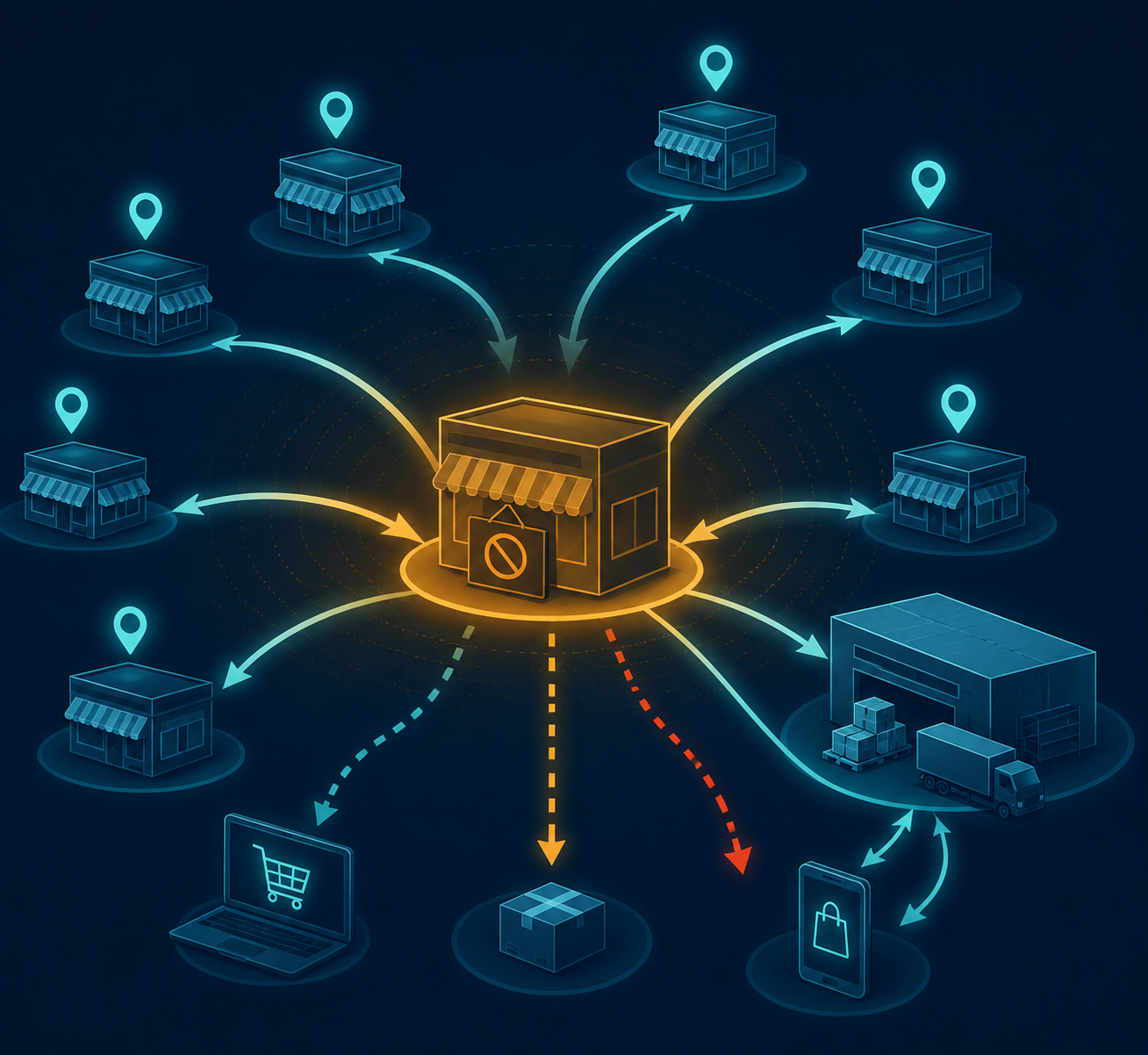
The store-level lens misses real value because the store has become more than a selling box. ICSC data reported by Forbes found that closing a store was followed by a 12% average decline in local online sales, with larger declines in fashion and home retail at 22% and 32%, respectively, based on 2022–2023 credit card transaction data.[3] That “horn effect” matters because it shows up after the P&L case has already been made. A location can look marginal on its own and still be holding up local digital demand, returns behavior, pickup convenience, brand awareness, and delivery economics.
The operational role of stores has also changed. Stores increasingly act as ship-from-store nodes, BOPIS pickup points, return points, and last-mile staging locations; when one closes, the work does not vanish just because the lease does.[4] It moves to another store, a distribution center, a parcel carrier, or a disappointed customer.
The Closure Problem Is Bigger Than the Store Ranking
Most retailers already have pieces of the answer. They may forecast demand in one system, model leases in another, plan markdowns in spreadsheets, and monitor post-closure sales in dashboards after the fact. The value leakage comes from the gaps between those tools.
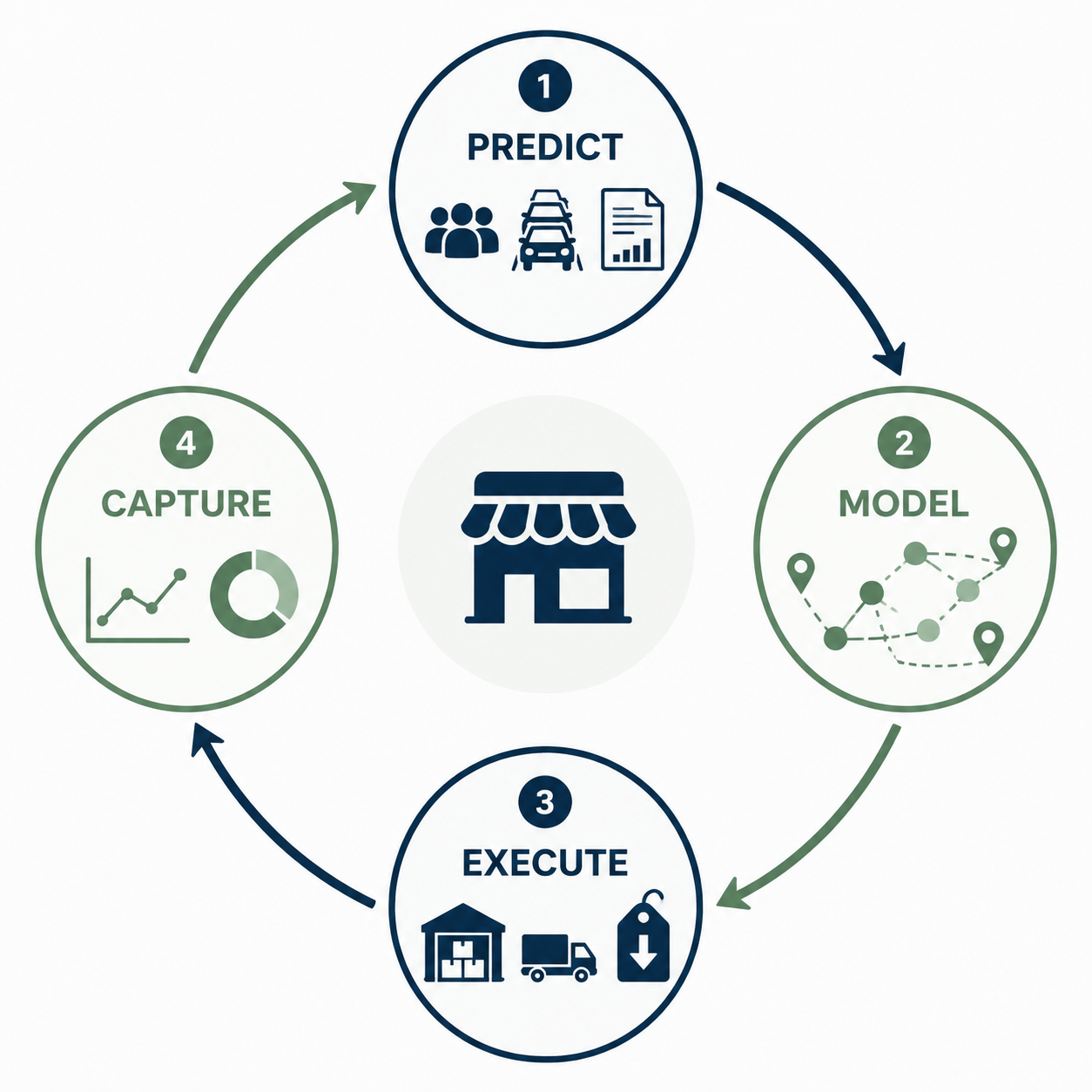
An integrated closure framework does not need to pretend there is one mature, peer-reviewed discipline called AI store closure optimization. There is not. The practical framework is a synthesis of adjacent work: demand forecasting, network design, liquidation science, inventory optimization, store operations, and post-closure demand monitoring. The point is to connect those decisions before a closure recommendation reaches the point of no return.
| Decision Loop | Operating Question | Where Value Leaks |
|---|---|---|
| Predict | Which stores are becoming closure candidates before the P&L is obvious? | Late identification leaves little time to renegotiate leases, reduce buys, or prepare nearby capacity. |
| Model | What happens to demand, fulfillment, labor, DC flow, and service levels if the store closes? | Store-level savings are counted before network costs and demand loss are visible. |
| Execute | Which inventory should be transferred, liquidated, held, or redirected? | Rushed markdowns, blanket transfer rules, and stranded inventory reduce recovery. |
| Capture | Did demand move where the model said it would, or did it disappear? | Nearby stores, e-commerce, and DCs absorb volatility without timely replenishment changes. |
The estimated 5–15% unrealized value in closure programs should be read as a planning hypothesis, not a guaranteed AI dividend. It is plausible because each handoff creates a place for value to leak. It becomes real only if the retailer can tie the four loops together with decision ownership, clean enough data, and a measurement plan that survives the announcement.
Predict Earlier, but Do Not Stop at the Watchlist
The prediction phase is often oversold because it is the easiest AI story to tell. A model ingests store sales, margin, labor, lease terms, traffic, demographics, competitive changes, local online demand, return rates, and cannibalization from nearby stores. It flags locations whose economics are deteriorating before the quarterly P&L makes the problem politically unavoidable.
The operational prize is time. If the retailer can identify at-risk locations 12–18 months earlier than traditional P&L analysis, planners can adjust buys, test labor coverage, prepare transfer paths, renegotiate lease options, and reduce the amount of inventory sitting in the wrong building when the closure clock starts. The forecast is not valuable because it names a store. It is valuable because it gives every downstream team more room to act.
A serious closure prediction model should separate signals that explain store weakness from signals that explain network dependence. A declining store with low fulfillment use, low pickup attachment, poor transfer potential, and weak local online influence is a different candidate from a declining store that supports a profitable delivery zone or absorbs returns from an otherwise healthy market.
That distinction is why demand forecasting references are useful but insufficient. Broader methods for AI demand forecasting accuracy can help retailers judge model quality, but closure planning needs an additional layer: the forecast must say what happens if the node is removed.
Model the Network Before the Closure Becomes Inevitable
Network modeling is where a closure plan either becomes supply chain analysis or remains a finance deck. This is the phase that should absorb the horn effect, the fulfillment-node role of stores, distribution center capacity, last-mile cost, service commitments, and local demand migration into one scenario view.
A closure scenario should start with the demand question: if this store closes, what share of demand is expected to move to nearby stores, what share is expected to move online, and what share may disappear? The ICSC finding does not prove that every retailer will lose 12% of local online sales after every closure, but it is strong enough to make a blanket “online will pick it up” assumption irresponsible.[3]
The next question is capacity. A store that ships orders, stages pickup, accepts returns, or relieves a congested DC is part of the fulfillment network. Remove it, and the retailer may push volume into a nearby store that lacks backroom space, into a DC that is already labor constrained, or into a parcel lane with weaker service and higher cost. This is where store operations and supply chain need to sit in the same scenario review, not exchange spreadsheets after approval.
Vendor-published network design benchmarks can help illustrate the planning logic, though they should not be treated as independently certified outcomes. Sophus states that AI-powered retail network design typically identifies 8–15% logistics cost reduction opportunities, 1–2 DC consolidation opportunities, and evaluates 20–50 network configurations before recommendation.[5] Those numbers are useful as a sense of what scenario modeling can examine: not just “close or keep,” but which nodes absorb demand, which lanes change, which service promises break, and which facilities become redundant or overloaded.
In a closure program, those scenarios should be run before the real estate calendar forces the answer. The model may compare a full closure against a smaller-format conversion, a dark-store role, a pickup-only role, a delayed closure after seasonal sell-through, or a closure paired with extra labor and inventory at two nearby stores. Not every option will survive finance review, but the organization should know what it is trading away.
This is also where DC strategy enters. A wave of closures may reduce replenishment stops but increase direct-to-consumer work. It may free some store delivery capacity while adding parcel volume. It may create enough flow changes to revisit a regional DC boundary, or it may create noise that looks like a consolidation opportunity but disappears after demand loss is accounted for. For retailers with multi-DC footprints, the closure model should connect directly to broader AI network design optimization rather than sit as a one-time store portfolio exercise.
The Scenario Review Should Have Operational Owners
A good model can still fail if the review meeting is staffed like a closure approval meeting instead of a network change meeting. Finance needs the P&L. Real estate needs lease timing and exit costs. Store operations needs labor and customer communication plans. Merchants need category-level liquidation guidance. Supply chain needs transfer constraints, DC capacity, transportation cost, and service-risk thresholds. E-commerce needs to know whether the digital business is gaining a customer, losing a customer, or inheriting one it cannot serve profitably.
The model output should therefore be more than a closure score. It should attach a demand-transfer estimate, expected online-demand risk, fulfillment capacity impact, inventory disposition plan, labor and timing constraints, and post-closure measurement window to each recommendation. That is the point where AI stops being a ranking tool and becomes a planning system.
Execution Is Where the Cash Either Appears or Leaks Away
Once a closure is announced, the organization’s options narrow quickly. Associates are leaving or being reassigned. Customers start changing behavior. Vendors may have stopped flowing new goods. The remaining inventory now has to become cash, transfer stock, online availability, or write-off. A spreadsheet markdown calendar is rarely enough.
The strongest evidence here predates current AI language but remains operationally important. Research by Nathan Craig and Ananth Raman found that an algorithmic approach to store liquidation could improve net recovery on cost by 2–7% of assets on hand by optimizing markdown timing, inventory transfers, and closure sequencing.[6] The Harvard Business School discussion of the work also highlighted a counterintuitive liquidation pattern: deeper markdowns earlier, when traffic is strongest, and more conservative markdowns later, rather than saving the sharpest discounts for the end.[7]
That finding should be framed carefully. The study is from 2013, before modern AI and machine learning tools became common in retail planning. It supports structured, algorithmic optimization; it does not prove that a current AI platform will automatically beat every liquidation team. The lesson is narrower and more useful: liquidation is a timing, traffic, inventory, and transfer problem, not simply a percent-off problem.
Execution models need to decide which units should sell down in the closing store, which should move to nearby stores, which should move to e-commerce fulfillment, and which should be cleared aggressively because transfer cost and future demand do not justify the handling. That requires item-level inventory accuracy, store capacity visibility, labor constraints, and enough demand signal in receiving locations to avoid dumping slow stock into stores that cannot move it.
Store-to-store transfer tools described by Impact Analytics emphasize scenario simulation before inventory redistribution, which is the right operating posture even though the source is vendor material.[8] The retailer should test transfer strategies against sell-through probability, freight and labor cost, shelf capacity, substitution risk, and the service impact of removing stock from the closing location too early.
A hypothetical example shows the tradeoff. If a closing store has remaining seasonal apparel, one rule might transfer all full-price goods to the nearest open store. A better model asks whether that receiving store has the size curve, traffic, labor, fixture capacity, and local demand to sell it before the season turns. If not, the nearest store is merely the easiest place to hide the problem.
Inventory optimization also depends on data readiness. Retailers do not need perfect data to start, but they do need agreement on which inventory records are trusted, how often on-hand balances update, which transfer costs are included, and who can override model recommendations. A practical data readiness assessment for AI inventory optimization is often more useful at this stage than another abstract AI roadmap.
Closure Sequencing Changes the Inventory Answer
When a retailer closes many locations, sequencing becomes part of the supply chain plan. The first store closed may create transfer opportunities for a nearby store that closes later. A regional wave may overload a DC with returns and transfers if all wind-downs end in the same week. A liquidation plan that looks optimal store by store can become unworkable once labor, trailers, receiving docks, and markdown signage are constrained across the market.
This is one reason the InStore Group case is worth mentioning without overstating it. The company reports that its zero-sales-disruption closure support model delivered 8–9% revenue gains for a national office supply chain.[9] That is a single case study and may not generalize across formats or categories. Still, it points to the execution reality: revenue protection during closure is a coordinated operating model, not only a better forecast.
Capture Is the Phase Most Retailers Underbuild
After the store closes, many organizations move on to the next location list. That is understandable, and it is exactly how forecast error becomes permanent. The capture phase asks whether the demand migration assumed in the approval case actually happened.
The monitoring should be local and channel-specific. Did the nearest stores gain traffic, conversion, pickup orders, returns, and category sales? Did local online demand hold, decline, or shift to marketplaces? Did delivery promises worsen? Did replenishment settings in nearby stores adjust quickly enough, or did stockouts cause the model’s “transferred demand” to vanish before anyone could count it?
This is where closure planning connects back to forecasting. The retailer needs a baseline for what would likely have happened without the closure, then a post-closure read on migration by geography, channel, category, and customer segment. Methods used in AI demand forecasting in CPG and retail can support this work, but the closure team also needs an operating cadence: who reviews the variance, who changes replenishment, who adjusts digital marketing, and who updates the next closure scenario.
The capture loop should feed three decisions. First, replenishment settings in nearby stores and DCs should adjust when transferred demand appears. Second, digital acquisition or retention efforts should activate when online demand weakens in the closed-store trade area. Third, the next closure model should learn whether the retailer overestimated transfer, underestimated capacity strain, or missed a category-specific dependency.
What an Integrated Closure AI Framework Actually Requires
The technology stack is not the hardest part to describe. The harder part is forcing decisions that usually live in different calendars into one loop. A practical framework needs shared data, shared scenarios, and shared accountability.
- A closure candidate record that combines P&L, lease dates, store traffic, local demographics, omnichannel demand, fulfillment activity, returns, labor constraints, and inventory exposure.
- A scenario engine that compares closure timing, demand migration, fulfillment reassignment, DC and transportation impact, service risk, and alternate store roles.
- An execution optimizer that recommends markdown timing, store-to-store transfers, DC returns, e-commerce allocation, and labor-aware sequencing.
- A post-closure measurement loop that compares expected and actual demand transfer, then updates replenishment, marketing, and future closure assumptions.
- A governance model that names the owner for each override, because closure plans always encounter facts that the model did not know.
The governance point is not cosmetic. A merchant may want to protect margin by transferring goods. Store operations may want to simplify the wind-down by clearing goods locally. Supply chain may want to avoid uneconomic moves. E-commerce may want more inventory near the customer. Finance may want the fastest cash recovery. The AI framework should expose those tradeoffs early enough that the company chooses them deliberately.
BCG’s 2026 retail AI maturity work places closed-loop AI optimization at the high end of retail maturity and describes a 3–5 year investment horizon for many retailers.[10] That timing is believable. A retailer cannot usually jump from disconnected store rankings and manual markdown files to a fully integrated closure command center in one budget cycle.
But the first step does not have to be a moonshot platform. It can be a disciplined closure packet. Every closure recommendation should carry four linked views: predicted demand loss and transfer, modeled network impact, inventory execution plan, and post-closure capture measurement. If one of those views is missing, the recommendation is not ready; it is only a store decision waiting to become a supply chain problem.
References
- “5 Inventory Management Challenges Solved by AI,” Tailor.
- “How Store Closures Will Reshape Retail,” a2b Fulfillment.
- “Closing Stores Can Result In Greater Losses Than Retailers Plan,” Forbes, 2024.
- “Store inventory intelligence becomes a core supply chain capability,” SCMR / GreyOrange-Zebra.
- “Supply Chain Network Design for Retail (2026 Guide),” Sophus, 2026.
- “Improving Store Liquidation,” HBS Working Paper.
- “Everything Must Go: A Strategy for Store Liquidation,” HBS Working Knowledge.
- “Store-to-Store Inventory Transfer Made Easy with AI,” Impact Analytics.
- “Case Study: Retail Store Closure Support,” InStore Group.
- “Retail Rewired: How AI Is Reshaping the Retail Business Model,” BCG, 2026.
Comments
Join the discussion with an anonymous comment.