
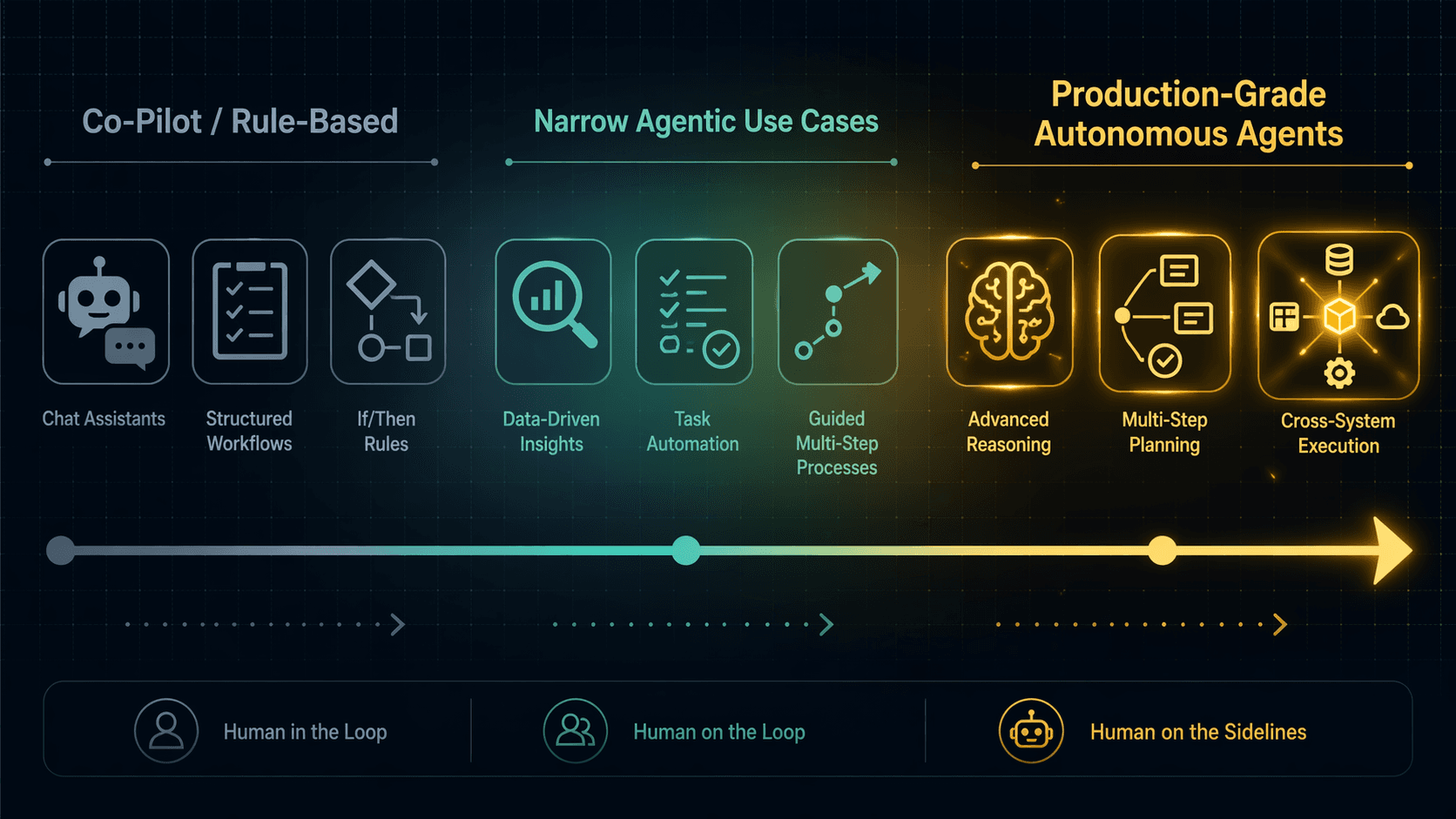
By Q2 2026, artificial intelligence in procurement and supply chain has a labeling problem. “Agentic AI” now appears often enough in vendor decks that the phrase no longer tells a buyer what the product can actually do. A chatbot that explains a shortage, a rules engine that sends an approval request, and a decision agent that changes a replenishment plan under defined limits may all be described with the same language. They should not be evaluated the same way.
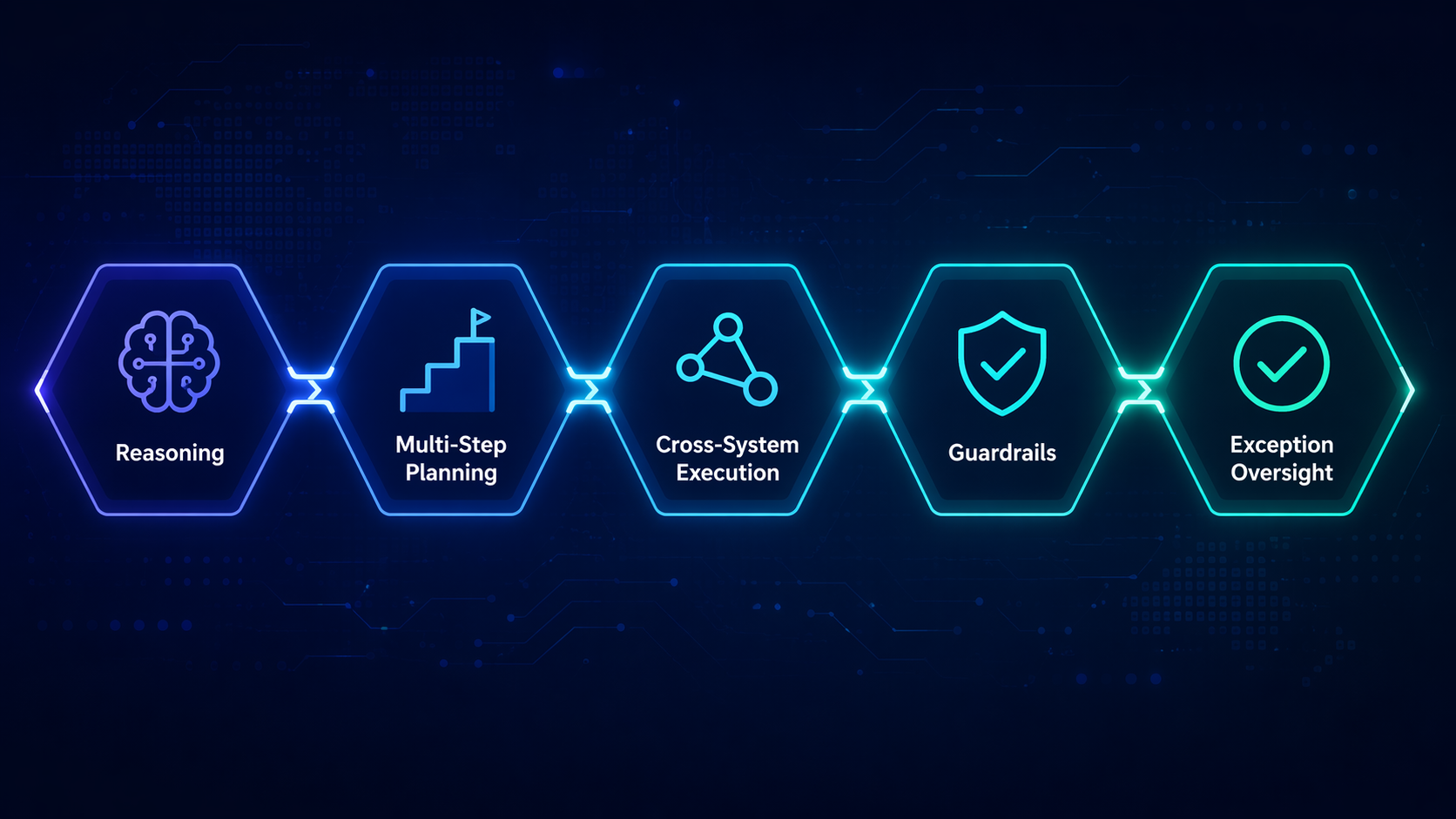
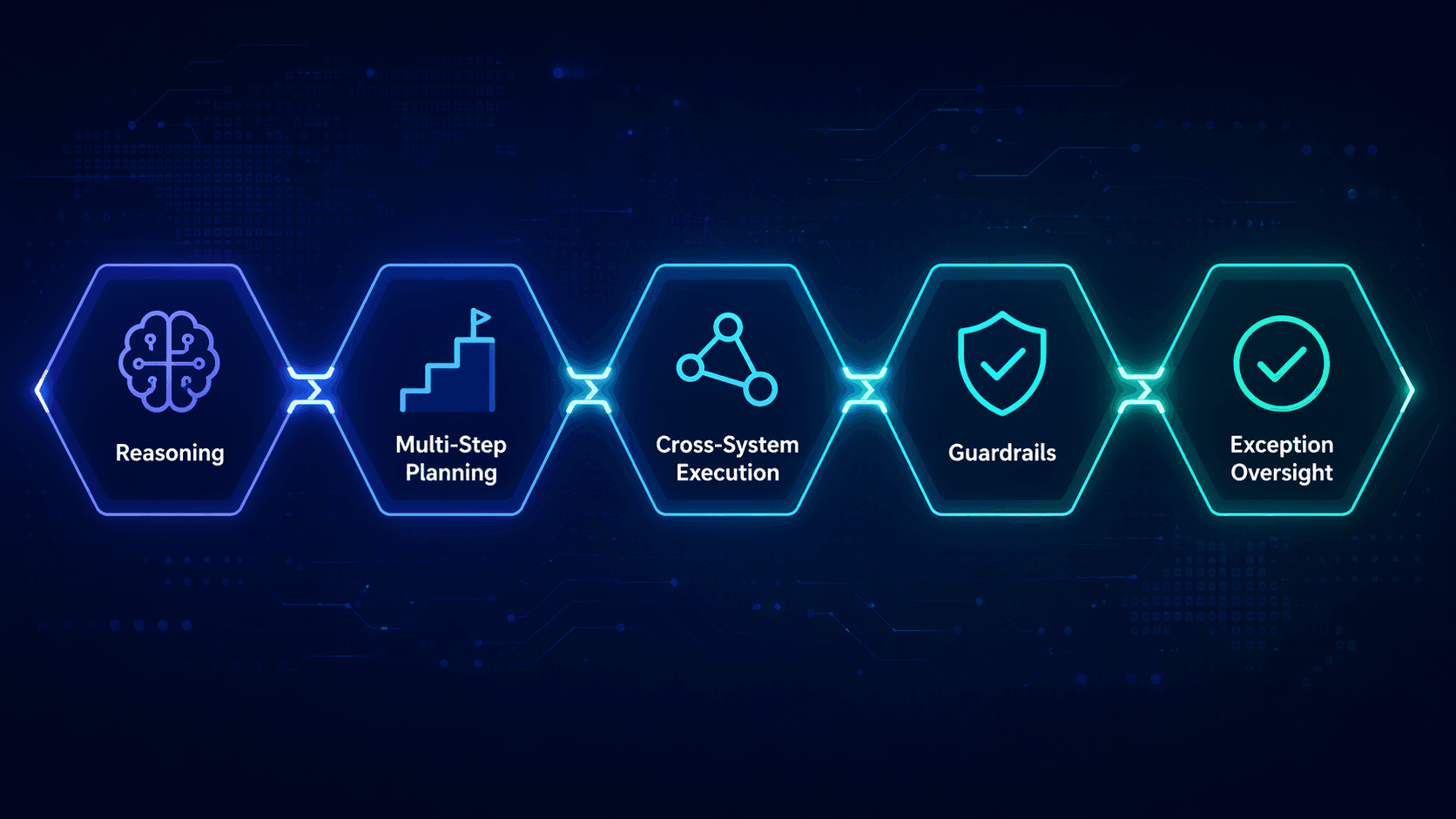
The practical test is simple, though not easy to pass: a production-grade agent must reason over a bounded procurement or planning problem, plan more than one step, act across the systems where work actually happens, operate inside explicit guardrails, and send work to humans by exception rather than at every handoff. If the product stops at summarizing supplier risk, drafting a recommendation, or triggering a preconfigured workflow that a person must still move through ERP, sourcing, or planning screens, it may be useful software. It is not yet autonomous agentic capability.
The distinction matters because the commercial pressure is loud. Gartner is cited as forecasting agentic AI in supply chain software to grow from $2 billion in 2025 to $53 billion by 2030, a projection that implies a 93.5% compound annual growth rate.[1] BCG analysis cited by Dataiku puts agentic systems at 17% of total AI value in supply chain in 2025, rising to 29% by 2028.[2] ABI Research is cited as finding that 94% of supply chain companies plan to use AI for decision support within two years.[3] Those are pressure signals, not proof that every “agent” in a sales cycle is ready to execute.
The more uncomfortable number is the governance one: Gartner’s 2025 finding, cited in procurement AI research, that only 23% of organizations have a formal AI strategy even among those already deploying AI.[4] That gap explains why buyers are vulnerable to rebranding. Budget urgency has moved faster than operating discipline. For a deeper treatment of that adoption-and-strategy mismatch, see ChainSignal’s analysis of the logistics AI adoption paradox.
The operating test for a real procurement or supply chain agent
A real agent in this market does not need to be universally autonomous. In fact, the most credible deployments are usually bounded. The question is whether the system can complete a meaningful job inside that boundary without turning every decision into another human queue.
| Criterion | What it means in procurement or planning | What fails the test |
|---|---|---|
| Reasoning over a bounded problem | The system interprets demand, supply, supplier, contract, inventory, or risk signals in relation to a defined objective. | A chatbot retrieves policy text or summarizes a dashboard. |
| Multi-step planning | The system sequences actions, not just one recommendation: identify constraint, compare options, select action, prepare execution, monitor result. | A workflow rule routes an exception to a planner. |
| Cross-system execution | The agent can act through ERP, sourcing, planning, procurement, WMS, TMS, or related systems where the transaction or plan is maintained. | The tool produces an answer that someone must manually copy elsewhere. |
| Guardrails | Autonomy is limited by thresholds, approval bands, supplier rules, policy constraints, audit logging, and rollback or escalation paths. | The vendor says “human in the loop” but cannot show where the loop sits. |
| Exception oversight | Humans review outliers, sensitive decisions, and boundary violations rather than validating every routine handoff. | Every material action still waits for a person to approve, re-enter, or trigger it. |
This is also why a co-pilot can be valuable without being agentic in the production sense. A category manager may save time with a sourcing assistant that drafts an event, analyzes bids, or summarizes supplier performance. A planner may appreciate scenario explanations in natural language. But if the human still carries the workflow from recommendation to execution, the product belongs in a different evaluation lane.
Aera Technology: strongest case for broad decision-intelligence agents
Aera Technology is the cleanest central case for production-grade agentic AI in supply chain because its posture is not merely conversational. It is positioned around decision intelligence: sensing issues, recommending actions, and enabling autonomous or semi-autonomous execution across supply chain workflows. Viewpoint Analysis identifies Aera among the stronger supply chain AI software options for agentic capabilities in 2026.[5]
The important part is what happens after insight. In many planning tools, the system flags a service risk, proposes an inventory move, and leaves the planner to validate and transpose that decision into the operational system. Aera’s agentic claim is stronger where it can connect the detection of a problem to the action path: identify the exception, evaluate possible responses, recommend or execute the selected action under policy, and preserve the decision trail.
That makes it a serious candidate for buyers who want autonomous decisioning across recurring planning and operations decisions. It also makes diligence harder. A buyer should not accept “AI decisioning” as a proxy for execution. The demo has to show which systems the agent writes back to, what thresholds prevent action, what evidence is logged, and what categories of decisions are still human-approved by design. ChainSignal’s guide to graduated autonomy in supply chain is useful here because Aera-style decision workflows should not be deployed as an all-or-nothing switch.
Ivalua: procurement-suite agentic assistance with a serious buyer angle
Ivalua deserves attention because procurement is full of workflows where apparent automation collapses into manual validation: intake review, supplier qualification, contract checks, sourcing preparation, buying-channel guidance, and exception handling. Ivalua describes IVA as an agentic procurement assistant within its AI procurement software positioning.[4]
The suite context is both its advantage and the thing evaluators should inspect closely. A procurement agent embedded in a source-to-pay environment can, in principle, see policy, supplier, contract, catalog, requisition, and sourcing context without relying on brittle handoffs. That is the right terrain for useful autonomy. But embedded assistance is not automatically autonomous execution.
For Ivalua, the buying question should be framed around specific procurement motions rather than the assistant label. Can IVA move an intake request into the correct buying path without human triage? Can it enforce supplier or contract constraints before a requisition becomes downstream rework? Can it initiate a sourcing or approval sequence under policy rather than simply advise the category manager? The product may be valuable even when the answer is partial, but the distinction determines whether it belongs in an autonomous-agent shortlist or a procurement co-pilot shortlist.
McKinsey is cited as estimating that agentic AI in procurement can deliver 25–40% efficiency improvement by shifting work from routine tasks to more strategic activities.[6] That kind of estimate is most plausible where routine procurement decisions are actually removed from human queues. Drafting, summarization, and guided intake can help, but the larger efficiency claim depends on execution design.
Pactum: narrow autonomy that is easier to believe
Pactum is a useful corrective to the market’s broadest claims. It is not trying to be a universal procurement brain. Its credibility comes from a narrower motion: autonomous supplier negotiation. Opstream’s 2026 procurement platform comparison identifies Pactum in the context of autonomous negotiation capabilities.[7]
This is the kind of bounded autonomy that tends to survive operational scrutiny. Negotiation can be constrained by approved terms, price bands, concession logic, supplier eligibility, and escalation rules. The agent does not need to understand every procurement process in the enterprise. It needs to conduct a defined negotiation within business-approved limits and hand off exceptions.
That narrowness should not be treated as a weakness. In agentic AI, a smaller operating box can produce more real autonomy than a broad assistant that never gets permission to act. For indirect procurement, tail spend, or high-volume supplier interactions where the negotiation parameters are clear, Pactum belongs in the real-agentic-use-case category. It does not, by itself, solve source-to-pay transformation.
Keelvar: autonomous sourcing events, not a general procurement agent
Keelvar sits in a similar evaluation lane: credible autonomy inside a specific procurement motion. The relevant use case is autonomous sourcing events, particularly where event structure, supplier participation, bid rules, and award logic can be defined tightly enough for the system to operate without constant category-manager intervention. Opstream’s procurement platform comparison places Keelvar in the AI procurement platform landscape for this kind of sourcing automation context.[7]
The operational test is not whether the platform can recommend suppliers or analyze bids. Many sourcing tools can do that. The test is whether it can run parts of the sourcing process: configure or launch events from known requirements, manage supplier interactions within rules, evaluate responses, and route awards or exceptions according to policy. When that is demonstrated, Keelvar is not just a co-pilot. It is a bounded agentic sourcing tool.
The boundary matters. A sourcing-event agent is not the same as an enterprise procurement agent that handles intake, contracts, supplier risk, purchasing, invoicing, and compliance. Buyers should give Keelvar credit for production autonomy where the sourcing workflow is explicit, and avoid inflating that into a broader claim than the use case supports.
o9: planning-side autonomy depends on scenario execution
o9 belongs on the shortlist for supply chain planning evaluators because the agentic question on the planning side is different from the procurement question. In planning, the hard work is not drafting a message or classifying a request. It is reasoning through demand, supply, capacity, inventory, service, and financial tradeoffs, then producing a scenario or plan adjustment that can be governed and executed. Viewpoint Analysis discusses o9’s Digital Brain in the 2026 supply chain AI software landscape.[5]
Autonomous scenario planning is a legitimate agentic candidate when the system can do more than generate alternatives. A useful planning agent should identify the constraint, create feasible scenarios, compare tradeoffs, select or recommend a path under policy, and push the approved change into the planning workflow. If the planner has to rebuild the scenario manually or re-enter the decision into another system, the autonomy is thinner than the label suggests.
The risk is proportional to the blast radius. A negotiation agent can be confined to a supplier segment or spend band. A planning agent can influence service levels, production schedules, inventory positions, allocation decisions, and customer commitments. That does not argue against autonomy; it argues for graduated release, auditability, and exception design. ChainSignal’s governance framework for agentic planning is the right companion lens for o9-style evaluations.
Dataiku: the custom-agent path for teams that can build and govern
Dataiku is different from the packaged workflow vendors. It is better understood as a platform for organizations that want to build custom agents on top of their own data, models, decision rules, and operational systems. Dataiku’s 2026 supply chain AI trends discussion cites BCG’s agentic-value trajectory and also points to the demographic pressure created by continued baby boomer departures through 2026, which increases the urgency to capture senior planner expertise before it leaves the organization.[2]
That demographic point is not a sentimental aside. In many supply chain organizations, the practical “model” for exception handling still lives in the heads of senior planners, buyers, and logistics managers. A custom-agent program can encode parts of that judgment: which supplier promises are credible, which substitutions are acceptable, when expediting is worth the cost, and when a forecast exception should be ignored because the customer behavior is familiar.
The tradeoff is ownership. A Dataiku-powered agent can be more precisely fitted to the company’s actual planning or procurement logic than a packaged agent. It also requires the company to own architecture, data quality, model governance, integration, testing, monitoring, and change management. For mature teams, that is a strength. For teams that do not yet have a formal AI strategy, it is a warning sign rather than a shortcut.
This is where human-in-the-loop design should be specific, not ceremonial. A custom agent needs defined approval thresholds, escalation triggers, prohibited actions, logging, and post-action review. ChainSignal’s human-in-the-loop design patterns for autonomous procurement AI cover those control points without turning every workflow back into manual processing.
Legacy-suite agents: useful, but often still assistant-led
Kinaxis Maestro Agents, Blue Yonder Cognitive Solutions, SAP, and similar enterprise-suite offerings should not be dismissed. They have distribution, embedded workflows, planning and execution context, and buyer trust that smaller AI specialists often have to earn the hard way. For many organizations, a well-integrated co-pilot inside an existing suite may produce more practical value than a more autonomous tool that cannot survive integration.
Measured against the production-agent test, though, the current posture of many legacy-suite claims remains closer to assistant-led recommendation, conversational access, or rule-triggered automation. Viewpoint Analysis describes Kinaxis Maestro Agents in the 2026 supply chain AI software landscape, but the evaluator still has to separate planning assistance from autonomous execution.[5] Zycus’s 2026 guide also reflects the broader market push around AI in supply chain and procurement, where vendor language can cover a wide range of decision-support and automation capabilities.[3]
The fair way to evaluate these suites is not to ask, “Do you have agents?” The fair question is: “Show the last mile.” After the system identifies a shortage, changes a forecast assumption, recommends a supplier, flags a contract issue, or proposes an allocation, what action is taken automatically? Which system is updated? What guardrail prevented a bad action? Who was notified only because the case was exceptional? If the answer repeatedly returns to a human approving and executing every step, the product may still be an excellent co-pilot. It is not operating as a production-grade autonomous agent.
A practical classification for 2026 shortlists
The market is easier to read when vendors are grouped by operating reality rather than by the words on the landing page.
| Category | Vendors that fit the category | What to believe | What to verify |
|---|---|---|---|
| Production-grade autonomous decision-intelligence candidates | Aera Technology; some custom Dataiku-powered agents | These can plausibly support multi-step decision workflows with execution under guardrails. | System write-backs, approval thresholds, audit trail, rollback process, and production references. |
| Procurement-suite agentic assistants with potential for embedded autonomy | Ivalua IVA | Suite context gives the assistant access to procurement workflows where autonomy could matter. | Whether the assistant executes procurement actions or mainly guides users through them. |
| Narrow but real agentic use cases | Pactum; Keelvar | Autonomy is credible because the operating domain is constrained. | The exact spend categories, event types, negotiation limits, and escalation rules supported. |
| Planning-side autonomous scenario candidates | o9 Digital Brain | Scenario generation and planning intelligence can be agentic when connected to governed execution. | Whether scenarios remain advisory or can move into approved planning workflows. |
| Legacy-suite co-pilots and rule-triggered automation | Kinaxis Maestro Agents; Blue Yonder Cognitive Solutions; SAP and similar suite claims | These may be highly useful for decision support and workflow acceleration. | Whether they act autonomously after recommending, or whether humans still validate each handoff. |
This classification is not a maturity ranking in disguise. A narrow sourcing or negotiation agent may deliver more genuine autonomy than a broad platform assistant. A legacy-suite co-pilot may be the right near-term choice for a company that is not ready to govern autonomous execution. A custom Dataiku path may be powerful for one organization and reckless for another. The buying error is treating all of these as the same category because the term “agentic” appears in the pitch.
What to ask in a vendor demo
A good agentic AI demo should make the evaluator slightly bored by how operational it is. The exciting part should not be a polished natural-language answer. It should be the visible chain from problem detection to governed action.
- Ask the vendor to define the agent’s operating boundary: spend type, category, supplier segment, planning horizon, inventory class, region, or exception type.
- Ask which systems the agent reads from and writes to. Reading from ERP while leaving humans to execute elsewhere is not the same as cross-system execution.
- Ask for a multi-step example in production, not a generated scenario. The example should show how the agent sequenced actions and what happened after the recommendation.
- Ask where humans intervene by default and where they intervene by exception. If humans approve every material action, the system is assistant-led.
- Ask to see the audit trail: inputs considered, options rejected, guardrails applied, action taken, notification sent, and post-action monitoring.
- Ask what the agent is forbidden to do. A vendor that cannot describe hard limits is not ready to discuss autonomy.
For a broader buyer-side checklist beyond agentic claims, ChainSignal’s framework for evaluating AI supply chain tools can sit next to this vendor screen. The point here is narrower: do not let a conversational interface stand in for evidence of autonomous workflow execution.
The 2026 judgment
Real agentic AI exists in supply chain procurement and planning, but it is not evenly distributed. Aera Technology is the strongest broad decision-intelligence case. Ivalua is the procurement-suite example worth watching closely because embedded workflow context could support meaningful autonomy. Pactum and Keelvar are credible precisely because their autonomy is bounded. o9 deserves careful planning-side evaluation where autonomous scenario work can move beyond recommendation. Dataiku is the build path for organizations with enough technical and governance maturity to own the agent layer themselves.
Many familiar enterprise names are still selling useful co-pilots, assistants, and rule-based triggers under a more ambitious label. That does not make them bad products. It does mean they should be bought for what they actually do: support decisions, accelerate users, and automate predefined steps. Production-grade agentic AI is the smaller category: systems that reason, plan, execute across workflows, stay inside guardrails, and leave a trail when the human was not asked to push every button.
References
- GEP Agentic AI Buyer's Guide — GEP
- Supply Chain AI Trends 2026 — Dataiku
- AI in Supply Chain & Procurement Guide 2026 — Zycus
- AI Procurement Software Buying Guide — Ivalua
- Supply Chain AI Buyer Guide — Viewpoint Analysis
- State of AI in Procurement 2026 — Art of Procurement
- Best AI Procurement Platforms 2026 — Opstream
Comments
Join the discussion with an anonymous comment.