

The awkward fact about agentic AI in supply chain planning is not that leaders distrust it. It is that they trust it selectively. In RELEX’s 2026 supply chain AI research, 67% of supply chain leaders said they were more confident in AI than they were in 2025, yet only 10% said they trust AI to make critical decisions without human review; 54% preferred a hybrid human-in-the-loop model.[1] That is not a contradiction. It is the operating model trying to surface before the technology roadmap catches up.
This is where the conversation about artificial intelligence and machine learning in supply chain management has changed. The useful question in 2026 is not whether AI can forecast, classify, summarize, or recommend. It is which decisions can be allowed to move from recommendation into action, under what conditions, and with what record left behind for the planner who has to explain the result.
The market is moving in that direction, though the evidence should not be flattened into one adoption story. Gartner expects 40% of enterprise applications to embed task-specific AI agents by 2026, up from less than 5% in 2025.[2] That says a great deal about application design. It says less about whether a planning organization is ready to let an agent change a supplier commitment, rebalance constrained inventory, or override a planner’s allocation rule.

Here, agentic AI means a system that senses a condition, decides on an action, and executes that action within predefined boundaries without a human triggering each step. That definition matters. A demand forecast is not automatically agentic. A workflow that routes an exception to a planner is not automatically agentic. A dashboard that explains why inventory moved is not automatically agentic. The line is crossed when the system is allowed to act.
Once that line is clear, the current production-ready territory looks narrower than the conference language, but more useful. The strongest cases sit in bounded planning work where the action is repetitive, the business rule is knowable, the downside can be capped, and the organization can reconstruct what happened afterward.
Where agentic AI is already useful
The three practical domains showing up now are purchase optimization, always-on integrated business planning, and autonomous root cause analysis. They are not equally mature, and they should not be governed the same way.
| Domain | What the agent can touch | Why it fits bounded autonomy | Governance concern |
|---|---|---|---|
| Purchase optimization | Supplier data, order timing, replenishment proposals, working capital opportunities | Many decisions are frequent, rule-bound, and slowed by fragmented information | Supplier impact, contract limits, approval thresholds |
| Always-on integrated business planning | Demand, supply, inventory, and financial plan reconciliation | Continuous monitoring can surface plan drift earlier than a monthly cycle | Cross-functional trade-offs still need ownership |
| Autonomous root cause analysis | Exception traces, service failures, on-hand imbalances, decision-chain evidence | Speed matters, and investigation steps are often repeatable | Finding the cause is safer than autonomously choosing every corrective action |
Purchase optimization is a sensible first domain
Purchase optimization is where agentic AI can look almost unglamorous, which is usually a good sign. The pain is not that planners lack intelligence. It is that supplier data, order constraints, minimums, lead times, payment terms, inventory policies, and exception notes often live across emails, ERP fields, spreadsheets, and planning systems. RELEX describes agentic AI in this area as coordinating fragmented supplier data across emails and disparate systems to surface working capital savings that would otherwise stay buried in coordination friction.[1]
That is the kind of work where bounded action can be justified. An agent can identify that a reorder should be pulled forward to consolidate with an existing supplier shipment. It can propose a quantity adjustment inside an approved inventory band. It can flag that a payment-term benefit is being lost because purchasing and planning are looking at different versions of supplier data. In lower-risk lanes, it may be allowed to execute the change directly if the action stays inside policy.
The boundary is the point. A purchasing agent should know whether it is allowed to adjust a replenishment quantity but not change a supplier. It should know whether it can combine orders but not amend contract terms. It should know whether a planner confirmation is required above a value threshold. If those lines are not set before deployment, the organization has not deployed autonomy; it has deployed ambiguity.
Always-on IBP changes the planning cadence, not the accountability
Always-on integrated business planning is more connective than transactional. The promise is a planning process that does not wait for the monthly IBP cycle to discover that demand, supply, inventory, and financial assumptions have drifted apart. Agents can monitor changes continuously, compare plans against current constraints, and push exceptions into the right review lane sooner.
This is also where maturity claims need care. Embedded task-specific agents in enterprise applications make continuous reconciliation more technically plausible, and Gartner’s enterprise-app prediction supports that direction.[2] But embedded capability is not the same as production autonomy. A vendor screen may contain an agent that drafts a plan adjustment; the business still has to decide whether that agent can rebalance inventory, change a production assumption, or only prepare the evidence for an IBP owner.
In practice, always-on IBP is most credible when the agent reduces waiting time between signals and review. It can detect that a promotion forecast no longer matches supply availability. It can identify that a financial target depends on an inventory assumption that operations no longer believes. It can assemble the affected SKUs, regions, constraints, and margin exposure before the meeting. Whether it should execute the trade-off is a different question, because IBP decisions often redistribute pain across functions.
Autonomous root cause analysis makes speed concrete
Root cause analysis is one of the cleaner examples of where agentic AI can reduce planning drag without pretending that every downstream decision should be autonomous. When service drops or on-hand inventory diverges from expectation, the manual investigation can move through forecast changes, order promising decisions, allocation rules, supplier receipts, replenishment settings, master data, and planner overrides. Dataiku’s 2026 supply chain AI discussion, citing Deloitte, says organizations using agentic AI can achieve double-digit efficiency gains and reduce decision latency from days to seconds.[3]
The important distinction is between investigation and correction. An agent that traces a service failure back through the decision chain and presents the likely cause can save hours of planner time. An agent that immediately changes allocation logic, expedites supply, or cancels a customer commitment is operating in a different risk class.
A strong deployment lets the system move fast where speed is mostly diagnostic. It can gather the evidence, rank likely causes, show the affected orders or locations, and recommend the next action. The decision to execute may still sit with a planner, customer service lead, supply manager, or commercial owner depending on the consequence.
The governance model matters more than the agent demo
The RELEX trust numbers are useful because they push the discussion away from a fake yes-or-no question. A planning team can be more confident in AI and still refuse to let it make critical decisions without review.[1] That is not resistance. That is risk segmentation.
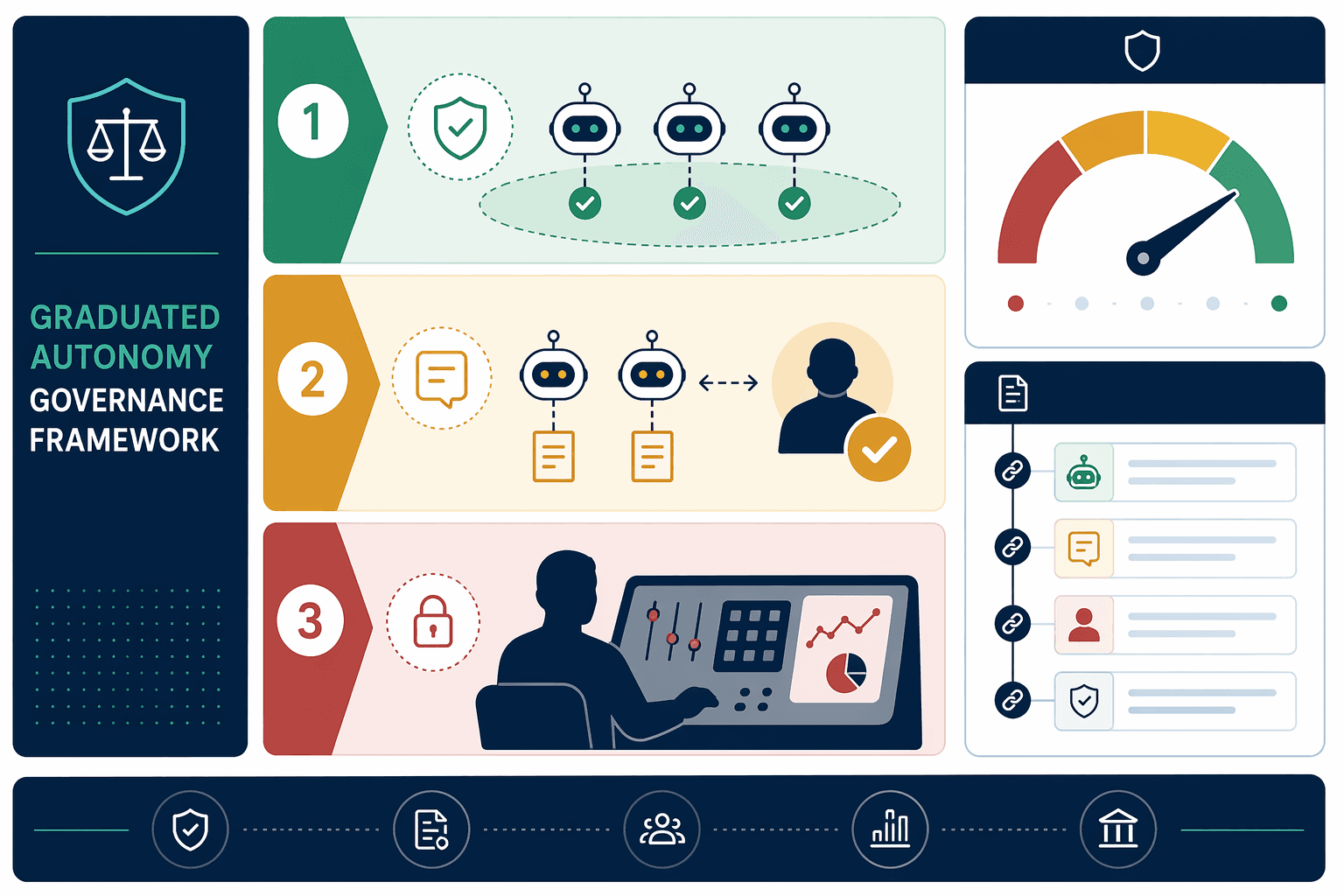
A workable model has three tiers:
- Tier 1: auto-execute. The agent can execute the action without human confirmation because the decision is low-risk, high-frequency, reversible or capped, and inside a validated confidence threshold.
- Tier 2: auto-propose, human confirm. The agent prepares the recommendation and supporting evidence, but a planner or functional owner must approve before execution.
- Tier 3: human-only. The agent may analyze, monitor, or explain, but it cannot execute or formally recommend an action as the decision owner.
The tiers should be assigned by decision type, not by technology confidence in the abstract. A planner may accept auto-execution for a replenishment adjustment on a stable, low-value item and reject it for a constrained allocation decision affecting strategic customers. The same agent may belong in Tier 1 on one decision and Tier 2 or Tier 3 on another.
Confidence thresholds need to be specific enough to operate
Confidence scoring only helps if it is tied to a decision class. A blanket statement that an agent is “95% confident” is not enough unless the business knows what the score measures, what historical pattern it was validated against, and what happens below the threshold. For a narrow purchase optimization action, the rule might be that the agent can execute only when confidence exceeds 95%; below that, it escalates to a planner with the supplier data, policy rule, exception reason, and expected impact attached.
That threshold is an operating control, not a universal benchmark. A lower-stakes diagnostic action may tolerate a different threshold. A customer allocation decision may require human ownership regardless of model confidence. The goal is not to make planners rubber-stamp the machine. It is to prevent the organization from discovering, after a supplier or customer problem, that nobody knew when the agent was allowed to act.
Audit trails are not administrative decoration
Every agent action needs an audit record: the triggering condition, data used, confidence score, rule or policy boundary applied, action taken, time of action, system touched, and human escalation if one occurred. For Tier 2 decisions, the record should also show who confirmed the action and what evidence they saw at the time.
This is where many planning transformations become uncomfortable. The executive benefit is faster decisions. The planner’s problem is reconstructability. If an autonomous recommendation creates a supplier conflict, an inventory imbalance, or a customer service miss, someone will have to explain the chain of events. The audit trail is the difference between a learning loop and a blame meeting.
Decision boundaries must be set before deployment
The most dangerous version of agentic AI is not the one that makes a bad recommendation. It is the one that learns its authority through production accidents. Before deployment, the business should define what the agent can read, what it can change, what value or volume limits apply, what policies are hard stops, who receives escalations, and which actions are prohibited even when the system is highly confident.
Those boundaries should be written in operational language. “The agent may recommend supplier consolidation opportunities” is not the same as “the agent may change purchase orders.” “The agent may identify allocation exceptions” is not the same as “the agent may reassign inventory between customer classes.” If the verbs are vague, the governance is vague.
Retiring expertise makes the boundary work more urgent
The demographic pressure on planning teams is real enough without turning it into nostalgia. Experienced planners are retiring, and with them go the informal rules that rarely fit cleanly into a process map: when to ignore a noisy signal, which supplier promise is soft, which customer exception will become political, which parameter change looks harmless but breaks the next planning cycle.
Agentic AI can offset some of that expertise loss only if the organization encodes judgment rather than bypasses it. The work is not simply to automate the old planner’s clicks. It is to capture the decision rules that determined when the planner clicked, waited, escalated, or refused. A retired expert’s value is not preserved by giving an agent broad authority. It is preserved by turning hard-won judgment into thresholds, exception logic, escalation paths, and review evidence.
What to scale first
The best starting point is not the most impressive decision. It is the decision where autonomy can be bounded tightly and measured honestly. Purchase optimization often fits because many actions are frequent, structured, and financially meaningful without requiring the agent to own a strategic supplier relationship. Root cause analysis fits because speed improves the planning response even when the final corrective action remains human-owned. Always-on IBP fits when the agent is used to keep plans reconciled and exceptions visible, not to quietly make cross-functional trade-offs that no executive has agreed to delegate.
The rollout sequence should follow evidence. Start with Tier 2 recommendations where planners can compare agent proposals against actual decisions. Move narrow actions into Tier 1 only after confidence thresholds are validated by decision type and the audit trail is useful enough to support post-hoc review. Keep Tier 3 for decisions where commercial exposure, supplier consequences, regulatory issues, or customer commitments make human ownership non-negotiable.
Broad forecasts about autonomy are worth watching, but they are not implementation plans. Gartner has projected that by 2031, 60% of supply chain disruptions will be resolved without human intervention.[4] Whether a given organization gets anywhere near that benchmark will depend less on the agent interface and more on the quality of its decision taxonomy, data readiness, process standardization, and escalation discipline.
Agentic AI is already useful in bounded planning work. The organizations that compound returns will be the ones that expand autonomy gradually, based on validated confidence and visible accountability, rather than the ones that either freeze at pilots or rush to full autonomy because the software can technically act.
References
- Supply Chain AI in 2026: The numbers behind the hype — RELEX Solutions, 2026.
- 2026: The age of the AI supply chain — Supply Chain Management Review, 2026.
- Supply Chain AI Trends 2026: Building Resilient Operations — Dataiku, 2026.
- 6 AI Trends Reshaping Supply Chains in 2026 — Supply & Demand Chain Executive, March 2026.
Comments
Join the discussion with an anonymous comment.