
The practical question in weather-aware supply chain planning is not whether a forecast model can ingest a weather feed. Most systems can. The question is whether temperature, precipitation, and seasonal anomalies change the demand forecast early enough for someone to move inventory, change replenishment, adjust allocation, or avoid producing perishable goods that will not sell.
That is where historical averages start to fail. A moving average may know that July usually lifts beverage sales. It does not automatically know that a cooler-than-usual week will soften that lift in one region while a heat wave pulls demand forward somewhere else. It may smooth rain into the residual error. A planner still has to decide whether the rain belongs in the forecast.
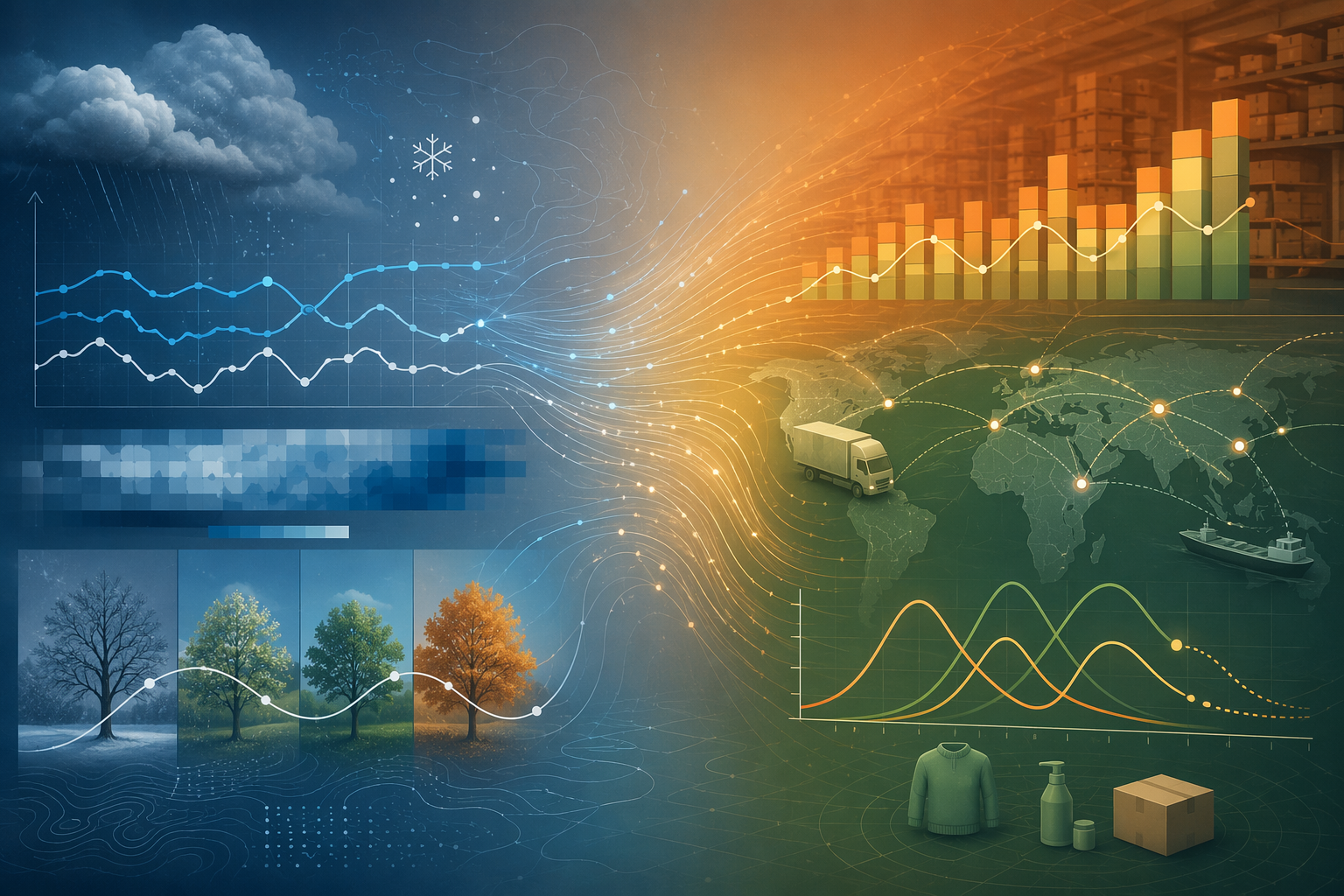
Weather-aware AI forecasting is useful when it treats those signals as part of the demand structure, not as after-the-fact explanation. The model has to learn that a hot spell can affect ice cream, bottled drinks, sunscreen, salad kits, air conditioners, and delivery patterns differently; that rain can move demand between channels; and that a cold snap can turn last year's same-week baseline into a poor guide. The value is not the weather data itself. It is the translation from weather into SKU, store, region, and time-phased planning decisions.
Weather Is A Demand Signal, Not A Disruption Story
Severe weather can close roads, delay ports, and interrupt suppliers. That is a real supply chain resilience problem, and it belongs in a different conversation about disruption mitigation. For demand planning in retail and food, the more common problem is less dramatic and more frequent: ordinary weather variation changes what customers buy and where inventory should sit.
A grocery planner does not need a hurricane to miss the forecast. A rainy weekend can reduce grill-food demand. A hot week can pull forward beverage and frozen treat sales. A mild winter can leave seasonal inventory sitting in stores. Those are not rare shocks. They are recurring planning variables that historical averages often blur.
The Weather Company describes the commercial logic as using predictive analytics and real-time weather insights to manage supply chain risk and align inventory with weather-driven demand. Its reported “Weather Means Business 2024” finding points to 5–10% revenue increases from better inventory alignment with weather-driven demand, a useful claim because it connects weather intelligence to inventory position rather than to a dashboard accuracy metric alone.[1]
The distinction matters. A forecast accuracy improvement that arrives after the buy is placed or after store replenishment is locked has limited operational value. A smaller improvement that changes tomorrow's replenishment, next week's allocation, or a perishable production run can matter more.
What The Reported Outcomes Actually Say
The strongest buyer-validation case for weather-aware forecasting is the cluster of reported outcomes around forecast error, product unavailability, waste, trucks, and revenue alignment. Those outcomes are not all equally verified, and they should not be read as guaranteed benchmarks. They do show why the use case has moved beyond “interesting external data” in retail and food planning.
Across practitioner and vendor materials citing McKinsey or C3 AI, weather-aware AI demand forecasting is associated with 20–50% forecast error reductions and up to 65% reductions in product unavailability.[2][3] The attribution trail is partly secondhand, so these figures are better used as directional evidence than as a procurement promise. A planning team should ask what baseline was used, which categories were included, whether promotional effects were separated, and whether the reduction held after planners began overriding the model.
The P&G Japan example is more operationally interesting because the reported result is not just a better forecast. The deployment is associated with a 30% reduction in trucks by using weather-aware forecasting to improve physical execution.[1] That is the kind of outcome demand planners should care about: fewer avoidable movements, fewer emergency corrections, and a cleaner handoff between forecast and logistics.
Waste reduction follows the same logic, especially in perishables. If rain suppresses expected weekend demand for fresh prepared foods, the relevant planning action is not to admire the model's weather sensitivity. It is to change production, replenishment, or allocation before the product ages out. In categories where short shelf life turns forecast error into shrink, a weather signal that arrives in time can reduce both stockouts and disposal.
| Reported outcome | What it measures | How to treat it |
|---|---|---|
| 20–50% forecast error reduction | Improvement against a prior forecasting baseline | Use as directional evidence; verify baseline, category mix, and attribution |
| Up to 65% less product unavailability | Reduction in items not available when customers want them | Look for store-SKU evidence and replenishment timing |
| 30% truck reduction at P&G Japan | Physical execution improvement linked to weather-aware forecasting | Most useful where forecasts directly drive transport and allocation decisions |
| 5–10% revenue increase from inventory alignment | Commercial lift associated with better matching inventory to weather-driven demand | Check whether the result reflects forecast accuracy, inventory placement, or both |
How The Signal Works In Planning
A useful weather model does more than attach tomorrow's forecast to a sales forecast. It has to learn local weather sensitivity by category, location, channel, and timing. The same temperature anomaly can mean different things in Phoenix, Minneapolis, and Seattle. Rain on a weekday commute can affect different demand pockets than rain on a holiday weekend. A hot day before a promotion is not the same as a hot day after the promotion has already pulled demand forward.
This is where AI adds something beyond a planner's manual adjustment. Machine learning models can test many interactions at once: weather by SKU, weather by store cluster, weather by promotion, weather by lead time, and weather by recent sales momentum. Kearney frames AI demand forecasting as a way to improve planning by incorporating broader external and internal signals rather than relying only on historical patterns.[2]
But weather still cannot explain demand by itself. Promotions, price changes, holidays, local events, competitor actions, and economic conditions can all dominate the weather effect. A model that attributes every miss to temperature is just a more expensive version of planner folklore. The practical test is whether it separates a weather-driven signal from other demand drivers well enough to improve the next decision.
For teams already evaluating broader demand sensing, the weather-specific use case sits inside the same operating discipline as AI demand forecasting in CPG and retail. Weather is not a separate planning universe. It is one high-value external variable that becomes useful only when it is connected to item-location forecasting, inventory policy, and execution calendars.
The Planning Horizon Determines The Weather Input
Weather-aware forecasting often gets discussed as if there is one forecast and one planning action. There are at least three practical horizons, and they ask different questions. Mixing them together is how teams end up with a good weather dashboard and no change in inventory performance.
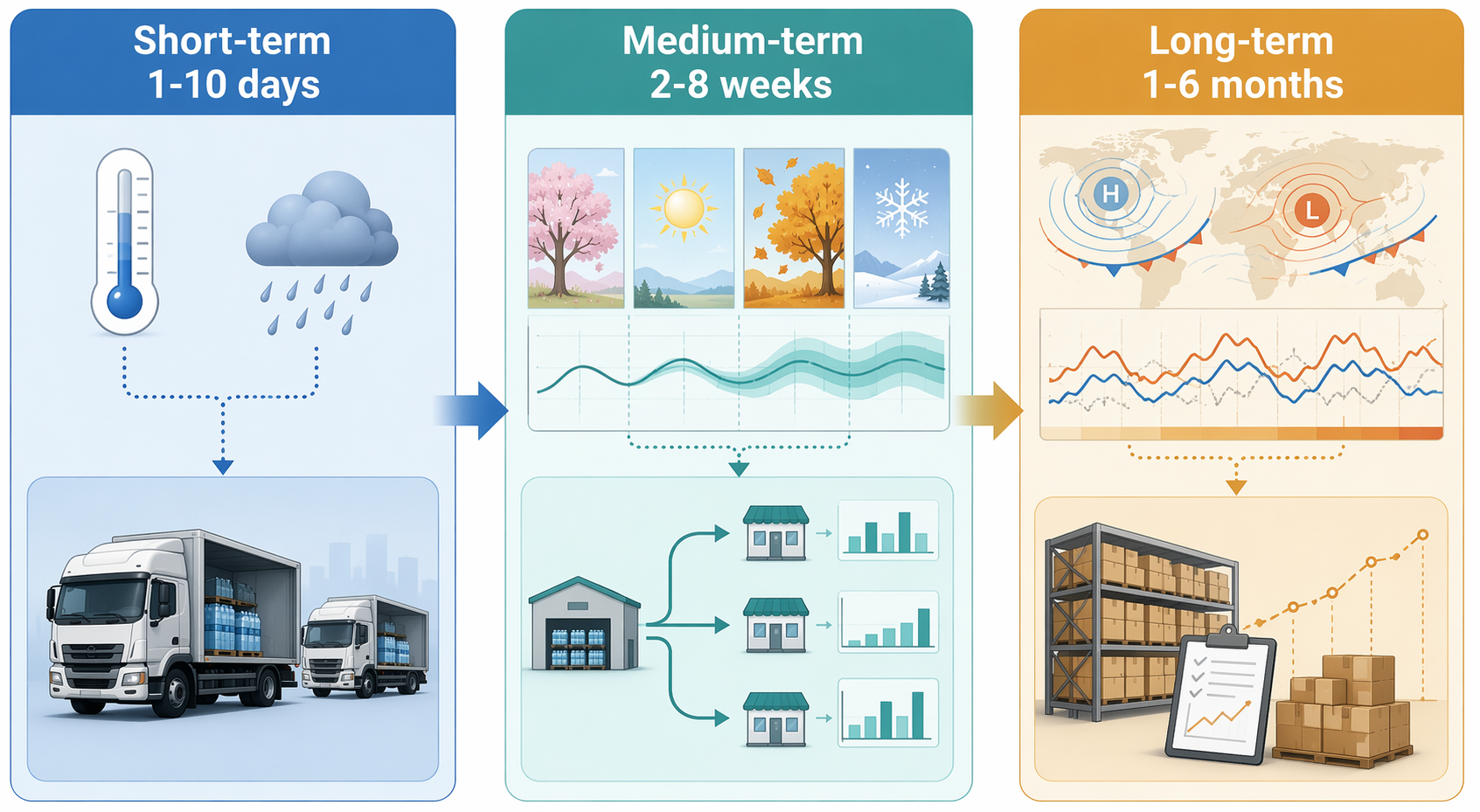
| Planning horizon | Weather input | Primary decision |
|---|---|---|
| Short term: 1–10 days | Forecasted temperature and precipitation | Store replenishment, labor-sensitive picking, perishable production, near-term allocation |
| Medium term: 2–8 weeks | Seasonal outlooks and expected anomalies | Regional allocation, inventory positioning, promotion readiness, safety stock adjustments |
| Longer range: 1–6 months | Historical weather normalization and climate-pattern context | Assortment planning, seasonal buys, baseline correction, supplier and capacity planning |
Short Term: Replenishment Has To Move Before The Customer Does
The 1–10 day horizon is where temperature and precipitation forecasts become operational. This is the window for store replenishment, order quantities, perishable production, and last-mile positioning. If the model sees that a weather pattern will likely change demand this weekend, the planning question is immediate: which stores need more inventory, which stores need less, and what is already too late to change?
This horizon is also where stockouts and shrink are easiest to feel. A beverage stockout during a heat wave is visible to customers. Overstocked fresh food after rain suppresses expected traffic is visible in markdowns and waste. A useful model narrows the gap between the weather forecast and the replenishment order, instead of leaving a planner to manually adjust a spreadsheet on Thursday afternoon.
Medium Term: Allocation Needs Regional Weather Logic
The 2–8 week horizon is less about tomorrow's rain and more about whether inventory is leaning toward the right regions before demand materializes. Seasonal outlooks and expected anomalies can help planners decide where to place goods, how to pace promotional inventory, and where safety stock deserves adjustment.
This is the horizon where averages can be especially misleading. A retailer may buy correctly at the chain level but allocate poorly if regional weather diverges from the seasonal norm. A warm early spring in one market and a delayed spring in another can turn the same assortment plan into both a stockout problem and a markdown problem.
Teams doing broader AI-based seasonal demand planning should treat weather intelligence as one of the signals that can reshape the seasonal curve, not as a late exception applied after the buy and allocation plan are already fixed.
Longer Range: Normalize The Baseline Before You Forecast The Season
The 1–6 month horizon is not about predicting each rainy day. It is about correcting the baseline. If last year's season was unusually hot, cold, wet, or dry, using it as a clean demand reference can build the wrong expectation into the plan. Historical weather normalization helps planners separate underlying demand from weather-assisted demand.
This matters for assortment, seasonal buys, supplier commitments, and capacity planning. A category that looked like it grew last summer may have benefited from an abnormal heat pattern. A category that looked weak may have been held down by unfavorable weather. Without normalization, the planning team can carry last year's weather distortion into next year's inventory decision.
Why Food And Beverage Carries More Weather Exposure
Food and beverage is a sharper test for weather-aware planning because weather acts on both sides of the business. It changes consumer demand at the shelf, and it can also pressure upstream supply through crop yields, growing-region shifts, and procurement conditions. ClimateAi describes weather intelligence for food and beverage procurement in terms of managing weather-related exposure across sourcing and planning decisions.[4]
That dual exposure changes the planning conversation. A beverage manufacturer may need to forecast hot-weather demand while also watching input availability. A grocery retailer may need to plan fresh inventory around demand swings while suppliers face weather-driven production variability. The same external signal can influence demand, supply, cost, and waste.
This does not mean weather explains every food and beverage forecast miss. Price, promotion, store execution, assortment, and macro pressure still matter. It does mean a forecast process that treats weather only as noise is poorly matched to a category where a badly timed hot week, cold snap, or rainy weekend can show up quickly in both service levels and shrink.
What Separates A Useful Model From A Weather Feed
The common implementation mistake is to assume the missing ingredient is simply better weather data. Granular weather inputs are necessary, but they are not enough. The planning system has to know which products are weather-sensitive, where that sensitivity appears, which decisions are still adjustable, and how a recommendation flows into ordering, allocation, or production.
- Weather granularity must match the decision level: store, micro-region, distribution zone, or supplier region.
- Demand history must be clean enough to distinguish weather effects from promotions, stockouts, price changes, and assortment changes.
- Lead times must leave room for action; a perfect signal after the replenishment cutoff is mostly forensic.
- Inventory and planning systems must accept the forecast change without manual rekeying or parallel spreadsheet work.
- Planner overrides need ownership, reason codes, and review, or the model and the human process will quietly contradict each other.
Transparency also matters, but it should be defined practically. Planners do not need every model coefficient before they act. They do need to know why the forecast moved, which weather factor drove the change, how large the expected effect is, and whether the recommendation conflicts with known commercial activity. “The model is a black box” is a legitimate adoption concern when the system cannot explain a major change. It is less convincing when it becomes a way to avoid fixing item masters, promotion calendars, location hierarchies, or override governance.
For teams moving from evaluation to deployment, the practical starting point is a data readiness review, not a model bakeoff. The same questions covered in a data readiness assessment for AI inventory optimization apply here: whether historical demand is usable, whether lost sales are visible, whether promotion and pricing data are reliable, and whether downstream systems can execute the recommendation.
Set Expectations By Decision, Not By Model Name
Vendor model names can be useful shorthand, but they are not evidence. A planning team should evaluate weather-aware AI forecasting by the decision it improves: fewer avoidable stockouts, less perishable waste, better regional allocation, fewer unnecessary trucks, or stronger revenue capture when demand shifts with the weather.
The reported 20–50% forecast error reduction and up to 65% unavailability reduction are worth attention, especially because they align with the operational pain planners already recognize.[2][3] They should still be translated into a local business case. A category with weak weather sensitivity will not behave like a highly seasonal beverage or fresh-food category. A retailer with poor stockout visibility may not be able to prove unavailability reduction until measurement improves.
Weather-aware forecasting is a credible and increasingly mature AI use case for retail and food supply chains. Its value comes from turning weather into an operational planning signal: a changed replenishment order, a different allocation, a corrected baseline, or an avoided waste decision. Buying a weather feed will not fix a broken forecast process. Connecting weather intelligence to clean demand data, planning horizons, inventory systems, and accountable planner processes can.
References
- Managing Supply Chain Weather Risks with Predictive Analytics and Real-Time Insights, The Weather Company
- The role of artificial intelligence to improve demand forecasting in supply chain management, Kearney
- AI-Driven Retail Demand Forecasting: Taming Weather Trends, Impact Analytics
- Weather Intelligence for F&B: 5 Procurement Solutions, ClimateAi
Comments
Join the discussion with an anonymous comment.