
The bluntest romaine recall is the one that starts before anyone can say which lettuce is actually implicated. Stores pull whole categories. Buyers freeze orders. Growers outside the contaminated supply path watch demand collapse anyway. Investigators begin the slow work of reconstructing where the product moved, who handled it, and whether the answer is sitting in a distributor file, a handwritten receipt, or a point-of-sale record that no longer carries the lot identity needed to separate one grower’s romaine from another’s.
That is the practical center of the traceability question for romaine recalls. The 2018–2019 romaine E. coli outbreaks did not merely expose that fresh produce supply chains were complicated. They exposed specific data failures: lot codes that did not persist to the consumer purchase record, paper records that slowed or broke traceback, and co-mingled product that lost a durable digital connection back to ranches and farms. In a peer-reviewed FDA and CDC traceback analysis of those outbreaks, investigators reported that traceback could take 5 to 25 days when records did not include lot codes, while records with lot code information could support traceback in under 24 hours.[1]

That comparison is more useful than most broad claims about artificial intelligence in food safety. AI does not make contaminated irrigation water clean. It does not remove pathogens from a field. Its defensible role after these outbreaks is narrower and more operational: make records searchable, preserve lot identity across handoffs, reconcile mismatched documents, flag records that do not fit the chain of custody, and keep product linkage intact when romaine is harvested, cooled, processed, shipped, and sold through different entities.
The real failure was not one missing dashboard
Fresh produce traceback is not a single file lookup. It is a reconstruction exercise across growers, coolers, processors, shippers, distributors, retailers, restaurants, and consumers. The FDA/CDC case study is valuable because it shows where that reconstruction slowed down. Investigators needed records that could connect a sick person’s exposure to a specific product movement and then back through the supply chain. When point-of-sale systems, invoices, and distribution records did not preserve lot codes, investigators had to work from broader product descriptions and shipment histories.[1]
That distinction matters for investment decisions. A traceability system that can show a polished shipment map after someone manually cleans the records is not the same as a system that keeps lot-level identity alive before the emergency. During an outbreak, the people doing the work are not asking for an elegant interface first. They need to know which lots moved through which facilities, which customers received them, which records conflict, and which growers can be excluded with enough confidence to avoid a broad advisory.
| Documented bottleneck | Operational consequence | Traceability capability that maps to it |
|---|---|---|
| Lot codes absent or not retained through sale | Traceback expands from specific product paths to broader regions, suppliers, or categories | Persistent digital lot identity across receiving, processing, distribution, and point of sale |
| Paper, handwritten, or inconsistent records | Investigators spend days reconciling documents and may hit dead ends | AI-assisted document ingestion, entity matching, and exception detection |
| Co-mingling without durable linkage | Product from many ranches or farms becomes hard to separate after aggregation | Digital batch genealogy that records inputs, outputs, splits, blends, and transformations |
Spring 2018: a single-farm finding that arrived too late to spare the market
The spring 2018 outbreak associated with romaine from the Yuma growing region ultimately produced a more specific traceback result than the public advisory that preceded it. The FDA/CDC traceback work linked the outbreak to romaine from a single farm, but that conclusion came only after weeks of investigation.[1] By then, the commercial effect had already moved far beyond a single farm. For operators, the hard lesson is that a precise answer delivered after the market has treated the product as broadly suspect is only partly useful.
This is where persistent lot identity becomes more than a compliance phrase. If romaine cases, cartons, pallets, and downstream sales records carry a machine-readable lot identity that survives every handoff, traceback starts with narrower candidates. Investigators can compare implicated purchase locations against actual lot movements instead of reconstructing the path from broad shipment records. Procurement teams can pull the lots that match the exposure window and keep unrelated product moving if the evidence supports exclusion.
AI’s useful contribution is not guessing the source from thin air. It is matching records that humans otherwise have to connect manually: supplier names that appear in slightly different formats, invoice lines that reference product differently than receiving logs, shipment dates that must be reconciled with harvest and cooling records, and distribution routes that overlap with exposure locations. In that setting, an AI traceability layer is closer to an investigation assistant than a prediction engine.
The FDA/CDC timing contrast gives the business case its spine. A 5-to-25-day traceback window leaves shelves, purchase orders, and public advisories operating under uncertainty. A sub-24-hour lot-code-enabled traceback does not make the outbreak harmless, but it changes the operating posture from broad suspicion to faster exclusion and targeted action.[1]
Fall 2018: paper records, missing lot codes, and a three-county advisory
The fall 2018 romaine outbreak is the case that should make any produce executive look past the software demo and ask how records are captured on bad days. The FDA/CDC analysis described traceback difficulties tied to paper and handwritten records, missing lot codes, and records that did not always let investigators connect retail or restaurant exposures back to specific lots.[1] The public health response narrowed to romaine from three California counties, but that still left a broad advisory rather than a lot-level recall.[1]
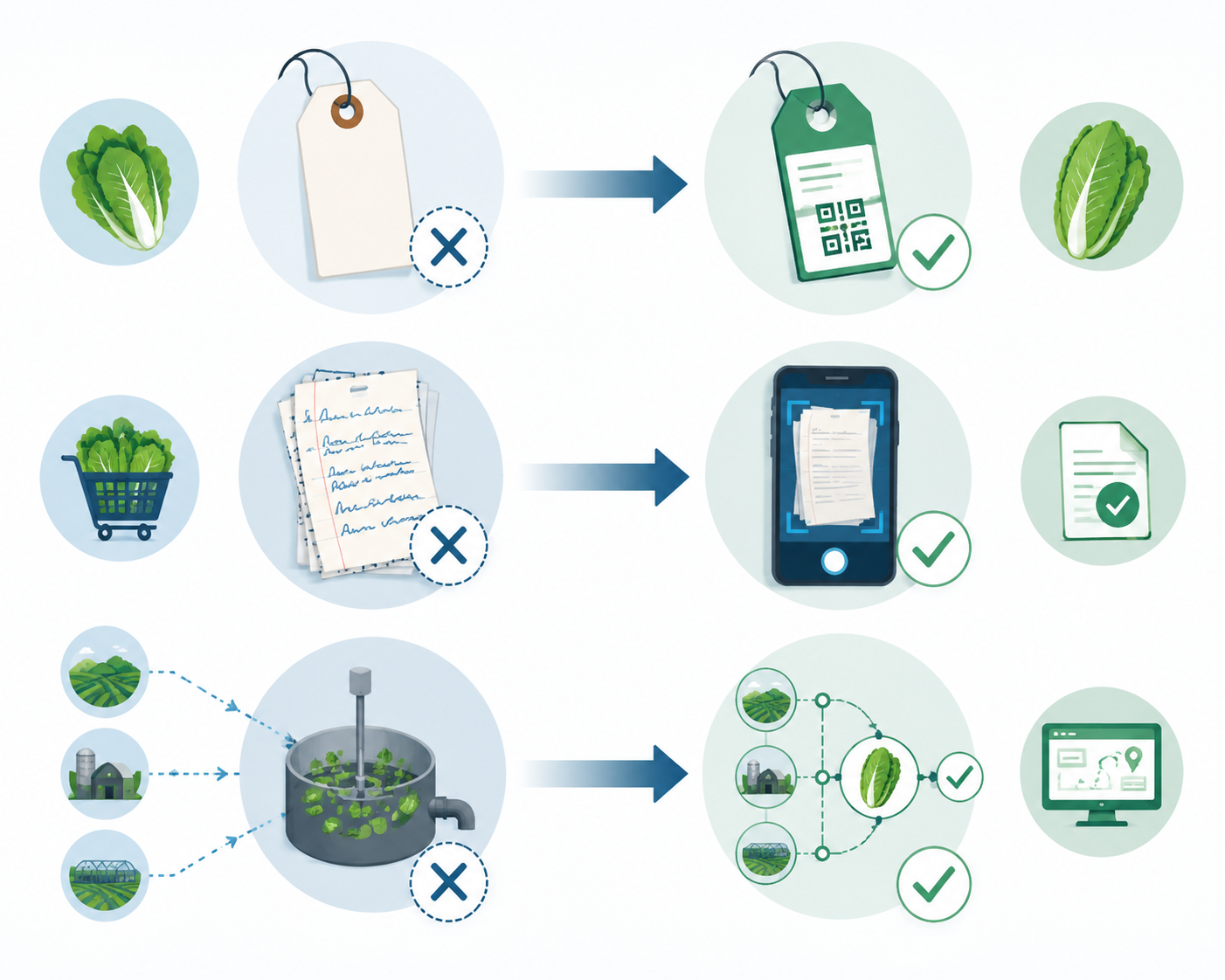
The frustration here is concrete. A handwritten receipt may satisfy a transaction at the time of delivery, but it becomes a weak record when investigators need structured fields: lot, grower, harvester, cooler, ship date, receiving location, product form, and downstream customer. A PDF invoice in an inbox is better than a lost slip of paper, but it still may not be searchable across the whole chain unless the fields are extracted, normalized, and connected to related records.
Automated document ingestion is one of the few AI traceability capabilities that maps cleanly to this failure. Optical character recognition and document understanding can pull structured data from bills of lading, invoices, receiving records, and certificates. Entity resolution can recognize that a ranch, shipper, or distributor appears under variant names. Anomaly detection can flag a shipment record with a missing lot, a date that does not fit the harvest window, or a supplier path that does not match the expected route.
None of that removes the need for disciplined receiving and labeling practices. If the lot is never captured, the system cannot infer a defensible lot identity later. But the fall 2018 bottlenecks show why digitization cannot stop at scanning documents into a repository. The record has to become structured enough that investigators can query it under pressure, compare it with other records, and use it to exclude product that does not belong in the advisory.
Fall 2019: co-mingling made identity a genealogy problem
The fall 2019 outbreak moved the traceability problem from missing records to blended identity. The FDA/CDC traceback case study reported that investigators dealt with co-mingling across more than 84 ranches and 45 farms.[1] In that kind of supply chain, the product identity is not simply handed from one company to the next. It is split, combined, packed, repacked, and redistributed.
Co-mingling is normal in produce operations. It is also where weak traceability systems lose the plot. If a processor receives romaine from several ranches and creates finished cases under a new production lot, the traceback record needs to preserve the relationship between each input and each output. If a cooler consolidates product from multiple farms before shipment, the system needs to remember the upstream sources after the outbound pallet label changes. If a distributor breaks pallets and ships partial quantities to multiple customers, the downstream record needs to retain the inbound linkage.
This is less like tracking a parcel and more like maintaining a batch genealogy. AI can help by reconciling input-output records, identifying missing transformation events, and surfacing product paths that share a common upstream source. The technology still depends on operators recording the events that matter: receiving, cooling, processing, blending, packing, shipping, and sale. Without those events, a model has no reliable chain to analyze.
The fall 2019 lesson is especially important for buyers who assume supplier-level traceability is enough. When dozens of ranches and farms feed into aggregated product, a supplier name may be too broad to support a targeted recall. The record has to carry the specific upstream links through the aggregation point, or the advisory will widen to cover the uncertainty.
What current benchmarks prove, and what they do not
The strongest public benchmark for compressed provenance remains the Walmart mango pilot often cited in traceability discussions. In that 2018 proof of concept, Walmart reported that tracing mango provenance fell from 7 days to 2.2 seconds when using a blockchain-based traceability system.[2] That is not evidence that every produce item in every current store can be traced in seconds today. It is directional proof that when the relevant supply chain events are digitized and linked, provenance lookup can collapse from a manual research project into a near-immediate query.
Vendor-reported deployment metrics point in the same operational direction, though they deserve the right label. FoodReady reports that its implementations have reduced mock recall time from 4–8 hours to 10–30 minutes and reduced data errors by 85–95%.[3] Those figures are not independent outbreak studies. They are useful as implementation signals: companies that digitize records, standardize fields, and run mock recalls can compress the work that otherwise burns time during a live incident.
These benchmarks should not be stretched into a promise that AI prevents contamination. They support a narrower claim: traceability systems can make provenance faster to retrieve, mock recalls faster to execute, and record errors easier to catch before regulators or customers are waiting.
The cost of imprecision is not theoretical
The economic case for better traceability is strongest when it stays attached to recall narrowing. An American Journal of Agricultural Economics study estimated that the single 2018 Yuma romaine outbreak caused $276 million to $343 million in societal losses and more than $280 million in agricultural sector losses.[4] That is one modeled outbreak, not a universal return-on-investment formula. Still, it shows why days of uncertainty have consequences well beyond the infected product itself.
Those losses accumulate through channels that produce teams understand immediately. Product is destroyed or left unsold. Retailers lose margin and shelf continuity. Restaurants rewrite menus. Procurement teams switch sources under pressure. Growers outside the implicated lot or farm lose sales when the public message cannot be narrowed quickly enough. Regulators and public health investigators spend scarce time assembling records that should have been queryable at the start.
That is why the 5–25 day versus under-24-hour traceback comparison matters more than a generic automation pitch.[1] Speed has value because it can narrow the recall field. Narrowing has value because it can protect consumers while also keeping uninvolved product, growers, and retailers out of the blast radius.
What fresh produce leaders should actually evaluate
The romaine record points to a practical buying standard. A credible AI traceability system should be judged by whether it closes the same gaps that made the outbreaks hard to investigate. It should not be enough to say the platform is AI-powered, blockchain-enabled, or compliant-ready. The question is whether it preserves usable evidence across the messy parts of the chain.
- Lot identity: Can the system retain lot codes from harvest or receiving through processing, shipment, distribution, and point of sale where applicable?
- Document conversion: Can it turn invoices, bills of lading, receiving logs, and handwritten or scanned records into structured, searchable data?
- Record reconciliation: Can it match suppliers, products, dates, and locations when names or formats vary across trading partners?
- Co-mingling linkage: Can it maintain input-output genealogy when product from multiple ranches or farms is cooled, processed, blended, repacked, or split?
- Exception handling: Can it flag missing lots, inconsistent dates, unexplained quantity changes, or product paths that break the expected chain?
- Recall execution: Can teams run a mock recall fast enough to prove that the record works before a real outbreak?
FSMA 204 adds regulatory urgency to the same operational problem. The rule’s traceability expectations make key data elements and critical tracking events harder to treat as optional recordkeeping. For teams that want the compliance path after the outbreak evidence, ChainSignal’s FSMA 204 traceability guide belongs next to the internal project plan, not as a substitute for testing whether records survive real operating conditions.
The investment judgment is therefore specific. The 2018–2019 romaine outbreaks are not old crisis stories to cite in a food safety presentation. They are requirements evidence. If a traceability system cannot preserve lot identity, digitize and reconcile operational records, and maintain linkage through co-mingling, it will struggle in exactly the places investigators already showed were weak. If it can do those things, the business case is not magical prevention. It is faster traceback, cleaner exclusions, and a better chance that the next romaine advisory is targeted instead of blunt.
References
- Traceback investigations during multiple Escherichia coli O157:H7 outbreaks associated with romaine lettuce, United States, 2018–2019, National Library of Medicine, https://pmc.ncbi.nlm.nih.gov/articles/PMC11467813/
- Walmart Food Traceability Initiative, LF Decentralized Trust, https://www.lfdecentralizedtrust.org/case-studies/walmart-case-study
- Food Traceability Software, FoodReady, https://foodready.ai/food-traceability-software/
- Economic impacts of the 2018 E. coli outbreak associated with romaine lettuce, American Journal of Agricultural Economics, https://academic.oup.com/ajae/
Comments
Join the discussion with an anonymous comment.