
The Boeing 787's 2025 supply chain story starts with a number that is hard to route around: Boeing booked 381 Dreamliner orders in 2025, its highest 787 order intake since the launch year, and delivered 88 aircraft. That is a 4.3:1 book-to-bill ratio, which is less a sales headline than a throughput test for the whole production system.[1]
A purchase order does not care whether the constraint sits at the named supplier, one tier below, or in a certification queue attached to a cabin product. The recovery call still lands on the program team, procurement, supplier quality, and risk people after the schedule has already moved. That is why the 787’s 2025 order boom matters beyond Boeing. It shows what happens when demand accelerates faster than the monitoring architecture can see across the network.

The Bottleneck Did Not Stay Put
The clean version of a production ramp says the factory stabilizes, suppliers catch up, and the rate moves. The 787’s 2025-2026 sequence was messier. Forecast International reported that the program stabilized around eight aircraft per month in the second half of 2025, then slipped below target in the first quarter of 2026 because of GEnx engine delays. When engine supply improved, the delivery rate still remained constrained because premium business-class seating certification became the next bottleneck.[2]
That sequence is the operational lesson. The first miss had an engine label on it. The next one had a seating-certification label. A tier-1 dashboard can show a red condition at the visible supplier, but the program does not recover simply because that box turns yellow or green. Once the first governing constraint eases, the hidden dependency with the next-longest recovery path takes control of the schedule.
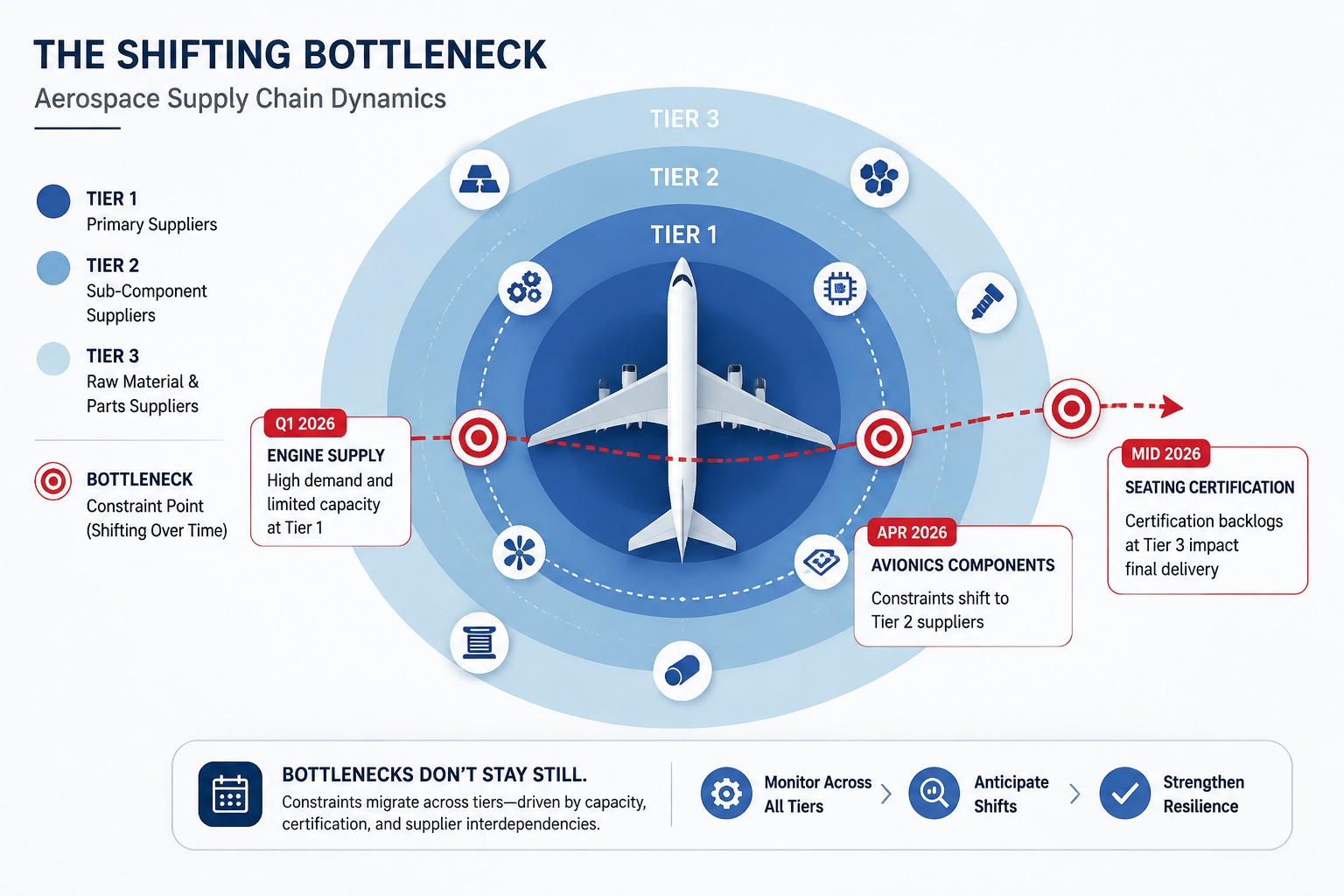
This is where conventional supplier visibility tends to disappoint the people who are expected to manage it. A supplier portal may be current. The tier-1 scorecard may be defensible. The escalation cadence may be disciplined. None of that guarantees that the next constraint is being watched if the weak signal sits in a sub-tier entity, a certification dependency, a labor issue, a financial stress pattern, or a regulatory event that is outside the normal purchase-order relationship.
The point is not that Boeing should have seen every issue earlier from the outside. The public record does not support that kind of certainty. The point is narrower and more useful: a production system that can move from engine delay to cabin-certification constraint in a single ramp period is not adequately described by tier-1 health alone.
Why 787 Supplier Visibility Is Structurally Hard
The 787 was built around an unusually distributed industrial model. Boeing outsourced about 70% of 787 content, with more than 50 major global suppliers across countries including Japan, Italy, South Korea, France, the United Kingdom, and the United States. Named major suppliers have included Mitsubishi Heavy Industries for the wing box, Kawasaki Heavy Industries for the forward fuselage, Alenia Aermacchi for the center fuselage, and Spirit AeroSystems for the nose section.[3]
That architecture can work, but it changes what “supplier management” has to mean. A major-structure supplier may have its own specialized sources. A seat supplier may depend on a certification path that is not visible in the same way as a late machined part. An engine delay may sit behind a prime propulsion supplier’s internal sub-tier constraints. In a network like that, the purchase order names the accountable supplier; it does not name every dependency capable of stopping delivery.
Static maps are useful at program launch and painful during recovery. They tend to preserve the official architecture, not the living risk surface. They show who is supposed to supply what, not which small entity has a deteriorating balance sheet, which facility is exposed to a local labor dispute, which regulatory process is stretching, or which sole-source part has no practical alternate route inside the ramp window.
This is also why the macro cost of bottlenecks is relevant, though it should not be misapplied. IATA estimated that aerospace supply chain bottlenecks cost airlines more than $11 billion in 2025, including $4.2 billion in excess fuel costs from operating older aircraft because deliveries were delayed and $3.1 billion in additional maintenance on aging fleets; Oliver Wyman separately addressed the need to revive aircraft supply chains to accelerate delivery.[4][5] Those are industry-level figures, not a 787 damages estimate. They still explain why earlier warning matters: when aircraft deliveries slip, the cost does not remain inside the OEM’s supplier-management meeting.
What AI Adds When It Is Used for the Right Problem
AI supplier risk monitoring is most useful here when it is not treated as a smarter scorecard for the same visible suppliers. The better use case is network expansion: connecting entities across tiers, monitoring weak public signals, and flagging relationships that a program team would not otherwise have the time or structure to track.
The signal sources are not exotic. They include financial filings, litigation, labor disputes, regulatory actions, sanctions and geopolitical events, plant-level news, import/export patterns where available, and ownership or relationship changes. Machine-learning models can connect those signals to entities and supplier relationships, then push alerts when a risk pattern forms around a company that may not be named on the OEM purchase order.
EY documented one aerospace and defense example in which a defense contractor used AI tools to expand its visible supplier base from 15,000 to 500,000 entities, a 33x increase, by mapping procurement relationships across sub-tiers.[6] That is not evidence that Boeing used the same system on the 787. It is evidence that the visible universe can be widened dramatically when supplier mapping is treated as a data problem rather than a portal-administration problem.
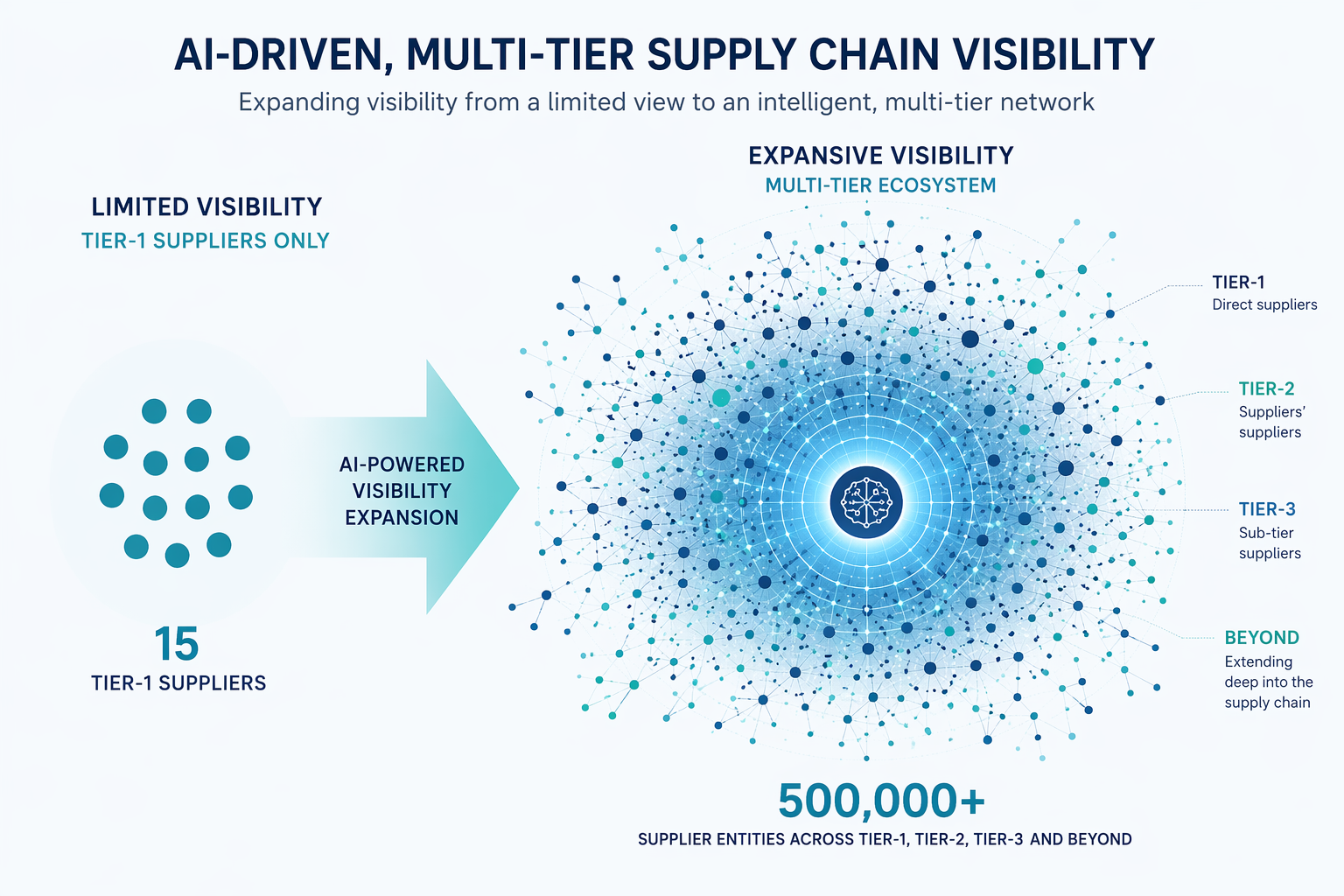
The practical value is not that 500,000 entities all become equally actionable. They do not. A risk team still has to filter severity, confidence, part criticality, sole-source exposure, inventory position, certification impact, and recovery time. But the difference between monitoring 15,000 known entities and scanning a much wider multi-tier network is the difference between waiting for a tier-1 supplier to report a problem and seeing a public weak signal before it is packaged into a delivery miss.
For teams evaluating the mechanics, the deeper technical question is how entity resolution, relationship inference, and alert prioritization are handled. A useful system has to distinguish a supplier with a noisy news footprint from a supplier with a material exposure to a constrained part. For a more detailed treatment of that mapping problem, see how AI extends supplier visibility in aerospace supply chains.
The Difference Between an Alert and a Recovery Option
Earlier detection only matters if it creates a recovery option. In a complex manufacturing ramp, that may mean placing supplier-development resources before the constraint is late, qualifying an alternate where an alternate is realistic, repositioning buffer stock, sequencing aircraft around a constrained configuration, accelerating certification support, or escalating a sub-tier issue through the tier-1 supplier before it becomes a formal shortage.
| What the system sees | What the team still has to decide |
|---|---|
| A public financial stress signal at a sub-tier company | Whether that entity touches a constrained part, has no substitute, or sits on a long recovery path |
| A labor dispute near a critical production site | Whether current inventory and transit stock can bridge the disruption window |
| A regulatory or certification delay around a cabin or systems component | Whether delivery sequencing, engineering support, or customer configuration changes can reduce impact |
| A geopolitical or sanctions-related exposure | Whether sourcing, logistics, or contractual controls need immediate escalation |
This is the part that gets lost when AI risk monitoring is sold as visibility. Visibility is not the finish line. The work starts when the alert is specific enough to assign to a buyer, supplier quality engineer, program manager, certification lead, or executive escalation owner. A warning with no relationship map and no operational consequence is just another dashboard tile.
Academic work on AI-driven predictive risk modeling for aerospace OEMs has reported reduced downtime and procurement delays through machine-learning early warning systems.[7] That supports the direction of travel, but it does not remove the implementation burden. Models must be tuned to the part family, the supplier network, the regulatory environment, and the actual playbook available to the team receiving the alert.
What the 787 Ramp Teaches Risk Teams
The 787’s order-delivery mismatch was not simply a story about demand exceeding capacity. It was a demonstration of moving constraints inside a high-value, globally distributed, partly sole-sourced production network. A program can look stabilized at one rate, miss on engines the next quarter, and then remain constrained by seating certification after the engine issue improves.[2]
That pattern should change how supplier risk teams define coverage. The relevant monitoring boundary is not the supplier master file. It is the set of entities, facilities, certificates, materials, logistics lanes, ownership links, and public events that can affect a constrained delivery path. Some of those will be inside the tier-1 relationship. Many will not.
AI can help if it expands that boundary and detects weak signals early enough for mitigation. It cannot certify a seat, machine an engine part, rewrite a sole-source contract overnight, or replace the supplier collaboration that keeps a ramp honest. But tier-1 monitoring alone is no longer a credible early-warning system when the next bottleneck may be several relationships away from the supplier named on the purchase order.
References
- Airbus and Boeing Report December 2025 Commercial Aircraft Orders and Deliveries, Forecast International, January 15, 2026.
- 787 Instability Threatens Program's Ramp-Up Timeline and Boeing's Broader Commercial Aircraft Deliveries, Forecast International, May 28, 2026.
- Boeing 787: Global Supply Chain Management Takes Flight, e2open.
- Aerospace Supply Chain Bottlenecks Continue to Constrain Airlines, IATA, December 9, 2025.
- How To Revive Aircraft Supply Chains To Accelerate Delivery, Oliver Wyman, October 2025.
- How can digital supply chains help manage aerospace risk?, EY, 2024.
- AI-Driven Predictive Risk Modelling for Aerospace Supply Chains, IIBA Journal.
Comments
Join the discussion with an anonymous comment.