
The Confidence-Execution Gap in Retail Predictive Analytics
The numbers paint a picture of near-universal optimism. According to RELEX Solutions' 2026 State of the Supply Chain report, 67% of supply chain leaders say they are more confident in AI than they were a year ago, and only 3% report decreased confidence. A full 60% of respondents plan to invest in predictive AI specifically — a jump of 17 percentage points from 2025. The intent is unmistakable.
But intent is not deployment. The same RELEX survey found that only 32% of organizations are actively investing in and scaling AI solutions right now. PwC's 2026 Digital Trends in Operations Survey, which polled 767 operations and supply chain leaders at US companies, delivers an even starker verdict: 89% of operations leaders say their technology investments have not fully delivered expected results. Just 27% have fully embedded an AI strategy across business units. And only 4% of organizations report success across four critical dimensions — AI fully embedded enterprise-wide, no significant barriers to scaling autonomous agents, a collaborative horizontal operating structure, and technology investments delivering full ROI.
This is the retail predictive analytics paradox: high confidence, high investment intent, but vanishingly low production deployment. The gap is not about model accuracy. McKinsey reports that AI-driven forecasting can reduce errors by 20% to 50% and cut lost sales and product unavailability by up to 65%. The ROI potential is well documented. The bottleneck lies elsewhere — in the messy, retailer-specific work of connecting systems, cleaning data, and redesigning workflows around predictions rather than around reports.
Why Retail Pilots Stall: The Data Integration Bottleneck
Retail supply chains are uniquely complex data environments. A single demand forecast for a grocery chain might need to ingest point-of-sale data from hundreds of stores, inventory positions from multiple distribution centers, supplier lead times from dozens of vendors, promotion calendars from the marketing team, weather data, and local event schedules. These signals live in separate systems — ERP, WMS, TMS, promotion management platforms, and external data feeds — each with its own schema, update cadence, and data quality profile.
PwC's survey quantifies the pain: 59% of consumer markets leaders cite integration complexity as the top reason their technology investments have not fully delivered — the highest percentage of any sector surveyed. Across all industries, 87% of operations leaders say poor data quality has impacted their organization's ability to achieve value from digital initiatives. Only 30% report significant improvement in data quality and reliability.
The consequences are measurable. Tradeverifyd's 2026 research found that 67% of enterprises report that despite increasing their financial commitment to visibility tools, the return on investment has stalled due to the continued use of fragmented legacy systems. And 42% of executives cite a lack of real-time data as their main limitation when responding to a disruption. In retail, where margins are thin and stockout costs are high, these delays directly hit the P&L.
- ERP and WMS data often use different product hierarchies and update cycles, making inventory reconciliation a manual weekly exercise.
- Promotion and pricing data lives in marketing systems that do not expose APIs to the planning team.
- External signals — weather, competitor pricing, social sentiment — are purchased from third-party vendors and arrive in formats that require custom ETL pipelines.
- Legacy on-premise systems lack the throughput to support real-time or near-real-time model inference.
The result is a familiar pattern: a retailer runs a successful pilot on a single category using manually curated data, achieves impressive forecast accuracy improvements, and then attempts to scale to 50,000 SKUs across 200 stores. The data pipelines break. The model's accuracy degrades. The planning team reverts to spreadsheets. The pilot becomes a permanent experiment.
The 4% Leader Cohort: What Fully Embedded Retailers Do Differently
PwC's survey identified a small cohort — just 4% of all respondents — that has broken through the pilot barrier. These organizations report success across four dimensions: AI fully embedded enterprise-wide, no significant barriers to scaling autonomous agents, a collaborative horizontal operating structure, and technology investments fully delivering expected results. Their practices offer a blueprint for retailers still stuck in the pilot phase.
| Practice | Leader Cohort (4%) | All Other Organizations (96%) |
|---|---|---|
| Digital capabilities integrated end to end | 87% | Not disclosed (implied minority) |
| Broad organizational impact from digital investments | 73% | Not disclosed (implied minority) |
| Measure both operations and financial impact of digital investments | 83% | Not disclosed (implied minority) |
| Significant improvement in data quality and reliability | 63% | 30% (overall survey average) |
Three patterns stand out for retail practitioners.
First, the leader cohort treats data quality as a prerequisite, not a project. While only 30% of all organizations report significant data quality improvement, 63% of leaders do. They invest in data governance, master data management, and automated data validation before they invest in advanced models. This is the opposite of the common retail pattern, where a team buys a predictive analytics platform and then discovers that their product master data has a 15% error rate.
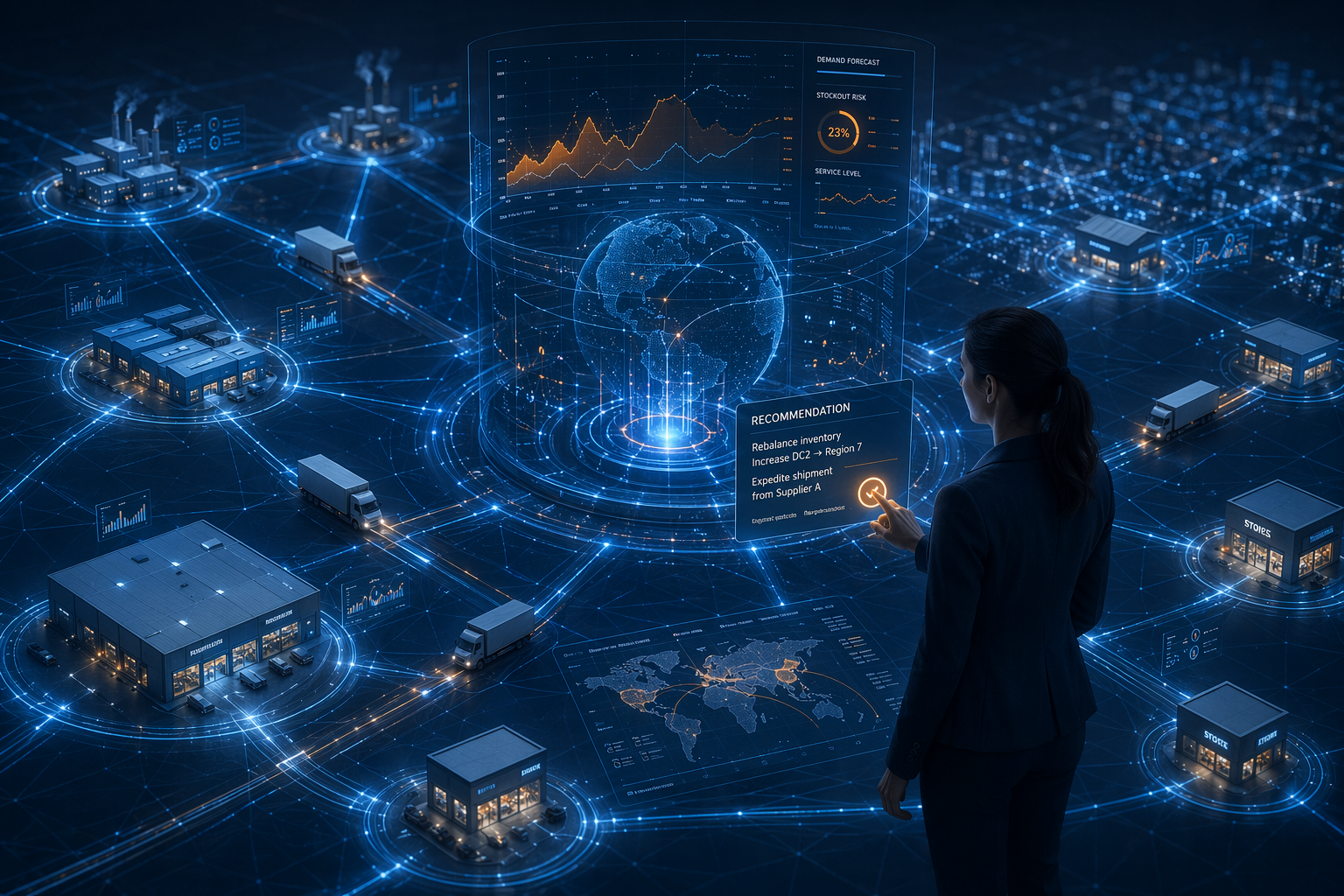
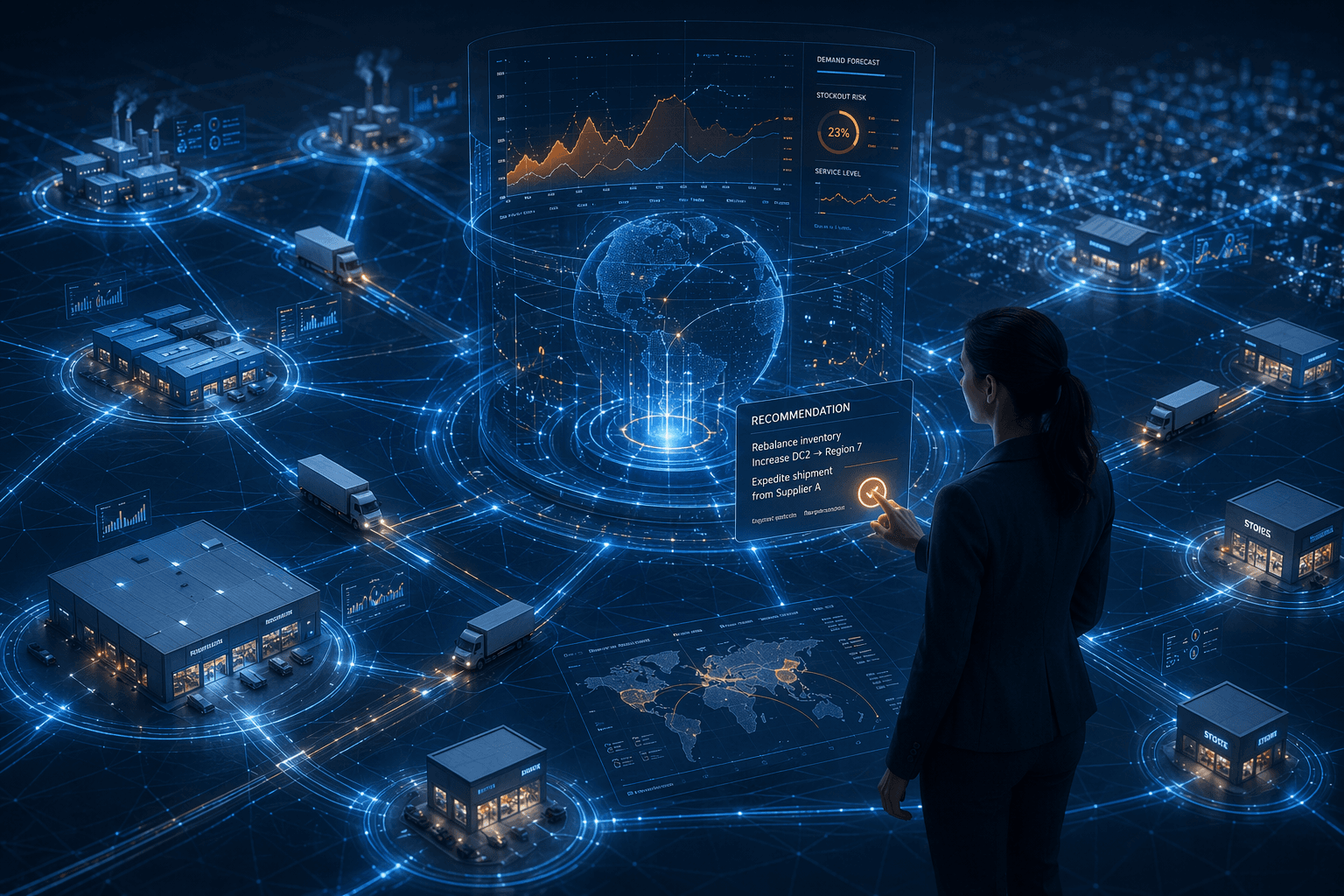
Second, leaders integrate end to end. 87% of the leader cohort has integrated digital capabilities across the full value chain — from supplier data through warehouse operations to store-level demand signals. In retail terms, this means the demand forecast is not a standalone output in a planning tool; it is a live input that adjusts inventory targets in the WMS, triggers replenishment orders in the ERP, and updates delivery schedules in the TMS. The prediction becomes an action, not a report.
Third, leaders measure both operational and financial impact. 83% of the leader cohort tracks both dimensions. A retailer in this group does not just measure forecast accuracy improvement; it measures the resulting reduction in stockouts, the inventory holding cost savings, and the revenue impact of fewer markdowns. This dual measurement creates a clear business case that sustains investment through organizational changes.
From Pilot to Production: A Retail-Specific Roadmap
Moving from a successful pilot to production deployment in a retail environment requires a fundamentally different approach than running the pilot itself. The pilot proves the model works on clean, curated data for a narrow scope. Production requires the model to work on real-world data at scale, integrated into daily workflows. McKinsey's finding that 60% of supply chain planning IT implementations take longer or cost more than expected is a useful caution: the timeline from pilot to production is typically 6 to 12 months, not weeks.
The following steps are anchored in the specific challenges of retail supply chains.
- Start with a narrow, high-value use case. Choose a single category with clear data quality, a manageable number of SKUs, and a direct line to a measurable business outcome — such as demand sensing for fresh produce in a regional grocery chain, where stockout costs are high and lead times are short. A focused pilot can be accomplished within 4 to 8 weeks, per BrainXtech's implementation guide. The goal is not to prove the model works; it is to prove the data pipeline works end to end.
- Enforce data contracts between systems. Before connecting the predictive model to production systems, establish formal agreements on data format, update frequency, and quality thresholds between the ERP, WMS, TMS, and any external data providers. A data contract specifies: 'The WMS will provide daily inventory snapshots by 6 AM with less than 1% discrepancy vs. physical counts.' Without these contracts, the model will silently degrade as upstream data quality drifts.
- Embed predictions into planner workflows, not dashboards. The most common failure mode is building a beautiful dashboard that planners check once a week. Production deployment means the prediction triggers an action in the planner's daily tool — a replenishment suggestion in the ERP, a reallocation alert in the WMS, a delivery reschedule in the TMS. The RELEX survey found that 54% of supply chain leaders prefer a hybrid human-in-the-loop approach, and only 10% trust AI for unsupervised decisions. The workflow must support this: the model recommends, the planner approves or overrides, and the system learns from the override.
- Plan for a 6-12 month timeline from pilot to production. The pilot proves technical feasibility. The production rollout requires data pipeline hardening, workflow integration, user training, change management, and iterative model tuning based on real-world feedback. Budget for the full timeline, not just the pilot phase.
- Measure both operational and financial impact from day one. Define the metrics before deployment: forecast accuracy improvement, stockout reduction, inventory turns improvement, and the financial impact of each. This creates the business case that sustains the program through inevitable setbacks.
| Phase | Typical Duration | Key Activities |
|---|---|---|
| Pilot (single category, curated data) | 4–8 weeks | Model selection, data pipeline proof-of-concept, accuracy validation on historical data |
| Data foundation build-out | 8–16 weeks | Data contracts, master data cleanup, automated quality checks, integration middleware |
| Workflow integration | 8–12 weeks | Embed predictions into planner tools, build override/feedback loop, train users |
| Production rollout (phased by category) | 12–24 weeks | Gradual expansion to additional categories, monitor model drift, refine based on feedback |
The Hybrid Model: Augmentation as the Middle Step
The data on trust is sobering. RELEX's 2026 survey found that only 10% of supply chain leaders trust AI to make critical decisions without human review. 54% prefer a hybrid human-in-the-loop approach. This is not a failure of the technology — it is a rational response to the current state of data quality, model explainability, and organizational readiness in most retail environments.
The instinct of many technology teams is to push for full automation: let the model generate purchase orders, adjust safety stock, and reroute shipments without human intervention. But the data suggests this is the wrong target for most retailers today. The RELEX report frames it directly: 'Augmentation is the middle step, not the destination.'
Augmentation is the middle step, not the destination.
A well-designed augmentation model works like this: the predictive analytics system generates a recommendation — for example, 'Increase safety stock for SKU 4512 by 15% due to a forecasted supplier disruption in the next 14 days.' The planner reviews the recommendation, sees the supporting data (the supplier's on-time delivery rate dropped from 92% to 78% over the last three weeks), and either approves, adjusts, or overrides. The system records the planner's decision and uses it to improve future recommendations.
This hybrid approach accomplishes several things that pure automation cannot. It builds trust gradually as planners see the model's recommendations validated by real outcomes. It creates a feedback loop that improves model accuracy over time. And it provides a governance layer that is essential for high-stakes decisions like inventory commitments and supplier allocations.
The path from pilot to production in retail predictive analytics is not a technology problem. It is a data integration problem, an operating model problem, and a trust problem. The 4% of organizations that have solved it did not do so by buying better models. They invested in data foundations, integrated their systems end to end, embedded predictions into daily workflows, and respected the human-in-the-loop reality. For the 96% still stuck in pilot, the roadmap is clear — but it requires a different kind of investment than the one that got them there.
Comments
Join the discussion with an anonymous comment.