

The AI in supply chain market is not a single number. For 2026, the credible analyst range sits at roughly $10.3B to $13.9B, and the gap is mostly about scope: some firms count only supply-chain-specific AI software, while others widen the market to include logistics automation hardware, robotics, and AI-as-a-service [1][2][3].

That difference matters more than the top line. Once hardware and services are folded in, the market can look several times larger by the mid-2030s: Mordor Intelligence points to $45B by 2031, Precedence Research to $236B by 2035, and GM Insights to $58.5B by 2034 [1][2][4]. The reports are not contradicting each other; they are measuring different slices of the stack.
| Source | Scope signal | Size / projection |
|---|---|---|
| Mordor Intelligence [1] | Narrow supply-chain-specific AI software | $10.3B in 2026; $45B by 2031 |
| Grand View Research [3] | Medium scope | $13.9B in 2026 |
| Precedence Research [2] | Broader scope including logistics automation hardware, robotics, and AI-as-a-service | $13.9B in 2026; $236B by 2035 |
| GM Insights [4] | Logistics and supply chain market | $58.5B by 2034 |
| MarketsandMarkets (via Market.us) [5] | CAGR benchmark | 42.7% CAGR |
Why the estimates diverge
The spread is a methodology problem, not a data-quality problem. Narrow reports track software tied directly to supply-chain workflows. Broader reports add enabling layers that buyers often budget for in the same program but that do not belong in a software-only market: robotics, sensors, automation hardware, and AI-as-a-service [1][2][3][4].
That is why the useful takeaway is a range, not a single point. Across the cited reports, the market converges to a mid-30% to low-40% CAGR band, which is strong enough to indicate structural adoption and still sensitive enough to definition choices that the market size itself must be read alongside scope [1][2][4][5].
Where the revenue is concentrated
Revenue is still concentrated in software, which accounts for 47%–56% of the market. Services are the fastest-growing offer side at about 19% CAGR because implementation, integration, and model governance are increasingly outsourced. Hardware becomes the largest absolute slice only in broader definitions that intentionally pull in robotics and sensors [1][4].
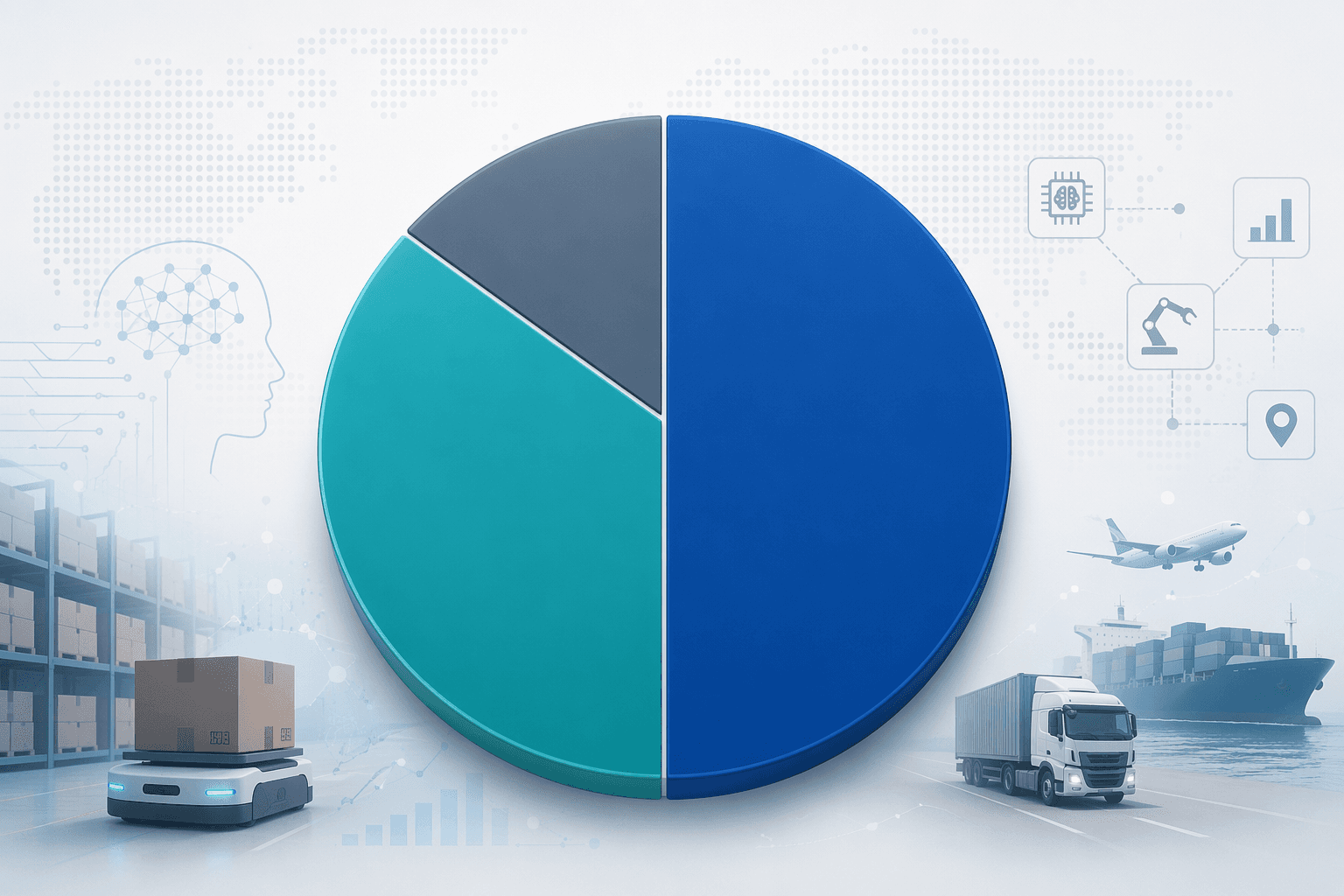
- Machine learning holds the largest technology share at 37%–47%; context-aware computing is growing fastest at 22% CAGR, and computer vision is also expanding, though more slowly at 18% CAGR [1].
- Supply chain planning is the largest application segment. Warehouse and transportation remain important, but they sit below planning in revenue concentration [1].
- Retail, automotive, and healthcare are the leading end-use industries, while North America still accounts for 41.25% of 2025 revenue and Asia-Pacific is the fastest-growing region at 17.9% CAGR [1].
What the competitive structure means
This is still a fragmented market, with the top five vendors holding under 20% of revenue. Buyers are not choosing among a handful of end-to-end incumbents so much as assembling a stack that usually passes through cloud infrastructure, planning software, and specialized execution tools. That fragmentation leaves room for vendors with narrow depth in aerospace-defense, life-science cold chains, and emerging-market logistics, where the operational constraints are specific enough that generic AI tooling is not enough.
For procurement teams, the practical implication is simple: benchmark vendors against the part of the market they actually address. A planning platform, a warehouse optimization layer, and a robotics-enabled logistics package may all be sold as AI in supply chain, but they compete in different revenue pools and justify different ROI assumptions.

References
- Mordor Intelligence, "Artificial Intelligence Supply Chain Market Size & Share Analysis 2031"
- Precedence Research, "AI in Supply Chain Market Size to Surpass USD 136.42 Bn by 2035"
- Grand View Research, "Artificial Intelligence in Supply Chain Market Size Report, 2024-2030"
- GM Insights, "AI in Logistics and Supply Chain Market Size & Share 2025–2034"
- MarketsandMarkets (via Market.us), "AI in Supply Chain Market Size, Share | CAGR of 42.7%"
Comments
Join the discussion with an anonymous comment.