
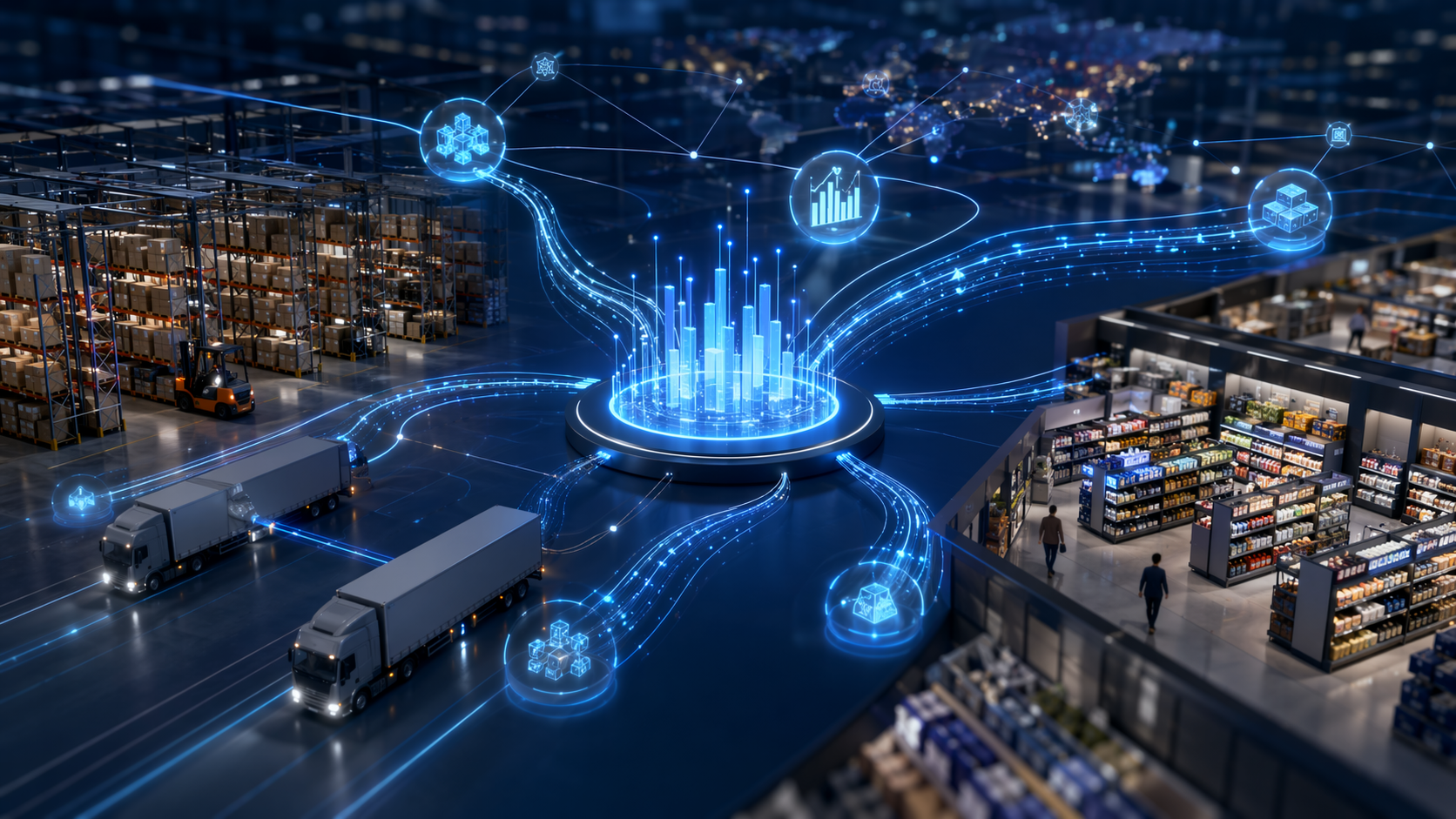
Retail supply chain predictive analytics gets attention for a reason: global retail inventory distortion is estimated to cost $1.73 trillion a year, combining overstocks and out-of-stocks, while AI-driven forecasting has been shown to reduce forecast error by 20–50% compared with traditional methods [1][2].
The useful question is narrower than “does it work?” It is whether a better forecast actually changes what gets ordered, moved, held, or expedited before the shelf goes empty or the warehouse fills up.
What the value case looks like
The evidence is strongest when the use case is separated by operational outcome instead of bundled into a vague “AI improves supply chain” claim.
| Retail use case | Reported outcome | What it means operationally |
|---|---|---|
| Demand forecasting | 20–50% forecast error reduction [2] | Better signals for buying, allocation, and replenishment timing |
| Inventory carrying cost | 15–30% reduction in reported deployments [5] | Less capital tied up in inventory that is unlikely to move soon |
| Inter-store balancing | 25–40% overstock reduction [6] | More aggressive stock shifts before markdowns or write-offs |
| Stockout reduction | Up to 30% reduction [7] | Fewer lost sales when demand sensing is tied to replenishment |
Those ranges are not interchangeable. Forecasting improves the signal, inventory optimization changes what is held, balancing changes where it sits, and stockout reduction shows up only when the downstream process can act on the signal fast enough [2][5][6][7].
Adoption is no longer hypothetical. In Deloitte’s 2026 Retail Industry Global Outlook, 30% of retailers said they already use AI for supply chain visibility, that share was expected to rise to 41% within 12 months, and 59% expected positive ROI from AI-driven supply chain initiatives in that same window [3]. For readers comparing this with the confidence-deployment gap, see The Retail Supply Chain Predictive Analytics Paradox.
Where retailers usually see value first
- Demand forecasting. This is usually the first place predictive analytics pays back because it improves the upstream signal that planning teams already depend on. McKinsey’s 20–50% forecast error reduction range is broader than retail alone, but it is still the clearest independent benchmark for the quality lift leaders can expect when they move from static forecasting to AI-assisted forecasting [2].
- Inventory optimization. Retailers reporting 15–30% lower carrying costs are not just getting a nicer dashboard; they are reducing the amount of stock that has to be financed, stored, and eventually cleared [5]. This is where predictive analytics starts to affect working capital rather than just planning discussion.
- Inter-store balancing and allocation. Reported deployment results from Retalon show 25–40% overstock reduction when stores are used as a balancing network instead of isolated silos [6]. That matters most in assortments where one location is short while another is overloaded.
- Stockout prevention. VusionGroup reports stockout reductions of up to 30% when predictive analytics is tied to retail inventory optimization [7]. Walmart is frequently cited as a proof point here: UPS reports that the company reached 90% demand prediction accuracy and reduced stockouts through improved demand sensing, while Zara is described as having 85% of manufacturing decisions informed by real-time demand data [9].
- Waste and supplier risk. In LatentView’s reported cases, a national grocery chain reduced produce waste by 15%, and an electronics manufacturer identified three high-risk suppliers within six months through predictive early-warning [10]. Those are narrower wins than “end-to-end transformation,” but they are the kind of wins that show up in operating reviews.
The practical pattern is consistent: predictive analytics tends to land first where the organization already has a decision cadence, a defined owner, and a way to convert a signal into action. If the forecast arrives after the reorder deadline, the model can still be accurate and still miss the business window.
What has to be connected before the forecast matters
This is where many pilots underdeliver. PwC’s 2026 Digital Trends in Operations Survey found that 87% of operations leaders said poor data quality had hampered digital initiatives, and only 30% reported significant data quality improvement in the previous two to three years [4].
PwC also found that 59% of consumer markets leaders cited integration complexity as the top reason technology investments underdeliver, the highest share in any sector surveyed [4]. That lines up with the more operational critique made by r4.ai: many implementations do not fail because the model is weak, but because improved forecasts reach execution systems too slowly to change the decision that matters [8].
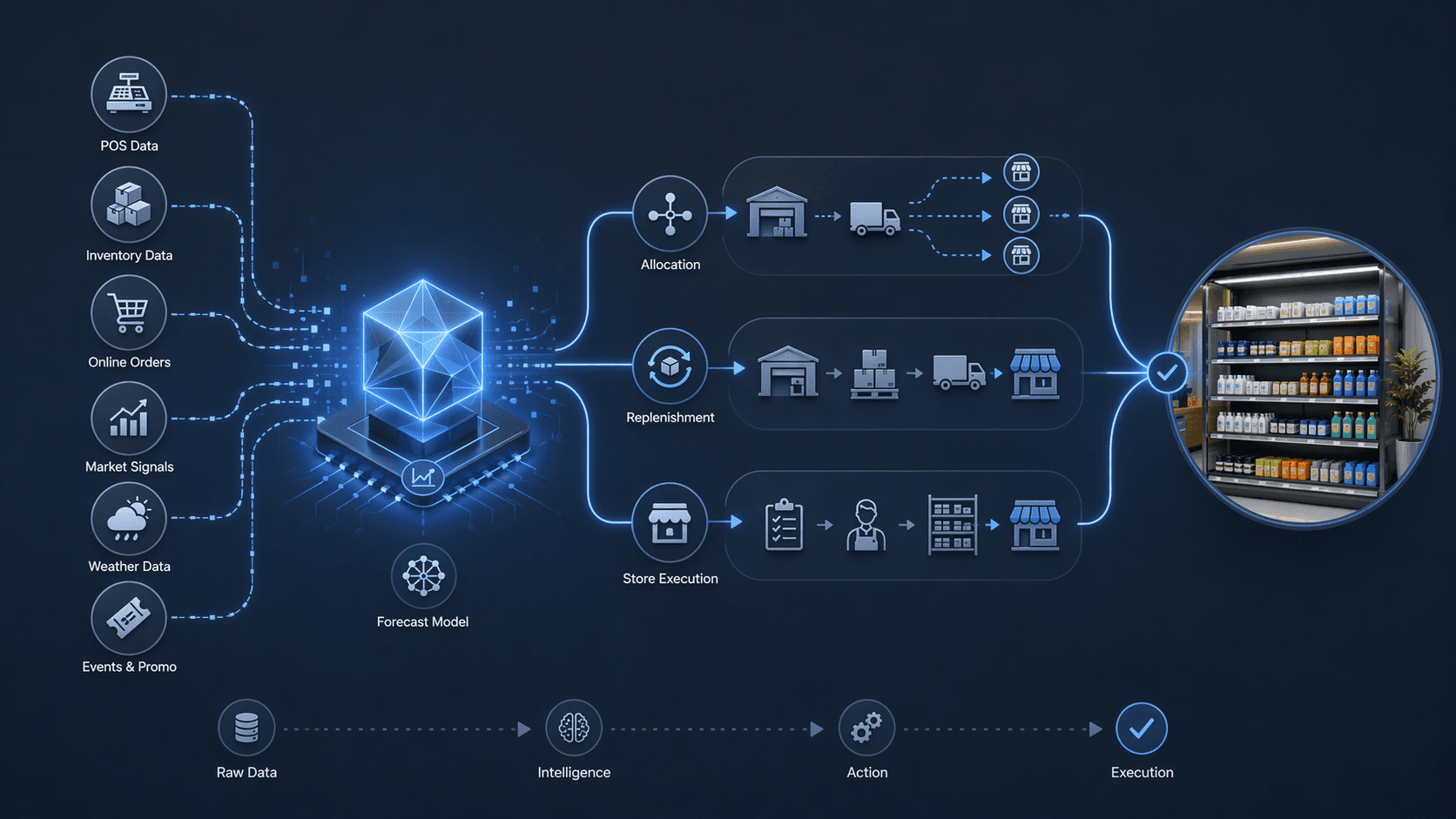
In practice, the handoff usually has to run through allocation, replenishment, store execution, and exception handling. If those systems are fragmented, the forecast stays informational. If those systems are connected but not governed, the forecast becomes another queue item.
That is why a data readiness review is usually the right next step for teams that already suspect their master data, item-location mapping, or integration layer is weaker than the business case assumes. For a deeper implementation lens, see Data Readiness Assessment for AI Inventory Optimization.
Representative platforms
The market is broad enough that buyers will find different strengths across Blue Yonder, Kinaxis Maestro, o9 Solutions, Oracle SCM Cloud, SAP IBP, Microsoft Azure ML, Retalon, RELEX, ThroughPut AI, and LatentView. The practical difference is less about whether these tools can produce a forecast and more about how cleanly they plug into planning, replenishment, and exception workflows.
For leaders building a formal business case, the right comparison is not between “AI” and “no AI,” but between a modeling layer and a workflow that can actually use the signal. That is also why the relevant ROI benchmark is usually cross-functional rather than isolated to the planning team; see AI Use Cases in Supply Chain by Function and From Pilot to Profit: The Real ROI of AI in Procurement and Supply Chain.
Predictive analytics is mature enough to justify evaluation in retail supply chains, especially for demand forecasting, inventory optimization, and stockout reduction. The investment should be treated as an operating-system change, though, not a standalone modeling project. The forecast is the beginning of the workflow, not the deliverable.
References
- Retail Inventory Crisis Persists (2025) — IHL Group
- AI-driven operations forecasting in data-light environments — McKinsey
- 2026 Retail Industry Global Outlook — Deloitte
- 2026 Digital Trends in Operations Survey — PwC
- Supply Chain Predictive Analytics: Cut Costs 25% — SR Analytics
- Predictive Analytics Transforms Inventory Management in Retail — Retalon
- Predictive Analytics for Retail Inventory Optimization — VusionGroup
- Retail Predictive Analytics Case Studies: Real Outcomes — r4.ai
- Retail Supply Chain Predictive Analytics Helps Retailers Meet Demand — UPS
- Predictive Analytics in Supply Chain: Examples and Use Cases — LatentView
Comments
Join the discussion with an anonymous comment.