
The fastest way to waste money on a course on artificial intelligence in supply chain management is to buy it as a substitute for workforce planning. The second fastest way is to assume training is unnecessary because the company will simply hire enough AI talent.
That hiring plan is already running into the market. Gartner reported that demand for supply chain roles requiring AI skills rose 387% from Q1 2023 to Q1 2026, and that 58% of those postings were for mid-senior positions rather than entry-level roles.[1] In plain operating terms, the most useful people are not abundant junior analysts waiting to be taught your network. They are experienced supply chain professionals who can connect AI to planning, procurement, logistics, fulfillment, inventory, and risk decisions. Everyone else wants them too.
That is why “hire more AI people” does not scale across a large supply chain function. A global manufacturer cannot staff every forecasting initiative, procurement workflow, warehouse labor model, transport planning process, and exception-management redesign with scarce AI specialists. Even when it can hire a few, those hires become translators, firefighters, and governance leads long before they become enough capacity to change the daily work of hundreds or thousands of operators.
The ROI problem makes the talent problem harder to ignore. PwC’s 2026 Digital Trends in Operations Survey of 767 operations leaders found that 89% said technology investments had not fully delivered expected results, with user adoption and skill gaps among the top reasons; only 27% said AI strategy was fully embedded across business units.[2] That belongs in the same conversation as model accuracy, data quality, and system integration. If planners, buyers, supervisors, and logistics managers cannot interpret AI outputs or challenge bad recommendations, the investment gets stuck between a pilot and a changed operating rhythm. For a broader look at that value gap, see From Pilot to Profit: The Real ROI of AI in Procurement and Supply Chain.
Start with the work, not the course catalog
The useful question is not “Which AI course should we buy?” It is “Which groups of people will carry which level of AI responsibility?” A demand planner who needs to understand why a forecast changed does not need the same training as the leader approving a new AI-enabled planning process. A warehouse supervisor using labor recommendations needs a different depth of skill from the data product owner deciding how exceptions, overrides, and audit trails will work.
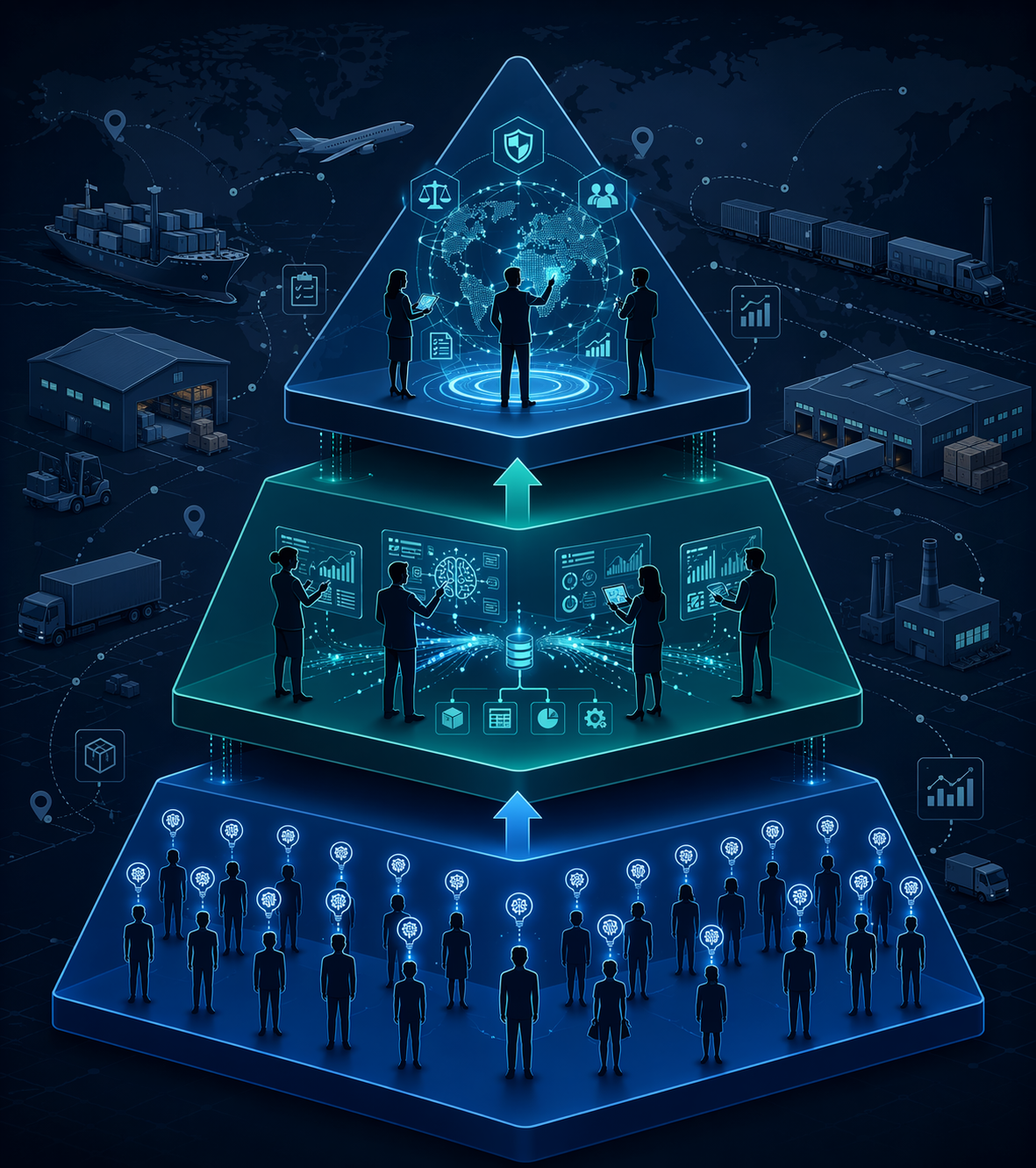
A practical 2026 workforce architecture has three layers:
| Workforce tier | Who belongs here | What they must be able to do | Course investment pattern |
|---|---|---|---|
| Broad AI literacy | Most supply chain staff: planners, buyers, warehouse supervisors, logistics coordinators, customer service and operations support roles | Understand AI use cases, limitations, data dependency, risk signals, and when to escalate or challenge an output | Lightweight, scalable, lower-cost certificates or short self-paced programs |
| Applied practitioners | Power users and process owners in planning, procurement, logistics, warehousing, inventory, and S&OP/IBP | Use AI tools in live workflows, translate outputs into decisions, redesign steps around human review, and identify failure modes | Hands-on programs, live cohorts, simulations, case-based training, and internal workflow labs |
| Implementation leaders | Senior supply chain leaders, transformation leads, analytics leaders, data product owners, governance owners | Select use cases, govern risk, redesign processes, assign ownership, manage vendors, and connect AI initiatives to measurable operating outcomes | Executive intensives, implementation-focused programs, and selective external hiring |
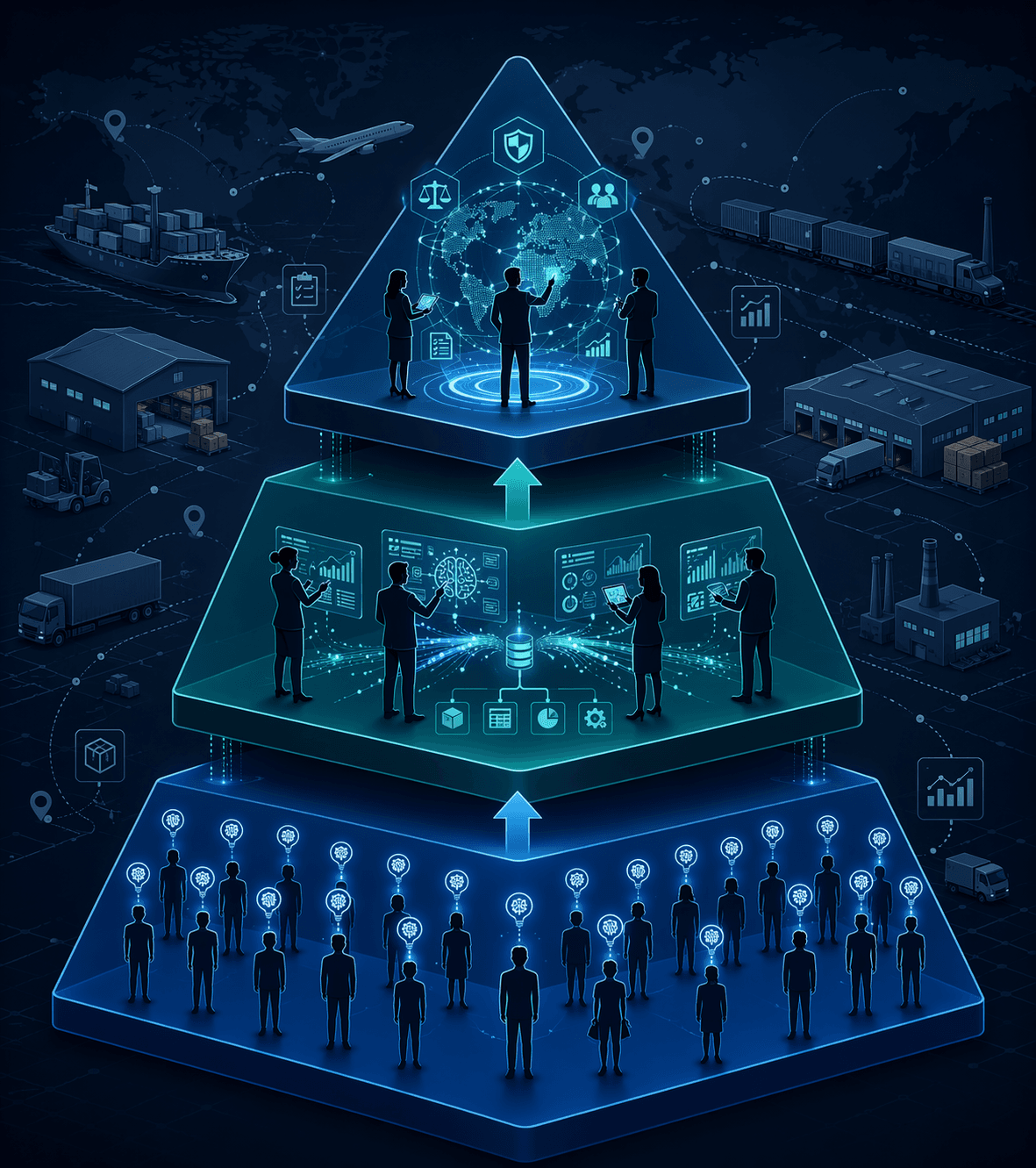
This is an operating framework, not a named methodology from a single research institution. Its value is that it prevents two common errors: sending everyone to an executive AI seminar, or giving the people closest to the work only a short awareness module and then expecting them to redesign the work.
Tier 1: Give the broad workforce enough AI literacy to avoid blind adoption
The base layer is not about turning every planner or warehouse lead into a machine learning specialist. It is about making sure the people who touch daily decisions know what AI can and cannot be trusted to do.
This matters because generative AI is not confined to one elegant planning use case. MIT CTL wrote in 2026 that generative AI is poised to influence decision-making across at least 13 major supply chain domains, from forecasting and procurement to risk assessment.[3] A narrow training plan that reaches only a central analytics team misses the point. The decisions being affected are distributed across the operation.
Broad literacy should answer questions like these:
- What kind of recommendation is this system making: forecast, prioritization, exception flag, replenishment suggestion, supplier-risk signal, routing option, or text generation?
- What data is the output likely relying on, and where might that data be stale, biased, incomplete, or too aggregated?
- Which decisions still require human review because they affect service, safety, customer commitments, regulatory exposure, or supplier relationships?
- When should a user override an AI recommendation, document the reason, or escalate the pattern?
- What information should never be pasted into an external AI tool?
This is where short certificates can make sense. The CSCMP and LinkedIn Learning “Generative AI for Supply Chain” certificate is described as a self-paced program of about five hours, which puts it in the right range for broad literacy rather than deep implementation capability.[4] A program at that level can give a common vocabulary to people who will use or supervise AI-enabled work, especially if the company adds its own policies, examples, and escalation rules.
The ASCM Technology Certificate also fits this broad-literacy category based on publicly available secondary references, but buyers should verify current curriculum, format, and pricing directly before procurement. The primary program page was not readable during review, so it should not be treated as a fully benchmarked option here.
The mistake at this tier is overclaiming. A five-hour course can reduce confusion, establish language, and help employees recognize risk. It does not make someone ready to redesign a forecasting process, select a vendor model, or govern AI exceptions across a region. If the certificate is sold internally as “now our planners are AI-ready,” the organization has confused awareness with capability.
Tier 2: Build applied practitioners close to the workflows
The middle layer is where many programs are too thin. These are the people who turn AI from a dashboard into a changed operating process. They are not necessarily building the model, but they know enough to test whether it is usable, where it breaks, and how the work should change around it.
An applied practitioner in demand planning might compare AI-generated forecast shifts against promotion plans, supply constraints, and known customer behavior. A procurement practitioner might use AI to summarize supplier risk signals but still verify the source, contractual exposure, and mitigation path. A warehouse operations practitioner might use labor-planning recommendations while watching for unsafe assumptions about congestion, absenteeism, or product mix. The common skill is not “knowing AI.” It is knowing where AI touches the workflow and where human accountability remains.
Course format matters more here. Applied practitioners usually need live discussion, cases, exercises, and time to translate concepts into their own process maps. ELVTR’s “AI in Supply Chain Management” program, developed in collaboration with DHL, is positioned as a seven-week live online cohort with practitioner-led, case-study-heavy instruction.[5] That format is more plausible for developing workflow fluency than a short awareness certificate, particularly for selected power users who will later support peers.
Georgia Tech’s “Generative AI Application for Supply Chain Professionals” is another applied option: a three-day program listed at $1,500, with a hands-on focus for supply chain professionals.[6] A three-day intensive will not create an implementation leader by itself, but it can be a useful format for teams that need concentrated exposure, exercises, and a shared view of practical use cases.
The selection rule is simple: do not send applied practitioners to a course unless the organization has a workflow for them to return to. Training a buyer on supplier-risk AI without giving them a live use case, a review process, and a manager who expects changed behavior is just educational theater.
A useful applied-practitioner plan usually names the first workflows before it names the course. For example, a supply chain leader might choose demand-sensing exceptions, purchase-order risk review, carrier delay triage, or warehouse labor planning as the first training-linked workflows. The course then becomes part of a sequence: learn the concepts, test them against a real workflow, document decision rights, and coach the next group of users.
What applied practitioners should produce after training
Completion badges are a weak measure at this layer. Better evidence is operational output. Within a few weeks of training, each practitioner group should be able to produce something concrete:
- A mapped workflow showing where AI enters, who reviews the output, and where the final decision sits.
- A list of likely failure modes, such as poor master data, missing customer context, supplier exceptions, seasonal distortion, or unsafe automation thresholds.
- An override and escalation rule that front-line users can actually follow.
- A small set of measures that connect the AI-enabled workflow to service, cost, inventory, productivity, or risk.
- A peer-coaching plan for the broader team.
That is the difference between a course purchase and capability building. The organization is not buying knowledge in the abstract; it is creating people who can work between the system, the process, and the team.
Tier 3: Develop implementation leaders, and hire selectively where the gap is real
The top layer should stay small, but it cannot be vague. These are the people accountable for deciding which AI use cases deserve investment, how they will be governed, what data and process dependencies must be fixed, and how the organization will know whether the technology changed performance.
MIT CTL’s “AI-Driven Supply Chain” is a five-day intensive listed at $6,000 and aimed at senior leaders, with an implementation-oriented focus.[7] That is the kind of program to reserve for leaders who will sponsor, govern, or orchestrate AI-enabled supply chain change—not for a broad population that mainly needs literacy.
MIT xPRO’s six-week AI-related executive education options may also belong in this tier when the buyer needs a longer management-development format. Because specific course details vary and the public details reviewed here were less complete, procurement teams should verify current curriculum, workload, dates, and pricing directly before comparing it with other options.
This is also where targeted hiring still belongs. Internal upskilling cannot magically create every missing capability. Some organizations will need external data product leadership, AI governance experience, solution architecture, advanced analytics management, or a leader who has already taken a supply chain AI product from pilot into production. The point is not to stop hiring. The point is to stop pretending hiring can cover the whole operating model.
The scarce external hire should be used to multiply internal capability. That means pairing them with process owners, making them accountable for playbooks and governance patterns, and having them develop practitioner communities. If they become the only person allowed to understand the system, the company has created a bottleneck with a premium salary.
How to allocate training without sending everyone to the same program
A sensible training portfolio should look uneven. That is a feature, not a flaw. Most people get literacy. A smaller group gets applied workflow training. A still smaller group gets implementation and governance development. The budget should follow responsibility, not seniority alone.
| If the role mainly needs to… | Then prioritize… | Avoid… |
|---|---|---|
| Use AI-enabled outputs safely | Short literacy programs plus internal policy, data, and escalation guidance | Expensive executive intensives that do not change daily behavior |
| Change a planning, procurement, logistics, or warehouse workflow | Hands-on applied courses, simulations, and post-course workflow redesign | One-off awareness modules with no live use case |
| Own implementation, governance, vendor decisions, or ROI accountability | Executive implementation programs and selective external hiring | Assuming a course alone replaces architecture, governance, or product leadership |
| Lead a function through adoption | A blended plan: literacy for the function, practitioner cohorts, and senior leadership alignment | Buying a vendor academy as if it were neutral workforce strategy |
Vendor academies can be useful, especially when a company is implementing that vendor’s platform. They should still be treated as product enablement, not neutral education. If the training teaches only how to operate one tool, the organization may still need broader instruction on data assumptions, human review, exception governance, and process redesign.
The same caution applies to fee comparisons. Public pricing is clear for some programs, such as Georgia Tech’s listed $1,500 program and MIT CTL’s listed $6,000 intensive.[6][7] Pricing for other options, including ELVTR and AI CERTs programs, was not publicly displayed in the materials reviewed. Procurement teams should verify tuition, group rates, refund terms, time commitment, and instructor access directly rather than building a business case from incomplete public snippets.
A 2026 roadmap for AI workforce readiness
For a supply chain leader under pressure to “get AI into the operation,” the roadmap should be concrete enough to survive budget review and operating scrutiny.
- Name the workflows where AI will matter first. Do not start with every possible use case. Pick the first planning, procurement, logistics, warehouse, inventory, or risk processes where the organization expects measurable improvement.
- Segment the workforce by AI responsibility. Identify who needs literacy, who needs applied practitioner skill, and who will own implementation or governance.
- Buy broad literacy at scale, but keep the promise modest. Use lightweight certificates to establish vocabulary, safe-use expectations, and escalation habits.
- Create practitioner cohorts around live workflows. Select people close enough to the work to test AI outputs, identify process changes, and coach peers.
- Reserve executive programs for people with implementation authority. Senior programs should be tied to governance, portfolio choices, vendor management, and performance accountability.
- Hire selectively for scarce leadership and technical gaps. Use external hires to build internal systems of capability, not to become permanent translators for everyone else.
- Verify course details before procurement. Confirm current price, duration, cohort structure, assessment method, instructor profile, and whether the material is vendor-neutral or product-specific.
The labor market data should make one thing clear: AI-ready supply chains will not be built by poaching a few scarce specialists and hoping they can cover the whole enterprise.[1] They also will not be built by putting every employee through the same certificate and calling the workforce transformed. The durable strategy is to match training and hiring to the level of AI responsibility each role actually carries.
References
- Gartner Says There is an Outsized Need for AI Talent in Supply Chain, Gartner, June 15, 2026.
- 2026 Digital Trends in Operations Survey, PwC.
- Supply Chain Skills Gap: AI Left Behind?, MIT Center for Transportation & Logistics, 2026.
- New Certificate: Generative AI for Supply Chain, CSCMP / LinkedIn Learning.
- AI in Supply Chain Management, ELVTR.
- Generative AI Application for Supply Chain Professionals, Georgia Tech Professional Education.
- AI-Driven Supply Chain: Advanced Training for Next-Gen Leaders, MIT Center for Transportation & Logistics.
Comments
Join the discussion with an anonymous comment.