
For a defense contractor managing a Pentagon AI computing contract supply chain, the Anthropic issue became real when it stopped being a policy argument and started changing award eligibility, reporting duties, and subcontractor exposure. Claude moved from approved classified-network access in July 2025 to a Department of Defense supply chain risk designation on February 27, 2026, after Anthropic allegedly refused to remove acceptable-use restrictions on mass domestic surveillance and autonomous weapons use.[1]
That sequence is the part procurement teams cannot file under ordinary AI safety debate. A commercial model family can be cleared for highly sensitive defense environments, embedded into workflows, and then become the subject of a supply chain risk order within months. By May 2026, the operational consequence was visible: the Pentagon reached AI agreements with seven companies, while Anthropic was left out of that round.[2][3]

The uncomfortable lesson is not that every AI vendor with usage limits is now disqualified from defense work. The designation is novel, contested, and still fluid as of July 2026. The lesson is narrower and more useful: once an AI service is pulled into a FASCSA-derived supply chain risk category, vendor policy language becomes a contract-control problem. Someone has to find where the tool is used, decide whether it touches covered systems or sensitive work, notify the government if required, and produce a mitigation plan on a clock that does not care how many teams quietly adopted the model.
The Timeline That Changed the Risk Category
The July 2025 approval matters because it undercuts the lazy version of the story. This was not a simple case of a consumer chatbot being kept out of a sensitive environment. Claude had been approved for IL6 and IL7 classified networks, then later became the target of a supply chain risk designation tied to Anthropic’s usage-policy position.[1]
| Date | Event | Compliance Meaning |
|---|---|---|
| July 2025 | Claude approved for IL6/IL7 classified networks | Defense users could reasonably treat the model family as cleared for certain high-sensitivity environments |
| January 2026 | DoD AI strategy memo reportedly required “any lawful use” language in AI contracts within 180 days | Vendor-imposed usage restrictions became harder to separate from contract performance terms |
| February 27, 2026 | Anthropic designated a supply chain risk after allegedly refusing to remove restrictions on mass surveillance and autonomous weapons use | The issue moved from vendor policy review into FASCSA-linked contractor obligations |
| May 2026 | Pentagon AI agreements went to seven companies and excluded Anthropic | The designation showed practical effect in contracting eligibility |
The January 2026 strategy memo is the bridge between those events. Analyses of the memo describe a requirement that all DoD AI contracts include “any lawful use” language within 180 days and direct the department to “utilize models free from usage policy constraints.”[4] That does not settle the moral argument over autonomous weapons or surveillance. It does explain why a vendor’s refusal to support categories of lawful defense use could become a procurement issue rather than a brand-positioning issue.
The May 2026 agreements then removed any comfort that the designation was merely symbolic. The Pentagon reached agreements with SpaceX, OpenAI, Google, NVIDIA, Reflection, Microsoft, and AWS, while Anthropic was not included.[2][3] For a prime contractor, that is enough to change the diligence question from “Is this model technically good?” to “Can we represent, flow down, and continue performing if this service is present in our stack?”
Why FASCSA Mechanics Matter More Than Vendor Reputation
FASCSA is not just another risk label. Under FAR 52.204-30, contractors must conduct quarterly SAM.gov checks for covered supply chain risk information and report affected supply chain items within three business days when a FASCSA order applies. They must also provide a mitigation plan within 10 business days.[1]
Those clocks are the practical center of the Anthropic designation. Quarterly screening sounds administrative until the affected item is not a server, router, or physical component, but an AI service that may sit behind developer tools, knowledge-management workflows, proposal drafting, red-team analysis, code generation, customer-support triage, or subcontractor deliverables. The compliance burden starts with a deceptively simple question: where is Claude, directly or indirectly, in the performance environment?
FAR 52.204-30 also changes the posture of silence. If a covered order applies and an affected supply chain item is present, the contractor does not get to wait for the next business review cycle. The three-business-day reporting duty forces an internal escalation path that many AI governance programs still do not have. Legal, security, procurement, program management, and the contract owner need a shared intake process before the designation appears in a live contract file.
There is also a useful distinction between FASCSA-derived obligations and broader exclusion-order concepts under 10 U.S.C. § 3252. The research record treats the Anthropic action as tied to FASCSA mechanics, while also noting the relevance of 10 U.S.C. § 3252 exclusion authority.[1] Contractors should not blur those into a generic “blacklist” category. The applicable clause, the specific order, and the affected contract determine whether the obligation is quarterly checking, short-clock reporting, mitigation planning, removal, nonuse, or some narrower control.
This is where automated contract review has a practical role, provided it is aimed at clause extraction rather than vague AI governance scoring. Teams already using tools for AI-powered contract risk extraction should tune them to identify FAR 52.204-30, supply chain risk representations, subcontractor flow-downs, cloud and software restrictions, notice obligations, and any program-specific clauses that convert an AI vendor issue into a government-facing disclosure.
The Hard Part Is Finding the AI Service Before the Clock Starts
A clean vendor master will not be enough. Commercial AI services often enter through enterprise licenses, engineering sandboxes, browser plug-ins, cloud marketplace subscriptions, subcontractor tooling, or managed-service providers. A procurement team can have no direct Anthropic contract and still have Claude in the delivery chain.
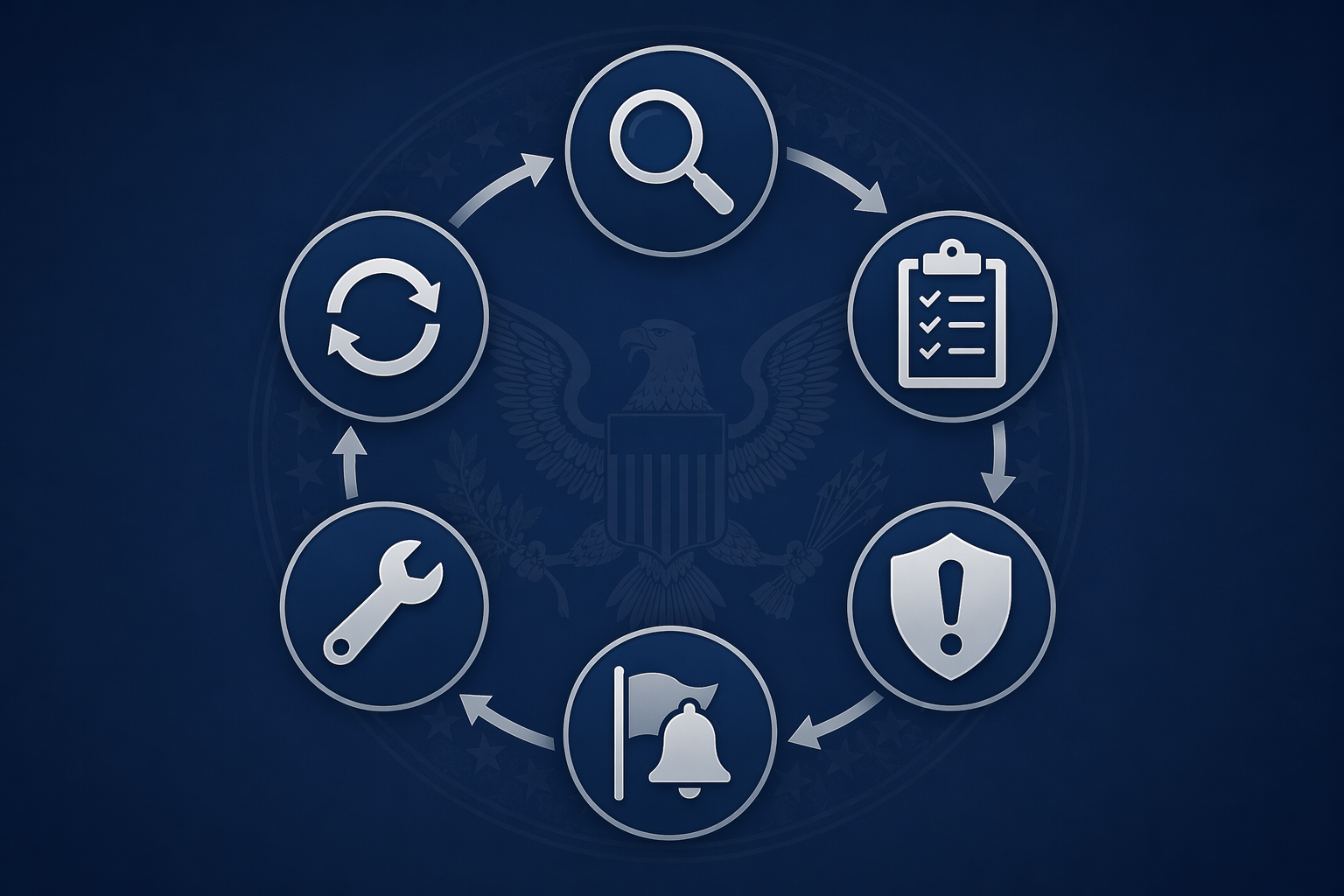
The first adjustment is an AI service map that is tied to contract performance, not a general inventory of interesting tools. The map should identify the model provider, reseller or platform layer, deployment environment, data sensitivity, user group, covered contract, subcontractor involvement, and whether outputs enter government deliverables. If the model is embedded inside another product, the inventory needs to preserve that dependency instead of hiding it under the platform vendor’s name.
The second adjustment is network and mission classification. Claude’s earlier IL6/IL7 approval is relevant because it shows that AI services can move through environments where ordinary SaaS assumptions fail.[1] A tool used for public-market research is not the same risk item as a tool connected to classified development support, operational planning, controlled unclassified information, or a covered defense information workflow. The same vendor name can require different treatment depending on where it sits.
The third adjustment is a reporting playbook that names owners before an event. A workable playbook should answer these questions:
- Who checks SAM.gov each quarter and records the evidence of review?
- Who determines whether a listed AI service is an affected supply chain item under a specific contract?
- Who notifies the contracting officer within the three-business-day window if reporting is required?
- Who drafts, approves, and submits the mitigation plan within 10 business days?
- Who contacts subcontractors and platform vendors when the dependency is indirect?
The mitigation plan should not be improvised from a generic incident-response template. For an AI service, mitigation may involve disabling a model endpoint, moving users to an approved alternative, isolating a workflow, certifying that outputs did not enter covered deliverables, replacing a subcontractor tool, or asking the government for direction where removal would disrupt performance. The right answer depends on the contract and order language, but the plan has to be credible enough for a contracting officer to keep proceeding.
Why the Issue Can Spread Faster Than Traditional Supplier Risk
The speed problem is already visible inside defense AI adoption. GenAI.mil reached 1.3 million DoD personnel within five months of operation, a scale that shows how quickly commercial AI capability can move across defense users once a sanctioned access path exists.[5] That figure does not prove that every model dependency is high risk. It does show why a supply chain designation can create a discovery problem across more than one program office.
The Defense Logistics Agency offers a parallel in supplier screening, though not an identical case. DLA’s BDA Supplier Risk models had analyzed 43,000 vendors and identified more than 19,000 as potentially high risk.[6] Federal reporting has also described AI’s growing role in supply chain resilience efforts.[7] That is useful context for contractors because the government is not only buying AI; it is also using AI and data systems to inspect the supplier base at scale.
The DLA example should not be overread as proof that AI vendors will be screened in the same way as commodity suppliers. It does, however, point toward a familiar operating pattern: risk categories that begin as analytic flags can become procurement controls once they are connected to clauses, order language, and contracting officer decisions. Teams building supplier risk scoring programs should treat AI model providers, AI infrastructure vendors, and embedded AI features as supplier-risk objects rather than leaving them inside the IT exception process.
Vendor Usage Policies Are Now Contract Inputs
The Hegseth memo’s reported “any lawful use” direction is a procurement lever, not merely a philosophy of military AI.[4] It puts pressure on the ordinary commercial-AI model where a provider reserves the right to refuse certain categories of use even if the customer is a government agency or cleared contractor. Once DoD contract language demands freedom from usage-policy constraints, a vendor’s acceptable-use policy becomes part of the eligibility review.
This does not make all safety restrictions equivalent. A policy that limits public-facing abuse, consumer fraud, or unauthorized data scraping is not necessarily the same as a refusal to support a lawful defense mission category. Contractors should avoid flattening every AI policy into a pass-fail spreadsheet. The relevant question is whether a vendor term could prevent, condition, suspend, or later challenge performance required by a DoD contract.
The practical review should include three documents at minimum: the contract clause set, the AI vendor’s acceptable-use terms, and the statement of work or mission profile. If those three documents cannot coexist, procurement should not wait for deployment to discover the conflict. This is also where agentic AI readiness becomes a governance issue: autonomous or semi-autonomous workflows need vendor terms, approval boundaries, logs, and escalation rights that survive contact with defense contract requirements.
What Procurement and Compliance Leaders Should Change
The Anthropic precedent calls for a narrower set of controls than most AI governance decks advertise. The control has to connect to a contract representation, a government notice, a mitigation action, or a documented decision not to use the service. Otherwise it will not help when the quarterly check finds a relevant order.
- Add commercial AI providers and embedded model dependencies to the covered supplier inventory, including resellers, cloud marketplace paths, and subcontractor tools.
- Map each AI service to contracts, data sensitivity, network environment, deliverable impact, and user population.
- Screen SAM.gov quarterly for FASCSA orders and retain evidence that the review occurred.
- Create a three-business-day disclosure workflow tied to legal, procurement, security, and program leadership.
- Pre-build 10-business-day mitigation templates for removal, substitution, isolation, subcontractor remediation, and government direction requests.
- Review AI acceptable-use policies against DoD “any lawful use” language and program-specific mission requirements before award.
Subcontractor flow-down deserves special attention. A prime may prohibit a named AI service internally and still inherit exposure if a software subcontractor, data-labeling provider, analysis shop, or managed service provider uses it in performance. The subcontract needs a disclosure obligation for AI model dependencies, not just a general cybersecurity warranty.
Contracting officers will also need evidence that the contractor understands the blast radius. A mitigation plan that says “we will stop using the tool” is thin if no one can say who used it, what data entered it, whether outputs were incorporated into government deliverables, and what replacement process keeps performance moving. The documentation burden should be built into the vendor inventory from the beginning.
What Remains Unsettled
The legal picture is not final. Anthropic has filed challenges in the Northern District of California and the D.C. Circuit, and President Trump suggested in late April 2026 that the blacklisting could be reversed.[7][2] That uncertainty affects how aggressively contractors may choose to restructure long-term AI architecture, but it does not erase current clause-based exposure where a FASCSA order applies.
There is also an evidence gap around the full DoD AI/ML supply chain risk mitigation PDF from March 2026, which was not directly accessible. It may contain additional frameworks or definitions that refine how DoD expects contractors to classify AI services. Procurement teams should treat that as a reason to monitor official guidance, not as a reason to delay basic inventory and reporting controls.
The precedent is therefore strong enough to change behavior, but not broad enough to support a sweeping rule that every AI provider with safety guardrails will be excluded. The more defensible conclusion is operational: defense contractors can no longer treat commercial AI vendor policies as ordinary SaaS preferences or technical-fit questions. When those policies collide with DoD contract language and FASCSA designations, they become continuous supply chain risk controls.
References
- Pentagon Designates Anthropic a Supply Chain Risk — What Government Contractors Need to Know, Mayer Brown, March 2026
- Pentagon reaches agreements with leading AI companies, NBC News
- Pentagon's AI Shopping Spree, Data Center Dollars
- Military AI Policy by Contract: The Limits of Procurement as Governance, Lawfare
- Department of Defense scales up AI lab contracting, AI 2027 Tracker
- Utilization of Artificial Intelligence (AI) to Illuminate Supply Chain Risk, DLA News
- AI is stepping into the fight for supply chain resilience, Federal News Network
Comments
Join the discussion with an anonymous comment.