
Start with the object procurement actually has to move: a 50-page supplier agreement sitting between business urgency and legal review. In a manual first pass, someone scans for liability caps, indemnities, warranty language, damages exclusions, force majeure carveouts, liquidated damages, and who owns the IP. Vendor materials from Sirion and Icertis describe AI review systems processing a standard 50-page commercial contract in under two minutes, compared with roughly two to four hours for manual review.[1][2] That is a meaningful contrast, but only if the contract is the kind these systems are built to handle: standard commercial agreements such as NDAs, MSAs, and vendor agreements, not every scanned archive, handwritten amendment, or bespoke negotiation file.
The useful way to think about AI for contract risk extraction in procurement is not as a machine “understanding” a contract the way counsel does. It is a pipeline that converts contract text into structured risk signals, then routes those signals to people who still decide what matters commercially. IBM, Icertis, and Sirion all frame AI contract review as an augmentation of legal and procurement work rather than a replacement for final human judgment.[1][2][3]
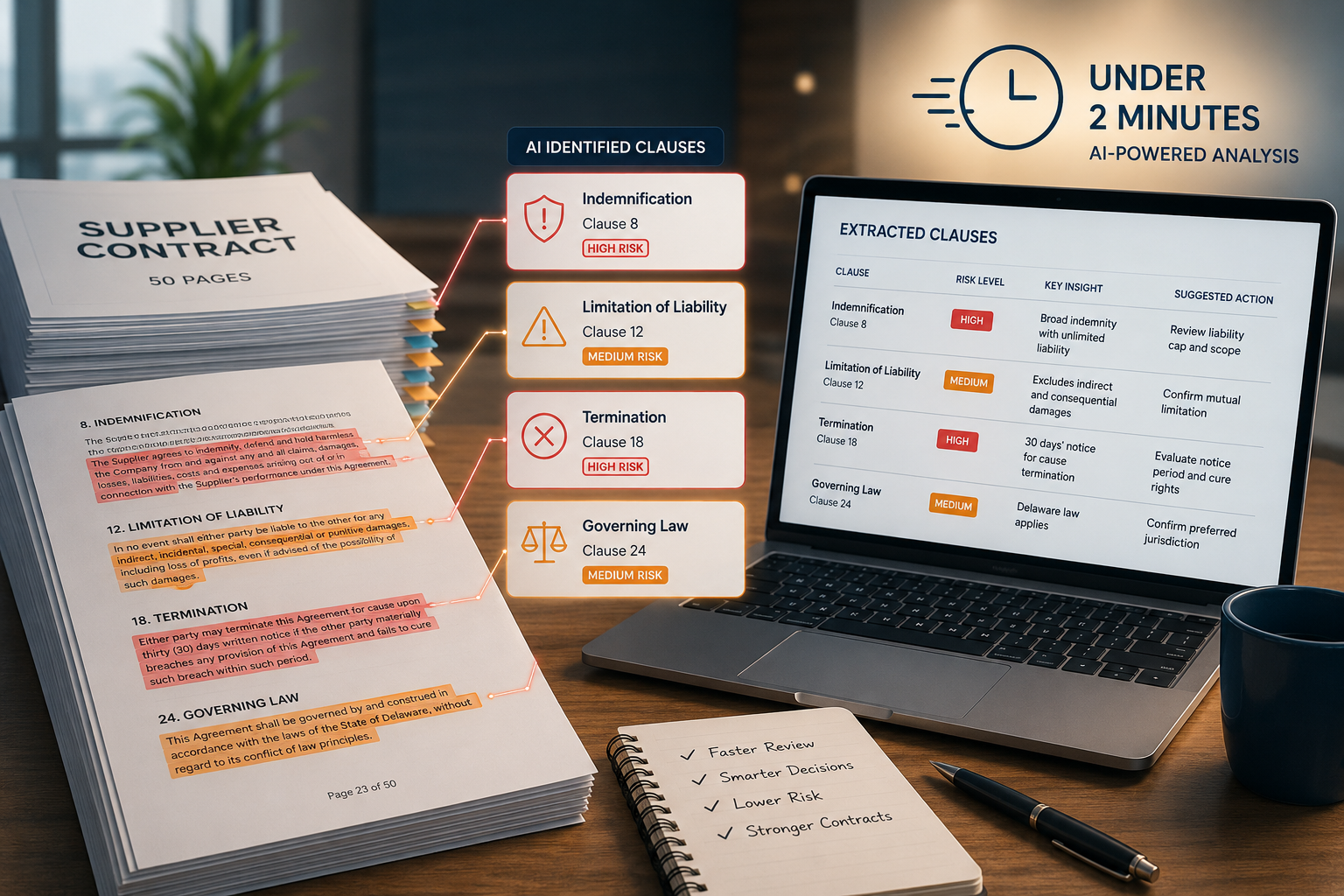
What Happens When AI Reviews a Supplier Contract
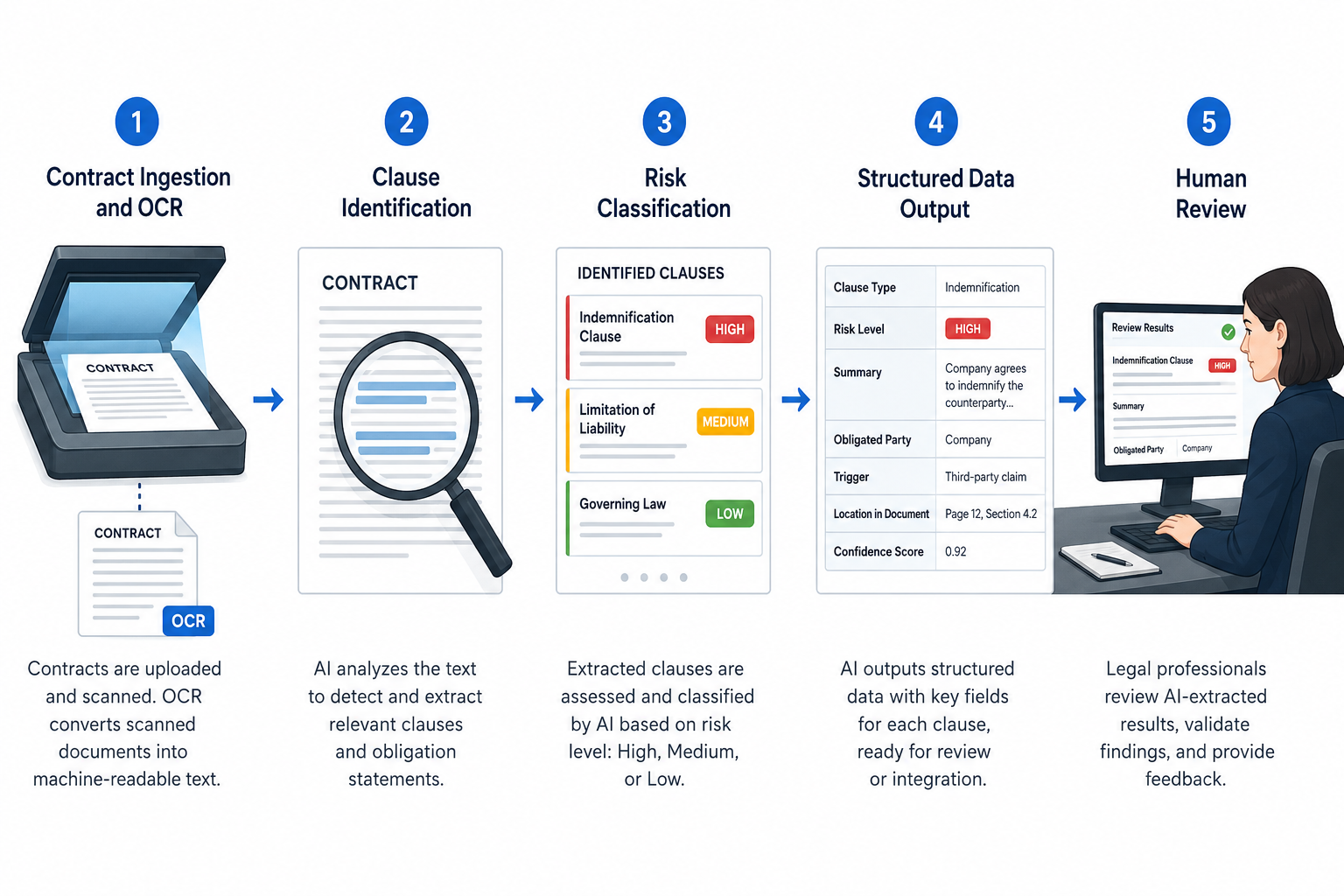
A credible AI contract risk workflow has five practical stages. The labels vary by vendor, but the sequence is stable: ingest the contract, identify clauses, classify risk, structure the output, and send the result for human review. Each stage narrows the gap between raw legal text and a procurement action.
| Pipeline stage | What the system does | Why procurement should care |
|---|---|---|
| Contract ingestion and OCR | Imports the file and converts readable or scanned text into machine-processable content. | Poor OCR at this stage can cause downstream clause misses or false flags. |
| Clause identification | Finds contract sections that correspond to known clause types such as indemnity or limitation of liability. | This is the first-pass hunt that removes much of the repetitive review burden. |
| Risk classification | Compares extracted language with configured policies, playbooks, or preferred positions. | This turns a found clause into a commercial signal: acceptable, unusual, missing, or escalated. |
| Structured data output | Stores clause text, metadata, obligations, deviations, and risk flags in a reviewable format. | The result can feed intake, approval, CLM, renewal, or supplier-risk workflows. |
| Human review | Procurement and legal teams verify the result and decide how to negotiate or approve. | Accountability stays with the people who understand leverage, context, and tolerance. |
Ingestion Is the First Quality Gate
The first decision is not legal at all. It is whether the system can reliably read the document. A digitally generated PDF or Word file gives the model cleaner text. A low-resolution scan, rotated page, embedded table, or handwritten amendment forces the system to depend on optical character recognition before it can do any useful extraction. IBM notes data-quality constraints around AI contract management, and the same issue applies directly to clause extraction: if the text layer is unreliable, the risk analysis built on that text is weaker.[3]
This is where some AI demonstrations are too neat. They show a polished contract flowing into a polished dashboard. In live procurement work, the intake folder may contain the supplier’s paper, an order form, an old MSA, redlines, addenda, and a side letter. The system can still be useful, but the implementation has to decide which documents are in scope, which languages are supported, and which scanned files should be remediated before review.
Clause Identification Finds the Legal Objects
Once the text is available, the model segments the agreement and identifies clause types. It is looking for language that performs a legal function, not just exact headings. A supplier agreement may label a liability clause as “Limitation of Liability,” “Liability Cap,” “Maximum Liability,” or bury the cap inside a broader remedies section. NLP and machine-learning models help match these variations to a clause category.
For procurement, this matters because the first-pass review problem is rarely that nobody knows what indemnity means. The problem is volume, deadline pressure, and inconsistent drafting. A reviewer can miss a consequential-damages carveout on page 38 because the business is waiting for signature. AI clause identification reduces the search burden, especially where contracts follow familiar commercial patterns.
Risk Classification Turns Text Into a Procurement Signal
Extraction by itself is not enough. A system that merely says “indemnity clause found” has saved time, but it has not yet helped procurement decide whether to escalate. The risk layer compares the extracted clause against a configured playbook: preferred language, fallback positions, required approvals, prohibited terms, missing terms, and thresholds.
A hypothetical example makes the difference clear. If the playbook expects a mutual indemnity but the supplier paper only protects the supplier, the system should not simply tag the clause as “Indemnity.” It should flag the asymmetry, show the exact text, and route the issue to the right reviewer. The commercial question is then whether the supplier’s role, spend level, data access, operational dependency, and negotiation leverage justify accepting the deviation.
Structured Output Is Where Review Becomes Workflow
The value improves when the result is not trapped in a one-off document summary. Clause text, clause type, contract name, supplier name, risk level, reviewer status, obligation owner, and approval history can become structured fields. Sirion describes AI clause extraction in terms of real-time obligation tracking, which is important because many procurement risks become operational only after signature.[5]
That bridge from review to workflow is where saved time can become better control. If a warranty obligation is extracted but never assigned to an owner, procurement has only accelerated reading. If it is extracted, flagged, approved with conditions, and made visible to the contract owner after signature, the review has changed the operating model.
Human Review Is Part of the System, Not a Footnote
The final stage is not ceremonial. Procurement and legal teams validate the output, decide whether the flag is material, and choose a negotiation position. A clause can be technically non-standard but commercially acceptable. Another clause can look ordinary but be unacceptable because the supplier is handling sensitive data, supporting a critical operation, or selling into a regulated environment.
That is why “human in the loop” should not be treated as a vendor disclaimer. It is the control design. AI can reduce the time spent finding and sorting recurring risk language. It cannot own the tradeoff between speed to contract, supplier leverage, business continuity, and legal exposure.
The Seven Clause Categories Worth Targeting First
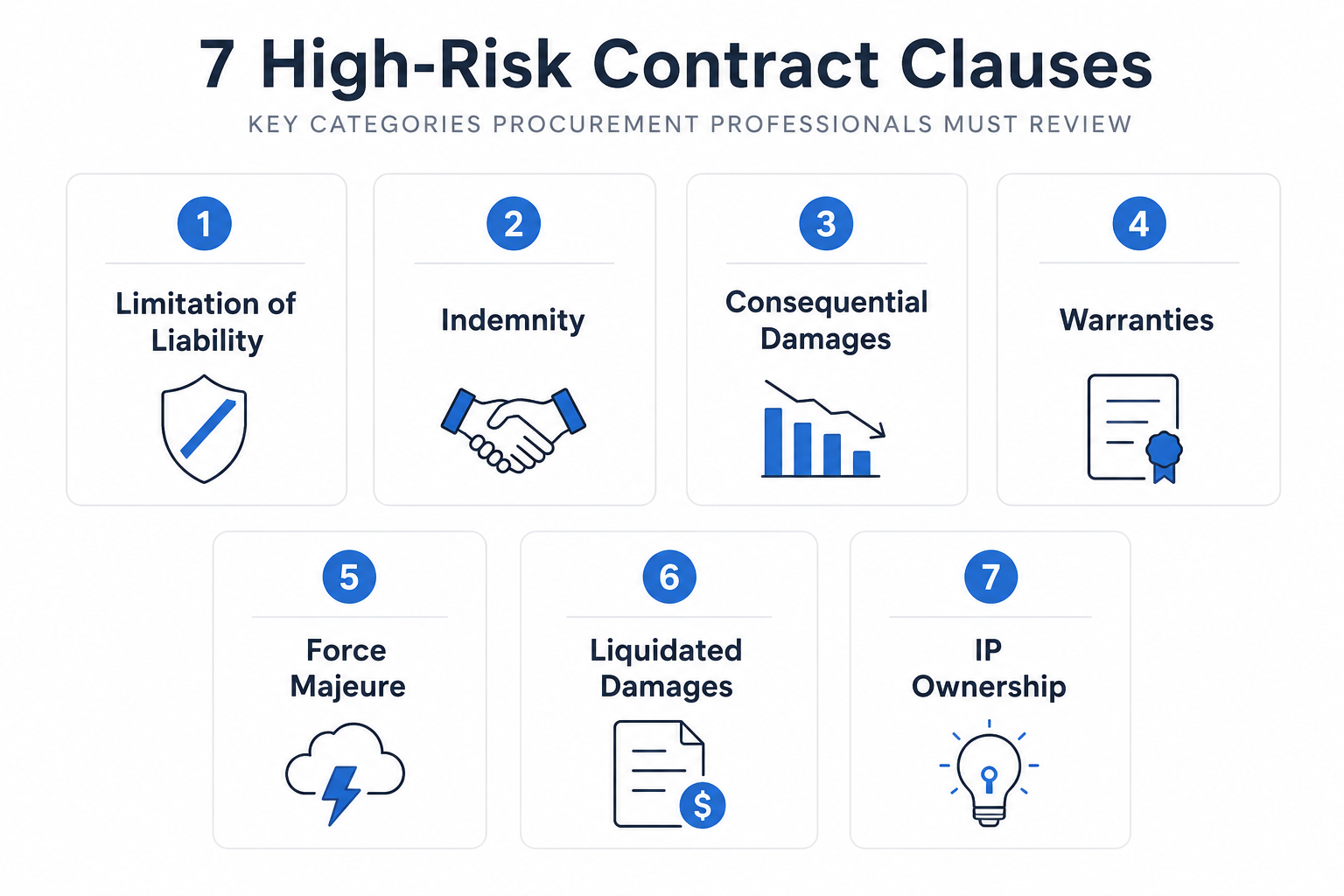
LegalSifter’s discussion of World Commerce & Contracting’s Most Negotiated Terms research highlights seven clauses that frequently carry business risk: limitation of liability, indemnity, consequential damages, warranties, force majeure, liquidated damages, and IP ownership.[4] The list is not a complete procurement risk universe. Pricing schedules, volume commitments, service-level remedies, renewal mechanics, and termination rights can matter just as much in particular categories. But these seven are a practical starting point because they appear across many supplier agreements and often determine who pays when something goes wrong.
Limitation of Liability
A limitation of liability clause sets the ceiling on what one party can recover. In procurement review, the extraction task is not merely to find the cap. The useful output identifies the cap amount, whether it is tied to fees paid, whether different claims have different caps, and whether important exposures are carved out.
A supplier-friendly cap may be acceptable for a low-risk commodity purchase and unacceptable for a critical software provider with access to confidential data. The AI system can surface the clause and compare it with the playbook. The reviewer still decides whether the business context supports the risk.
Indemnity
Indemnity language allocates responsibility for third-party claims and specified losses. Procurement teams should care about whether the indemnity is mutual or one-way, which claims are covered, whether defense obligations are included, and whether the indemnity sits outside the liability cap.
AI extraction is helpful here because indemnity provisions can be long, dense, and spread across multiple sections. The system should identify the operative language and the exceptions, not just the heading. If the output cannot show the exact text that triggered the risk flag, reviewers will not trust it under negotiation pressure.
Consequential Damages
Consequential-damages language often appears inside exclusions of damages, not as a standalone clause. The procurement issue is whether the contract excludes categories of damages that the buyer expects to recover in a serious supplier failure, and whether exceptions restore recovery for confidentiality breaches, IP claims, data incidents, or willful misconduct.
This is a good test of extraction quality. A system that can find only clause headings may miss the commercial substance. A better system identifies the exclusion, the carveouts, and the relationship with the liability cap.
Warranties
Warranty clauses define what the supplier promises about goods, services, software, authority, compliance, or performance. In procurement, the concern is often practical: what exactly is promised, how long does the promise last, what remedy applies if the promise fails, and does the supplier disclaim implied warranties broadly enough to undercut the deal expectation?
AI can extract warranty text and flag missing or non-standard language. But the review cannot end with the label. A warranty for office supplies and a warranty for an operational technology platform do not carry the same consequence even if the clause structure looks familiar.
Force Majeure
Force majeure provisions excuse or delay performance when specified events occur. Procurement review should focus on what events are covered, whether payment obligations are excluded, how long non-performance can continue, and whether prolonged disruption creates termination rights.
The extraction issue is subtle because the risk is often in omissions. A clause may be present but silent on notice timing, mitigation duties, or exit rights. A configured playbook can flag those absences; a generic extraction model may simply report that force majeure language exists.
Liquidated Damages
Liquidated damages clauses set pre-agreed amounts for specified failures, often tied to delay, non-performance, or missed milestones. Procurement teams should look at the trigger, amount, exclusivity of remedy, and whether the clause is aligned with the operational harm the business is trying to manage.
For AI, the useful task is to extract both the clause and the surrounding conditions. A damages amount without its trigger can mislead the reviewer. A trigger without the remedy cap can leave the commercial exposure unclear.
IP Ownership
IP ownership provisions decide who owns pre-existing materials, newly created work, configurations, deliverables, data, documentation, and improvements. In supplier contracting, this can decide whether the buyer has the rights needed to use, maintain, modify, or transition away from the supplier’s work.
The extraction should distinguish ownership from license rights, and license rights from usage restrictions. Those distinctions are exactly where a procurement lead needs legal support, not just a colored risk badge.
What the Accuracy Benchmarks Actually Measure
The published benchmarks are encouraging, but they should be read carefully. Icertis reports 85% to 95% clause identification accuracy for AI contract review across standard agreements such as NDAs, MSAs, and vendor agreements.[2] Sirion reports greater than 95% accuracy on standard clauses and describes sub-two-minute processing for a 50-page contract in the context of AI-driven contract risk detection.[1] These are vendor-published figures, not independent certifications at a shared benchmark standard.
The distinction matters. Clause identification accuracy measures whether the system correctly finds and labels clauses. It does not automatically prove that the system made the right commercial judgment, negotiated the right fallback, or understood a category-specific business dependency. A high extraction score can still leave a hard decision for the reviewer.
It also matters that the strongest numbers are tied to standard clauses and standard commercial agreements. That is not a flaw; it is the use case. Standard NDAs, MSAs, order forms, SaaS agreements, and supplier paper with recurring structures are exactly where procurement teams burn time on repeat analysis. Highly bespoke contracts, unusual formatting, non-English documents, and files with poor OCR quality should be expected to perform less predictably.
Where the Business Value Shows Up
The most obvious value is cycle-time reduction. A first-pass review that moves from hours to minutes gives the category manager a faster answer on what needs attention.[1][2] But speed is the beginning of the case, not the end of it. The better question is what procurement does with the time returned.
In a mature workflow, AI risk extraction gives procurement four practical advantages. It standardizes the first-pass check across reviewers. It makes deviations visible before the business is emotionally committed to signature. It routes legal attention toward exceptions rather than routine language. And it preserves structured data that can be used after signature for obligation tracking, renewal review, and supplier-risk monitoring.
That last point is often underweighted. If the contract review process creates structured knowledge, procurement can see patterns: which suppliers repeatedly reject the buyer’s liability position, which categories carry the most warranty deviations, which templates generate escalations, and which obligations need operational owners. The same logic connects contract extraction with adjacent procurement AI work such as supplier risk scoring and spend analysis, where structured inputs matter more than polished dashboards.
Adoption Momentum Is Real, but It Does Not Remove the Implementation Work
Gartner predicted in May 2024 that 50% of organizations would support supplier contract negotiations through AI-enabled contract risk analysis by 2027.[6] The same forecast sits in a broader procurement context where AI is moving from experimentation into planned operating models. Gartner also reported in November 2023 that 58% of procurement leaders were already implementing or planning AI.[6]
That market signal is useful, but adoption is not the same as effectiveness. A procurement team can buy an AI review tool and still get uneven results if it has no clause playbook, messy contract repositories, inconsistent templates, or no clear escalation path between sourcing, legal, privacy, security, and the business owner.
The operational work is familiar to anyone who has implemented contract governance. Decide which contract types go first. Clean up intake. Define preferred and fallback positions. Configure risk thresholds. Test on real supplier agreements. Measure misses and false positives. Train reviewers on what the system is good at and where they must slow down. For teams planning a rollout, a phased approach like an AI procurement implementation roadmap is more useful than treating contract extraction as a plug-in feature.
The Conditions That Make AI Contract Extraction Work Better
The strongest deployments tend to share a few conditions. The contract types are reasonably standardized. The files have clean text or reliable OCR. The organization has a defined playbook. The system is tested against the buyer’s own supplier paper, not just vendor demos. Reviewers know when to accept a low-risk deviation and when to escalate.
- Good fit: NDAs, MSAs, standard vendor agreements, recurring SaaS terms, and high-volume supplier paper with predictable structures.
- Higher-risk fit: scanned PDFs, handwritten amendments, non-English agreements, embedded tables, heavily negotiated redlines, and bespoke strategic-supplier contracts.
- Required control: a configured playbook that reflects the organization’s preferred positions, fallbacks, escalation rules, and risk appetite.
- Required ownership: procurement and legal reviewers who validate the output and decide the negotiation position.
Playbook configuration deserves special attention because it is where generic AI becomes company-specific review. Organizations commonly need additional deployment time to train or configure models on their own playbook language. The exact duration will vary by environment, but the point is stable: out-of-the-box extraction can identify familiar clause types; procurement-grade risk review requires the organization’s own rules.
This is also where a data readiness assessment for AI procurement automation earns its keep. If the organization cannot locate current templates, identify governing agreements, or separate active supplier contracts from expired drafts, the AI model is being asked to solve a records problem before it can solve a review problem.
A Practical Decision Standard
AI-powered contract risk extraction is a strong procurement use case when the work is repetitive, the clause categories are known, and the business needs faster triage without giving up legal control. It is especially credible for standardized NDAs, MSAs, and vendor agreements where the system can ingest clean text, identify recurring risk language, compare it with a configured playbook, and send exceptions to human reviewers.
It is not a replacement for negotiation strategy, supplier leverage analysis, or accountability. If the saved review time goes only into faster signatures, the organization has captured speed but not necessarily better contracting. If that time goes into cleaner obligations, more consistent escalation, and fewer overlooked supplier exposures, the technology is doing work procurement can defend.
References
- How Fortune 500 Procurement Teams Evaluate AI-Driven Contract Risk Detection in 2026 — Sirion
- How Does AI Contract Review Work? A Complete Guide for Legal and Procurement Teams — Icertis
- Optimizing Contract Management in Procurement with AI — IBM
- The 7 Contract Clauses That Cause the Most Business Risk (and How AI Review Helps) — LegalSifter
- AI Clause Extraction for Real-Time Obligation Tracking — Sirion
- Gartner Predicts Half of Procurement Contract Management Will Be AI-Enabled by 2027 — Gartner, May 2024
Comments
Join the discussion with an anonymous comment.