
The Panasonic toaster oven recall starts with a narrow defect and a wide finished-goods boundary. On July 16, 2026, U.S. and Canadian regulators posted recall notices for Panasonic NB-G200 and NB-G205 FlashXpress toaster ovens after a fiberglass sleeve was found not to fully cover the power cord, creating shock and fire hazards. The action covers 13,664 units: 11,480 in the United States and 2,184 in Canada. The ovens were manufactured by Panasonic Manufacturing Xiamen Co. Ltd. in China and sold from October 2024 through April 2026 through Amazon, Costco, and Panasonic.com. The reported harm, so far, is limited: five reports of circuit breakers tripping and no injuries reported in the U.S. notice.[1][2]
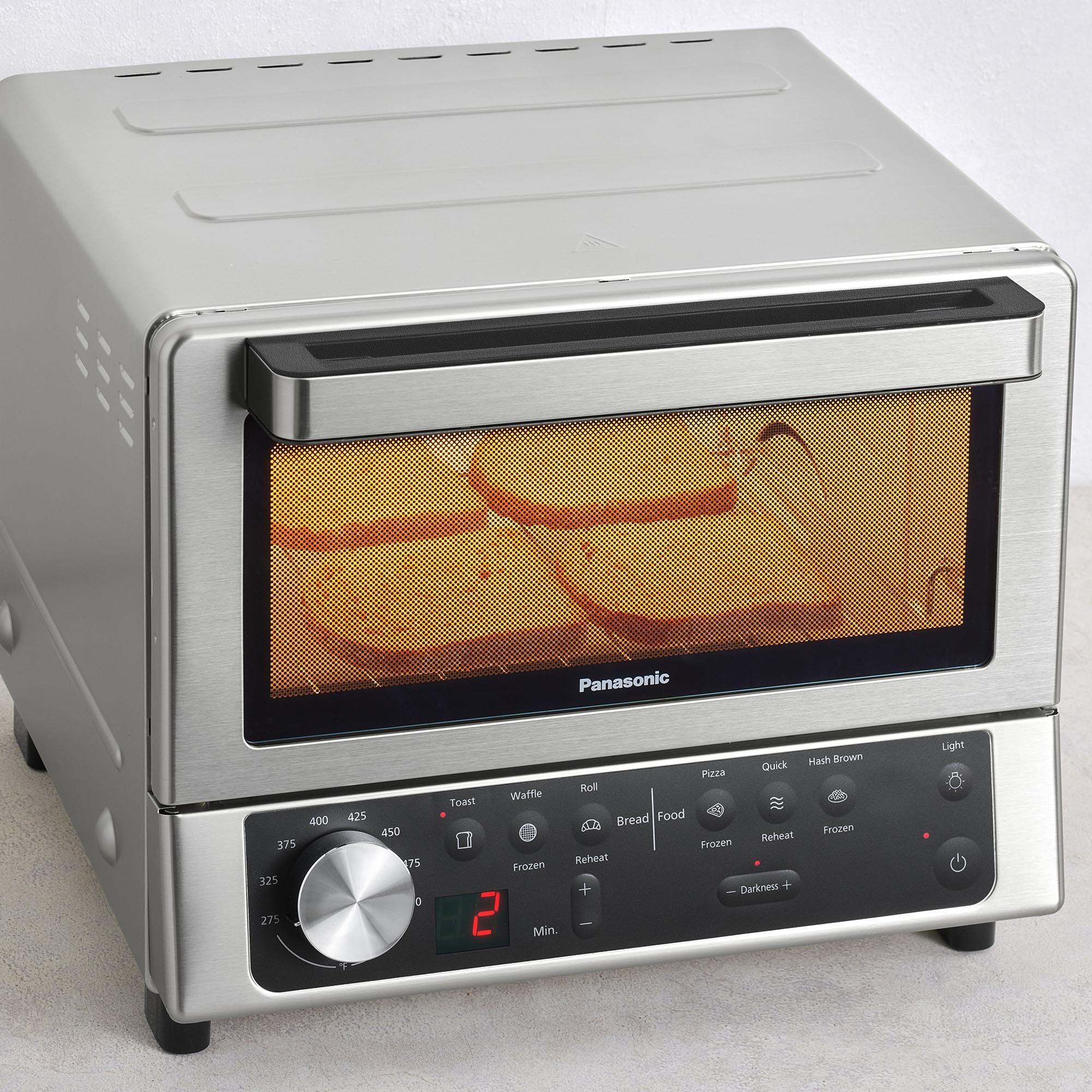
That is not the profile of a runaway consumer safety crisis. It is the profile of a containment problem. A component-level issue appears to sit in or around the insulation system of a cord assembly, but the market action is expressed as a model-and-sales-window recall across two countries. The useful question is not whether Panasonic could write a cleaner consumer notice. It is why the defect perimeter could not be stated more narrowly in public: a supplier lot, a cord assembly batch, a production lot, a line, a shift, or a serial-number range.
A small sleeve detail becomes a finished-goods population
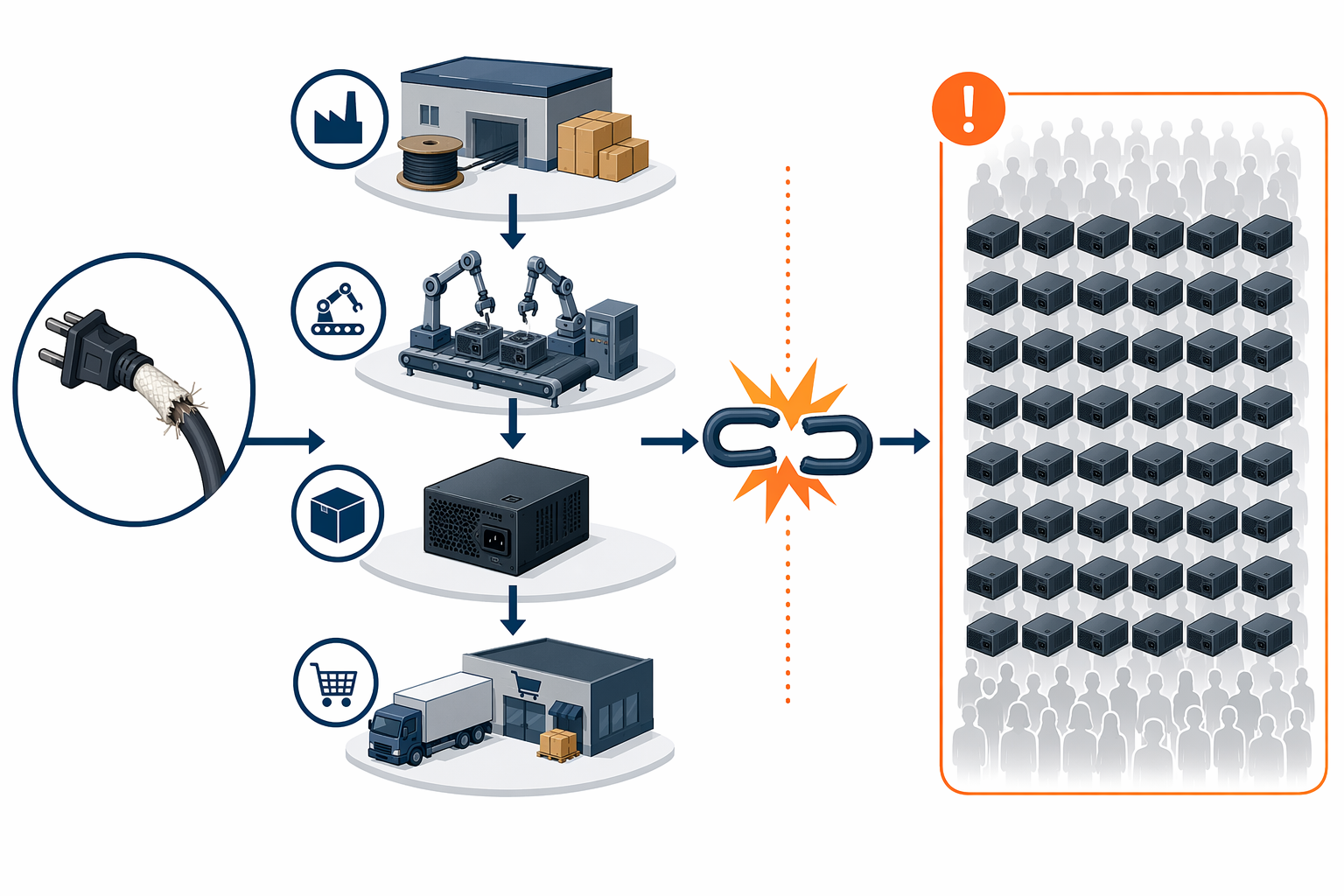
A fiberglass sleeve that does not fully cover a power cord is not a branding issue. It is a genealogy issue. Somewhere upstream, the sleeve material, the cord assembly, the installation process, or the inspection step failed to produce a condition that the finished product needed. Once the defect is found, the recall boundary depends less on the elegance of the engineering explanation and more on the records that can prove which units share the exposure.
For a quality team, the first split is whether the nonconformance belongs to the part, the assembly, or the process. If a supplier shipped a sleeve or cord assembly batch with a dimensional or installation risk, the company needs the supplier lot number, shipment date, receiving record, and where-used history. If the part was acceptable but installed incorrectly, the company needs production routing, station records, work instructions, operator or shift data if retained, in-process inspection records, and any deviation history. If the issue is intermittent, the investigation has to test whether it clusters around a date range, a line, a rework path, or an undocumented substitution.
The public notices do not say which of those explanations applies. They say the sleeve did not fully cover the power cord. That distinction matters. A supplier-lot problem can sometimes be contained to units that consumed that lot. A process-control problem may require a broader production-window recall. A documentation gap can force the broadest answer of all: recall every finished unit that might plausibly contain the defect because the company cannot prove which ones do not.
What a narrower recall would have to prove
A narrower recall is not won by confidence. It is won by evidence that survives regulator review, channel reconciliation, and internal legal scrutiny. In this Panasonic case, the evidence chain would have to connect the sleeve or cord assembly to finished units and then connect those finished units to the market.
| Containment question | Records that would matter |
|---|---|
| Which component population carried the risk? | Supplier lot records for sleeve material or cord assemblies, specifications, certificates, incoming inspection results, supplier deviations, and shipment identifiers |
| Where did those components go? | Receiving transactions, inventory movements, kit pulls, production orders, line consumption records, scrap and rework records, and substitutions |
| Which finished units used them? | Model, serial, production lot, assembly date, line, shift, bill-of-material version, and final test or inspection records |
| Which units reached customers or channels? | Distributor shipments, Amazon, Costco, and Panasonic.com sales records, returns, inventory on hand, and country-specific channel data |
| Can unaffected units be defended? | Negative genealogy: proof that specific serial ranges, lots, or shipment windows did not consume the suspect component or process path |
That last line is where recall scope usually becomes expensive. It is not enough to identify the bad lot. The company also has to defend the good lots. If supplier records are in one format, manufacturing execution data in another, channel data in another, and service complaints in yet another, the investigation slows down at exactly the moment executives want a smaller number.
The 13,664-unit perimeter may be exactly right for the risk Panasonic and regulators saw. There is no public post-mortem showing that Panasonic had a traceability failure, and the recall was only posted two days before the current date. But the shape of the notice is still instructive. It describes a component condition and resolves it through a finished-goods recall boundary. That is the operational penalty manufacturers pay when the defect genealogy cannot be narrowed, or cannot be narrowed quickly enough to rely on in a public safety action.
Where AI traceability actually belongs
AI does not make a fiberglass sleeve cover a cord. It does not replace incoming inspection, process capability, supplier audits, or engineering judgment. Its plausible role is narrower and more useful: connecting records that already exist, curating supplier signals faster, and simulating recall boundaries before the company is forced to choose between delay and over-inclusion.
In a live traceability graph, the suspect object is not simply “a toaster oven.” It can be a sleeve material lot, a cord assembly, a supplier shipment, a receiving batch, a production order, a serial range, a retail shipment, and a customer-facing recall population. The graph matters because the same defect can be queried from different directions. Starting from a supplier notice, the company can ask which finished units consumed the affected component. Starting from field complaints, it can ask whether incidents cluster around the same assembly path. Starting from channel inventory, it can separate units still in warehouses from units already sold.
Vendor materials point to pieces of that work, with the usual caution that capability examples are not proof of performance in this Panasonic recall. Oracle’s AI Recalls Curation Assistant, described in Oracle SCM 25D documentation, is built to ingest supplier recall letters in PDF form and curate them into supplier recall notices.[3] Trumetric describes recall simulation that can evaluate affected lots in seconds rather than the hours or days associated with manual tracing.[4] Those are credible categories of work for AI: document ingestion, entity matching, relationship mapping, and scenario testing. They are not evidence that a toaster oven defect would have been prevented.
The distinction is not academic. If the underlying records are incomplete, AI can only organize the incompleteness. If supplier lot identifiers are not captured at receipt, if components are backflushed without lot precision, if rework consumes parts outside normal transactions, or if serial numbers are not reliably tied to production lots, the graph will look modern and still fail the recall question. A fast simulation of bad data is just a faster way to discover that the company cannot defend a narrow boundary.
Consumer electronics is still paying for weaker lot discipline
Consumer electronics has not had the same traceability pressure as automotive or food and beverage. Cars are built around serial-numbered systems, regulated safety campaigns, and deep supplier production part approval habits. Food and beverage traceability has been pushed by perishability, contamination risk, and regulatory recordkeeping. Appliance and consumer electronics supply chains often sit somewhere less mature: complex enough to have multi-tier component risk, but not always disciplined enough to trace every relevant component lot into every finished unit.
The Panasonic notice is a clean example because the trigger is not exotic. A power cord insulation detail sits several layers below the consumer-facing product. The finished unit was sold through large channels from October 2024 through April 2026.[1][2] Once units have moved through Amazon, Costco, and a direct brand site, containment becomes partly a supply chain problem and partly a channel-data problem. Knowing what was built is not enough. The company has to know what is still in inventory, what shipped, what sold, what can be blocked before sale, and what requires consumer outreach.
Industry survey data suggests this is not a marginal concern. In the ETQ Pulse of Quality in Manufacturing survey cited by SupplyChainBrain in September 2024, 61% of manufacturers said up to half of all product recalls can be attributed to supplier quality issues. The same survey reported that recall rectification costs $10 million to $49.99 million per event for 39% of U.S. manufacturers, with additional impacts including brand damage for 35%, delayed product introductions for 32%, and plant shutdowns for 30%.[5] Those figures are self-reported, so they should not be treated as audited loss data. They are still a useful signal: supplier quality failures have recall economics attached to them long before anyone writes the press release.
Recall frequency adds pressure. CRC Group reported that consumer product recalls reached 101 events in the first quarter of 2025, up 90.6% from the prior quarter, and that food recall units surged 232% in the same broader recall environment.[6] A specialty insurance broker’s trend analysis is not the same as a government root-cause study, but it does reinforce the practical point: recalls are common enough that readiness cannot be assembled after the defect is discovered.
The adoption problem is not the algorithm
The slow part is usually not buying software. It is forcing agreement on identifiers, record ownership, and data discipline across suppliers, plants, contract manufacturers, logistics partners, retailers, and service teams. A supplier may know the sleeve batch. A contract manufacturer may know the production order. A retailer may know the customer shipment. The recall team needs those facts to meet in one defensible chain.
That is why multi-tier visibility work matters even when the immediate topic is not forced labor, tariffs, or trade compliance. The same boundary problem appears in different clothes: tier-one data is too shallow, tier-two and tier-three relationships are not modeled, and the company learns during a crisis that the critical evidence sits outside its normal operating view. Tools built for mapping supplier networks can help, but only if procurement and quality teams treat supplier structure as operating data rather than an annual questionnaire.
AI-enabled traceability also changes the legal texture of a recall. Faster tracing can reduce overbroad action, but it creates a richer record of what the company knew, when it knew it, and which scenarios it considered. That is useful if the trace is accurate and governance is disciplined. It is dangerous if the system produces confident-looking boundaries that no one validates. The companies most likely to benefit are not the ones with the most ambitious AI roadmap. They are the ones that can already trust their lot, serial, supplier, and channel data.
The recall-readiness question
The Panasonic toaster recall does not prove that AI would have prevented the defect. It does not prove that Panasonic lacked internal traceability. It does not show injuries, and it should not be inflated into a consumer safety drama beyond the reported five circuit breaker incidents and no injuries in the U.S. notice.[1]
It does show how quickly a small component detail can become a multi-country finished-goods action when the public boundary must be drawn around models, dates, and channels. For supply chain and quality leaders, the hard question is immediate: if a supplier-linked component defect appeared this week, could the organization prove the affected lots quickly enough to avoid recalling more products than necessary?
References
- Panasonic Recalls Electric Toaster Ovens Due to Shock and Fire Hazards, U.S. Consumer Product Safety Commission, July 16, 2026
- Panasonic FlashXpress Toaster Oven recalled due to electric shock hazard, Health Canada, July 16, 2026
- Oracle AI Recalls Curation Assistant, Oracle SCM 25D documentation
- Trumetric Trace Central, Trumetric
- ETQ Pulse of Quality in Manufacturing survey, cited by SupplyChainBrain, September 2024
- Recall trend analysis, CRC Group, October 2025
Comments
Join the discussion with an anonymous comment.