
The supply chain lesson in the Panasonic toaster oven recall starts with a part most people would never notice: a fiberglass sleeve on a power cord. On July 16, 2026, the U.S. Consumer Product Safety Commission announced a recall of about 11,480 Panasonic NB-G200/205 toaster ovens because the power cord insulation could be insufficient, creating a fire hazard. The units were manufactured at Panasonic Manufacturing (Xiamen) Co., Ltd. in China and sold from October 2024 through April 2026.[1][2]
That is not the kind of defect that announces itself on a finished-goods line. A toaster oven can power on, pass a basic visual check, look clean in packaging, and still carry a cord assembly where the sleeve coverage is not doing the job it was supposed to do. By the time the issue becomes a recall, quality and procurement teams are left reconstructing a trail that should have been easier to see: which supplier lot, which assembly step, which inspection field, which nonconformance, which CAPA, which complaint, and which shipment window belonged to the same pattern.

The public record supports the concrete failure mode, but it does not prove exactly where the defect entered the chain. The fiberglass sleeve problem could have originated in component manufacturing, in a supplied cord assembly, or during final assembly in Xiamen. The CPSC notice and Panasonic recall page do not disclose enough to assign the fault to a Tier 2 supplier or to final assembly with certainty.[1][2] That uncertainty matters, because supplier quality work often lives in precisely that gray area: the defect is physical and specific, but the evidence is scattered across companies, plants, systems, and checklists.
What Had to Be Detected Earlier
A sleeve that does not fully cover a power cord is not a vague quality culture problem. It is a component-level conformance problem. Someone either specified the required coverage, supplied a part that did not consistently meet it, assembled it in a way that left exposure, inspected it without measuring the right thing, or stored the evidence in a place where nobody saw the trend.
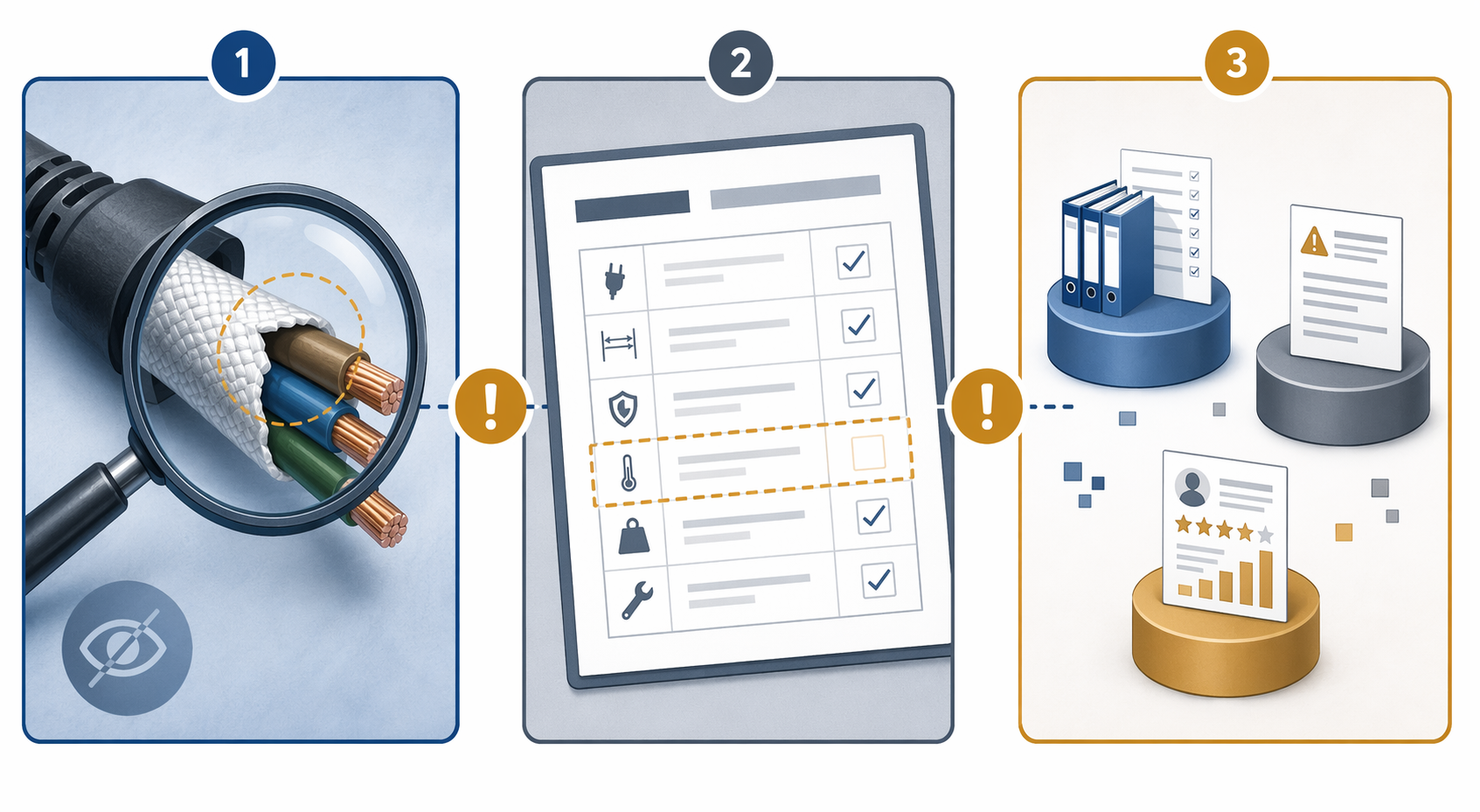
Three gaps are exposed by this kind of recall.
- The defect may not be visible during routine inspection. A finished power cord can look acceptable from the outside while an internal sleeve fails to cover the relevant section.
- The checklist may not ask the right question. If the inspection record says only “cord condition,” “insulation present,” or “visual OK,” it may not capture sleeve length, overlap, exposure, heat-resistance placement, or lot-level variation.
- The signal may be split across systems. Supplier audits, incoming inspection notes, nonconformances, CAPAs, line rework, customer complaints, and supplier scorecards often sit in separate tools or spreadsheets.
That last gap is usually the expensive one. One odd inspection miss can be contained. One vague audit observation can be corrected. One supplier deviation can be dispositioned. But when each record is handled as a local event, nobody sees that the same component family has been generating small exceptions for months.
Why Ordinary Supplier Quality Systems Miss This Kind of Defect
It is too easy to say conventional inspection failed. In a consumer electronics factory, inspection can be doing exactly what it was designed to do and still miss a defect that was never translated into an observable, measured, recurring field.
Visual inspection favors external defects: cuts, burn marks, deformation, missing labels, loose parts, misalignment. Dimensional QC favors dimensions that appear on the control plan. Periodic supplier audits favor process conformance at the moment of the audit. None of those methods automatically catches a fiberglass sleeve coverage problem unless the requirement is explicit, the sampling plan reaches the relevant variation, and the defect record is coded in a way that can be trended.
A hypothetical example shows the issue without pretending to know Panasonic’s internal records: an incoming inspection team might record several minor notes about cord handling, sleeve placement, or supplier packaging. A line team might separately log rework on cord routing. A supplier quality engineer might open a CAPA using broad language such as “insulation issue” or “assembly variation.” A customer service team might later see a small number of heat-related complaints. If those records never share a component ID, supplier lot, defect taxonomy, or production window, they do not become one signal.
That is why the supplier-quality angle matters. In ETQ and Hexagon’s 2024 Pulse of Quality in Manufacturing survey of 750 respondents across multiple manufacturing sectors, 61% of manufacturers said up to half of their product recalls trace back to supplier issues, and 48% said they had experienced more recalls than five years earlier.[3] The survey is not limited to toaster ovens or small appliances, so it should not be overread as an appliance-specific benchmark. But the direction is familiar: supplier quality is often treated like a procurement subfolder until the defect becomes a regulatory event.
Where AI Changes the Workflow
AI would not have magically “seen” through a power cord. It would have needed data. More specifically, it would have needed connected data: the part number, supplier and sub-supplier where available, plant, line, lot, inspection result, nonconformance code, CAPA text, deviation history, complaint notes, production quantity, and shipment timing.
That is the practical role of supplier quality risk platforms. Tools in categories represented by ComplianceQuest, Everstream, Kodiak Hub, GEP, and similar systems do not replace engineering judgment. They try to keep the evidence from being trapped in separate workflows. Audit findings, nonconformances, CAPAs, supplier scorecards, complaint records, and production quality metrics can be ingested into a monitoring layer that looks for abnormal patterns by supplier, component family, plant, material, process step, or time window.
| Fragmented Evidence | What AI Monitoring Tries To Connect | Why It Matters for a Sleeve-Coverage Defect |
|---|---|---|
| Supplier audit notes | Repeated language about cord assembly, insulation handling, sleeve placement, or process drift | Turns a vague audit observation into a component-risk signal |
| Incoming inspection records | Defect codes, measured fields, supplier lots, and acceptance history | Shows whether exceptions cluster around one supplier, lot, or date range |
| CAPAs and deviations | Corrective-action language, recurrence, overdue actions, and related part numbers | Separates one-time containment from unresolved recurrence |
| Line rework and scrap | Assembly station, operator notes, rework reason, and production batch | Finds process-side evidence that may not appear in supplier scorecards |
| Customer complaints | Early field symptoms tied back to production and shipment records | Supports faster containment if finished goods have already shipped |
The important change is not a prettier dashboard. It is the ability to ask, continuously, whether weak signals that look harmless alone become material when joined. A supplier with a normal on-time delivery score but a rising rate of insulation-related nonconformances should not look healthy just because procurement’s scorecard is green. A CAPA that uses the same defect language for the third time should not be closed as routine if inspection escapes and complaint notes point to the same component.
For a defect like the Panasonic sleeve issue, an AI-enabled workflow would have four jobs.
- Normalize the language around the defect so “insulation,” “fiberglass sleeve,” “cord sleeve,” “coverage,” “exposure,” and similar terms can be treated as related signals instead of unrelated text entries.
- Score supplier and component risk dynamically, so a cord assembly or insulation material does not wait for the next quarterly review before being flagged.
- Escalate before shipment when defect recurrence, supplier deviation, inspection misses, or CAPA recurrence crosses a threshold.
- Support containment after escape by identifying affected lots, shipment windows, and customer destinations faster.
The Business Case Is Regulatory, Not Just Operational
Quality leaders usually have no trouble understanding the operational value of earlier detection. The harder internal argument is budget. Supplier quality systems compete with ERP work, procurement analytics, manufacturing execution upgrades, and the hundred smaller tools every plant already lives with.
The recall environment changes that argument. In Q1 2026, the CPSC issued an $11.5 million penalty against a bicycle parts manufacturer for delayed defect reporting.[4] That case is not Panasonic, and it should not be treated as evidence of Panasonic’s conduct. Its relevance is broader: regulators are willing to penalize slow reporting and delayed action when companies have defect information and do not move fast enough.
That makes supplier quality monitoring a compliance capability as much as a cost-control tool. If defect signals are spread across supplier audits, CAPAs, inspection records, and customer complaints, the company may lose time not because nobody cared, but because nobody had a complete view soon enough.
Vendor-published metrics point to the kind of time compression buyers are being promised, though they should be treated carefully. Everstream Analytics reports client data showing a 50–70% reduction in time to identify disruption impact.[5] QualityLine reports predictive quality defect detection accuracy above 95%.[6] Those figures are not independently verified in the research record here, and they do not prove that either product would have prevented the Panasonic recall. They do, however, describe the business target: less time spent discovering which products, suppliers, plants, and shipments are implicated once a pattern appears.
Broad recall-cost averages are less useful for this specific case. Panasonic has not disclosed the financial cost of the toaster oven recall, and the U.S. unit count was 11,480.[1][2] A generic recall-cost benchmark can make the problem sound larger or cleaner than the known facts allow. The stronger argument is narrower: when component-level quality evidence is monitored continuously, the organization has a better chance to contain a defect before it becomes a public recall, and a better record of what it knew and when it acted.
What Procurement and Quality Teams Should Look For
For teams evaluating AI supplier risk scoring, the Panasonic case points to selection criteria more useful than generic “visibility.” The system has to reach the evidence that actually carries quality risk.
- Component-level traceability: risk scoring should work below the supplier-name level, down to part families, materials, lots, plants, and production windows where data exists.
- Text and code normalization: the platform should connect related defect language across inspections, CAPAs, audit notes, and complaints.
- Supplier and plant context: a green commercial scorecard should not hide recurring quality exceptions from the same component stream.
- Escalation discipline: alerts should create reviewable actions for supplier quality, engineering, procurement, and regulatory teams, not just dashboard color changes.
- Containment support: once a defect escapes, the system should help identify affected shipments, lots, and customers quickly enough to support reporting decisions.
This is distinct from broader supplier disruption monitoring, even though the data architecture can overlap with systems used for natural disasters, geopolitical disruptions, cyber incidents, or logistics visibility. A wildfire near a supplier plant and a fiberglass sleeve that does not fully cover a cord are different risk classes. The first asks whether production can continue. The second asks whether production should continue unchanged.
The implementation burden is not trivial. If inspection checklists never capture sleeve coverage, AI cannot infer a reliable measured field from nothing. If CAPAs are written in generic language, the model has less to work with. If Tier 2 component data is unavailable, the system may only see the final assembler or Tier 1 supplier. The work starts with better data discipline, then uses AI to find relationships and recurrence that humans are unlikely to catch across thousands of records.
A Plausible Earlier Warning, Not a Guaranteed Prevention
The clean version of the story would say AI could have prevented the Panasonic toaster oven recall. The more useful version is conditional: AI could plausibly have produced an earlier warning if the relevant supplier, component, inspection, nonconformance, CAPA, production, and complaint data had been captured and connected before the defect reached consumers.
That distinction is not a hedge for its own sake. It is the difference between buying software and improving supplier quality. A model cannot correct a missing inspection requirement, a vague CAPA, or a supplier lot that was never tied to finished-goods shipments. But when those records exist and remain fragmented, AI monitoring can make a practical difference: it can connect repeated anomalies, raise the risk level around a component, force earlier review, and shorten containment when the first evidence of escape appears.
The lesson is not that AI eliminates recalls. It is that small component defects become much harder to miss when supplier quality evidence is continuously monitored instead of being assembled after the damage is already public.
References
- Panasonic Recalls Toaster Ovens Due to Fire Hazard, CPSC.gov, July 16, 2026, link
- Panasonic NB-G200/205 Toaster Oven Recall Page, Panasonic, July 2026, link
- Pulse of Quality in Manufacturing 2024, ETQ / Hexagon, 2024, link
- CPSC Civil and Criminal Penalties, CPSC.gov, Q1 2026, link
- Everstream Analytics Client Data on Time to Identify Disruption Impact, Everstream Analytics, link
- QualityLine Predictive Quality Defect Detection Accuracy, QualityLine, link
Comments
Join the discussion with an anonymous comment.