
Offshore wind construction logistics are not a side budget. Vessel logistics, material supply chains, and construction scheduling can account for 25–30% of total project cost, which puts them in the part of the job where a bad sequence becomes a visible commercial problem, not just a planning inconvenience. The target for AI is therefore narrow and practical: fewer vessel days burned waiting on weather, port slots, materials, crews, permits, or another contractor’s unfinished handover.
That distinction matters for anyone searching for ai for offshore wind lease and supply chain. Lease timing affects the development runway, but the stronger evidence today sits in construction execution: foundation transport, cable installation, turbine installation vessels, crew transfers, marshalling ports, and the material movements that have to arrive in the right sequence. Operations and maintenance logistics have their own economics; ChainSignal’s offshore wind O&M logistics cost analysis is the complement. This piece stays with construction, where a plan can look solved on Friday and still put a high-day-rate vessel on standby by Monday morning.
Where AI Actually Touches the Construction Plan
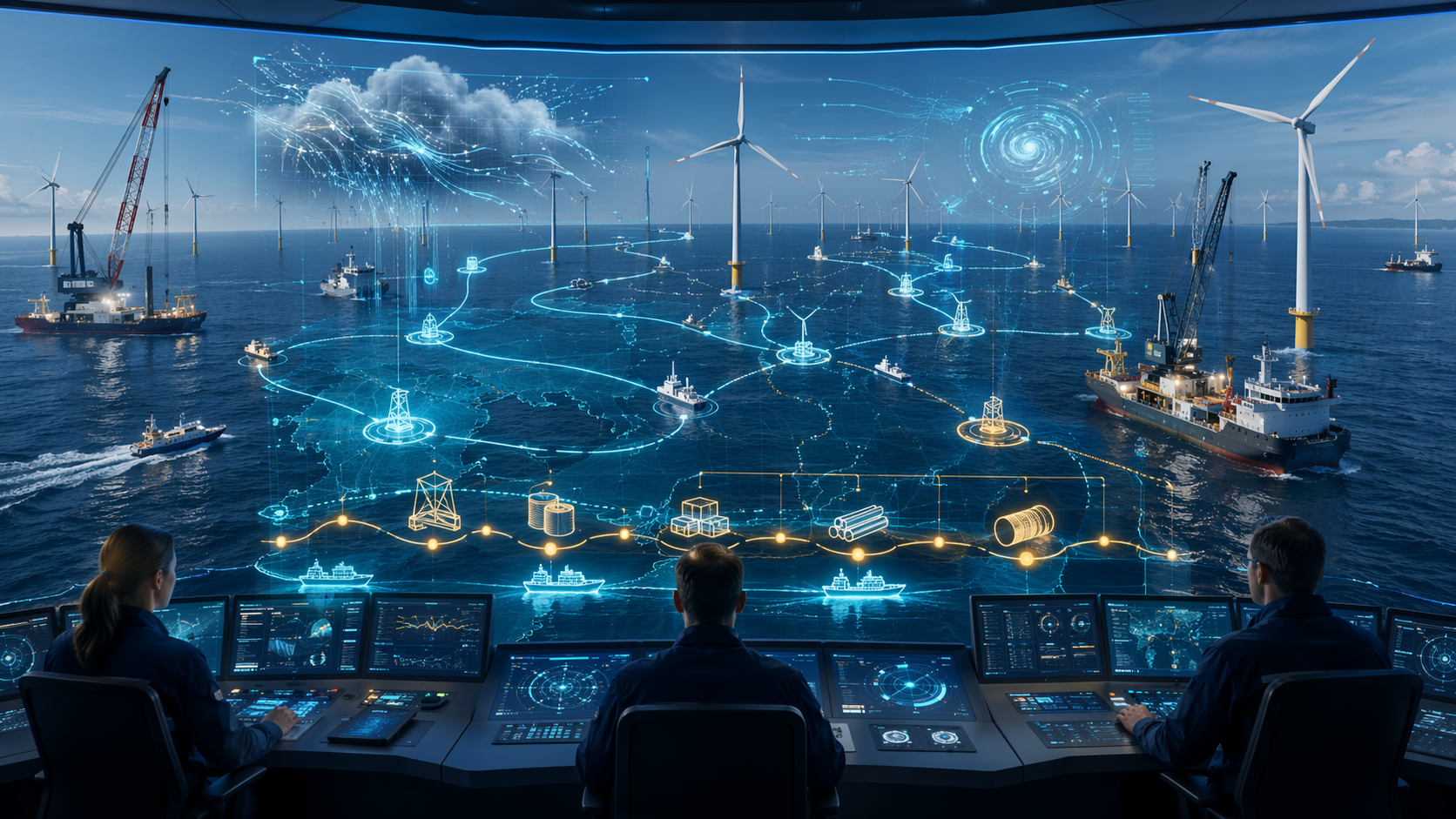
The useful systems are not just producing a prettier Gantt chart. They are trying to hold several moving parts in one model: which vessel is available, which component is ready, which port can receive or release it, which installation activity depends on it, which weather window is realistic, and what happens if one assumption fails.
GE Vernova described this as an AI/ML digital twin for wind turbine logistics and installation. In its 2022 announcement, the company said the approach had achieved a 10% reduction in logistics costs and projected that similar methods could create $1.7 billion to $2.6 billion in annual global savings by 2030. The first number is the one to handle as a deployment claim; the 2030 figure is a forward-looking estimate, not a bankable result from completed projects.[1]
Shoreline Wind’s reported figures land even closer to the construction desk. Wind Systems Magazine reported that Shoreline’s AI automation saved 3 hours per planner per day, generated vessel cost savings of up to $300,000 per day from optimized plans, and ran about 2 million simulations across 465 GW of projects in 2025. Those are vendor-reported results, but they point to the right unit of value: planner time, vessel days, and scenario volume.[2]
The Savings Come From Avoided Mismatches
A construction logistics model saves money when it prevents assets from arriving out of order. A cable lay vessel booked before cable readiness is not optimization. A foundation shipment released into a congested marshalling port is not progress. A crew transfer plan that ignores a narrowing weather window is only a plan until the marine coordinator says no.
The digital twin or logistics control tower earns its keep by testing those collisions before they become invoices. It can compare installation sequences, simulate delays, flag Non-Productive Time exposure, and show whether a different vessel sequence reduces standby. IBS Software describes an offshore wind logistics control tower that connects marine port, quarry, and offshore operations with real-time weather monitoring and Non-Productive Time alerts. That is the right shape of system: not a forecast in isolation, but a coordination layer across physical movements and schedule consequences.[3]
| Construction decision | What AI can test | Cost exposure it can reduce |
|---|---|---|
| Installation vessel scheduling | Alternative vessel sequences, day-rate exposure, activity dependencies | Standby time, avoidable mobilization, missed weather windows |
| Material and component movement | Readiness dates, marshalling capacity, transport timing | Early arrivals, port congestion, rehandling, delayed installation |
| Cable and foundation logistics | Vessel availability, installation sequence, weather constraints | Idle specialized assets, broken handoffs between contractors |
| Crew and marine coordination | Crew transfer timing, offshore accessibility, workfront readiness | Crew waiting time, aborted trips, lost productive hours |
Cable installation shows why the planning window matters. UTM Consultants notes that cable installation vessel lead times can be 2–3 years, with many vessels booked through 2026. When a scarce vessel class is locked that far ahead, the planning problem is no longer just finding the shortest route. It is protecting the few feasible installation windows from late engineering, late materials, port clashes, and weather disruption.[4]
This is also where scenario simulation has a different value from normal reporting. A dashboard tells the project team what slipped. A simulation model asks what the project should do if it slips: hold the vessel, resequence foundations, advance a different string, change the port call, or accept the delay because every alternative is worse. That is the decision support project controls managers actually need when the schedule meeting turns into a commercial argument.
Not Every Savings Figure Carries the Same Weight
The most defensible way to use the current figures is to separate what each one measures. GE Vernova’s 10% logistics cost reduction is a company-reported deployment result tied to digital twin logistics. Shoreline Wind’s $300,000-per-day vessel savings and 3-hours-per-planner-per-day automation claim are vendor-reported operational metrics, not independent industry averages.[1][2]
The academic evidence is useful because it tests optimization logic without a sales deck around it. An MDPI study of collaborative vessel scheduling optimization reported total cost reductions of 15.44% and 13.20% in real-world offshore wind farm cases. Those results should not be converted into a universal 13–15% benchmark. They are better read as evidence that collaborative scheduling can materially reduce cost when the project data, constraints, and operating assumptions are good enough to model.
That difference is not academic nitpicking. A developer using these numbers in an internal business case needs to avoid stacking them as if they were additive. A 10% logistics reduction, a 13–15% scheduling reduction, and a $300,000 daily vessel saving may overlap. They can all describe value from better sequencing and fewer idle days. The job is to map each claim to the project’s own cost baseline: vessel day rates, port costs, crew costs, transport contracts, liquidated damages exposure, and the part of the schedule where the current plan is brittle.
Why Vessel Coordination Is the First Credible Use Case
AI often struggles to prove itself in supply chain work because the value is spread thinly across thousands of small decisions. Offshore wind construction is different. The constraints are structured, the assets are scarce, the weather windows are visible, and the daily cost of waiting can be large enough to justify better modeling. If the model prevents one bad vessel move or one avoidable standby period, the saving is not buried in a quarterly efficiency estimate.
The stronger scheduling tools therefore act less like autonomous planners and more like argument testers. They help a project team compare plans before committing marine assets. They make local optimization harder to hide: procurement cannot claim success just because a component shipped, marine coordination cannot claim success just because a vessel is booked, and installation cannot claim readiness if the upstream sequence is broken.
- If weather risk increases, the model can test whether holding a vessel, moving to another workfront, or changing the installation sequence creates the lowest total cost.
- If a port slot moves, the model can show which component flows and vessel activities are now exposed.
- If a supplier misses a delivery date, the model can test whether resequencing protects the main installation vessel or only shifts delay to another contractor.
- If a cable installation vessel is constrained, the model can show which earlier decisions must be protected because replacement capacity is not readily available.
Weather-aware logistics is not unique to offshore wind. The same discipline appears in broader disruption planning, including AI-based flood disruption planning and vessel route optimization under geopolitical risk. The offshore wind version is sharper because weather, vessel scarcity, and installation sequence are inseparable. A better route is not enough if the next workfront is not ready.
The Lease Question Belongs Upstream
Lease activity still matters because it determines which projects enter the development funnel and when they may need ports, vessels, suppliers, and grid interfaces. But lease-area optimization and consenting support are not the same use case as construction logistics execution. ORE Catapult has described AI and smart sensing as reducing consenting timelines by up to 40%, which is relevant to project development timing, not proof that construction vessel schedules will improve once a project reaches execution.[5]
For supply chain leaders, the handoff is the practical point. A lease award or consent milestone can create demand signals for ports, vessels, foundations, cables, and substations years before offshore work begins. AI can support that long-range planning, but the savings figures discussed here come from construction logistics and scheduling, not from lease selection itself.
The Scaling Limit Is Integration, Not Interface Design
Most pilots can look convincing when the data set is curated. The harder test is whether the system can stay useful when it has to ingest ERP data, port management updates, contractor schedules, weather feeds, vessel availability, procurement status, and live field changes without turning every exception into manual reconciliation.
That is where the commercial impact is still capped. If the AI scheduler cannot see that a component is still under quality hold, it may optimize a movement that should not happen. If the port system does not feed reliable berth or laydown changes, the model can preserve a sequence the port cannot execute. If installation contractors update progress outside the shared planning environment, the digital twin becomes a polished version of yesterday’s meeting.
The buying decision should therefore start with integration questions before algorithm questions. Which source is authoritative for material readiness? How often does the marine schedule update? Who owns weather downtime assumptions? Can contractor lookaheads be imported without rekeying? Does the system preserve the logic behind a recommendation well enough for commercial teams to defend a change order, standby claim, or resequencing decision?
AI is already credible for offshore wind construction logistics when vessel scheduling, weather-aware planning, material readiness, and installation sequence are modeled together. Its real ceiling is not the demo model. It is whether the project’s ERP, port systems, contractor schedules, and live operational data can keep the model close enough to the job for the next vessel decision to change.
References
- GE Using AI/ML To Reduce Wind Turbine Logistics and Installation Costs, GE Vernova, 2022.
- Shoreline Wind report: AI on rise in wind projects, Wind Systems Magazine.
- Offshore Wind Supply Chain, IBS Software.
- 5 Areas AI Will Transform, UTM Consultants.
- Artificial Intelligence Driving Forward the Future of Offshore Wind Deployment, ORE Catapult.
Comments
Join the discussion with an anonymous comment.