

The readiness question comes before the use case
Before a warehouse team asks what machine learning for warehouse management can optimize, it should ask whether the site can feed the system trustworthy operational data and act on what comes back. That is the uncomfortable gap hiding behind most deployment decks. Only 23% of supply chain organizations say they have a formal AI strategy, while 94% plan to use AI within two years [1][2]. At the same time, 74% of businesses report no meaningful value from AI use, and 75% of companies struggle with AI adoption because of data management challenges [3][4].
That is not an algorithm problem first. It is usually the warehouse version of a much older problem: conflicting item masters, WMS event logs no one fully trusts, supervisors keeping side spreadsheets, and finance asking for software payback before the operating model has changed. The opportunity is real, because roughly 80% of warehouses globally remain non-automated [5], but that also means many facilities are starting from a low baseline for both automation and data discipline.

What data readiness means in warehouse terms
In a warehouse, data readiness is not an abstract score. It means the site can produce consistent transaction histories, inventory snapshots, labor activity data, and, where relevant, sensor or equipment data, then connect those records to measurable operational outcomes. If a recommendation cannot be traced back to the right item, bin, shift, and timestamp, it will not survive contact with the floor. The same basic discipline used in a data readiness assessment for AI procurement automation applies here, even though the warehouse data domains are different.
| Readiness area | What to verify | What usually fails |
|---|---|---|
| Data infrastructure | WMS, ERP, TMS, labor, and equipment data describe the same items, locations, and times; inventory snapshots can be reconciled; history is deep enough to compare demand cycles. | Conflicting item masters, missing event timestamps, stale feeds, and records that cannot be matched across systems. |
| Organizational ownership | Someone owns exceptions, overrides, and retraining; supervisors know when to trust, challenge, or bypass a recommendation. | The pilot lives in IT while the floor keeps using side spreadsheets. |
| System integration | ML can read from and write back to the WMS and adjacent systems instead of sitting in a dashboard. | Recommendations never reach the transaction layer, so nothing operational changes. |
| Decision governance | Rules exist for which decisions are advisory, semi-automated, or automated, and drift is reviewed on a schedule. | No one knows who is allowed to approve exceptions or reset thresholds. |
| ROI staging | Success metrics match the deployment scale and time horizon, not a generic software payback template. | Finance expects enterprise payback before the process design has even stabilized. |
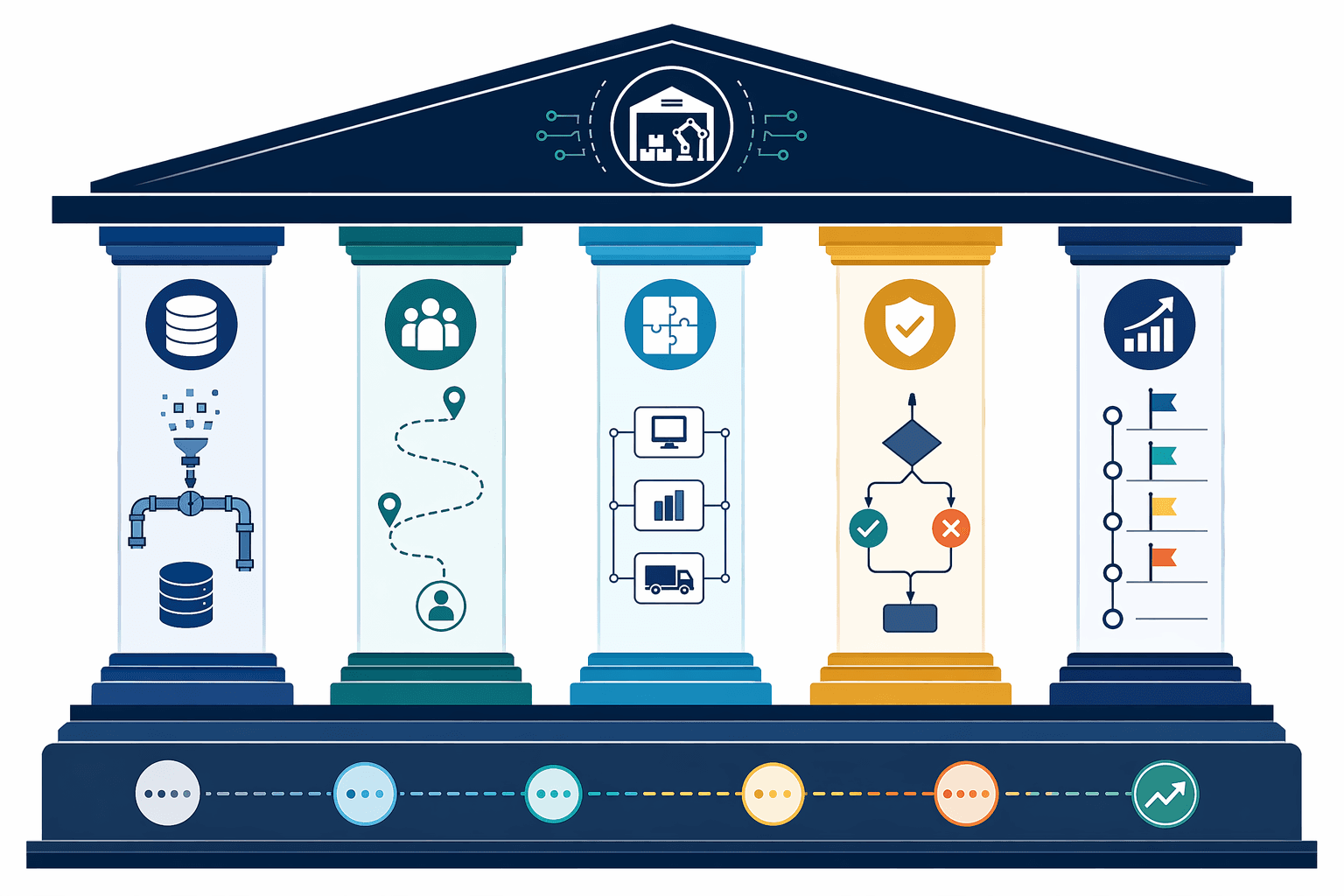
The point of a framework like this is not to slow the work down. It is to stop the usual sequence where a pilot is approved because the demo looked clean, then the operations team spends months discovering that the data is fragmented, the integration scope was underbuilt, and the site never agreed on who can act on the output. That is why readiness is the real implementation work, not a preamble to it.
Strategy and ownership decide whether outputs become decisions
A warehouse can have decent data and still stall if no one has decided which decisions ML is allowed to influence. The formal AI strategy gap matters because it forces choices that pilots often avoid: who owns exceptions, which recommendations are advisory only, how supervisors are trained to trust or challenge the model, and what has to happen before a pilot is allowed to graduate into production. That is the part a change-management plan has to handle explicitly; a practical WMS AI change management checklist becomes useful here because the hard work is usually behavioral, not technical.
This is also where the warehouse leader and the IT/data team need the same map. Operations needs clarity about which exceptions can be automated and which still require human review. IT needs to know which systems must exchange events in near real time and which data quality rules must be enforced before recommendations are trusted. If those decisions are not named, the site gets a model that can predict something but cannot change anything.
Use cases matter, but only after the foundation
Dynamic slotting, labor planning, replenishment, inventory accuracy, predictive maintenance, and autonomous exception handling are all valid examples of where ML can help a warehouse. They should not be treated as a shopping list, because each one depends on a different mix of data and operating behavior. A site with reliable movement history and clean inventory snapshots may start with slotting or replenishment. A site with better labor activity data may get more value from labor planning. A site with usable equipment telemetry can begin to explore predictive maintenance. The use case should follow the data, not the other way around.
ROI should be staged, not promised upfront
The most useful ROI question is not whether machine learning will pay back eventually, but what time horizon matches the deployment scale. Most organizations see satisfactory AI ROI in two to four years, and only 6% report ROI in under a year [1]. That does not mean warehouse ML is slow by definition. It means a single-site pilot and an enterprise-wide transformation should not be judged by the same clock. A pilot can prove a narrow workflow, such as slotting in one building or labor guidance in one shift pattern, while a broader program has to absorb process redesign, exception handling, and integration work across multiple sites.
The upside can be substantial when readiness is in place. McKinsey has reported that AI-enabled distribution operations can deliver 5% to 20% logistics cost reduction and 20% to 30% inventory reduction [6]. Those are conditional outcomes, not generic promises. They depend on the warehouse already being able to generate trustworthy records, route recommendations into work, and keep people accountable for the exceptions the model cannot settle on its own.
That is also why waiting for perfect readiness is the wrong conclusion. The data advantage compounds over time. Each demand cycle, each exception, and each override gives the model more useful history, but only if the organization has decided how to capture and govern that history. Sites that delay the first disciplined deployment often delay the learning curve as well.
The horizon is real, but not automatic
Gartner projects that by 2031, 60% of supply chain disruptions may be resolved without human intervention [1]. That is a meaningful horizon for warehouse leaders, but it does not reward shortcuts. It rewards organizations that start with readiness assessment, formal AI strategy, and a governance model that lets ML outputs turn into operational decisions often enough to matter. The disciplined investment decision is not to choose between delay and hype. It is to recognize that the first deployment work is making the warehouse ready to use the output.
References
- Supply Chain AI Statistics: 18+ Statistics You Should Know for 2026 — Open Sky Group
- AI in Warehouse Management: Use Cases, ROI & Risk Control — Appinventiv
- A Practical Guide to AI in Warehouse Management — LIDD Consultants
- AI in Warehouse Management — Codiant
- Warehouse Automation Statistics 2026 — Synkrato
- Harnessing the power of AI in distribution operations — McKinsey
Comments
Join the discussion with an anonymous comment.