

Machine learning in procurement is past the point where the only real question is whether it can work. The harder question now is which use cases deserve the first budget line, which ones still depend on too much cleanup, and which ones are being sold as strategy before they are ready to carry production load. That distinction matters because the broader AI adoption gap is still visible: Hackett Group found that 49% of CPOs had piloted genAI, but only 4% had scaled it [1].
A fuller look at the adoption gap is in The AI-in-Procurement Chasm, but the decision most procurement leaders need now is more practical: fund the use cases that already survive contact with messy supplier data and real workflows.

Five use cases at a glance
These five ML applications do not sit at the same maturity level. Spend classification and supplier risk scoring are the clearest production bets. Demand forecasting is powerful, but some of the value lands in planning and inventory rather than procurement alone. Anomaly detection is useful control work. Contract intelligence is moving fast, but it still depends on clean metadata and a workflow that legal and procurement can both live with.
| Use case | Maturity signal | Evidence to watch | Main constraint |
|---|---|---|---|
| Spend classification | Most mature | ~80% of transactions automatable at 95%+ accuracy with human-in-the-loop oversight [2] | Needs normalized supplier, item, and GL data; exceptions still need review |
| Supplier risk scoring | Production at scale | 58% production rate in ISG's 2025 study; average investment of $2.0M per deployment across enterprise use cases [3] | External data quality and escalation rules matter more than model novelty |
| Demand forecasting | Strong, but broader than procurement | 20-50% forecast error reduction, 20-30% inventory reduction, and 5-15% procurement spend reduction in McKinsey's 2024 research [4] | Benefits often depend on planning discipline outside procurement |
| Anomaly detection | Useful control layer | Best suited to duplicate invoices, unusual price movements, split POs, and payment exceptions | Needs tight thresholds and a defined review queue or it becomes noise |
| Contract intelligence | Fast-growing | Gartner expects 50% of organizations to use AI-enabled contract tools by 2027, while Deloitte says 41% of CPOs are prioritizing contract summarization [5][6] | Clause taxonomy, searchable metadata, and legal/procurement handoffs must be in place |
Spend classification is the clearest production win
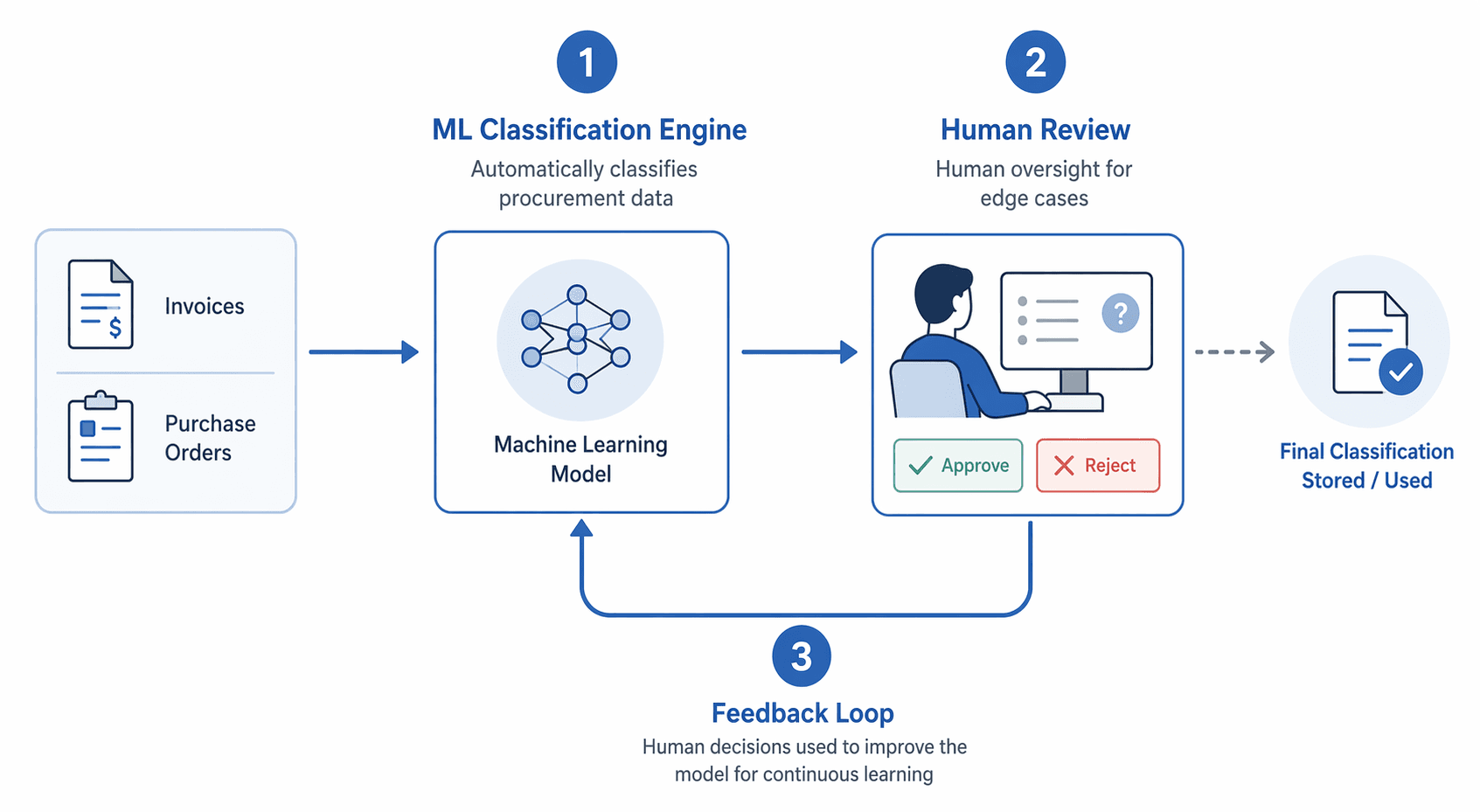
This is the easiest place to defend an early ML budget because the output is obvious to the business. The model takes messy invoice lines, supplier records, and item descriptions, then assigns them to a usable spend taxonomy. In the best-documented implementations, roughly 80% of transactions can be automated and accuracy can clear 95% when people stay in the loop [2].
That is a procurement result a finance leader can understand without translation. It means fewer analysts spending time reclassifying the same lines, faster visibility into what the organization is actually buying, and a cleaner spend base for category work. For a deeper technical look at the workflow, see How Machine Learning Transforms Spend Analytics.
The human reviewer is not decorative. They catch new suppliers, ambiguous descriptions, and odd one-off exceptions, then feed the corrections back into the model. That feedback loop is what keeps the system useful after the first rollout, when the easy mappings are already solved and the long tail starts showing up.
Supplier risk scoring is already real in production
Supplier risk monitoring is not the flashiest ML use case, but it has the strongest signal that production deployment is already happening at scale. ISG's 2025 State of Enterprise AI Adoption puts supplier risk at a 58% production rate, the highest among the procurement-adjacent ML use cases in its study, and reports average investment of $2.0M per deployment across enterprise back- and middle-office use cases [3].
That does not mean every deployment is an automatic win. It means the use case has enough operational urgency to survive budgeting, especially when it is tied to disruption monitoring, geopolitical exposure, sanctions, financial instability, or supplier performance signals that procurement teams already track. The model only matters if the alert leads somewhere specific: review, escalation, renegotiation, or a sourcing decision.
The practical advantage is that risk scoring can compress a lot of monitoring work into a queue that humans can actually handle. The failure mode is equally clear: too many alerts, no owner, and a dashboard that looks sophisticated while the team keeps working the old way underneath it.
Demand forecasting stretches the value case beyond procurement
Forecasting is where the numbers get broad enough to matter and broad enough to require caution. McKinsey's 2024 research says ML-driven forecasting can reduce forecast error by 20-50%, cut inventory by 20-30%, and reduce procurement spend by 5-15% [4]. Those are strong results, but they come from broader supply-chain settings, not procurement alone.
That boundary matters when the budget is being assigned. If the main gain is lower inventory, the value belongs partly to planning and operations. If procurement is close enough to demand signals, lead times, and supplier constraints to shape the forecast, then the model can create direct savings in sourcing and buying decisions as well. In practice, the best implementations are the ones where category data, seasonality, and supplier behavior are already measurable enough for the model to learn from.
Anomaly detection is useful, but narrower than the hype suggests
Anomaly detection has a legitimate place in procurement, especially where duplicate invoices, split purchase orders, unusual price changes, or payment exceptions create avoidable leakage. Its value is usually in reducing the number of things humans have to inspect by hand, not in replacing the review process.
That makes it a control-layer tool. The best implementations are boring in the right way: clear thresholds, clean escalation paths, and a review team that knows which alerts deserve attention. Without that structure, anomaly detection becomes another queue of false positives that procurement operations has to clean up.
Contract intelligence is moving fast on intent, not yet on depth
Contract intelligence is gaining traction because it saves time in places procurement teams can feel immediately: summarizing clauses, surfacing obligations, comparing versions, and routing work faster. Gartner expects 50% of organizations to use AI-enabled contract tools by 2027 [5], and Deloitte's 2025 Global CPO Survey shows why the interest is not just vendor marketing: spend analytics leads 2026 deployment priorities at 53%, followed by RFP/RFQ generation at 42% and contract summarization at 41% [6].
The catch is that contract work is only partly a summarization problem. The model still needs structured metadata, clause libraries, version control, and a handoff model for legal review when the tool finds something unusual. The closer the task is to routing and summarizing, the easier it is to operationalize. The closer it gets to legal judgment, the more the human review layer stays central.
The evidence points to a clear funding order
The sequencing is not mysterious. Spend classification is the safest first buy because the accuracy benchmark is already strong and the operational payoff is immediate. Supplier risk scoring is the next serious bet because production use is already widespread and the cost of missing risk is easy to explain. Demand forecasting deserves the next layer when procurement is close enough to planning to share the value. Anomaly detection and contract intelligence are credible, but they pay back best once the data foundation is usable and the workflow ownership is explicit [3][4][5][6].
That is the real pattern across machine learning in procurement: not transformation language, but usable data, defined handoffs, and budget expectations that match what production systems actually cost.
References
- Hackett Group. 2025 CPO Agenda Report.
- Industry sources on ML spend classification, including Suplari and Precoro.
- ISG. State of Enterprise AI Adoption 2025.
- McKinsey. AI in supply chain research 2024.
- Gartner. Leadership Vision for CPOs 2025.
- Deloitte. 2025 Global CPO Survey.
Comments
Join the discussion with an anonymous comment.