
A new McDonald's menu item starts with an awkward fact: before launch day, it has no sales history. The marketing calendar may be fixed, suppliers may already be lining up ingredients, restaurants may need freezer or cooler space, and operators still have to know whether the lunch rush will drain the product by 12:45 or leave cases sitting in the walk-in. That is the cold-start problem behind McDonald's AI demand forecasting for new product launches. The useful question is not whether AI can forecast demand in general. It is how a system creates a forecast that planners can use when the product itself has never sold a single unit.
McDonald's answer appears to depend less on a single model than on a loop: infer likely demand from product attributes and analogous launches, watch real transactions as soon as the item goes live, adjust for local context, and then push the signal into restaurant inventory, supplier planning, and digital-menu decisions. That is a more demanding standard than model accuracy in a dashboard. The forecast has to enter the kitchen before a stockout, the distribution network before replenishment misses the window, and the supplier conversation before the next production commitment.
The Launch Forecast Starts Before Sales Exist
For a repeat item, the planner can begin with its own history: last year's volume, weekday pattern, regional lift, promotional response, and substitution behavior. A new item does not offer that comfort. Attribute-based forecasting fills the gap by treating the new product as a bundle of comparable characteristics rather than as a blank row in the demand table.
In new-product forecasting, machine learning methods can use surrogate data from similar products, launch profile clustering, regression-style initialization, and transfer-learning approaches to estimate an opening forecast before item-level history exists.[1] For a quick-service restaurant, the attributes that matter are not abstract. They may include protein type, flavor family, price point, daypart, limited-time status, required ingredients, preparation complexity, promotional intensity, and whether the item resembles a known past launch closely enough to borrow its demand curve.
A hypothetical example makes the distinction clear. If a chain launches a spicy chicken sandwich, the model should not wait for that exact sandwich to accumulate weeks of history. It can begin from prior spicy items, chicken sandwiches, premium sandwich launches, comparable promotional campaigns, and stores where similar products over- or under-indexed. That opening estimate will be imperfect, but it is operationally better than treating every restaurant as equally likely to sell the same quantity.
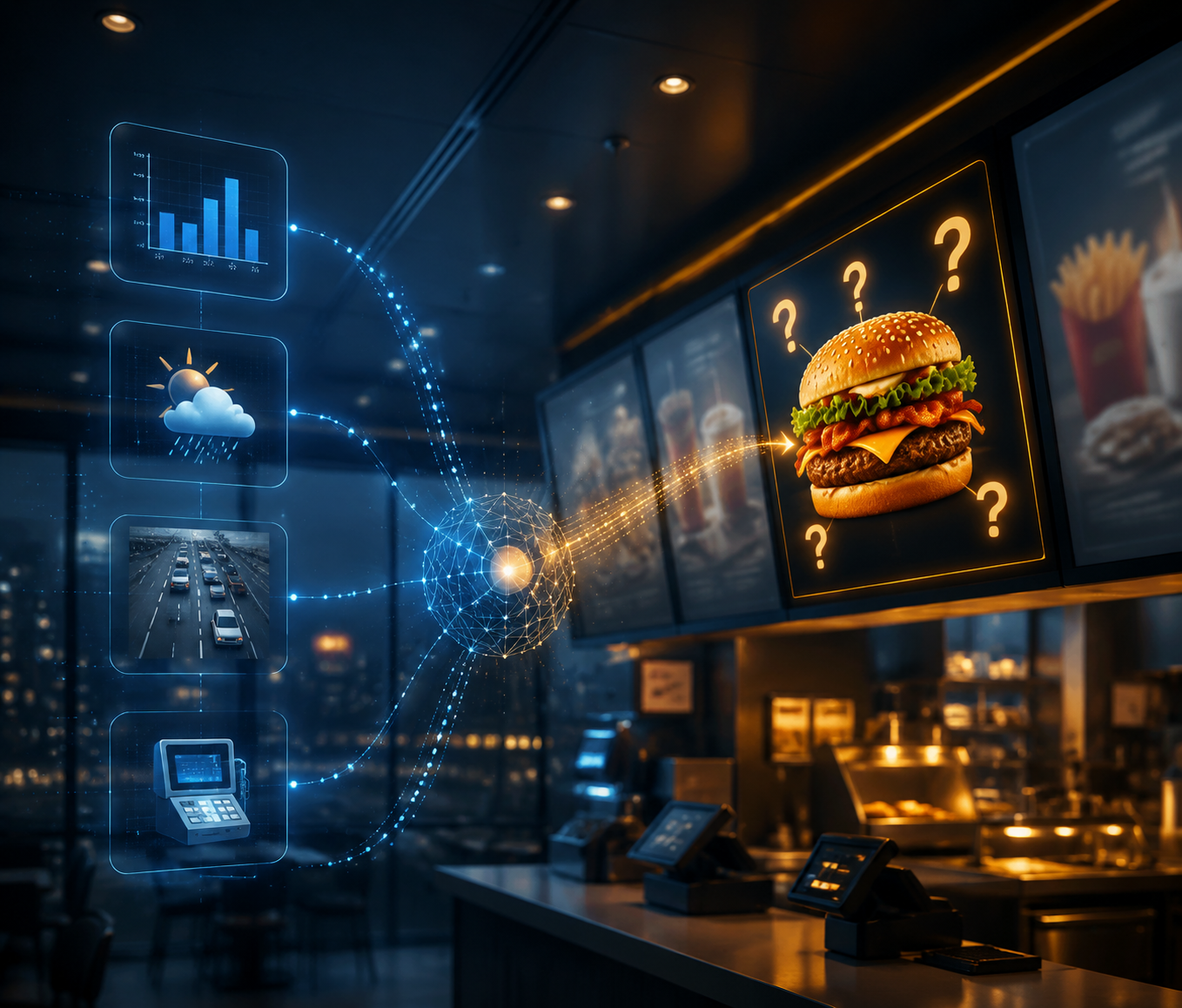
The McDonald's case becomes interesting because the forecast is not isolated from the rest of the operating system. Dynamic Yield's McDonald's case material describes digital menu boards that can change recommendations based on factors such as time of day, weather, restaurant traffic, and current item popularity; it also gives the practical example that if chicken patties run low, the menu can promote beef items instead.[2] That is a planning detail disguised as a merchandising feature. It means the system is not only predicting demand; it can also dampen or redirect demand when inventory makes the original forecast risky.
From Analog Launches to Live POS Correction
The first forecast for a new item is a starting position, not a verdict. Once launch day begins, the more valuable work is rapid correction. Early POS movement tells the system whether the launch is tracking above or below the profile borrowed from analogous products. The difference between a merely clever model and a useful restaurant forecast is how quickly that information changes decisions at store level.
| Signal | What It Contributes to a New-Item Forecast |
|---|---|
| Historical analogs | Initial demand shape when the new product has no direct sales history |
| Item attributes | Similarity matching across protein, format, price, daypart, preparation, and promotion type |
| Real-time POS | Launch-day correction when actual sales diverge from the assumed profile |
| Weather, traffic, and local events | Store-level context that can explain why similar restaurants behave differently |
| Restaurant inventory | Constraint signal that determines whether demand should be fulfilled, replenished, or shaped |
| Supplier forecast sharing | Forward view for upstream production and distribution planning |
This is where restaurant-level context earns its keep. Two stores may look similar in the historical data but diverge on launch day because one is next to a local event, one is hit by bad weather, or one sees a traffic pattern that shifts demand into the drive-thru. McDonald's corporate announcement of its Google Cloud partnership says the company planned to use cloud and edge technologies to connect restaurants more closely to digital platforms, with thousands of restaurants beginning hardware and software upgrades in 2024.[3] As of mid-2026, the source material supports the announced deployment direction, not an independently verified completion count.
Technology Magazine reports that McDonald's operates at a scale of more than 43,000 locations and describes the company's use of Google Distributed Cloud to process data closer to restaurants, including support for real-time insights and supply chain decision-making.[4] For new product introduction, that edge layer matters because the useful signal is perishable. A lunch-period POS surge is less valuable if it arrives after the store has already run through inventory, after the digital menu keeps promoting a constrained item, or after replenishment planning has moved on.
The architecture can be read as a sequence. The new item's attributes generate the first forecast. Analog launches supply the likely demand curve. Live POS confirms or challenges that assumption. External context explains local variance. Inventory status determines whether the system should encourage, limit, or substitute demand. Supplier-facing forecasts turn the restaurant signal into an upstream planning input.
Demand Shaping Is Part of the Forecasting System
Many forecasting discussions stop once the model predicts unit volume. In a restaurant network, that is only half the job. If demand exceeds supply, the system either lets the guest discover the stockout at the counter or it intervenes earlier by changing what the customer sees, what the crew prepares, and what the supply chain expects next.
Dynamic Yield is central to that closed loop. McDonald's acquired Dynamic Yield for roughly $300 million, a deal widely discussed because it moved personalization and decision logic directly into the ordering environment.[2][5] The important operating point is not simply that a menu board can personalize offers. It is that the menu board can become a demand-shaping surface tied to restaurant conditions.
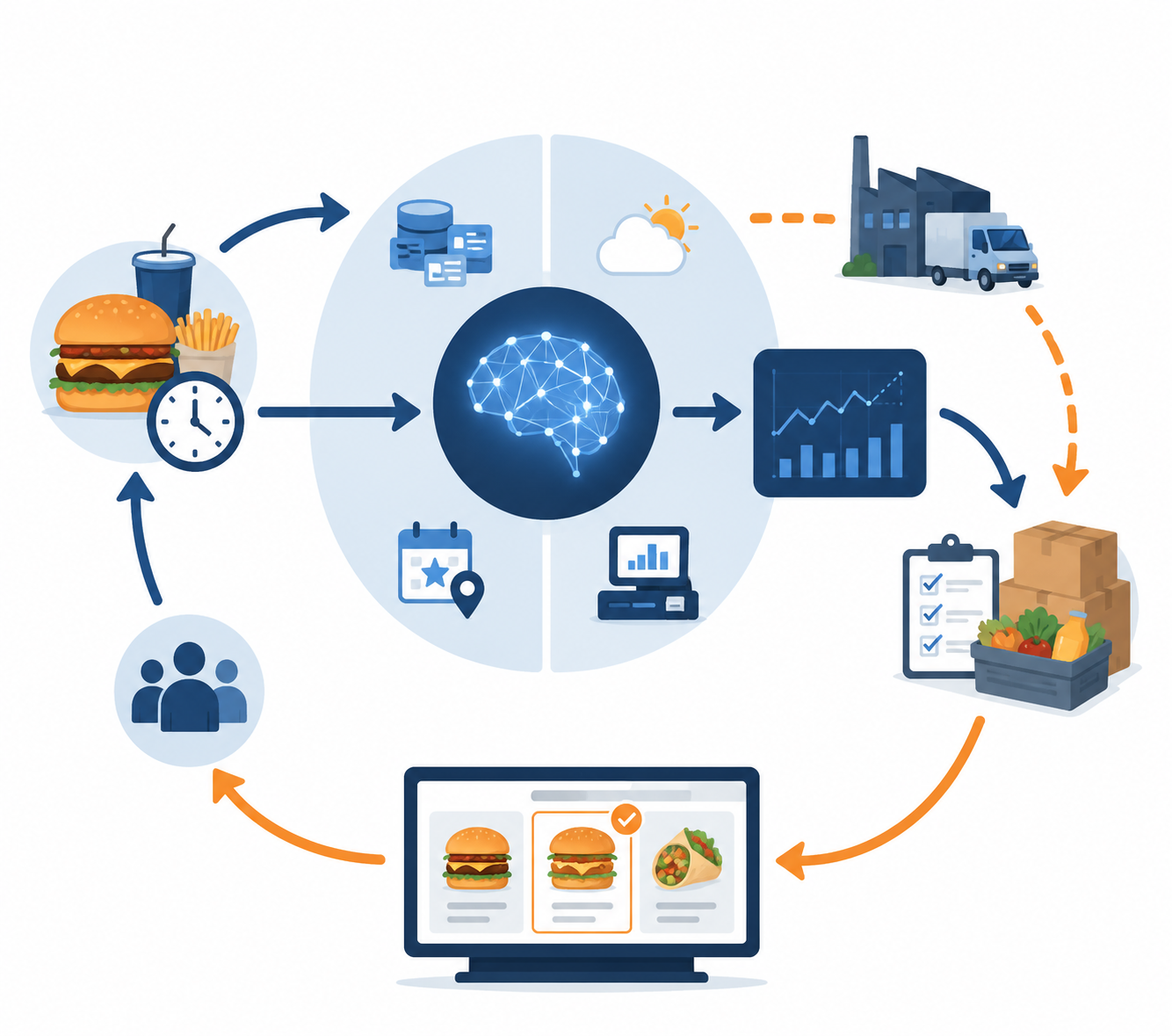
Klover.ai frames the McDonald's system as a flywheel that links customer demand prediction, restaurant stock levels, kitchen execution, and the supply chain. It cites former CEO Steve Easterbrook describing the ambition as connecting “the predictive nature of customer demand all the way through your stock levels in the restaurant and the kitchen, and flex it back down through the supply chain.”[5] That line is useful because it names the missing middle in many AI forecasting claims: the forecast has to travel through stock, kitchen, and supply response, not remain a planning artifact.
The chicken-patty example shows the mechanism. If the new item is chicken-based and a restaurant's patties are constrained, a conventional promotion engine might keep pushing the item because it is popular. A supply-aware decision engine can instead promote beef alternatives, reducing pressure on the constrained ingredient while still capturing demand that might otherwise become a lost sale.[2] That does not erase the forecast error. It gives the operation another lever while the forecast and replenishment plan catch up.
For planners, the important distinction is adoption versus effectiveness. A chain can install digital menu boards and still fail to improve new-item forecasting if the boards do not receive inventory constraints, if POS data is too delayed, or if supplier forecasts are not updated in time to matter. McDonald's case is compelling because the public materials point to integration across multiple layers: menu decisioning, restaurant telemetry, edge infrastructure, supplier visibility, and historical demand logic.
Where the Supplier Signal Enters
New menu items are especially unforgiving upstream. Ingredients may be perishable, packaging may be item-specific, and production lead times may force commitments before the market has spoken. A restaurant-level forecast that never reaches suppliers is a local optimization problem, not a launch-planning system.
Technology Magazine reports that McDonald's shares an eight-week rolling forecast with suppliers, giving upstream partners visibility into expected demand and helping coordinate inventory and replenishment decisions.[4] For a new item, that rolling window is where the cold-start forecast becomes financially consequential. If launch-day sales revise the expected curve, the change needs to affect production expectations, distribution positioning, and restaurant replenishment before inventory either expires or disappears.
This also explains why the edge-computing story should not be treated as a separate technology announcement. Processing data closer to restaurants can reduce dependence on distant data-center round trips for time-sensitive decisions, which matters when digital channels, kitchen status, and POS movement need to influence the same operating loop. The cloud partnership is infrastructure in service of a planning problem, not the planning result itself.[3][4]
Readers looking at a narrower version of this same cold-start pattern can compare the related ChainSignal use case on AI forecasting for limited-time breakfast items. The same principles apply: use attributes and analogs to open the forecast, then let live sales and external context revise it before the promotion window closes.
The Evidence Is Promising, but Not All of It Carries the Same Weight
The strongest public evidence for McDonald's system is architectural: the Dynamic Yield acquisition, the Google Cloud partnership, the stated edge-deployment direction, the reported scale of more than 43,000 locations, and the eight-week supplier forecast-sharing mechanism.[2][3][4][5] Those materials do not prove every forecast improved by a specific percentage, but they do show the components needed for new-product demand sensing to affect operating decisions.
Outcome figures require more careful handling. WorldMetrics, citing Food Industry Association 2023 data, reports that AI-driven demand forecasting has been associated with a 40% reduction in new menu item failure rates in the fast-food industry.[6] That should be read as directional industry evidence from a secondary source, not as an audited McDonald's-specific result. It supports the argument that better launch forecasting can matter, but it should not be used as a clean ROI guarantee.
Similarly, Supply Chain Dive coverage has been secondarily referenced for figures including a 22% reduction in overstock and 30% fewer delivery delays tied to McDonald's AI demand-planning efforts.[7] Those are operationally relevant metrics if verified, because overstock and late deliveries are exactly where a poor new-item forecast becomes expensive. But without a directly accessible primary methodology in the provided material, they should be attributed rather than treated as settled benchmark performance.
The familiar claim that most new consumer products fail is less useful here unless tied to a named, accessible source. The practical lesson does not need a dramatic failure statistic. A planner already knows the risk: commit too little and the launch loses sales; commit too much and restaurants inherit waste, congestion, and markdown pressure. The McDonald's case is valuable because it shows how a chain can reduce that uncertainty by connecting the first forecast to fast feedback and constrained-demand decisions.
What Transfers Beyond McDonald's
The transferable pattern is not “buy the same stack.” McDonald's has advantages that most chains cannot simply copy: global transaction volume, standardized menu architecture, a large supplier network, existing digital ordering surfaces, and the capital history behind a roughly $300 million Dynamic Yield acquisition.[5] The company can justify infrastructure that would look excessive in a smaller regional chain.
What does transfer is the forecasting sequence. Start new-product planning with attributes and analogs instead of waiting for item history. Define which historical launches are similar enough to borrow from. Feed POS data back into the forecast as soon as the launch opens. Add external signals only where they explain real store-level variance. Connect the revised forecast to inventory, replenishment, menu promotion, and supplier visibility.
A smaller chain may approximate the loop selectively. It might begin with attribute-based launch forecasts in its demand-planning tool, update forecasts daily rather than in near real time, and use manual rules to pause promotion when inventory drops below a threshold. That is less elegant than the McDonald's architecture, but it preserves the operating logic: the forecast should move before the launch is over.
The decision point for QSR and food retail planners is therefore not whether AI forecasting is fashionable. It is whether the organization has enough clean product attributes, historical launch data, timely POS feeds, inventory visibility, and supplier integration to make the forecast actionable. Without those pieces, the model may still produce a number. It just may not reach the restaurant, distribution center, or supplier early enough to change the outcome.
References
- Get Started Using Machine Learning for New Product Forecasting, ToolsGroup.
- McDonald's, Dynamic Yield.
- McDonald's and Google Cloud Announce Strategic Partnership to Connect Latest Cloud Technology and Apply Generative AI Solutions Across Its Restaurants Worldwide, McDonald's Corporation, December 2023.
- How AI Is Powering McDonald's Global Supply Chain, Technology Magazine.
- Klover.ai analysis of McDonald's demand-shaping flywheel, Klover.ai.
- AI in Fast Food Industry Statistics, WorldMetrics, citing Food Industry Association 2023 data.
- McDonald's AI demand planning coverage, Supply Chain Dive.
Comments
Join the discussion with an anonymous comment.