
Defense ship dismantling looks like a waterfront job until the file reaches the contracting desk. Before steel is cut, the government has to decide who is eligible to bid, which subcontractors can be trusted around controlled material, how price and recovered value are treated, which exceptions require review, how modifications are recorded, and what proof remains when the contract is closed. That is where AI-enabled contract management for defense logistics ship dismantling becomes a practical question rather than a technology label.
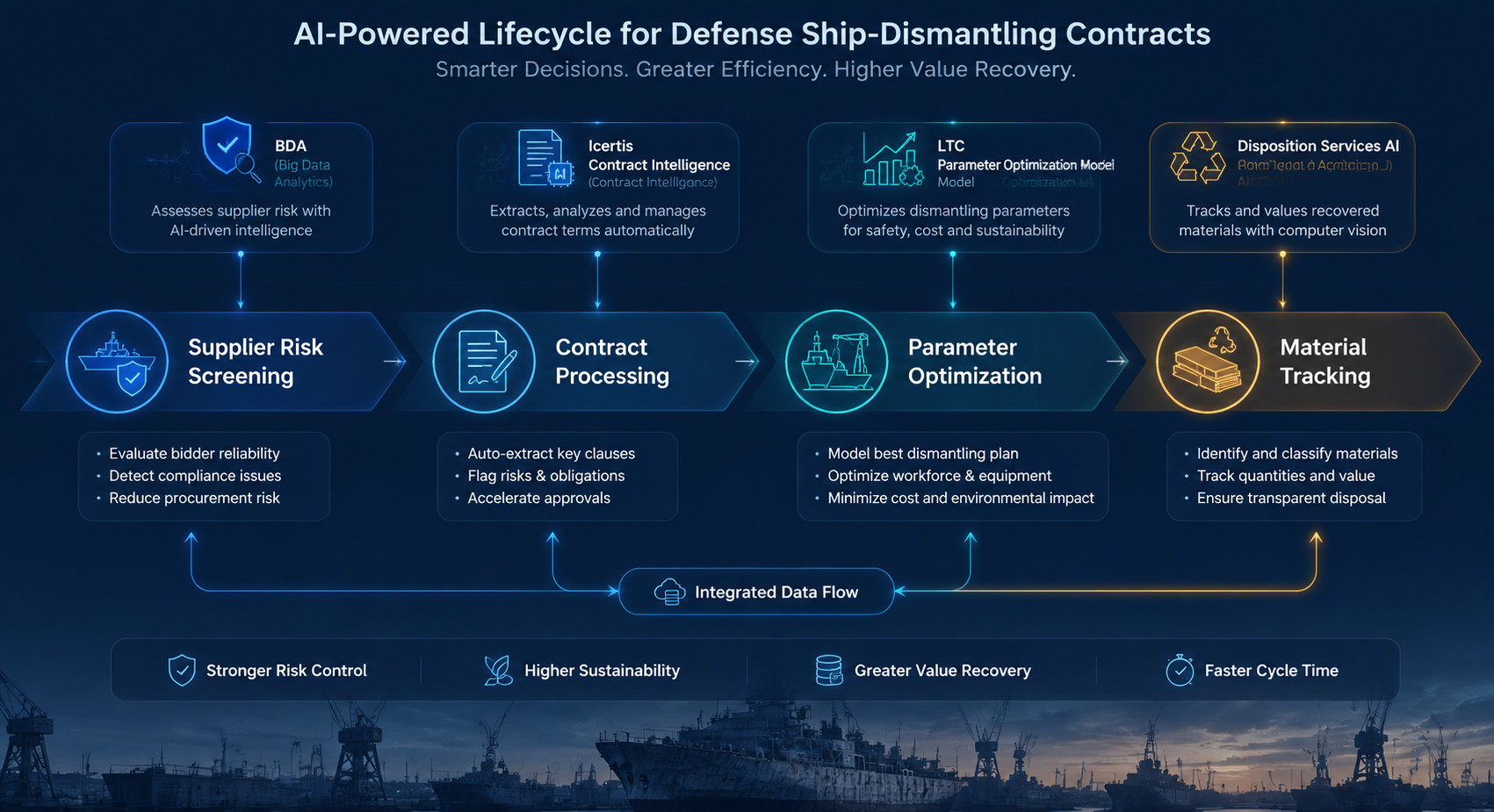
The Defense Logistics Agency now has several AI-enabled components that touch that lifecycle: Bid Data Analytics for supplier risk, Icertis Contract Intelligence for contract processing and exception handling, the LTC Parameter Optimization Model for long-term contract structure, and Disposition Services AI for material-handling visibility. Those are not the same thing as a fully integrated ship-dismantling contract pipeline. They are more useful than that kind of claim would be, because each one lands on a known failure point.
The measurable promise is large enough to matter. DLA’s February 2026 Icertis deployment is projected to reduce contract cycle times by 30–40%, cut errors by more than 50%, and generate tens of millions of dollars in savings over five years, while DLA already processes about 10,000 automated contract orders per day.[1] Those figures should stay in their proper box: they are deployment projections, not audited outcomes from completed ship-dismantling awards.
The Contract Lifecycle Is the Real Workload
A ship-recycling contract can absorb delay long before dismantling starts. Supplier screening can stall because the government has to check business history, compliance exposure, pricing behavior, and the risk of counterfeit or non-conformant items entering the support chain. Solicitation and bid evaluation add another layer: bidders may rely on subcontractors, recovered material values can move, and contract terms have to survive a multi-year performance period.
Once awarded, the contract keeps changing shape. Equipment is removed, material is sorted, environmental and disposition requirements have to be documented, and contract modifications may become necessary when the physical condition of a vessel does not match the assumptions in the paper file. Closeout is not ceremonial. It is where missing approvals, weak exception documentation, and unclear material records become audit findings.
| Lifecycle pressure point | AI component with a documented DLA basis | What it can credibly reduce |
|---|---|---|
| Supplier vetting before award | Bid Data Analytics | High-risk vendor exposure before the procurement process absorbs it |
| Contract processing and exception handling | Icertis Contract Intelligence | Manual cycle time, document errors, and human review of routine exceptions |
| Long-term contract term setting | LTC Parameter Optimization Model | Poor parameter choices in variable-value, multi-year contract structures |
| Material and asset visibility during performance | Disposition Services AI | Slow reporting and unnecessary equipment purchases |
That map is the right way to read DLA’s AI activity. The tools are not one application with a ship-dismantling button. They are a phased overlay on the contract lifecycle, and the evidence is strongest when a named tool is tied to a named administrative burden.
BDA Moves Supplier Risk Earlier in the File
The most concrete starting point is DLA’s Bid Data Analytics supplier-risk work. In a DLA analysis of 43,000 vendors, BDA flagged more than 19,000 as high risk for issues including counterfeit, non-conformant, or overpriced items.[2] That is not a shipyard anecdote; it is a procurement control finding at a scale that matters.
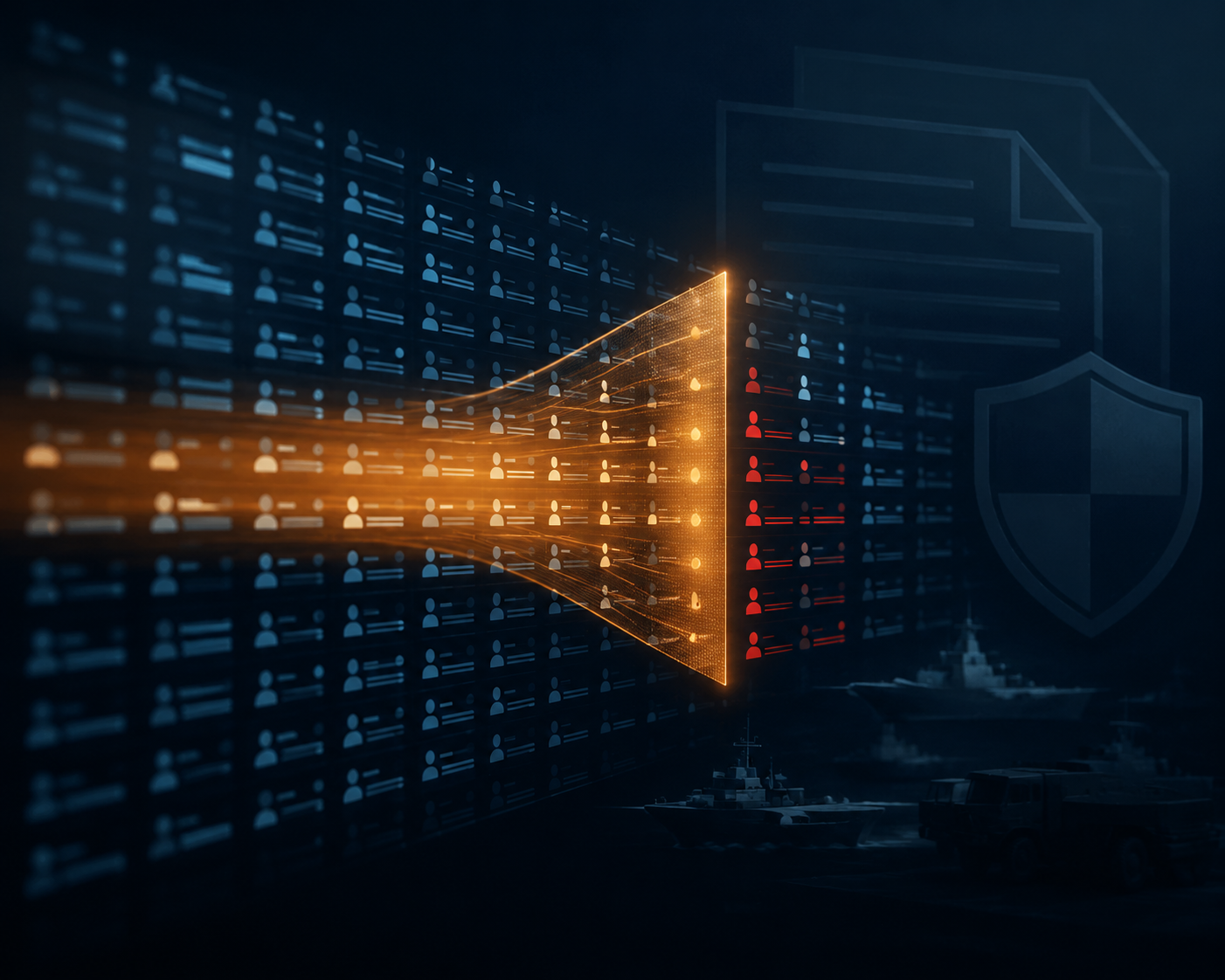
For ship dismantling, the value is not that BDA magically knows which recycler will perform well. The value is that risk can be surfaced before the contract file has already accumulated momentum around a vendor. A contracting officer can see whether a bidder or a related supplier has patterns that deserve review before award, rather than discovering the problem during performance or closeout.
The distinction matters. The 43,000-vendor analysis is documented as a screening result, not proof of continuous real-time monitoring across every dismantling subcontractor relationship. It still gives DLA a defensible input at the front end of the procurement process: a way to separate ordinary competition from vendors that need a harder look before they are allowed near a sensitive logistics chain.
That broader supplier-risk baseline is also why DLA’s BDA work belongs beside, but not inside, wider military logistics discussions. ChainSignal’s overview of AI in military supply chain logistics covers the broader operating picture; the narrower question here is how that screening capability changes the ship-dismantling contract file before award.
Icertis Targets the Administrative Middle, Where Exceptions Accumulate
The Icertis deployment deserves the most careful treatment because it carries the headline performance claims. DLA selected Icertis Contract Intelligence in February 2026 to support the federal push toward digital contract management, with projected reductions of 30–40% in cycle time, more than 50% in errors, and tens of millions of dollars in savings over five years.[1]
That kind of gain would be meaningful in any procurement shop, but it is especially relevant to DLA because scale turns clerical delay into operational drag. DLA’s existing volume of roughly 10,000 automated contract orders per day gives the agency a large base of routine actions, and the stated AI target is to handle exceptions without human intervention where the system can do so appropriately.[1] The practical question is not whether a contract platform can store clauses. It is whether exception routing, approval evidence, and term consistency improve without hiding judgment calls that a contracting officer later has to defend.
In a ship-dismantling context, the same pressure appears in several places. A bid may require clarification. A clause may need to reflect disposition requirements. A modification may be triggered by a vessel condition that changes the work package. A closeout reviewer may need to see why a deviation was allowed and who approved it. If contract intelligence shortens those loops, the benefit is not simply faster paper movement; it is a cleaner administrative chain from solicitation through closeout.
The evidence still stops short of a completed dismantling result. The 30–40% and greater-than-50% figures are projected outcomes tied to the DLA Icertis deployment, not measured reductions from ship-recycling contracts already run end to end through the system.[1] That caveat does not make the deployment unimportant. It keeps the claim honest: Icertis is a credible contract-management layer for the DLA environment, and its strongest documented value is projected administrative compression at enterprise scale.
Parameter Optimization Belongs Before the Contract Is Locked
Ship dismantling is a poor fit for lazy contract parameters. The work can run across long timelines, and the economics can be affected by recovered material value, reusable equipment, environmental handling, storage constraints, and schedule uncertainty. A term that looks safe at award can become expensive or awkward when conditions move.
DLA Aviation’s LTC Parameter Optimization Model is relevant because it uses machine learning to optimize terms for Long-Term Contracts.[3] The documented model is not presented as a fully deployed ship-recycling contract engine. Its usefulness here is more specific: it shows how DLA is applying AI to the problem of setting contract parameters before the government commits to a long-term structure.
Transferred carefully, that logic fits dismantling. A ship-disposal contract may need term choices that account for duration, variable outputs, pricing exposure, and material recovery assumptions. AI-supported parameter setting can help procurement staff test those choices earlier, before they become modification requests or disputed expectations during performance.
This is also where overclaiming would be easy. The available evidence supports a narrower conclusion: DLA has a documented machine-learning approach for optimizing long-term contract parameters, and that approach is applicable to the contract-design problems found in ship dismantling. It does not prove that every dismantling award has already been optimized through that model.
Disposition Services AI Is the Closest Operational Proof Point
DLA Disposition Services is the natural place to look for operational proof because it manages the Navy’s ship-recycling program and sits close to the asset and material side of the lifecycle. Its AI work for material handling equipment produced two results that are easier to understand than broad lifecycle language: about $10 million in avoided unnecessary purchases and monthly reporting compressed from 45 days to 2–3 minutes.[4]
Those figures matter because material visibility is not a back-office nicety in dismantling. If equipment status, handling capacity, or material movement is poorly tracked, the contract office sees the consequences later as schedule pressure, modification requests, disputed quantities, or weak closeout documentation. A monthly report that arrives after 45 days is already stale for many management decisions. A report that can be produced in minutes changes who can act while the issue is still live.
This proof point should not be stretched into a claim that AI now tracks every component removed from a decommissioned vessel. The documented case concerns material handling equipment, not a full digital twin of ship recycling. But it is still the closest DLA example to the physical side of dismantling: AI reducing reporting latency and preventing purchases that the existing asset picture did not justify.
Governance Is What Keeps the Tools From Becoming Islands
DLA established its AI Center of Excellence in June 2024 to support governance, model validation, and scaling across agency supply chains.[5] For ship-dismantling contract management, that matters less as an organizational announcement than as a control point. Supplier-risk analytics, contract intelligence, parameter optimization, and material-handling AI all produce outputs that someone may rely on in a procurement file.
A contracting officer does not need another dashboard that cannot be explained during review. The useful governance questions are plain: Which data fed the risk flag? Which exception was handled automatically? Which contract parameter did the model recommend, and what human approval followed? Which material report changed a purchasing or performance decision? If those answers are not preserved, automation simply moves the weak point from manual processing to auditability.
The AI Center of Excellence gives DLA a framework for preventing that outcome, but it does not by itself prove integration. Integration would mean the supplier screen, solicitation record, contract terms, exception history, performance data, material reports, modifications, and closeout evidence can be connected without forcing staff to rebuild the story manually after the fact.
Where the Evidence Stops
DLA’s current position is stronger than a pilot story and weaker than an end-to-end transformation claim. BDA has demonstrated large-scale supplier-risk screening. Icertis has been selected for enterprise contract intelligence with projected cycle-time, error, and savings benefits. The LTC Parameter Optimization Model shows how machine learning can improve long-term contract design. Disposition Services AI has already compressed reporting time and avoided unnecessary purchases in material-handling operations.[1][2][3][4]
That combination is directly relevant to ship dismantling because the contract lifecycle carries the same burdens: vendor risk, exception volume, long-term parameter choices, material visibility, and defensible closeout. The responsible conclusion is not that AI has already transformed defense ship dismantling from award to final disposition. It is that DLA now has credible AI components for the main pressure points in that lifecycle, with projected contract-management gains large enough to deserve attention and governance mature enough to support scaling.
The remaining boundary is integration. Until DLA can show these tools operating as a connected pipeline across actual ship-dismantling contracts, the best reading is phased compression and de-risking, not completed automation. For the people who have to defend the file later, that distinction is not cautious wording. It is the difference between a useful AI control and an unearned procurement story.
References
- Icertis Contract Intelligence deployment, Icertis press release and Nextgov, November 2025 / February 2026.
- DLA's BDA Supplier Risk Assessment, DLA.mil, May 2025.
- LTC Parameter Optimization Model, DLA.mil.
- DLA Disposition Services AI for material handling equipment, DLA.mil.
- DLA AI Center of Excellence, DLA.mil, June 2024.
Comments
Join the discussion with an anonymous comment.