
The Red Sea problem for supply chain planners is no longer simply whether a container ship can avoid a dangerous lane. It is whether the planning system can absorb a chokepoint that keeps changing the answer to basic operating questions: which route is realistic, which port can take the volume, which inventory buffer is still enough, and which customer promise has already become too expensive to keep.
By November 2024, Suez Canal container vessel volume had fallen 72% versus 2023, according to project44’s analysis of the first year of Houthi attacks on Red Sea shipping.[1] The operational effect was not a neat one-time delay. Asia-Europe transit times stretched by roughly 10–14 days, and 5–7% of the global container fleet was tied up by longer routings around southern Africa.[1] That is enough capacity distortion to turn a “contingency route” into a rolling constraint on the whole plan.
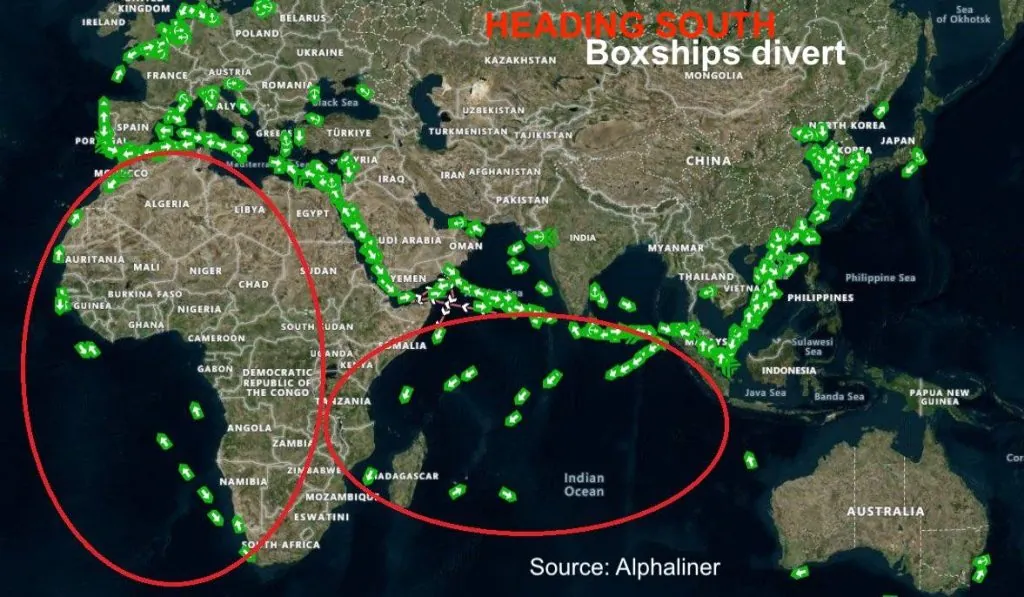
This is where AI scenario planning stops being a software category and becomes a budget argument. Static contingency planning assumes the organization can decide in advance what it will do when the exception occurs. The Red Sea crisis has made the exception persistent. A reroute through the Cape of Good Hope may be the right answer for one sailing window and the wrong answer three weeks later if port congestion, carrier schedules, freight rates, or customer allocation priorities shift again.
The costs are not limited to ocean transit. Siemens Digital Logistics, citing Portcast, described roughly $6 billion per week in disrupted global trade flows and reported that China-to-Brazil container shipping costs jumped 249% in a single year.[2] Those figures do not tell a planner which SKU to protect first, but they do explain why the old habit of revisiting contingency assumptions once a quarter is too slow for a chokepoint disruption that keeps feeding through freight economics.
The Planning Failure Is Timing, Not Awareness
Most enterprises affected by the Red Sea disruption are not blind. They can see vessel delays. They can see freight quotes moving. They can see customers asking for revised delivery dates. The failure is that those signals often arrive after the practical choices have narrowed.
A visibility dashboard can show that a shipment has been rerouted. It may even show the revised ETA. That is useful, but it is not the same as deciding two months earlier whether to pull forward production, split allocation by margin, shift a supplier lane, reserve space through a different port, or change the promise date before sales has already committed it.
The static plan breaks because it freezes too many assumptions at once. It treats the Suez route, the Cape diversion, alternate ports, safety stock, premium freight, and supplier substitution as separate playbook entries. In reality, they interact. A longer sailing time consumes fleet capacity. Capacity pressure changes rates and carrier behavior. Rate changes affect which products can absorb the cost. Longer lead times change inventory exposure. Inventory exposure changes customer allocation. By the time all of that is rebuilt manually, the plan may already be describing yesterday’s network.
AI scenario planning is valuable only if it changes that timing. The standard should not be whether the software produces a more polished scenario deck. It should be whether planners get enough warning and enough decision structure to make a different operating choice before delay, cost, and service damage are locked in.
What AI Scenario Planning Has To Do Differently
For Red Sea-dependent supply chains, AI scenario planning works less like a single forecasting model and more like a workflow. The useful version has three linked jobs: represent the supply chain as it actually behaves, sense changes before they appear as missed milestones, and simulate decisions across route, inventory, sourcing, and service constraints.
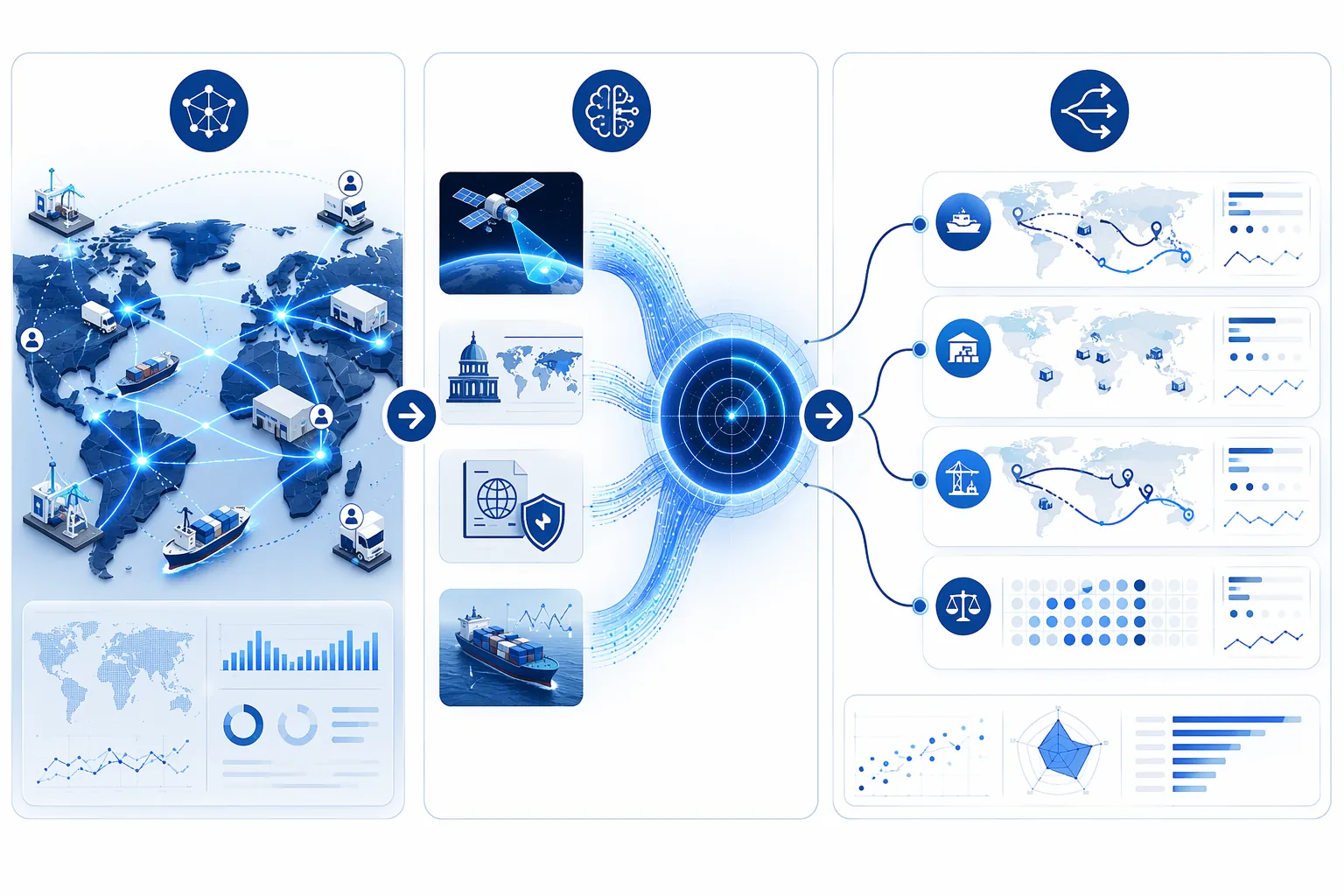
The digital twin is the operating model
A digital twin is only useful here if it reflects the constraints planners actually fight with. That means lanes, ports, suppliers, contract carriers, lead times, inventory buffers, production calendars, warehouse capacity, customer priorities, and substitution rules. A route map alone is too thin. A lane-level model that ignores minimum order quantities, port handling constraints, or product allocation rules will produce scenarios that look clean and fail in execution.
In a Red Sea scenario, the twin should be able to answer questions such as: which purchase orders are exposed to the Suez route, which finished goods will miss the selling window if transit adds two weeks, which customers can tolerate delay, which suppliers can shift origin ports, and which products justify higher freight cost. That is not glamorous modeling work. It is master data, lane data, inventory policy, and business rules brought close enough together that a scenario can be executed rather than admired.
The sensing layer has to watch behavior, not just headlines
The Red Sea crisis is geopolitical, but planners cannot wait for a clean geopolitical forecast. They need operational signals that indicate carriers, ports, insurers, and governments are changing behavior. Industry materials on AI disruption planning describe models ingesting satellite data, political stability indices, trade policy signals, and carrier behavior patterns to generate 60–90 day advance disruption warnings.[4] That kind of claim should be treated carefully because the public evidence base is vendor-led, but the direction is right: the signal that matters is often a pattern of decisions, not a single event.
Carrier behavior is especially important. If a carrier quietly removes Suez from a schedule, delays a restart, adjusts blank sailings, or tests a limited re-entry while competitors stay away, the planning implication is different from a generic “Red Sea risk elevated” alert. The model has to translate those movements into exposure by lane, product, supplier, and customer promise.
Simulation has to compare decisions that compete for the same capacity
The simulation layer is where AI scenario planning earns or loses trust. A planner does not need twenty theoretical futures. They need to compare a small number of executable choices while there is still time to act.
| Planning choice | What the scenario must test | Who has to act |
|---|---|---|
| Reroute around the Cape of Good Hope | Added transit time, freight cost, vessel capacity, customer service impact | Logistics, sales, finance |
| Pre-position inventory | Working capital, warehouse space, demand uncertainty, obsolescence risk | Planning, finance, commercial teams |
| Use alternative ports | Port capacity, drayage availability, customs flow, inland network impact | Logistics, brokers, regional operations |
| Shift supplier or origin | Qualification status, lead time, cost, volume limits, quality risk | Procurement, quality, planning |
| Change customer commitments | Allocation rules, margin exposure, contractual penalties, account priority | Sales, customer service, legal |
The point is not that the model chooses automatically. In most enterprises, it should not. The point is that the model makes the tradeoffs visible early enough that the S&OP or control tower conversation can move from “what happened?” to “which option are we authorizing, and who owns the consequence?”
That distinction matters because many organizations already have disruption dashboards. A dashboard can create awareness without changing authority. Scenario planning has to connect the alert to an executable decision path: reroute approval thresholds, inventory release rules, supplier escalation, allocation logic, and customer communication triggers. ChainSignal’s related work on AI capabilities for disruption planning is useful here because capability selection should follow the disruption type, not the software category.
The Evidence Is Promising, But Not Yet Clean
The strongest case for AI scenario planning is operational logic backed by directional industry benchmarks, not a settled body of independent academic evidence. Trax Technologies cites MIT Center for Transportation & Logistics research indicating that AI-powered scenario planning can enable 35% faster response and reduce disruption-related costs by 23% on average.[3] Those numbers are worth paying attention to, but they should not be repeated inside a business case as audited ROI for every company.
The same caution applies to preparedness claims. Debales AI, citing Ivalua, reports a 98% versus 0% preparedness gap between organizations using mature AI disruption planning and non-adopters for geopolitical shocks.[4] That is a stark framing, and it likely reflects survey-based self-reporting rather than an objective stress test of every respondent’s network. Still, the underlying point is credible: organizations that have modeled disruption paths, data feeds, and decision rules before the crisis are in a different position from organizations starting with a blank spreadsheet.
Vendor materials also describe an unnamed automaker that reportedly avoided $220 million in losses during the 2024 Red Sea crisis by using AI-supported rerouting through 12 alternative ports pre-mapped with political stability scores.[5] Because the company is unnamed and the case is not independently audited in the available materials, it should be read as an illustration of the workflow rather than proof of a general outcome. What makes it useful is not the size of the claimed loss avoidance. It is the sequence: map alternatives before the disruption hardens, score them against risk variables, and move freight before the best options are exhausted.
Market-size figures add momentum but little decision quality. Trax cites McKinsey estimates that the global digital twin market could reach $125–150 billion by 2032, with 30–40% annual growth.[3] Siemens described the maritime AI market at $4.3 billion in 2025, growing 40.6% annually.[2] Those numbers suggest investment is flowing into the category. They do not prove that a specific digital twin reflects a company’s real supply constraints or that a scenario recommendation will be acted on in time.
Where AI Planning Usually Breaks
The first break is data quality. If purchase orders are late, lane mappings are incomplete, supplier lead times are averages no one believes, and inventory records are not trusted by the people who replenish stock, the model will only automate weak assumptions. Red Sea scenarios are particularly unforgiving because a few days of transit error can change whether inventory arrives before a production stop or after it.
The second break is an over-simplified twin. Some tools model the transportation network but not the business rules that make a decision executable. A scenario may show that an alternative port reduces delay, while ignoring inland capacity, customs handling, warehouse appointment limits, or the fact that the customer order tied to that container is lower priority than another order using the same scarce freight budget.
The third break is governance. AI can rank scenarios, but it cannot quietly change the company’s tolerance for cost, service risk, or inventory exposure. If finance will not approve earlier inventory positioning, if sales will not accept allocation rules, or if procurement cannot qualify alternate suppliers until after the disruption, the organization has bought faster alerts without buying faster decisions.
That is why Red Sea scenario planning should be designed around decision rights as much as data feeds. A useful implementation identifies who can authorize a Cape diversion, who can release extra inventory, who can approve premium freight, who can change a customer promise, and what evidence each person needs before saying yes. Without that, the model becomes another source of urgency in a room already full of urgency.
A Practical Test For Red Sea-Exposed Networks
The cleanest way to evaluate AI scenario planning is to test it against decisions the business actually struggled with during the Red Sea disruption. Do not start with a generic AI roadmap. Start with a shipment lane, product family, supplier group, or customer segment where the Cape diversion changed cost, service, or inventory exposure.
- Can the system identify which open orders, inventory positions, and customer commitments are exposed to Red Sea routing within the planning horizon?
- Can it model the difference between Suez transit, Cape diversion, alternate port routing, and supplier-origin changes without manually rebuilding the spreadsheet?
- Can it show the working-capital, service-level, and freight-cost tradeoffs before the decision window closes?
- Can planners trace why the model favors one option over another, including the data signals and constraints behind the recommendation?
- Can the recommended action flow into execution systems or approved workflows, rather than stopping as a dashboard insight?
A company that cannot answer those questions does not yet have scenario planning in the operational sense. It may have visibility, risk scoring, or a promising pilot. Those are useful ingredients, but they do not replace the planning muscle required for a prolonged chokepoint disruption.
A company that can answer them has a stronger case for moving beyond static, calendar-based contingency planning. The Red Sea crisis is exactly the kind of disruption where the plan has to keep moving: not because the organization wants more scenarios, but because the cost of waiting for the next formal review can be a missed sailing, a locked freight premium, a production shortage, or a customer promise no one can still meet.
What Becomes Necessary
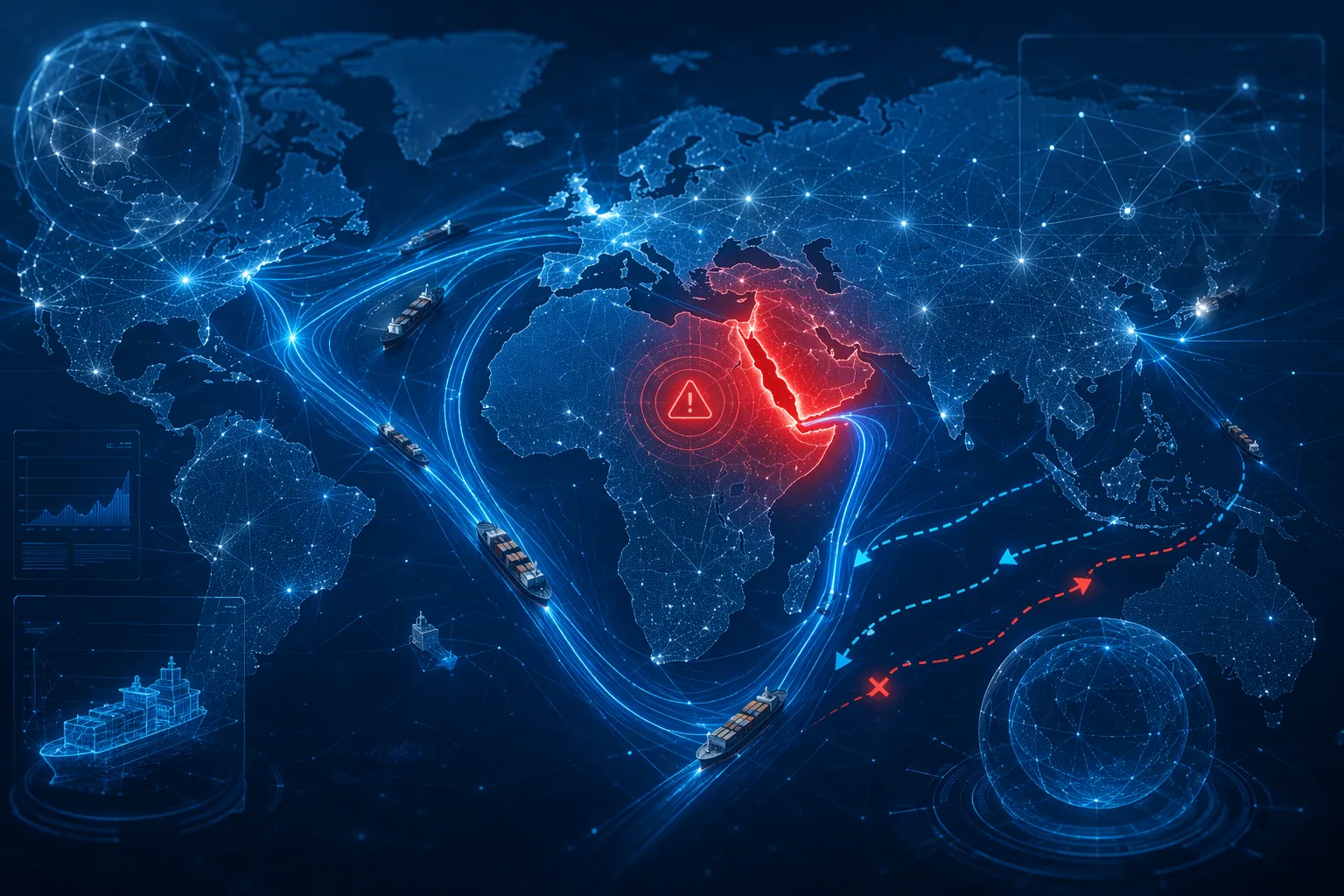
For supply chains dependent on Red Sea-adjacent lanes, AI scenario planning is moving from an advanced planning experiment toward a continuity capability. The reason is not that AI makes geopolitical disruption forecastable. It does not. The reason is that prolonged chokepoint volatility forces planners to evaluate route, capacity, inventory, sourcing, and customer commitments together, repeatedly, under time pressure.
The organizations that benefit will be the ones with mature enough data, credible enough digital twins, and clear enough decision processes to act before disruption costs are already embedded in the network. The rest may still get faster alerts. In the Red Sea environment, faster alerts without executable choices are not resilience.
References
- The Red Sea Crisis: A Year of Houthi Attacks, project44
- When sea freight gets smarter, Siemens Digital Logistics, September 5, 2025
- AI-Powered Scenario Planning, Trax Technologies
- How AI Manages Risk and Disruptions in Supply Chains, Debales AI
- Navigating Turbulent Waters: How Geopolitical Shifts and AI-Powered Visibility Stabilize Global Supply Chains, Sensos
Comments
Join the discussion with an anonymous comment.