
The first reassuring sentence in a procurement meeting is usually the least useful one: “We have inventory.” For AI chips, inventory can absorb a delayed shipment, a price spike, or a supplier that needs a quarter to catch up. It cannot absorb three input lines breaking on three different clocks.
That is the planning problem the Iran war has created for AI chip supply chains. The visible shock is energy. The downstream shock is petrochemicals. The quieter structural shock is helium, because the affected supply is concentrated, the recovery timeline is measured in years, and the usual comfort moves—pay more, qualify an alternate, lean on a strategic reserve—do not solve the shortage.
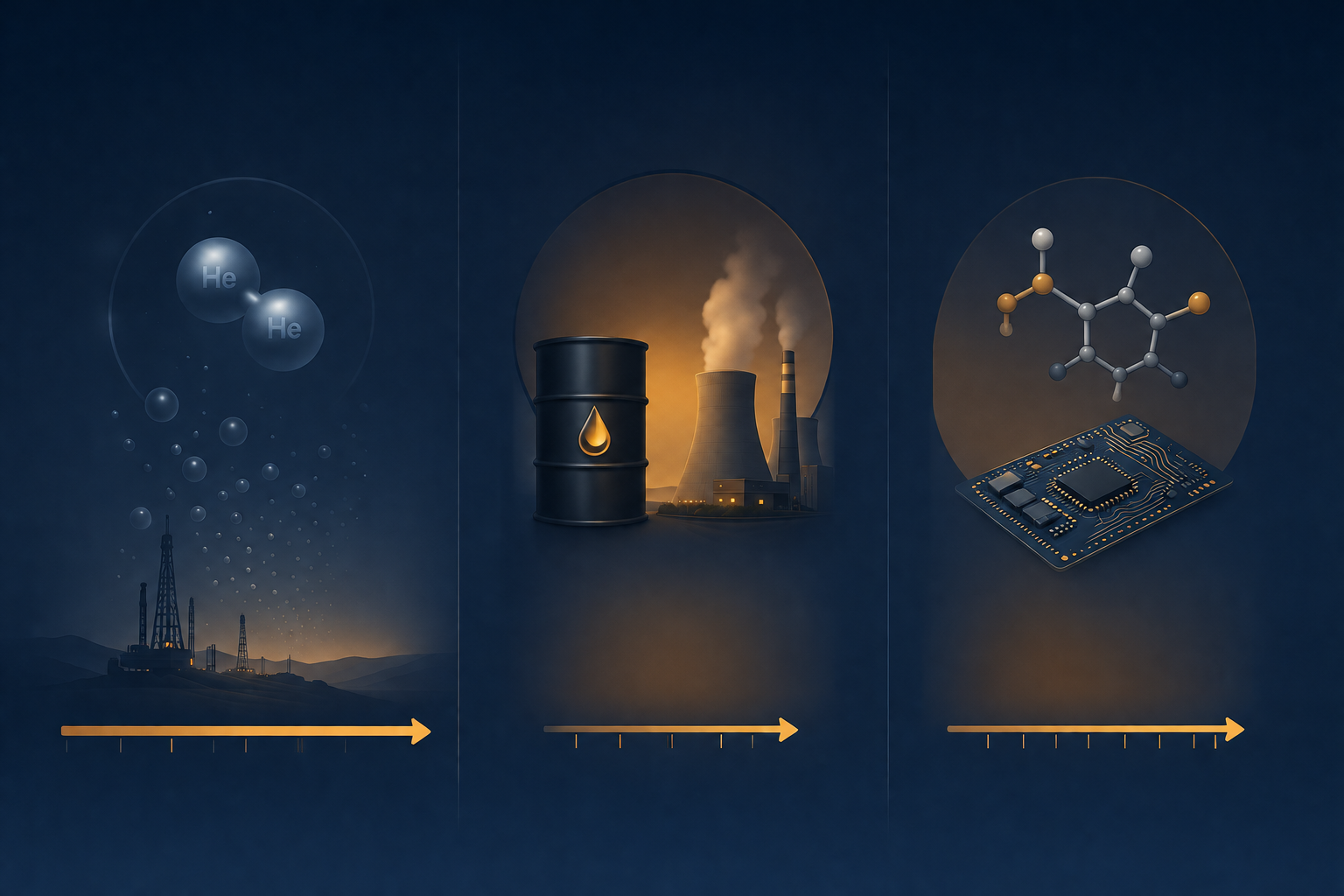
| Input line | Immediate impact | Likely repair clock | Procurement implication |
|---|---|---|---|
| Energy | Higher power, freight, and feedstock costs | Weeks if oil and LNG flows normalize after a ceasefire | Model as a severe but potentially reversible cost shock |
| Petrochemicals | PCB resin, engineering plastics, and equipment-material pressure | Months to years depending on sub-grade and rebuild path | Separate redesignable materials from qualified high-purity inputs |
| Helium | Constraint on fab processes that require inert, ultra-clean environments | Three to five years for the damaged Qatar supply line | Treat as an allocation constraint, not a price line |
The table is not a forecast. It is the difference between a buyer asking, “Can I afford this?” and a fab asking, “Can I run this?” Those are not the same question.
The uncomfortable line item is helium
Helium is exactly the kind of material that gets under-modeled until it is missing. It is a small share of fab cost—less than 1% in the figures cited by Forbes/Tirias Research—but it supports process steps where cleanliness, cooling, leak detection, and inert atmospheres matter more than purchase-order size.[1] If the price triples, the accounting problem is still manageable. If the gas is not available in the required grade, the production problem is not.
The disrupted node is Qatar’s Ras Laffan complex. The most consistently cited range puts it at roughly 30% to 35% of global helium supply, with some sources higher; QatarEnergy’s repair timeline is reported at three to five years.[2][3] That timeline matters more than the exact share. A ceasefire can change shipping risk, insurance costs, and oil-market expectations. It does not rebuild a damaged helium production complex on a quarterly procurement calendar.
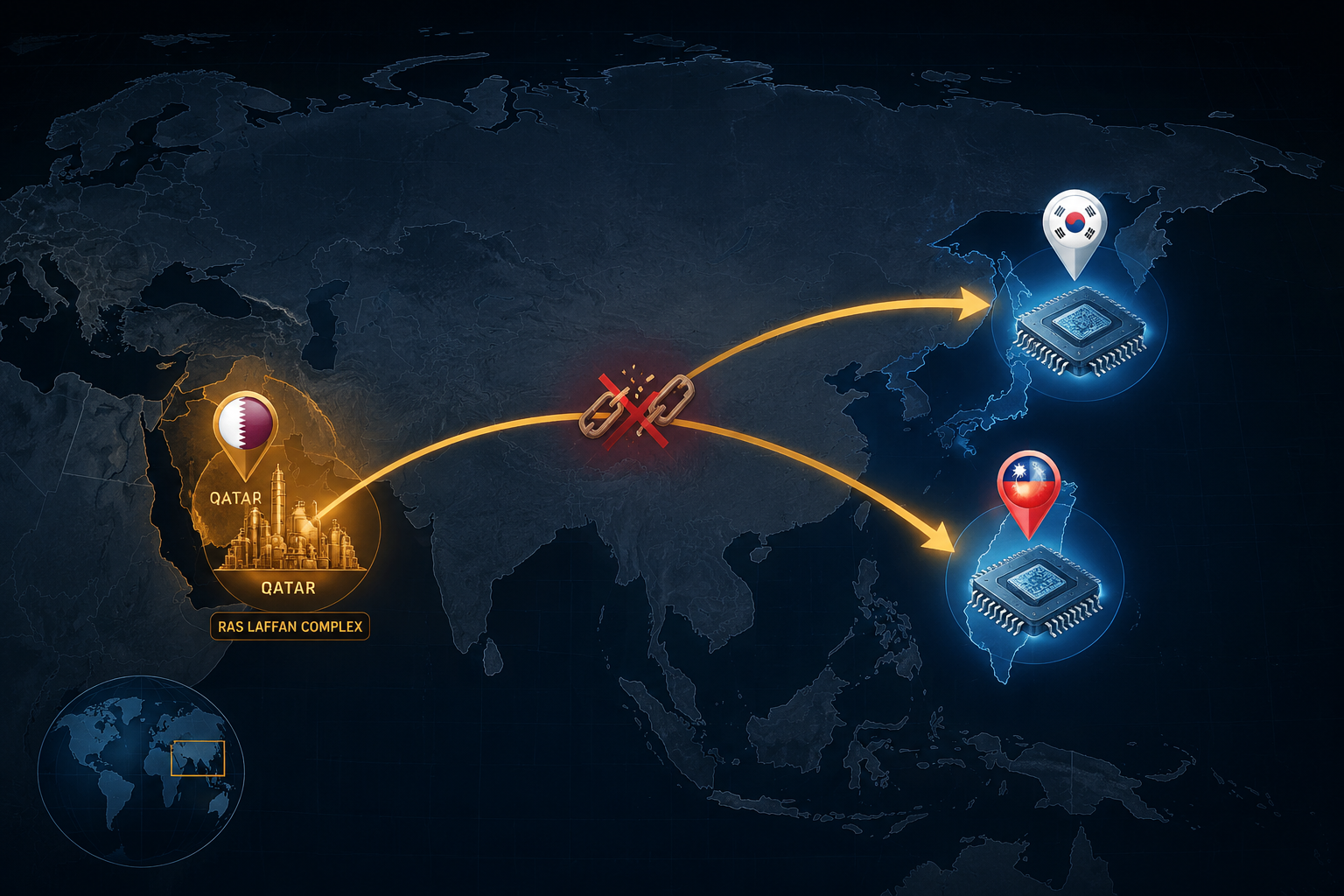
The exposure is not evenly distributed. South Korea imports 64.7% of its helium from Qatar, and Taiwan is reported at about 69%.[4] Fitch Ratings has called Samsung and SK Hynix particularly vulnerable, and those two companies account for roughly 80% of global high-bandwidth memory production.[5] For AI infrastructure buyers, that is where the materials footnote becomes a capacity question. HBM is already one of the tightest parts of the accelerator stack. A helium constraint does not need to shut every fab to change allocation behavior.
This is also where “we have inventory” starts to sound thin. Inventory buffers protect against short disruptions when replenishment is visible. Helium lost from a major production base with a three-to-five-year repair timeline is not a normal expediting problem. It forces someone to decide which customers, product lines, and process steps receive scarce gas first.
Why substitution does not bail out the plan
Semiconductor procurement teams are not helpless here. Large fabs recover and recycle helium. Samsung has deployed a helium recovery system, and TSMC has reported recovery rates in the 80% to 90% range.[1] Those systems reduce net demand and blunt the shock. They do not create a global replacement for a lost export stream.
New sources are not a fast answer either. U.S. projects such as Rudyard in Montana and ExxonMobil’s LaBarge operations, along with emerging Canadian supply, may help over time, but the cited development paths are measured in years rather than weeks.[1] The timing is the problem. AI accelerator demand is being contracted now. Data-center buildouts are being planned now. Materials repair arrives later.
The loss of the U.S. Federal Helium Reserve removes another old assumption. The remaining stockpile was auctioned in 2024, leaving no strategic helium buffer comparable to the kind of reserve policymakers can at least discuss for oil.[1] Buyers can dislike that fact, but they cannot negotiate around it.
Energy is ugly, but it is the most legible shock
The energy channel is easier to see because it looks like every other severe commodity disruption, only larger. Strait of Hormuz disruption cut roughly 20% of global LNG flows and about 27% of oil flows in the estimates cited by Resilinc, while Brent crude moved from about $70 to about $120 per barrel.[6] The International Energy Agency described the event as the largest supply disruption in oil market history.[6]
For semiconductor manufacturing, those figures flow into electricity, industrial gas production, shipping, chemicals, and supplier working capital. Taiwan imports 97% of its energy, and TSMC alone consumes 7% to 10% of Taiwan’s national electricity.[7] South Korea has already seen industrial power prices rise 39% to 55%, according to the figures cited in the research set.[8]
That is serious, but it is not the same kind of constraint as helium. If Hormuz access stabilizes and oil markets normalize, the energy shock could ease within four to six weeks under the scenarios cited by Resilinc.[6] If escalation returns, the same source models a harsher path, including oil at $130 to $150 and U.S. Strategic Petroleum Reserve pressure by November 2026.[6] Both cases belong in planning models. Neither should be confused with a material line that lacks a strategic reserve and a quick replacement.
Energy deserves hedging, contingency freight planning, and close supplier liquidity monitoring. It also deserves humility: as of mid-July 2026, ceasefire conditions remain fragile, and Strait access can change faster than a quarterly supply review can be rewritten.[6][7] But if an executive asks which line is most likely to reverse first under a calmer geopolitical tape, energy is the answer.
Petrochemicals sit between cost inflation and qualification risk
The petrochemical channel is messier because it does not break the same way at every buyer. Some materials can be repriced. Some can be dual-sourced. Some require qualification work that makes “alternate supplier” sound much easier in a slide deck than it is inside an engineering change process.
The most important figure needs careful wording: SABIC’s Jubail complex is reported to produce about 70% of global high-purity PPE resin for a specific PCB resin sub-grade, not 70% of all PCB materials.[2][9] That distinction matters. Over-broad materials claims make procurement analysis look dramatic and sloppy at the same time. The narrower claim is still consequential because high-purity resin constraints can move through server boards, accelerator assemblies, and semiconductor equipment supply chains.
PCB prices have surged about 40% since March 2026, while engineering plastics used across semiconductor equipment supply chains are up 5% to 20%.[9] Aluminum has also hit four-year highs, adding another cost layer for equipment, facilities, and structural components.[10] These are not all identical risks. A board material shortage affects assembly planning differently from an equipment-plastics price increase or an aluminum-driven capex adjustment.
The procurement work here is classification. Which petrochemical-derived inputs are qualified into existing designs? Which can be redesigned without touching performance, thermal behavior, or reliability? Which suppliers are carrying the working-capital burden of higher feedstock and power costs before they pass it through? Those questions are less cinematic than watching oil headlines, but they decide whether a buyer sees a price increase, a build delay, or a silent de-prioritization by a supplier with better customers to serve.
Exposure models are useful, not dispositive
Resilinc estimates that the Hormuz disruption affects more than 11,000 suppliers and more than 100,000 products, with roughly $460 billion in revenue exposure.[6] Those numbers are useful as a scale marker. They should not be treated as an independent measurement of every company’s actual loss. Resilinc is a supply-chain-platform vendor, and its exposure figures reflect proprietary modeling assumptions.
The same caution applies across vendor research. A modeled exposure number can tell a procurement leader where to look first. It cannot replace a bill-of-materials walk, supplier-by-supplier capacity calls, gas-contract visibility, or fab-specific yield and throughput assumptions. The danger is not that the models are useless. The danger is that a broad exposure figure becomes a substitute for asking which input cannot be rationed without changing output.
What changes in AI chip sourcing conversations
For AI infrastructure planners, the practical consequence is not that every accelerator order is suddenly at risk in the same way. The consequence is that medium-term sourcing assumptions should be governed by the slowest disrupted input, not the loudest one.
A buyer can still use inventory intelligently. Finished-goods buffers, substrate commitments, second-source board strategies, and longer visibility to foundry and memory partners all matter. But buffers should now be attached to a recovery clock. Energy buffers and financial hedges may help bridge weeks. PCB and engineering-material actions may need quarters and redesign discipline. Helium allocation needs a multi-year view.
The supplier conversation also has to change. “Do you have helium?” is too blunt. A useful review asks where helium is consumed, what recovery rates are actually being achieved by site, which product families receive priority under constrained gas supply, whether Qatar-linked exposure is direct or indirect, and how allocation decisions would be communicated if HBM, advanced logic, or packaging capacity tightens.
- For energy, ask suppliers which cost pass-throughs are temporary, indexed, or already embedded in 2026 pricing.
- For petrochemicals, separate commodity resin exposure from qualified high-purity sub-grades used in PCBs and equipment.
- For helium, ask for site-level dependency, recovery capability, allocation policy, and exposure to Qatari supply.
- For AI chip contracts, pressure-test delivery assumptions against HBM availability, not just accelerator assembly capacity.
None of those questions creates supply. They do make false confidence harder to hide. That matters because the people who will explain missed allocations six months from now are unlikely to be the people who treated “inventory on hand” as a complete answer in July.
The planning stance
Ceasefire-driven energy relief is possible. Petrochemical recovery is likely to be uneven, with some materials repriced quickly and others stuck in qualification or rebuild queues. Helium is the line that should govern medium-term AI chip sourcing, because the damaged supply share is large enough to matter, the repair timeline is long enough to outlast news-cycle relief, and there is no remaining strategic reserve to smooth the gap.
That does not make AI buildouts impossible. It does make the sourcing conversation less forgiving. The right question is no longer whether a supplier has chips, substrates, or memory in inventory today. It is whether the upstream inputs that make the next several planning cycles possible are still available on the clock the buyer is assuming.
References
- Helium Crisis Tightens Grip On Global Chip Supply Chain, Forbes/Tirias Research
- The Iran War's Supply Chain Shockwaves, LightSource
- WIRED helium supply reporting, WIRED
- KITA helium import data, Korea International Trade Association
- Fitch Ratings semiconductor vulnerability assessment, Fitch Ratings
- U.S.–Iran Conflict, Resilinc
- Iran Conflict Threatens Global Chip Supply Chain, Bloomberg
- South Korea industrial power price reporting, The American Prospect
- Middle East Conflict Ripples, ChemNet
- How the Iran war is exposing weak spots, CNBC
Comments
Join the discussion with an anonymous comment.