
A temperature alert is a good place to judge whether an AI agent belongs in logistics. If a shipment carrying a critical product such as insulin drifts toward an unsafe condition, the useful question is not whether the agent can sound fluent. It is whether the agent knows the shipment, recognizes the threshold, contacts the right party, records the response, and gets a human operator involved before the situation becomes a compliance or service failure.
That is the important detail in DHL Supply Chain’s work with HappyRobot. DHL says a smart temperature alert use case built with HappyRobot won its internal Supply Chain CIO Award, and HappyRobot describes the workflow as an escalation system for temperature-sensitive shipments, including critical items such as insulin.[1][2] The agent is not being presented as a free-ranging logistics manager. It is part of a response structure.

That distinction matters for anyone evaluating DHL’s use of AI in supply chain logistics in 2026. The credible lesson from DHL is not that logistics communications can be left unattended. It is that a narrow, well-instrumented agent can take real work out of carrier calls, email queues, invoice follow-ups, customs collection, and warehouse coordination when the handoff rules are designed before production begins.
What DHL Actually Put Into Production
DHL’s November 2025 announcement says the company deployed HappyRobot AI agents across more than ten use cases, spanning voice, email, and messaging channels, in three divisions across multiple continents.[1] HappyRobot’s customer story gives the more operational view: carrier tracking and ETA confirmation, customs duty collection, freight invoice follow-up, smart temperature alert escalation, new hire orientation, and warehouse coordination.[2]
Those examples sit in the part of supply chain operations where the work is repetitive but still consequential. A dispatcher needs an ETA. A broker or customer needs a customs payment update. A finance team needs missing invoice details. A warehouse needs to know whether a carrier appointment is still realistic. None of these tasks is glamorous; all of them can become expensive when the answer arrives late, lands in the wrong inbox, or never gets logged.
HappyRobot says DHL’s operations involve hundreds of thousands of emails and millions of voice minutes annually.[2] That figure is useful as a scale signal, not as a productivity result by itself. High communication volume explains why automation is attractive. It does not prove that exceptions got easier, customers received better answers, or human teams had cleaner days after deployment.
The Workflow Pattern Is More Important Than the Label
The working pattern behind these use cases is fairly consistent. A message or call arrives, the agent identifies the task, looks up or confirms the relevant shipment or workflow data, responds through the same channel or triggers a follow-up, checks whether the condition is still inside its permitted range, and escalates when confidence or operating thresholds are not met.
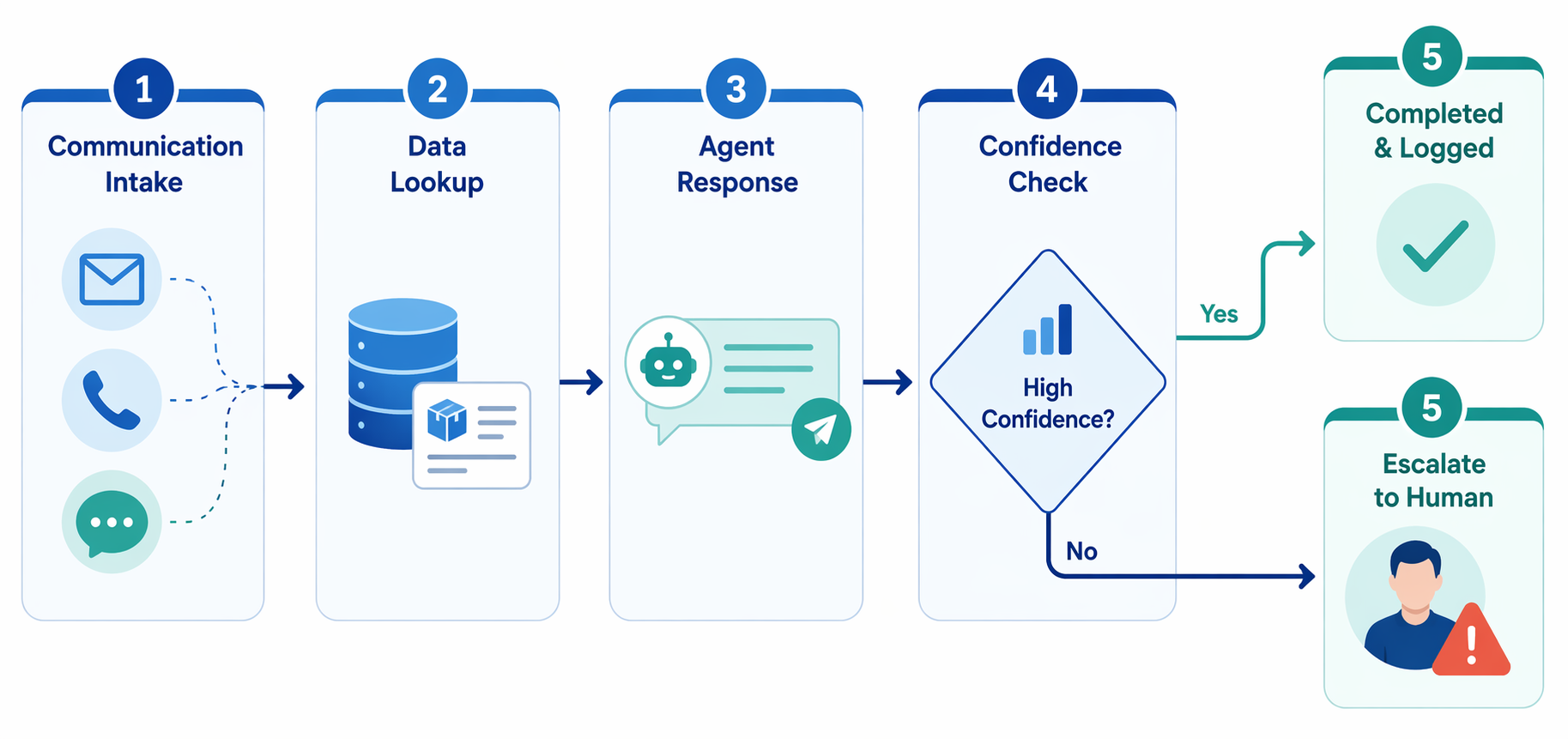
| Workflow stage | What the agent must know | What should happen when the case stops being routine |
|---|---|---|
| Communication intake | Channel, sender, shipment or account reference, requested action | Route unclear or unauthenticated requests to a person or controlled queue |
| Data lookup or confirmation | Shipment status, ETA, invoice record, duty status, appointment or alert details | Stop if source data is missing, conflicting, or outside the agent’s allowed scope |
| Agent response or follow-up | Approved message content, permitted action, logging requirement | Escalate if the response would require judgment, negotiation, or exception approval |
| Confidence and condition check | Thresholds, confidence level, service rule, escalation level | Create a handoff with context, not just a generic alert |
| Completion and audit trail | Outcome, timestamp, contact, next action owner | Keep the human team accountable for unresolved or risk-bearing work |
Carrier tracking is the cleanest example. A carrier status call or email has a limited objective: confirm where the load is, whether the ETA has changed, and whether the warehouse or customer needs an update. The agent can ask for the status, compare the answer with shipment data, record the result, and send a follow-up. If the carrier cannot confirm, gives a contradictory answer, or reports a delay that changes downstream commitments, the work is no longer just communication. It becomes exception management.
Customs duty collection has a different risk profile. HappyRobot lists customs duty collection among DHL’s agent workflows.[2] The repeatable part is the contact cycle: notify, explain what is needed, confirm payment status, and update the record. The uncomfortable part is that customs, payment, and shipment release are not merely customer-service topics. If the customer disputes the amount, claims payment was already made, or the shipment is time-critical, the agent should be a coordinator, not the final authority.
Freight invoice follow-up sits in the same territory. The agent can chase missing information, request clarification, and keep finance or operations from burning time on the first two rounds of outreach. But invoice work often turns on small mismatches: accessorial charges, detention, reference numbers, duplicate bills, or a rate that someone remembers differently. Those are exactly the cases that look minor in a queue and then consume a supervisor’s afternoon.
Bounded Autonomy Is the Design, Not a Caveat
HappyRobot describes DHL’s implementation around bounded autonomy, with AI agents operating inside defined workflows and escalation structures.[2] That is not a soft limitation. It is the condition that makes the deployment believable.
In logistics communications, autonomy has to be bounded across several dimensions at once: the channel the agent can use, the systems it can read, the records it can update, the messages it can send, the thresholds it can interpret, and the point at which a person must take over. If those boundaries are loose, the agent may appear productive while quietly pushing ambiguity into tomorrow’s exception queue.
The temperature alert case shows why the escalation path is not administrative plumbing. A cold-chain alert for a critical shipment is not solved because a message was sent. Someone may need to decide whether to reroute, inspect, quarantine, notify a customer, or document a service incident. An agent can compress the time between signal and response, but the accountability remains with the operation.
This is where some AI language gets sloppy. “Agentic” can make a system sound as if it owns the outcome. In a warehouse handoff or freight exception, ownership is rarely that clean. A human team still carries the late truck, the rejected delivery, the missed appointment, the unresolved invoice, and the customer escalation. A good agent reduces the number of routine touches reaching that team. It should not make the remaining touches harder to understand.
Where the DHL Case Is Strongest
The strongest evidence in the DHL case is operational pattern evidence. DHL disclosed a production deployment across more than ten use cases, multiple channels, three divisions, and multiple continents.[1] HappyRobot supplied workflow-level examples and volume context.[2] Together, those details show that AI agents have moved beyond a pilot script for at least some routine freight communication work.
The weaker evidence is return-on-investment evidence. The available materials do not provide an independently audited before-and-after view of response quality, exception aging, labor redeployment, customer satisfaction, claim reduction, or total cost per resolved communication. HappyRobot’s figures on email and voice volume describe the size of the communication surface DHL is addressing, but they do not by themselves measure the net operational gain.[2]
That does not make the case unimportant. It just sets the right burden of proof. A buyer should not read the DHL deployment as proof that any logistics communication queue can be automated safely. A better reading is that agentic AI is mature enough for production when the workflow is narrow, the data is accessible, the response set is controlled, and the escalation logic is explicit.
The Broader DHL AI Strategy Is Context, Not the Main Event
DHL’s agentic AI work sits inside a wider technology agenda. Supply Chain Management Review has described DHL Supply Chain’s focus on data foundations, robotics, generative AI, computer vision, and agentic AI as part of its growth strategy.[3] That matters because communication agents depend on the same unglamorous groundwork as other logistics systems: clean master data, reliable shipment events, connected operational records, and teams that trust the handoff.
The breadth examples in HappyRobot’s customer story—new hire orientation and warehouse coordination—are useful signals that DHL is not treating agents only as outbound call bots.[2] Still, the center of gravity remains freight communications. That is where the volume is high, the questions repeat, and the cost of slow coordination is visible in appointments, releases, dwell time, and escalation calls.
Benchmark Questions for Buyers
A supply chain leader evaluating a similar deployment should start with the work, not the model. The first pass should identify the communication types that are repetitive, high-volume, and painful when delayed, but not so judgment-heavy that every interaction becomes an exception.
- What exact task is the agent allowed to complete: ETA confirmation, duty payment follow-up, invoice clarification, alert notification, or appointment coordination?
- Which channel is in scope: phone, email, messaging, or a specific combination with different rules for each?
- Which system of record does the agent use for shipment, invoice, customs, warehouse, or alert data?
- What can the agent update, and what must it only read or recommend?
- Which conditions force escalation: missing data, conflicting answers, low confidence, threshold breach, customer dispute, payment exception, regulatory exposure, or service-critical delay?
- What does the human receive at handoff: transcript, shipment context, attempted actions, confidence reason, deadline, and recommended next step?
The last question deserves more attention than it usually gets. A bad escalation creates a second job for the human operator: reconstruct what the agent did. A good escalation preserves the thread, shows why the case left automation, and gives the operator enough context to act without replaying the whole interaction.
Metrics should also be source-attributed. Vendor-reported email volume, call minutes, containment rate, or response time can be useful, but buyers need to separate adoption from effectiveness. An agent can handle many contacts while still leaving the hardest work untouched. Better measures include exception rework, handoff completeness, reopened cases, aging of escalations, customer response quality, and whether experienced coordinators are spending less time on first-touch chasing and more time on decisions only they can make.
What This Means for Logistics Communications
DHL’s HappyRobot deployment is credible evidence that agentic AI is production-ready for bounded logistics communications. The deployment scale, channel coverage, and workflow breadth make it more substantial than a demo, and the temperature alert example shows the right instinct: let the agent move quickly through routine coordination, but do not pretend the risk disappears when the message is sent.
The replicable lesson is not to replace the communications team. It is to design agents around narrow workflows, channel-specific behavior, trusted operational data, source-attributed metrics, and clean escalation paths. In freight operations, the easy contacts are worth automating because they consume real time. The hard contacts still need people who understand the shipment, the customer, the service commitment, and the consequence of getting it wrong.
References
- DHL boosts operational efficiency and customer communications with HappyRobot's AI Agents, DHL Group, November 2025.
- DHL Reimagines How Operational Work Gets Done with HappyRobot, HappyRobot.
- DHL Supply Chain bets on data foundations, robotics, and agentic AI to drive growth, Supply Chain Management Review.
Comments
Join the discussion with an anonymous comment.