
A recall does not become operationally hard when the notice goes out. It becomes hard when the same component family is suddenly needed in three places at once: on the assembly line, in regional parts depots, and at dealers with service bays already booked. The defective material then has to come back through a controlled lane, often with inspection, core disposition, warranty validation, and sometimes hazardous-material handling attached.
That collision is why AI for automotive recall supply chain logistics matters. The useful question is not whether AI can identify a recall faster or send better owner messages. The harder question is whether it can orchestrate the physical flow of constrained parts well enough to shorten repair completion time without starving production.
The pressure signal is already visible. In the U.S., average recall scope per event rose from 26,600 vehicles in the first half of 2025 to 41,900 vehicles in Q3 2025, a 60% increase for that period, according to an SCMR analysis of NHTSA data.[1] That does not prove every future recall will be larger. It does show why spreadsheet triage and manual dealer allocation become fragile when a defect cuts across platforms, suppliers, or component families.
Completion performance adds another warning. A 2025 recall-risk discussion citing NHTSA data put the average recall completion rate at 45%, while also noting that performance varies by manufacturer and recall type.[2] Some of that gap is owner behavior. Some of it is dealer capacity. But parts availability is the piece logistics teams can most directly influence, and it is often the piece that determines whether a customer appointment becomes an actual repair.

The Recall Parts Trap
A normal service-parts forecast assumes some version of historical demand, seasonality, vehicle parc, and dealer ordering behavior. A safety recall breaks that rhythm. Demand is no longer a slow signal coming from retail repair history. It is a campaign-driven surge tied to a defined VIN population, a repair procedure, a part number or kit, and a geographic service network.
The trap is that replacement demand often competes with production demand. The same supplier may be building parts for assembly plants while the service organization asks for an urgent recall kit build. Pull too much material into aftersales and production planners start escalating shortages. Protect production too aggressively and dealers sit on appointment backlogs with no repair stock. The customer sees a recall letter and an unavailable part; the factory sees a constrained component being diverted into a campaign.
Traditional recall systems tend to manage the administrative shell: affected VIN lists, regulatory filings, dealer bulletins, owner notifications, and completion reporting. Those are necessary. They are not the same as deciding how many kits should be in Phoenix versus Philadelphia next Tuesday, whether a supplier expedite should feed a depot or an assembly plant, or which dealers should receive partial allocation because their service capacity is the actual bottleneck.
AI orchestration earns its keep only if it reaches those decisions. It has to connect demand forecasting, available inventory, supplier output, transportation constraints, dealer throughput, and return handling into one operating picture. Without that connection, it is just another dashboard reporting that the campaign is late.
Where AI Actually Intervenes
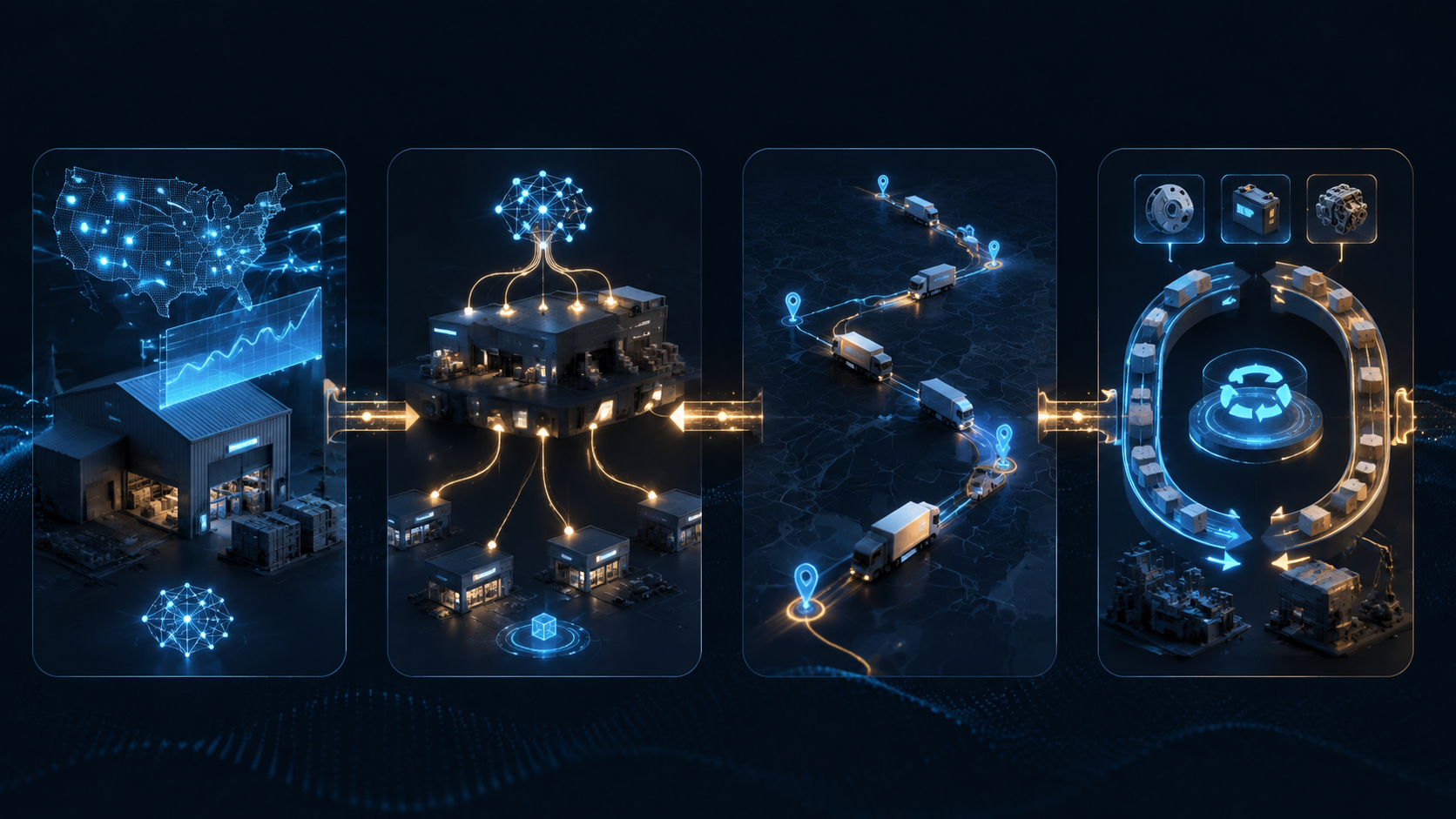
The useful workflow is not mysterious. It is the same recall logistics sequence teams already run under pressure, except the decisions are made earlier, refreshed more often, and constrained by more than one objective at a time.
| Recall logistics decision | What AI orchestration changes | Operational consequence |
|---|---|---|
| Forecast affected demand | Models translate the affected VIN population into part-number, kit, region, and timing demand | Parts planners can see where the campaign will strain inventory before dealer orders fully materialize |
| Pre-position inventory | Optimization recommends which depots, dealers, or forward locations should receive constrained stock first | Service stock moves closer to likely repairs without blindly draining production supply |
| Allocate to dealers | Allocation logic weighs inventory, VIN density, appointment capacity, open backlogs, and shipment timing | Dealers with real repair capacity receive stock ahead of locations that would simply warehouse kits |
| Route and expedite | Routing engines rebalance lanes as supplier output, carrier availability, and depot inventory change | Transit time improves without treating every order as an expensive emergency shipment |
| Control reverse flow | Return routing tracks defective parts, cores, quarantine requirements, and hazardous handling rules | Warranty, remanufacturing, investigation, and disposal paths stay visible after the repair |
Forecasting Starts With VINs, Not Dealer Orders
The front-end forecast is where recall logistics either gets ahead of the event or spends the next month explaining backorders. Dealer orders are late signals. By the time they arrive, owners have been notified, service advisors have started booking work, and the first wave of frustration is already visible.
A better model starts with the affected VIN population. It maps where vehicles are registered or serviced, which repair procedure applies, which part numbers or kits are needed, whether inspection-only branches may reduce actual replacement demand, and how completion is likely to phase by region. The output is not one national demand number. It is a time-phased regional requirement by part, kit, depot, and dealer service area.
This is also where the model has to respect production continuity. If the recall part is shared with current production, the forecast cannot treat every available unit as recall stock. It should show what happens if the service organization pulls forward supply, what happens if supplier overtime is approved, and where substitutes, remanufactured cores, or repair-kit variants change the constraint.
The practical value is not a prettier forecast curve. It is earlier positioning. If the model can identify that a certain region has a dense affected VIN population, high dealer throughput, and long replenishment lead times, inventory can be moved before the first week of appointments consumes all local stock. If another region has affected VINs but limited dealer capacity, the system can avoid parking scarce kits there while higher-throughput dealers wait.
Allocation Has To See Dealer Capacity
Allocation is where many recall campaigns lose time. A fair-share rule may look reasonable in a spreadsheet, but it can send parts to dealers that cannot install them quickly while higher-capacity dealers run short. A pure VIN-density rule has the same problem. VINs near a dealer are not repairs unless technicians, bays, appointments, and special tools are available.
AI allocation should therefore balance at least four live constraints: available service stock, affected VIN density, dealer repair capacity, and replenishment lead time. A fifth constraint appears when production is exposed: the amount of supplier output that can be diverted into recall kits without increasing assembly risk. That is the uncomfortable decision logistics teams already make; orchestration software should make the trade-off visible rather than hide it inside an allocation rule.
In practice, that can mean splitting supply in ways that feel counterintuitive. A high-volume dealer may receive less than requested if its appointment calendar is blocked for unrelated work. A medium-size dealer may get priority because it has open bays and a cluster of affected vehicles nearby. A regional depot may be held above its normal minimum because supplier output is about to dip and replenishment time is long. These are not exotic AI decisions. They are familiar parts-planning decisions made continuously, with more inputs than a human team can refresh by hand twice a day.
Routing Is More Than Finding the Shortest Lane
Route optimization matters because recall campaigns create uneven urgency. Some shipments justify premium freight because a dealer has scheduled repairs and no stock. Others can move through standard lanes because the destination has parts on hand or limited near-term capacity. Treating every recall shipment as an emergency burns logistics budget without necessarily increasing completions.
An orchestration layer can rank shipments by completion impact. The system can ask which move will unlock the most repairs in the next service window, which depot transfer prevents a regional backorder, and which expedite simply fills a shelf. That distinction is where timeline reduction becomes plausible: the same number of parts can produce more completed repairs if they arrive at the locations ready to install them.
Routing also needs exception handling. Supplier output slips, a depot count is wrong, a carrier misses a cutoff, a dealer cancels a block of appointments, or a quality hold changes the usable inventory number. AI does not eliminate those events. Its value is in recalculating allocation and shipment priorities before the next manual review cycle.
Reverse Logistics Cannot Be an Afterthought
The repair is not the end of the material flow. Defective parts may need to be returned for root-cause analysis, warranty validation, supplier chargeback, controlled disposal, remanufacturing, or core recovery. If that return path is loose, the OEM loses visibility into both quality evidence and recoverable value.
Reverse orchestration should track which removed parts must be quarantined, which can enter core processing, which need supplier inspection, and which require special packaging or certified handling. EV battery recalls raise the stakes because the return flow may involve hazardous-material rules, state-of-charge requirements, thermal-event risk, specialized containers, and limited receiving locations. A forward-parts plan that ignores the return lane simply moves the bottleneck downstream.
Why Multi-Tier Visibility Comes Before Orchestration
The strongest real-world signal is not a recall-specific end-to-end deployment. It is the supplier-visibility infrastructure some OEMs are building around supply risk. GM says its SupplyMap platform collects data from thousands of suppliers across multiple tiers to create map-based views of supplier locations, relationships, and potential risk exposure; GM also describes SupplyAlert as a centralized communications tool used for fast supplier response during disruptions and recalls.[3]

That matters because recall parts logistics depends on facts that often sit outside the service-parts system. Which sub-tier supplier feeds the constrained component? Which plant uses the same part family in current production? Which supplier site has a quality hold, labor disruption, or transport exposure? Which depot inventory is actually serviceable and not already reserved?
A platform can optimize only the network it can see. If supplier capacity arrives by email, dealer capacity sits in a separate scheduling tool, and reverse returns are tracked in a warranty workflow after the fact, the orchestration layer will make elegant recommendations against partial truth. GM’s example is useful because it shows the kind of cross-tier data foundation recall orchestration needs. It should not be overread as proof that every OEM can buy a recall AI platform and immediately replicate the same visibility.
What the Evidence Supports—and What It Does Not
The most directly relevant figure comes from JSRRB, which reports a 23.7% reduction in recall completion timelines for its automated recall orchestration platform, tied to AI-coordinated owner outreach and dealer parts logistics.[4] The number is specific enough to be useful, and the mechanism is operationally plausible: better forecasting, better allocation, and fewer parts-related appointment failures should shorten a campaign.
It is still a vendor-reported figure. The public material does not provide the kind of third-party validation, baseline design, recall mix, sample size, or control group that would make it a general benchmark for the industry. The right way to use it is as an indicative outcome, not as a guaranteed ROI line in a capital request.
Broader supply-chain AI benchmarks widen the business case but require the same caution. Star.global cites McKinsey-linked estimates that AI supply-chain optimization in automotive can reduce logistics costs by up to 15%, lower inventory by 35%, and improve service levels by 65%.[5] Those figures are directionally relevant to recall logistics because the same levers are involved: inventory placement, routing, planning accuracy, and service-level execution. They are not, by themselves, proof of recall-specific ROI.
The adjacent OEM examples are similar. Toyota’s LLM-powered delivery optimization is reported to have reduced lead times by 17%, and Honda’s AI inventory forecasting is reported to have reduced excess stock by 22%.[5] Those are encouraging signals that AI can improve automotive delivery and inventory decisions. They do not demonstrate a complete recall logistics loop from affected VIN forecast through dealer allocation and defective-part return.
That distinction matters. Adoption is not effectiveness. Delivery optimization is not recall completion. Inventory reduction is not proof that service stock was available in the right dealer at the right time. The evidence is strong enough to justify pilots and operating-model investment. It is not clean enough to treat every published percentage as transferable across recall types, networks, or OEM maturity levels.
The Implementation Work OEMs Cannot Skip
The hard part is not installing an optimization engine. It is giving that engine timely, trusted inputs across functions that often operate on different clocks. Recall teams think in affected VINs and regulatory milestones. Service parts teams think in depots, dealer orders, and backorders. Manufacturing thinks in line continuity and supplier schedules. Warranty and quality teams think in returned parts, inspection codes, and evidence preservation.
At minimum, an OEM needs four data capabilities before end-to-end orchestration can be more than a partial pilot.
- Cross-tier supplier visibility: The system needs current supplier capacity, part-family relationships, quality holds, and production exposure, not just tier-one purchase-order status.
- Accurate service-parts inventory: Depot, in-transit, dealer, reserved, quarantined, and substitute inventory must be distinguishable, or the model will allocate stock that cannot actually repair a vehicle.
- Dealer capacity visibility: Appointment slots, bay constraints, technician qualification, tooling availability, and campaign backlog need to influence allocation.
- Reverse-flow tracking: Defective returns, cores, hazardous material, supplier inspection, and disposal status need to remain linked to the campaign and part serial or lot data where applicable.
Governance matters as much as data plumbing. Someone has to decide when the model is allowed to divert supply from production, when it may recommend premium freight, when a dealer allocation can be overridden, and how conflicting objectives are weighted. A recall command center that cannot make those decisions quickly will not become faster because an AI system produces recommendations.
The first useful pilot is usually not the most complex recall. It is a campaign with constrained but trackable parts, a defined VIN population, cooperative dealers, and enough regional variation to test whether pre-positioning and allocation logic improves completions. The pilot should measure actual repair throughput, parts-related appointment failures, expedite spend, production impact, dealer inventory aging, and return-flow compliance. If it measures only notification response or dashboard usage, it is not testing recall logistics orchestration.
A Practical Standard for AI Recall Logistics
AI orchestration should be judged by whether it changes the physical sequence of a recall. Did the forecast move kits into the right region before demand peaked? Did allocation send parts to dealers that could install them? Did routing reduce dead time without turning every shipment into premium freight? Did production remain protected while service demand accelerated? Did defective material come back through controlled lanes with usable quality and warranty data?
Current evidence supports a conditional answer. AI-driven recall logistics can materially reduce completion times and costs when it is connected to cross-tier supplier data, accurate inventory, dealer capacity, and reverse-flow tracking. The reported 23.7% timeline reduction is a credible directional signal, not an independently verified industry benchmark. The cost, inventory, and service-level benchmarks from broader automotive supply-chain AI are relevant, but they should not be pasted into a recall business case without explaining the attribution gap.
For OEM logistics teams, the conclusion is neither wait-and-see nor buy-and-hope. The 2025 recall scope increase makes manual allocation look increasingly exposed, especially when replacement demand and production demand collide. But the OEMs that benefit most will be the ones that treat AI as an orchestration layer on top of disciplined data integration, not as a substitute for it.
References
- Turning vehicle recalls into a test of supply chain resilience, SCMR, 2025.
- Automotive recall risk in 2025: Why the trend isn’t slowing down, Tokio Marine HCC / Sedgwick recall index 2025.
- How AI is revolutionizing GM's supply chain, GM newsroom, Aug 2025.
- JSRRB Recall Management Automation, JSRRB.
- A guide to AI in automotive supply chain management, Star.global.
Comments
Join the discussion with an anonymous comment.