
At the compensation desk, the question is not whether an airline can be more automated during disruption; it is whether the airline can decide eligibility, calculate the amount, document the reason, communicate the answer, and pay it without turning every claim into a manual exception queue. In 2024, 220,000 disrupted flights translated into more than €6.5B in potential EU261 exposure, while US DOT non-compliance penalties can reach $20K-$100K+ per violation, which is enough to make compensation automation a board-level operational problem rather than a back-office convenience.[1]

That exposure is only the starting point. Potential liability is not actual payout, because extraordinary-circumstances exemptions and unfiled claims both reduce what actually leaves the airline. The useful unit of work is narrower than generic IROPS management: it is a regulated financial workflow with rules, evidence, and an audit trail.
What the workflow actually covers
The workflow usually has five decisions: is this passenger eligible, what amount applies, what facts support the decision, how is the answer explained, and when does the case move to a human. That makes it similar to other exception-heavy supply chain processes: the model is not optimizing the whole operation, only removing repetitive judgment from a bounded rule path.
| Workflow stage | What automation does | What stays human |
|---|---|---|
| Eligibility | Checks delay, distance, route, and exception data against the rule set | Reviews ambiguous extraordinary-circumstance claims |
| Calculation | Applies the fixed compensation band and payment logic | Approves overrides and policy exceptions |
| Communication | Drafts multilingual explanations and status updates | Handles complaints, legal pushback, or sensitive cases |
| Audit trail | Stores the facts, rule path, and message history | Validates sampled cases for compliance |
| Disbursement | Triggers payment once the case is approved | Resolves payment failures and disputes |
The important distinction is that payment logic has to survive review. If the airline cannot reconstruct why a claim was approved or denied, automation only moves liability from the queue to the audit team.
Architecture that keeps the math deterministic
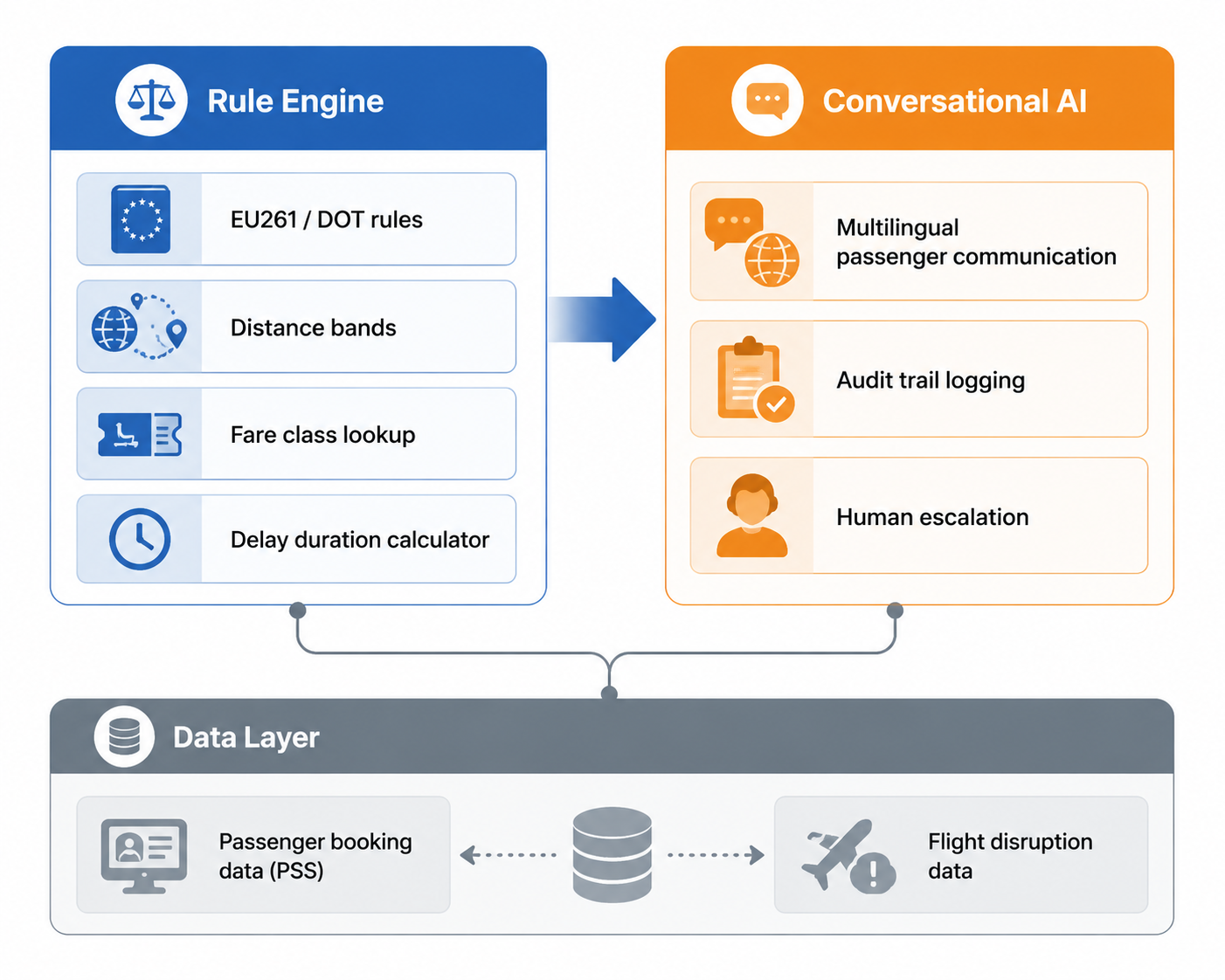
Zowie's model is the clearest proof point in the research set: the deterministic decision engine handles the rule path and exact compensation calculation, while the conversational layer handles passenger communication in plain language and multiple languages.[2] Under EU261, the amounts stay in the rule engine, not in the LLM; the language layer can explain why a passenger gets €250, €400, or €600, but it should not decide that amount.[2]
That separation matters because it keeps the same disruption facts tied to the same outcome, regardless of channel or language. GetVocal takes a similar position with its Context Graph, encoding airline policy as transparent, testable decision paths with full audit trails and routing borderline cases to humans instead of pretending an agentless model can resolve every exception cleanly.[3]
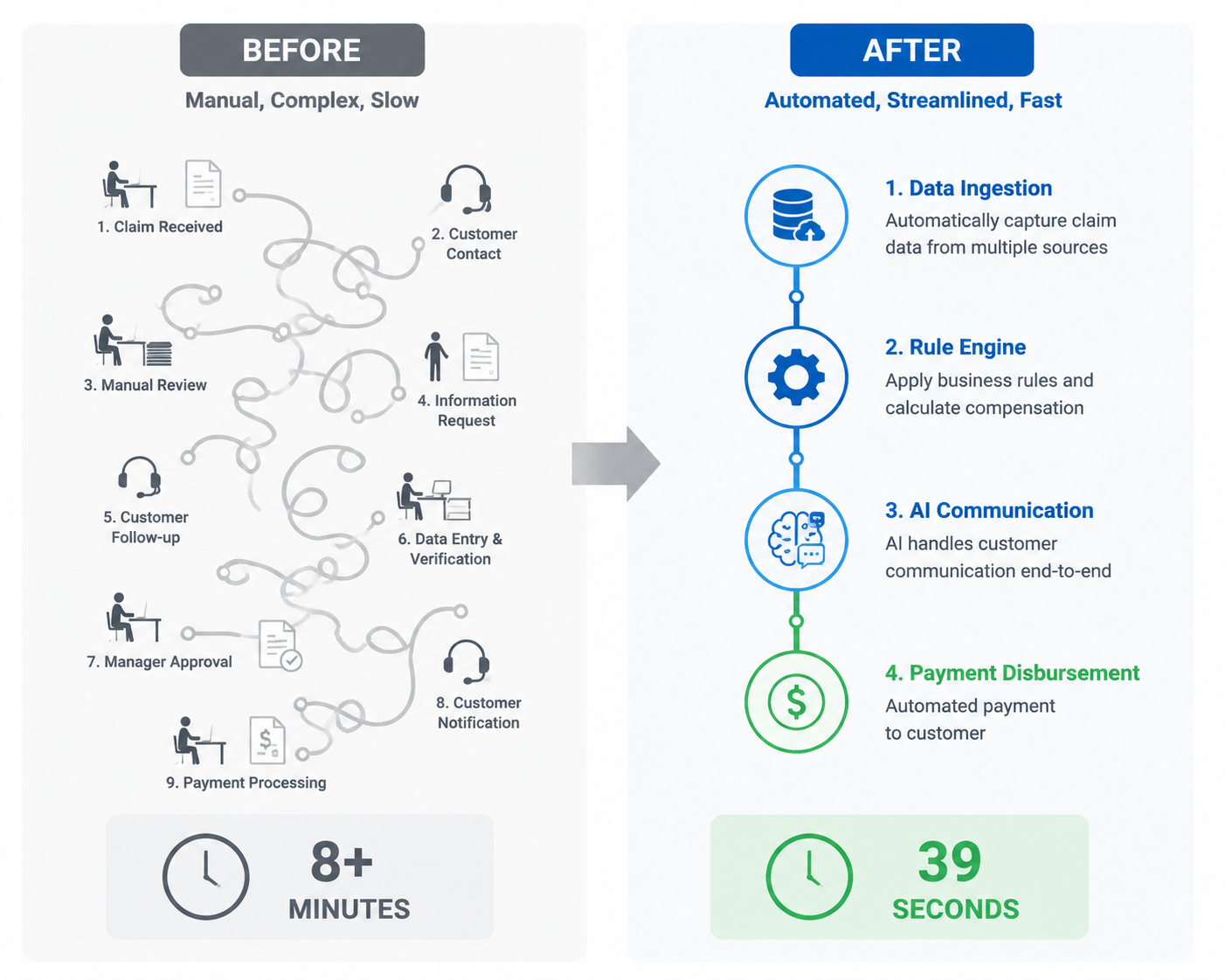
Zowie's published results also show why buyers care about the architecture, not the chatbot veneer: one deployment report says processing time dropped from 8+ minutes to 39 seconds, with up to 43% CSAT improvement.[2] The point is not that every airline will match that number; it is that the manual work the teams complain about is real work, and the right division of labor can remove a large part of it.
What the documented outcomes actually show
AirHelp's case is the strongest operational signal in the brief. After consolidating three tools onto Zowie, the company said it was handling 1.5M+ annual claims, resolving 48% autonomously, and answering emails 50% faster.[4] Those are vendor-published figures, so they are evidence of what one deployment achieved, not proof of a universal ceiling.
MarketIntelo's framing is broader but still useful: it attributes AI-driven compensation automation with a 25-40% reduction in total disruption costs and a 60-75% reduction in compliance and admin overhead.[5] That should be read as source-bounded evidence, not a blanket ROI promise, but it does align with what operations teams care about: fewer cases waiting on policy checks and fewer humans spending time on work that rules software can do repeatably.
Where buyers still need to be strict
The risks are not abstract. The first is bias: if the same disruption facts produce different outcomes because a passenger is a lower-tier loyalty member, the workflow has failed its audit test even if the chatbot sounds polite. The second is transparency: EU AI Act readiness is not a marketing slide, because an airline has to show how the decision was reached, not just that an AI system participated.
The third is integration realism. Compensation automation has to sit on top of legacy passenger service system data, flight disruption feeds, and payment rails, and that is usually where elegant demos become expensive programs. For that reason, shortlist candidates should be the vendors that can show deterministic rule execution, a clear human escalation path for extraordinary circumstances and policy exceptions, reproducible outputs for the same fact pattern, and a communication layer that explains decisions without making them.[2][3]
That is enough to make airline disruption compensation automation a credible use case, but only in the narrow sense that matters to claims operations, contact center leaders, compliance owners, and finance: the workflow is automatable when the rules are explicit, the math is inspectable, and the AI layer stays where language helps and judgment hurts.
References
- MarketIntelo report citing OAG via AeroTime on 2024 disrupted flights, potential EU261 exposure, and DOT non-compliance penalties
- Zowie documentation on deterministic decision engines and conversational AI separation
- GetVocal Context Graph architecture for transparent airline policy automation
- AirHelp customer case study on claim automation with Zowie
- MarketIntelo report on AI-driven disruption cost reduction and compliance overhead
Comments
Join the discussion with an anonymous comment.