
Airline disruption does not start with a dashboard. It starts when a tail is out of service, a planner is trying to protect the next bank, materials is chasing a component through three time zones, and operations is already asking whether the aircraft can be swapped. That is the right place to judge AI supply chain resilience for airline disruptions: not by how polished the model looks, but by whether it keeps an avoidable AOG from turning into a schedule, crew, passenger, and inventory problem.
The cost pressure is not subtle. Reported AOG cost ranges run from $10,000 to $150,000 per hour, emergency repairs have been cited at 4.8 times the cost of planned maintenance, and 22% of U.S. flights were delayed in 2024.[1][2] Those numbers do not all measure the same thing, but they point in the same operational direction: reactive maintenance is expensive because the repair itself is only one part of the damage.

A grounded aircraft forces ugly choices. Pull a part from another aircraft and create a second maintenance exposure. Buy on the spot market and pay the premium. Expedite freight and hope customs, receiving, inspection, and stores do not become the next bottleneck. Defer noncritical work and compress tomorrow’s maintenance window. None of that shows up cleanly in a single maintenance-cost line.
That is why predictive maintenance deserves attention, but only if it is connected to parts planning. Predicting that a component is likely to fail is useful. Predicting it early enough to schedule the work, reserve the slot, position the part, and avoid a scramble is where the supply chain value starts.
What the model has to change on the hangar floor
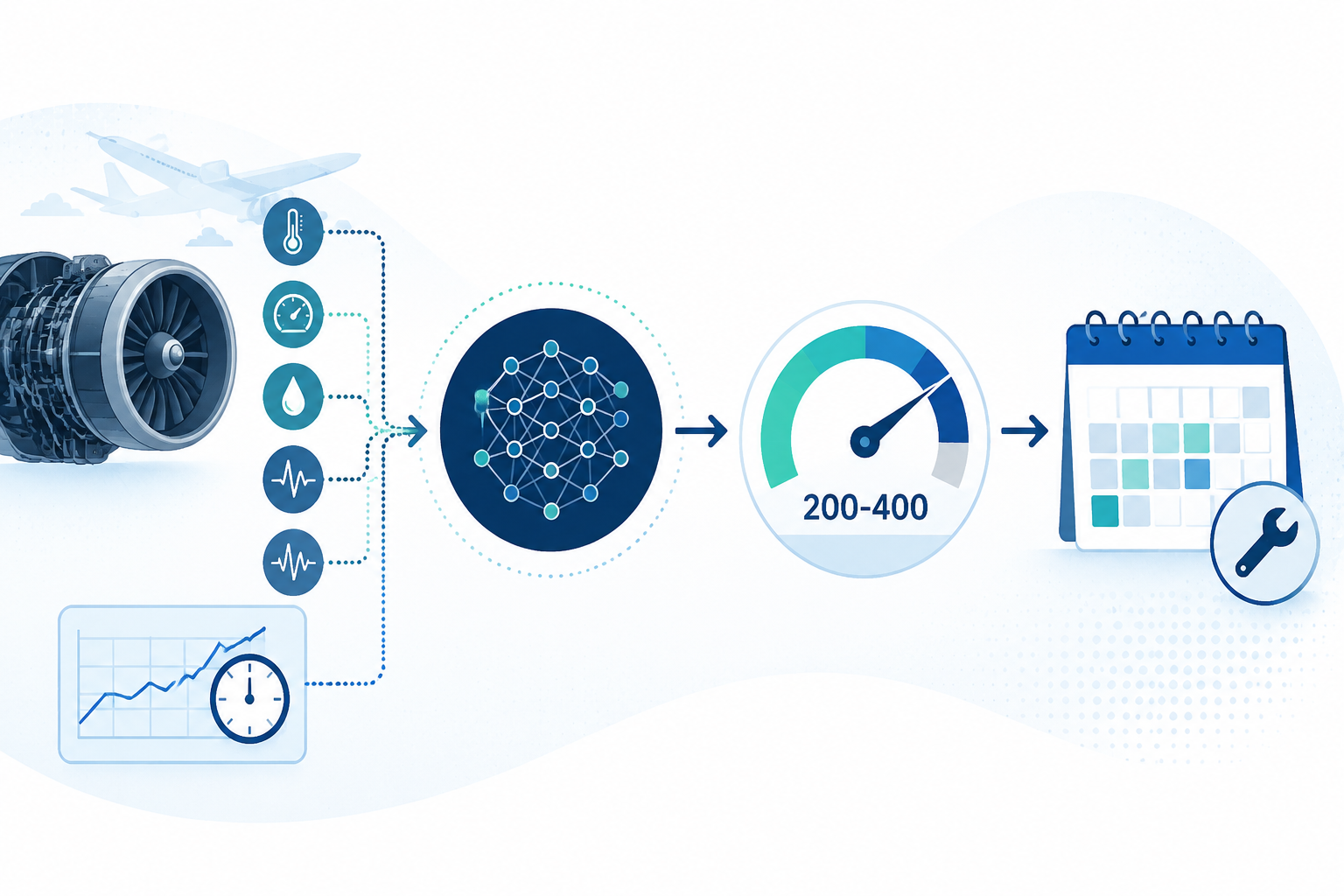
The practical version of AI-powered predictive maintenance is not magic. Machine learning models ingest aircraft sensor data, flight hours, and cycle counts, then estimate remaining useful life for monitored components. In the research available here, that prediction window is described as 200 to 400 hours before failure.[3]
| Input or decision point | What it changes operationally |
|---|---|
| Sensor data, flight hours, and cycle counts | Moves the discussion from calendar-only maintenance to condition-aware risk |
| Remaining-useful-life estimate | Gives planning a window to choose when the aircraft should come out of service |
| Maintenance planning signal | Turns a likely defect into a work package, labor requirement, and slot decision |
| Parts demand signal | Lets inventory reserve, reposition, repair, or buy material before the AOG call |
That 200-to-400-hour window matters because most disruption is created by timing. A part that fails after a scheduled overnight check is a different problem from the same part flagged before the check. The defect may be identical, but the consequences are not. In one case, materials is reacting. In the other, planning can pull the task forward, package it with other work, and ask stores whether the part is actually available before the aircraft is committed.
The model’s job is not to eliminate judgment. It should narrow the planner’s field of uncertainty. If the model flags a component with deteriorating behavior, the maintenance organization still has to decide whether to act immediately, align the work to the next planned opportunity, increase inspection frequency, or monitor until another threshold is crossed. A useful system makes those tradeoffs visible early enough that the decision is not made at the gate.
This is also where weak implementations usually show themselves. If the alert volume is too high, planners stop trusting the system. If the remaining-useful-life estimate is not tied to engineering rules and approved maintenance programs, it becomes a side channel instead of an operating tool. If the output cannot be consumed by maintenance control, production planning, materials, and reliability engineering, the model may be technically interesting and operationally irrelevant.
The minimum test is simple: when the model identifies a risk, can the organization answer who owns the next action, what work package changes, what part is needed, where that part is, and which aircraft window can absorb the work? If those questions still require a manual chase across systems, the AI layer has only shifted the firefighting earlier.
The parts system has to move with the prediction
Maintenance prediction without inventory intelligence is an unfinished job. Airlines do not operate in a world where every rotable, consumable, repair slot, and loaner unit is sitting in the right place. The hard value comes when the predicted maintenance event becomes a demand signal that the supply chain can act on before the aircraft is down.

That means the inventory engine has to see more than historical consumption. It needs the maintenance forecast, open defects, fleet utilization, cycle patterns, repair turnaround times, supplier lead times, station-level demand, interchangeability, and the current health of repairable pools. A part that looks overstocked in aggregate may still be unavailable where the next failure is likely to occur. A part that looks safe by average monthly demand may be a disruption risk if several high-utilization aircraft are approaching the same removal window.
This is where the ROI claim becomes more credible. OxMaint reports AI demand forecasting reducing parts spend by 22%, and an ePlaneAI case study published by Aviation Week reported 95% short-term forecast accuracy, a 65% labor efficiency improvement, and identification of 37% of inventory as stale.[3][4] Those figures should be treated as directional benchmarks, not guaranteed results. The 22% parts-spend figure is vendor-attributed, and the ePlaneAI case is vendor-reported rather than an independent academic evaluation.
Still, the mechanism is sound. Better demand signals reduce the two failure modes that punish aviation materials teams: shortage and excess. Shortage creates AOG exposure, expedite cost, cannibalization pressure, and service recovery work. Excess quietly traps cash in parts that do not turn, including stale inventory that may sit long after the operational reason for holding it has disappeared.
A disciplined inventory-intelligence program should not start by asking the model to optimize everything. It should start with disruption-sensitive parts: high AOG impact, long lead time, repairable pool constraints, poor supplier reliability, high removal variability, or station-specific exposure. Those are the items where a forecast error can become a flight disruption rather than a purchasing inconvenience.
- Use predictive maintenance signals to create forward demand, not just reliability reports.
- Separate critical AOG exposure from ordinary replenishment optimization.
- Tie part recommendations to lead time, repair turnaround, location, interchangeability, and shelf-life constraints.
- Measure avoided AOG events and schedule protection, not only inventory reduction.
That last point matters. If the project is measured only on lower inventory, the supply chain team may be rewarded for making the operation more fragile. If it is measured only on service level, the answer may be to buy more. The better scorecard looks at avoided emergency buys, avoided expedites, reduced cannibalization, fewer unplanned removals, stale inventory reduction, and the percentage of predicted work that had material available before the maintenance window opened.
What the evidence supports, and what it does not
The headline figures are strong enough to justify a serious business case, but not strong enough to justify blind confidence. Vendor-attributed material cited by OxMaint points to 30% to 40% reductions in unplanned downtime from AI-enabled predictive maintenance.[3] That is the kind of range that gets budget attention, and it should. It also needs to be stress-tested against fleet type, data quality, component scope, baseline maturity, and whether the measured downtime reduction came from a full maintenance-and-materials workflow or from a narrower analytics deployment.
Computer vision is a useful supporting capability, especially for inspection-heavy workflows. OxMaint reports 96%+ defect detection accuracy compared with 70% to 75% for human inspectors.[3] That may help inspection consistency and turnaround, but it should not distract from the larger supply chain question. Finding defects faster only reduces disruption if the organization can approve the finding, plan the work, provide the part, and release the aircraft inside the required window.
The market context says the stack is maturing. The global MRO market is cited at $74 billion in 2026, while AI-enabled predictive maintenance in aerospace is projected to grow from $1.3 billion in 2026 to $4.4 billion by 2034.[3] Separately, AeroDynamic Advisory is cited as finding that 68% of MRO leaders are prioritizing AI adoption in 2026.[5] Adoption, though, is not effectiveness. A crowded market can make buying easier, but it can also make claims louder.
The same caution applies to the broader disruption-cost framing. A CMAC Group post citing Wipro puts global airline disruption cost at $60 billion, and the research brief flags that the original Wipro report was not independently crawled.[2] It is reasonable to use that figure as a signal of scale, not as a precision instrument for an airline-specific ROI model.
For investment approval, the safer case is built from the airline’s own baseline: AOG hours, delay minutes tied to technical causes, emergency purchase orders, expedite freight, no-fault removals, cannibalization events, stale inventory, repair turnaround misses, and planned maintenance compliance. Then the AI program can be judged against a known starting point instead of against a vendor’s best published result.
The prerequisites are operational, not cosmetic
The first prerequisite is data readiness. Maintenance history, removals, defects, flight hours, cycles, part master data, effectivity, interchangeability, repair orders, supplier lead times, and station inventory have to be clean enough to support decisions. A model trained on messy removals and inconsistent part records will create confident noise. For teams still working through that foundation, a structured data readiness assessment for AI inventory optimization is not a side exercise; it is part of the maintenance-risk control.
The second prerequisite is workflow authority. If a predictive alert cannot trigger a review by reliability engineering, maintenance control, production planning, and materials, it will sit outside the real operating rhythm. Someone has to decide which alerts become planned work, which become watch items, and which are rejected. Someone else has to confirm whether the part position supports that plan.
The third prerequisite is a measured pilot scope. Pick components and stations where disruption cost is high and the data is usable. Do not start with the broadest promise. Start where the organization can verify whether the prediction arrived early enough, whether the planner acted on it, whether the part was available, and whether the aircraft avoided an unplanned removal or delay.
This is also where adjacent disruption intelligence can help, as long as it does not blur the maintenance use case. Airport ground stops, weather events, and network disruptions matter because they change aircraft routing, station demand, and recovery options. They belong in the wider resilience plan, alongside work such as predicting supply chain disruptions from airport ground stops and AI-driven weather disruption planning. But for technical-delay reduction, the core remains the same: forecast the likely maintenance event, then make sure the part and slot are ready.
The first AI bet worth funding
For an airline or MRO leader trying to build resilience against disruption, predictive maintenance paired with inventory intelligence is the first AI investment I would fund before broader, vaguer programs. It attacks a high-cost failure mode, it has a plausible operating mechanism, and the available benchmarks point in the right direction even after discounting the vendor glow.
The business case should be hard on assumptions. Treat 30% to 40% less unplanned downtime and 22% lower parts spend as upside scenarios, not entitlements. Require the pilot to prove alert quality, planning adoption, material availability, and disruption avoidance. Make the parts team a design owner, not a downstream recipient of another analytics feed.
When it works, the benefit is not that AI predicts a failure in isolation. The benefit is that maintenance, materials, and operations get time back. Time to schedule the work. Time to move or repair the part. Time to avoid an emergency buy. Time to keep a tail from becoming another AOG call.
Comments
Join the discussion with an anonymous comment.