
A canceled flight becomes an airline recovery problem the moment the delay board stops being the passenger’s main concern. The next question is not whether the aircraft will depart. It is who gets the last protected seat through a hub, who must wait overnight, who receives a meal or hotel option, and which cases spill into the call center before the airline has made a coherent offer.
That is where AI for airline rebooking disruption management has become useful: not as a smarter flight-status alert, but as a connected recovery loop. The system has to detect the disruption early, rank affected passengers, generate workable itineraries, communicate clearly, let routine cases self-serve, and leave human agents with the exceptions that actually need judgment.
The pressure is large enough to punish slow handoffs. In 2024, U.S. airlines recorded more than 96,000 cancellations and roughly 22% of U.S. flights were delayed, while industry disruption-cost estimates put the global burden around $60 billion annually.[1][2] Those numbers do not prove AI value by themselves. They explain why a recovery queue that moves ten minutes too slowly can turn into thousands of avoidable calls.
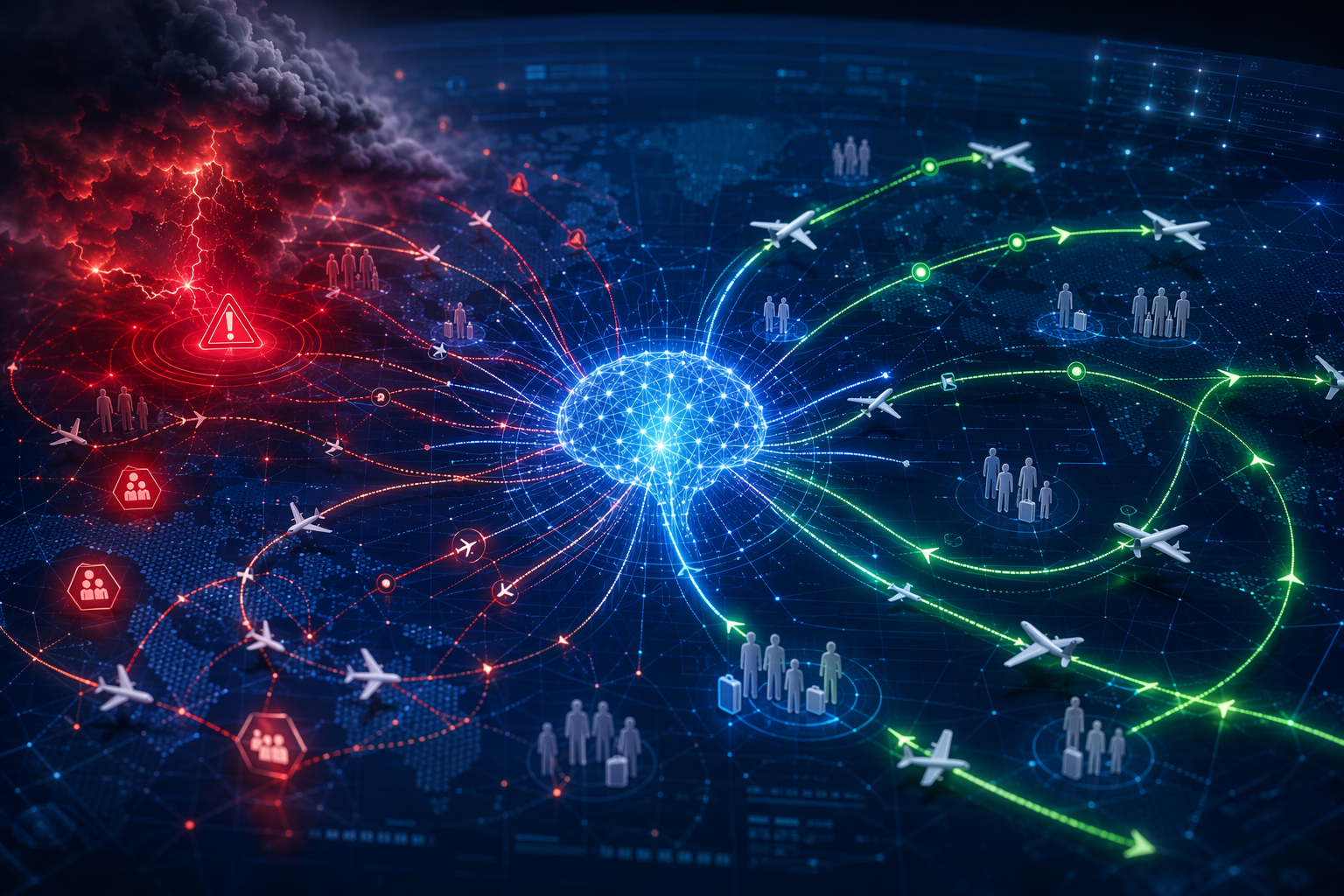
For supply chain and logistics teams, the aviation case is useful because it compresses the whole disruption-management problem into a visible clock. A ground stop, crew legality issue, weather cell, or aircraft swap is the trigger; the scarce resources are seats, crews, gates, bags, hotel inventory, and agent time. ChainSignal has already covered how AI predicts supply chain disruptions from airport ground stops. Airline rebooking shows the next step: early warning only matters if it can trigger an executable recovery process before customers flood the manual channels.
The Rebooking Stack Starts Before the Cancellation Is Public
Detection is the first layer, but it is not the whole job. Machine learning models used in airline operations are reported to forecast potential disruptions 24 to 72 hours ahead with 82% to 88% accuracy, using signals such as weather, crew, maintenance, and air traffic control data.[3][4] That gives the airline a head start, not a solved recovery.
The useful question is what happens after the alert. A weather risk over a hub can affect aircraft rotations, downstream connections, crew legality, baggage routing, and seat availability on later departures. If the system only posts a warning, the operations team still has to assemble the recovery by hand. If the warning flows into rebooking decisioning, the airline can begin shaping offers while passengers are still looking at their phones instead of waiting on hold.
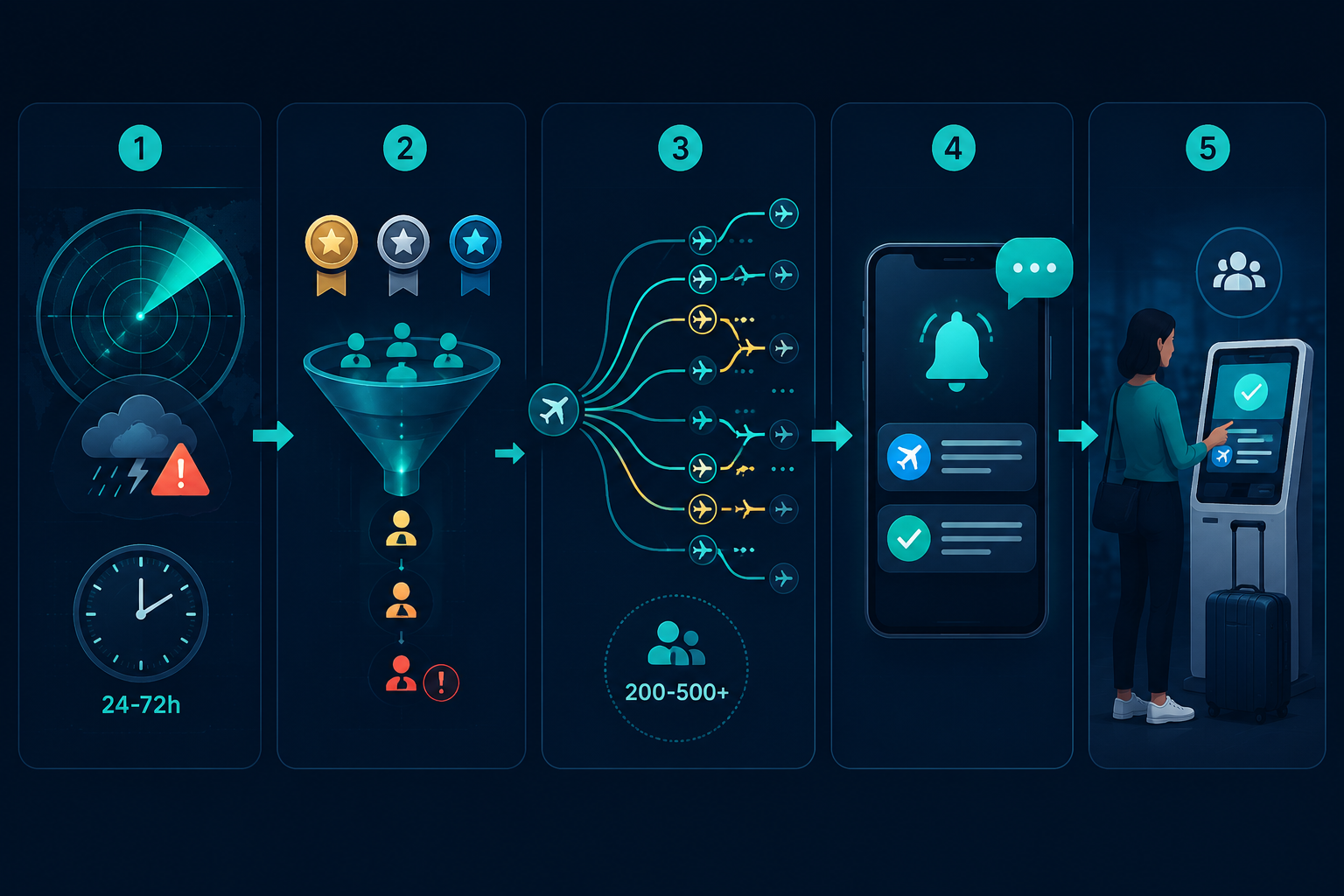
| Layer | Operational failure mode it reduces | What the AI-assisted system must produce |
|---|---|---|
| Disruption detection | Late awareness | A forecast or event signal early enough to act on |
| Passenger prioritization | Unranked recovery queues | A sequenced list of affected travelers and constraints |
| Itinerary generation | Slow manual option building | Feasible alternatives that respect rules, inventory, and network limits |
| Automated communication | Confusing or delayed passenger updates | A clear offer, status, or next action through digital channels |
| Self-service execution | Call center overload | Passenger acceptance, change, or escalation without starting with an agent |
Prioritization Is Where the Queue Becomes a Decision
A disruption does not create one homogeneous group of inconvenienced travelers. It creates a mixed queue. Some passengers are at the gate with a tight international connection. Some are local origin travelers who can move to a later flight. Some are families who need adjacent seats. Some are high-value loyalty customers. Some are traveling on fares with restrictive rules. Some have checked bags already moving through the system.
A serious rebooking stack has to turn that messy set into ranked work. The ranking is not simply “most loyal passenger first” or “earliest departure first.” It has to consider connection risk, itinerary recoverability, service commitments, inventory scarcity, fare conditions, traveler status, and the downstream cost of waiting. If five remaining seats can prevent five missed long-haul connections, assigning them to five passengers who could easily travel later may look fair in isolation and still make the operation worse.
This is where AI differs from a static rules table. Rules still matter: airlines cannot ignore fare conditions, interline agreements, loyalty rules, or capacity constraints. But a model-supported decision layer can continuously reorder cases as the situation changes. A passenger who was safe twenty minutes ago may become urgent when the protected connection closes. A routing that looked acceptable may disappear when another flight fills. The work is not one decision; it is a moving queue under shrinking options.
The strongest production evidence in the research set comes from Stack Overflight’s disruption-management case study for an Asia-Pacific carrier. The deployment reported a 40% reduction in recovery time, 70% passenger self-service adoption, 50% fewer inbound support calls, a 27% customer-satisfaction improvement during disruptions, and 30% customer support cost savings.[5] Because this is a single carrier case, it should not be treated as a universal benchmark. It is still useful because the metrics line up with the operational failure modes that matter: speed, containment, and reduced manual load.
Itinerary Generation Has to Respect the Network, Not Just Find a Seat
Once passengers are ranked, the system still has to build alternatives that an airline can actually operate and honor. Vendor descriptions and case materials describe automated re-accommodation systems evaluating roughly 200 to 500 or more routing options per passenger in seconds, taking into account fare rules, loyalty tier, and network constraints.[5][6] The important word is “constraints.” Without them, a rebooking engine becomes a suggestion machine that hands impossible work back to agents.
A feasible offer has several quiet dependencies. The replacement flight needs available inventory in the right cabin or booking class. The connection time must be legal and realistic. The routing must not strand the passenger away from checked baggage without a policy decision. The option may need to respect alliance or interline rules. If compensation, hotel, or meal eligibility applies, the communication layer has to know that too.
In practice, this is a search-and-filter problem under time pressure. The system explores candidate routings, removes options that violate hard constraints, scores the remaining alternatives, and exposes the best offers to the passenger or agent. The scoring can reflect airline policy: shortest arrival delay, fewest added connections, lowest reaccommodation cost, highest likelihood of completion, or protection of vulnerable connection banks. There is no single universal objective function, which is why integration with airline rules and operational systems matters more than the label “AI-powered.”
American Airlines provides a useful production signal at a larger event scale. OAG reported that the airline’s AI rebooking tool served more than 200,000 travelers during a single severe-weather event, while its flight-hold AI helped prevent thousands of missed connections.[7] That example does not isolate the effect of every model in the stack, but it shows AI being used in live irregular operations where passenger recovery and connection protection have to be coordinated quickly.
The Call Center Is the Bottleneck the System Has to Protect
During a disruption, call volume is not just a customer-service problem. It is a sign that the recovery loop has failed to make enough acceptable offers through faster channels. Every passenger who calls because they received no option, an unclear option, or an option they cannot accept joins the same queue as the truly complex cases. Then agents inherit the backlog, passengers wait longer, and the airline loses the advantage created by early detection.
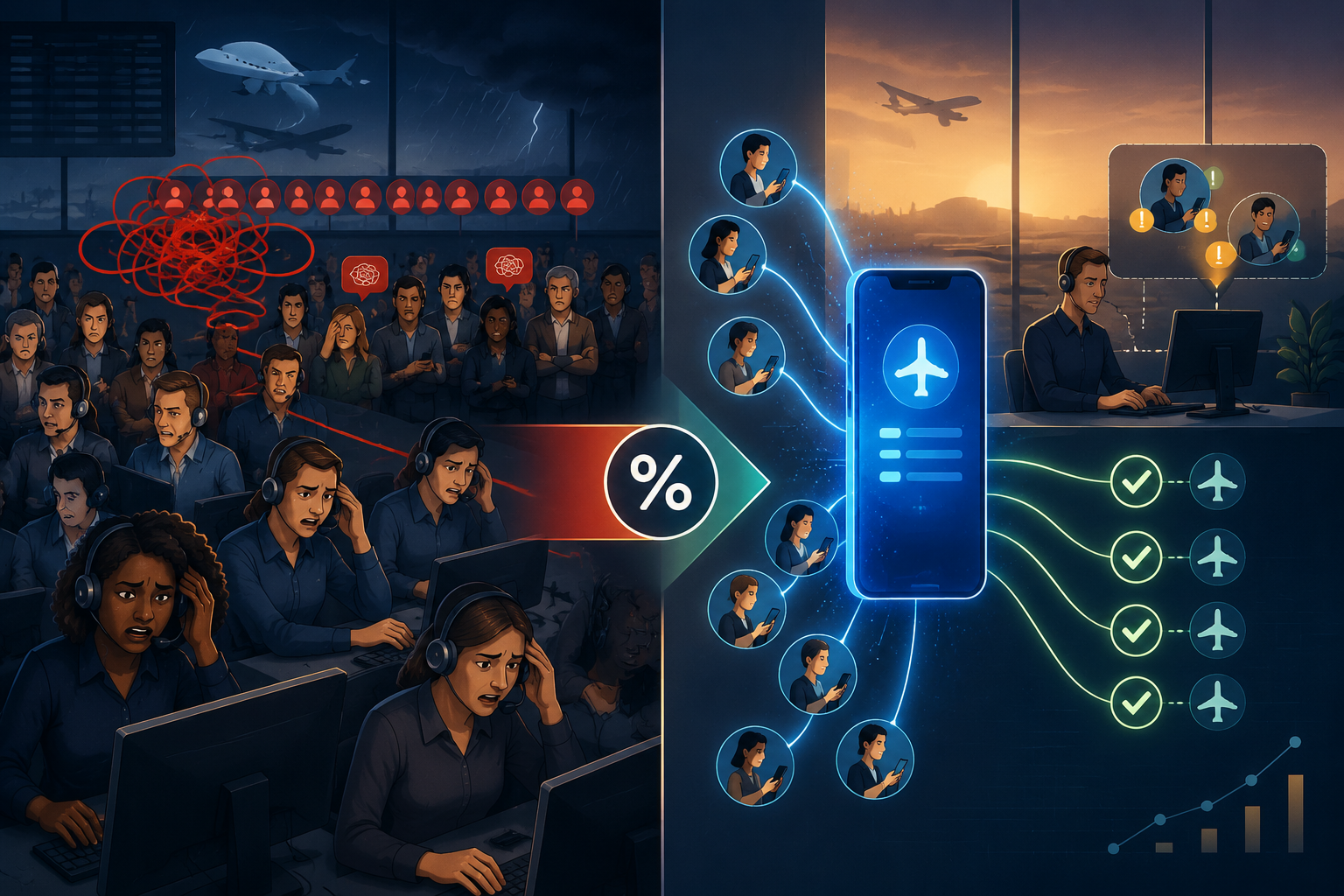
Automated communication is therefore not a cosmetic layer. It is the point where the airline turns internal recovery decisions into passenger action. A useful message tells the traveler what changed, what option is available, what they can accept immediately, what alternatives they can choose, and when they need an agent. A weak message merely announces disruption and pushes the passenger into a queue.
The Stack Overflight case is again worth attention because it reports behavior, not just capability. A 70% self-service adoption rate means most affected passengers in that deployment used digital recovery instead of beginning with manual support, while the 50% reduction in inbound support calls indicates that automated handling translated into call-center relief.[5] Those two measures belong together. High self-service adoption without lower support demand could mean customers were trying the tool and still escalating. Lower calls without adoption could mean suppressed demand or poorer access. Together, they suggest the recovery path actually absorbed routine work.
Chatbots can help, but only when they are connected to the actual recovery workflow. Air India’s AI.g chatbot reportedly handled 97% of customer queries autonomously without human intervention.[4] That is a strong containment signal for customer-service automation. For disruption rebooking, however, query containment is only part of the test. The passenger still needs a valid itinerary, policy-aware entitlements, and a clean escalation route when the case falls outside automation.
What Should Escalate to an Agent
The best use of automation is not to remove agents from disruption management. It is to stop spending scarce agent time on cases where the acceptable answer is already known. A passenger accepting a same-day alternative on the same airline should not need the same manual attention as a family split across cabins, a traveler with an interline connection, or a passenger whose bag, visa, disability assistance, and overnight stay all interact.
- Routine cases should receive an automated offer that can be accepted or modified without calling.
- Policy-sensitive cases should carry the relevant rules and entitlements into the agent desktop.
- Constraint-heavy cases should be escalated early, before the passenger burns time in a self-service path that cannot solve them.
- Uncertain cases should preserve context, so the agent does not restart diagnosis from the beginning.
That handoff is often where weak deployments show themselves. If the chatbot, mobile app, rebooking engine, and agent tool do not share state, automation becomes another front door into the same manual queue. The passenger repeats the story. The agent checks systems the model already queried. The clock keeps running.
Agentic Coordination Is the Direction, Not Yet the Baseline
The next step being described by aviation technology vendors is broader agentic coordination: systems that coordinate aircraft, crew, gates, baggage, passenger reaccommodation, and compensation in a unified decision loop. SITA frames the disruption problem as one created by a clock that is not being watched across the whole operation, and describes a future in which AI agents coordinate these linked decisions in real time.[8]
That direction is plausible because passenger rebooking is rarely isolated from the rest of the airline. Holding a flight for connecting passengers affects gate availability, crew timing, downstream punctuality, and the passengers already onboard. Rebooking a traveler onto a different route may create baggage consequences. Offering compensation changes cost exposure and customer expectations.
Still, these broad control-loop descriptions should be read carefully. Vendor pages are useful for understanding intended system functions, but they are not the same as independent proof that every airline has solved cross-system orchestration. The production evidence is strongest where the scope is narrower and measured: recovery time, self-service adoption, inbound call reduction, query containment, and travelers served during actual disruption events.
The Airline Lesson for Operations Teams
Airline rebooking is a clean example for any operation that has to recover scarce capacity under customer-facing time pressure. The lesson is not that every disruption needs a chatbot. It is that warning, decisioning, optimization, communication, and execution have to be connected tightly enough that the organization acts before the manual queue absorbs the event.
For freight, logistics, and supply chain teams, the analogous question is straightforward: when a disruption signal appears, does the system create executable recovery options, rank the affected customers or loads, communicate the next action, and reserve human intervention for exceptions? If the answer is no, prediction alone will have limited operational value.
The evidence supports a narrow but important conclusion. AI rebooking is credible when it is integrated across detection, prioritization, itinerary generation, communication, and self-service. Outcomes will vary by network complexity, data quality, policy design, and integration depth. But production deployments already show measurable reductions in recovery time and call-center load when routine reaccommodation moves out of overwhelmed human channels and into a connected recovery workflow.
References
- IROPS Without the Chaos: Resilient Airline Operations, Dreamix
- A Proactive Approach to Managing Disruptions in Aviation with AI, INFORM Software
- AI and Trusted Data: Building Resilient Airline Operations, OAG + Microsoft
- How Proactive AI helps Airline Disruption Management, 1Point1
- Disruption Management Case Study — Asia-Pacific carrier, Stack Overflight
- AI-Powered Re-accommodation Automation for Airlines, Kaiban
- Three Smart Ways Airlines Are Using AI to Improve Operations, OAG, Aug 2025
- Aviation's disruption cost is a problem created by the clock nobody is watching, SITA
Comments
Join the discussion with an anonymous comment.