
Extreme heat creates three different losses in supply chains: health-driven absenteeism, labour productivity decline, and indirect supply-chain disruption [1]. That split matters because AI does not solve each bucket with the same ROI. The first two are visible and local; the third is slower, more networked, and financially larger over time.
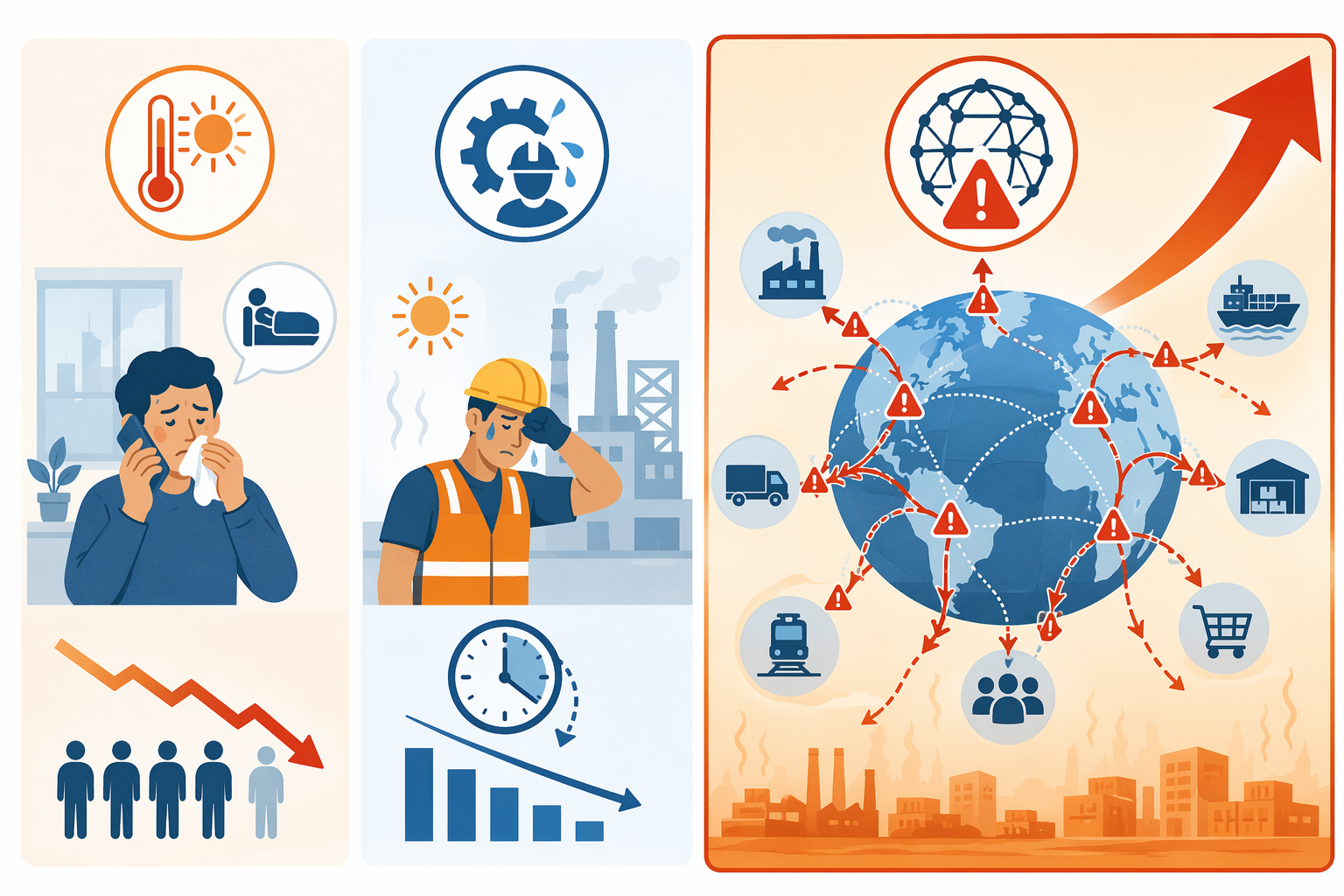
The loss split is the budget split
The cleanest way to read the heat problem is by what it breaks. The Nature study by Sun et al. separates the damage into health, labour productivity, and indirect supply-chain effects, with estimated shares of total heat losses at 37–45%, 18–37%, and 12–43% respectively [1]. That is not just an accounting detail. It tells you which AI tools fit which loss, and which losses are still being under-instrumented.
| Loss type | What it looks like operationally | Where AI fits | Why it matters to the CFO |
|---|---|---|---|
| Health-driven absenteeism [1] | Fewer people on site, more call-offs, more last-minute shift coverage. | Heat-health early warning, risk alerts, and mortality prediction; IBM's HE2AT Center and Extrema Global are current examples [6]. | Protects staffing continuity, but the damage is still concentrated at the workforce edge. |
| Labour productivity decline [1] | Slower outdoor work, lower output per hour, and tighter safe-work windows. | Forecast-driven scheduling and work-shift adjustments based on heat stress measures such as WBGT. | Useful where crews can be moved or hours can be shifted, but it is still a local operating problem. |
| Indirect supply-chain disruption [1] | Supplier delays, route failures, substitution costs, and knock-on effects across trade networks. | Digital twins, supplier risk scoring, and scenario modeling for network stress-testing [7]. | This is the largest projected loss pool and the hardest to see with conventional resilience programs. |
Why the indirect disruption case is the one that compounds
The indirect loss bucket deserves the most room because it grows into the biggest number. Under the high-emissions SSP585 scenario, Sun et al. project indirect supply-chain disruption losses rising from 0.1% of global GDP in 2030 to 1.5% by 2060, with total heat-related loss reaching $24.7T and indirect damage accounting for up to 38% of heat-related GDP damage [1]. That is a projection, not a current bill, but it is exactly the kind of projection a capital allocator needs to see early.
The geographic pattern sharpens the case. The same study estimates 2.7% GDP loss from indirect supply-chain effects in China and 1.8% in the US [1]. That is the profile of a manufacturing-heavy, globally connected economy getting hit where trade concentration and network exposure overlap. If a supply chain portfolio depends on East and Southeast Asia for production density, the loss is not only in local heat exposure; it is in the way disruptions travel through the chain.
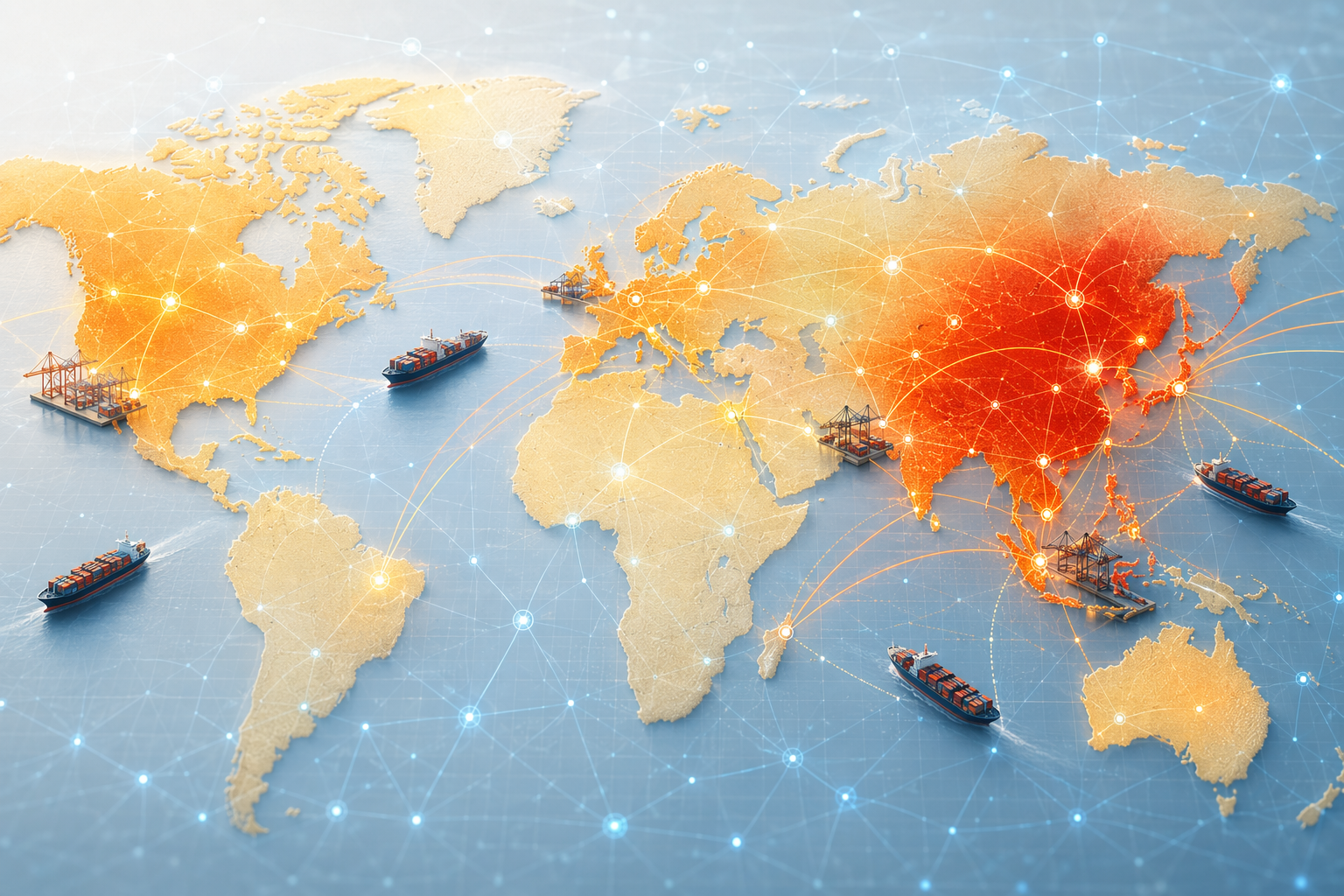
What heatwaves do to supply networks
Song et al. add a more specific mechanism view. Their published abstract identifies three channels through which heatwaves reduce supply chain resilience: reduced trade competitiveness, policy-driven resource misallocation, and weakened global value chain participation [2]. The useful part of that framework is not the labels; it is the reminder that heat does not only slow trucks or close plants. It can change which firms stay competitive, how public resources get redirected, and how easily firms remain embedded in cross-border production networks.
That is also why digitally intensive and knowledge-based sectors deserve attention instead of exemption. Song et al. flag those sectors as especially vulnerable [2], which is a useful correction to the habit of treating heat risk as mainly a blue-collar or field-operations problem. For AI investment, this is the layer where digital twins, supplier mapping, and scenario analysis have the clearest business logic: they let planners test how a heat shock moves through tiered suppliers, alternate lanes, and constrained regions before the disruption becomes a service failure.
WIRED's reporting offers short, practical illustrations of that toolset. It describes the R3GROUP consortium using AI-driven digital twins and Sentrisk using LLM-based supplier mapping to trace exposure across supply networks [7]. Those examples are directional, not proof of ROI, but they show the kind of application that belongs in the indirect-loss bucket: visibility, simulation, and prioritization rather than generic climate dashboards.
The smaller buckets still deserve targeted AI
Health-driven absenteeism is the easiest place to see immediate operational value. AI heat-health warning systems can give managers lead time to adjust staffing, staging, and protective measures. IBM's HE2AT Center uses earth-observation foundation models, and Extrema Global focuses on heat-mortality prediction [6]. That kind of model is useful where the main problem is knowing when people will not safely show up or should not be asked to.
Labour productivity decline is a narrower but still material problem. Here the AI use case is more prosaic: schedule heavy work earlier, shift crews, and align tasks with heat-stress forecasts such as WBGT. Nature's regional estimates show West Africa and Southeast Asia facing 2.0–3.3x the global average labour productivity loss [1], which is enough to justify targeted automation in outdoor, manual, or tightly timed operations. The point is not to rebuild the network; it is to preserve output during the hours when heat makes standard planning assumptions false.
The supporting signals point the same way
Vendor evidence is useful here, but only as a secondary check. A Weather Company and Magid report says companies using AI weather intelligence see 5–10% revenue improvements and substantial operating cost reductions [3]. Capgemini, citing IDC, says 55% of Forbes Global 2000 OEMs will revamp service supply chains with AI by 2026 [4]. Everstream adds the urgency backdrop: 7,348 major weather and climate events since 2000 versus 4,212 in the prior 20 years, and 80% of organizations reporting supply-chain disruptions, most more than once [5]. None of those numbers prove the case on their own, but together they explain why the buying window is opening now.
For this use case, the board-safe order is straightforward: fund indirect disruption first, then use the same stack to strengthen staffing and warning time in the two smaller buckets. The other losses matter, but the strongest climate-AI business case starts where heat turns into cascading supply-chain damage that current resilience programs are least equipped to see.
References
- Economic consequences of heatwaves from a supply-chain perspective. Nature
- Heatwaves and supply chain resilience. Sustainable Development
- Managing Supply Chain Weather Risks with Predictive Analytics and Real-Time Insights. The Weather Company
- Supply Chain Resilience, The AI Way. Capgemini
- Climate change is accelerating supply chain disruption. Everstream Analytics
- AI battle extreme heat. IBM Think
- Manufacturers hope AI will save supply chains from climate crisis. WIRED
Comments
Join the discussion with an anonymous comment.