
Indoor lettuce supply chain Cyclospora prevention has become a live sourcing question, not a theoretical technology pitch. The 2026 Cyclospora outbreak was reported at 1,645 confirmed lab-positive cases across 34 states, with the source traced to Taylor Farms de Mexico field-grown imported lettuce; Michigan alone reported more than 5,000 cases against a typical annual level of about 50.[1][2][3] That does not make controlled-environment agriculture automatically safe. It does make the difference between an unmanaged exposure pathway and a monitored control point much harder to ignore.
Indoor lettuce operations start with useful structural advantages: enclosed growing rooms, controlled water sources, no routine soil contact, fewer wildlife vectors, and tighter lot-level records. Those advantages matter only after they are converted into measurable controls. A retailer or distributor does not need a grower to say the farm is indoors. It needs to know what the farm watches, what triggers a hold, who signs the corrective action, and which records survive a food safety audit.
The stack has to follow the risk pathway
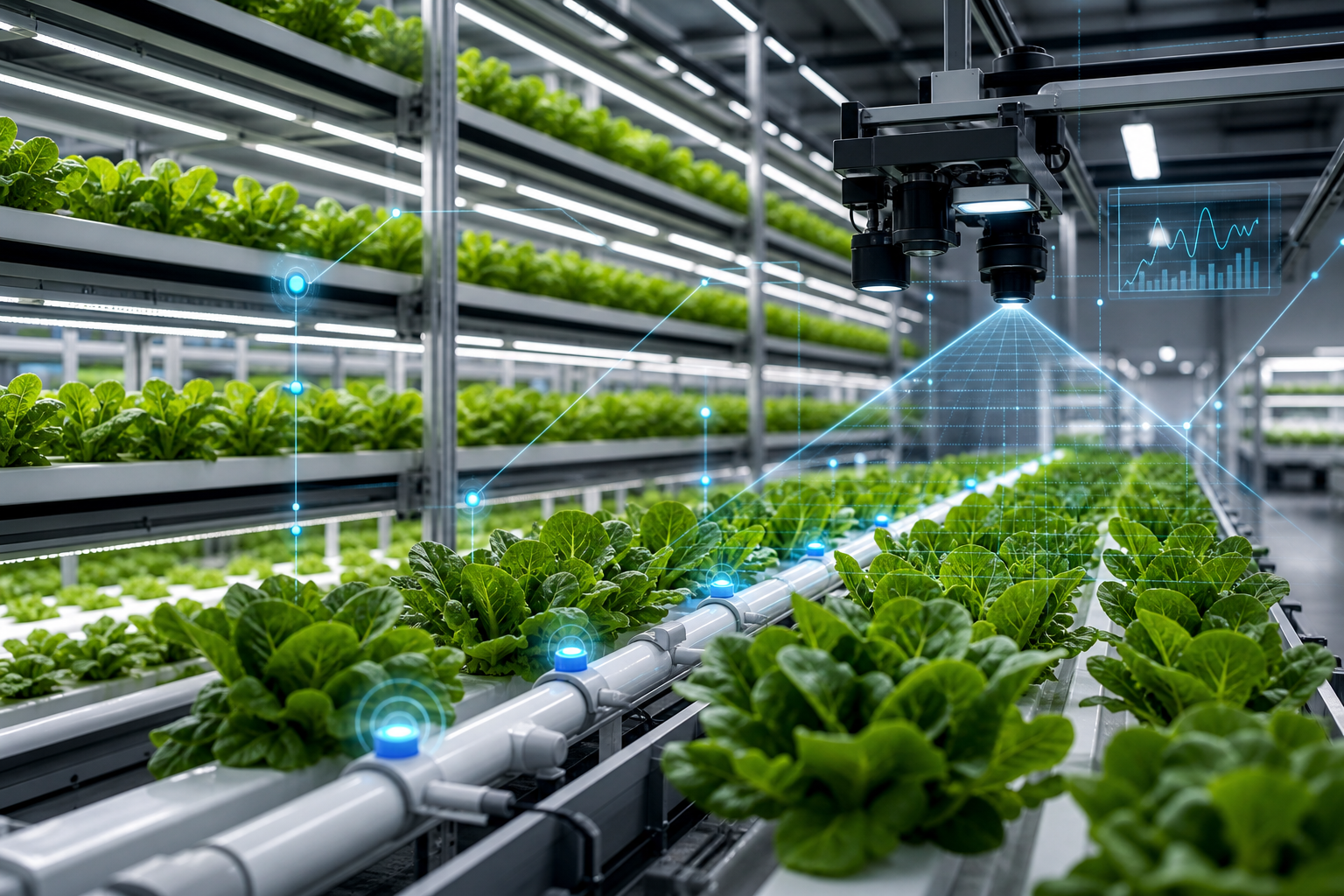
Cyclospora prevention in indoor lettuce is mostly an exercise in keeping plausible contamination routes from becoming invisible. The relevant stack is not a single AI model. It is a set of monitored layers: water treatment, continuous water sensing, visual screening for contamination vectors, and analytics that connect weak signals before they become a shipment-level problem.
| Layer | What it can reduce | What it cannot prove |
|---|---|---|
| UV-C and recirculating water control | Microbial burden in hydroponic nutrient solution and untreated water-loop drift | That every harvested leaf is free of Cyclospora |
| IoT water quality monitoring | Delayed awareness of pH, ORP, TDS, free chlorine, and other water anomalies | The identity of a microscopic pathogen without lab confirmation |
| Computer vision inspection | Visible soil, decay, and foreign material entering wash or pack flows | Direct optical detection of Cyclospora oocysts |
| Sensor-fusion analytics | Slow response to combined environmental, water, and inspection drift | Replacement of microbial testing, GAP audits, or certification |
That distinction is the procurement discipline. Each layer should have a job narrow enough to validate. If the claim is that a system shortens time from drift to intervention, it can be tested against alerts, holds, corrective actions, and release records. If the claim is that AI “prevents Cyclospora” by seeing the organism, the claim has already outrun the evidence.
Why water control carries the heaviest burden
In a recirculating hydroponic system, water is both an advantage and a liability. It is controlled, filtered, monitored, and contained in ways field irrigation water often is not. It is also a shared medium. If a water-loop control fails quietly, the failure can move through more plants than a manager would like to imagine.
This is where UV-C treatment earns attention. A 2024 Scientific Reports study found that UV-C treatment of recirculating hydroponic nutrient solution could control microbial contamination while maintaining crop growth.[4] The useful point is not that UV-C solves Cyclospora by itself. It is that the water-treatment layer has a scientific footing: treatment can reduce microbial contamination in a recirculating nutrient solution without turning the production system into an agronomic compromise.
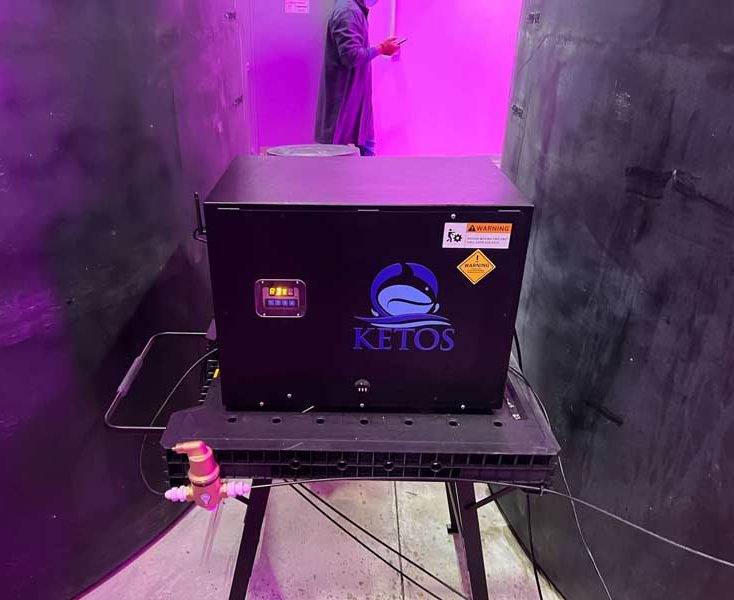
Treatment still needs measurement around it. KETOS describes a platform for vertical farming water quality that measures more than 30 water parameters in real time, including pH, oxidation-reduction potential, total dissolved solids, and free chlorine, with automated alerts when values drift outside thresholds.[5] For operations teams, that changes the cadence. Periodic sampling asks, “What did the water look like when someone checked it?” Continuous monitoring asks, “What changed, when did it change, and who responded?”
That cadence matters because corrective action is not a philosophy. A credible water layer should generate records that show the threshold, the timestamp, the affected loop or zone, the hold decision if product is implicated, the retest or sanitation step, and the release authority. A supply chain buyer may never see the sensor dashboard, but it should be able to audit the chain of decisions the dashboard initiated.
The better use of AI here is exception management. A model can learn normal operating bands for a farm, detect combinations that deserve attention, and escalate a drift event faster than a human review cycle. It can also reduce noise by distinguishing a harmless transient from a pattern that coincides with filtration, dosing, temperature, or sanitation changes. None of that identifies Cyclospora in the water. It narrows the window in which an unsafe water condition can remain operationally invisible.
Computer vision belongs before microbial claims begin
Computer vision has an obvious appeal in lettuce: cameras can watch every product stream in a way people cannot. The mistake is to make the claim biological when the evidence is visual. A camera can screen for visible defect classes that raise contamination concern. It cannot look at a leaf and certify that microscopic Cyclospora oocysts are absent.
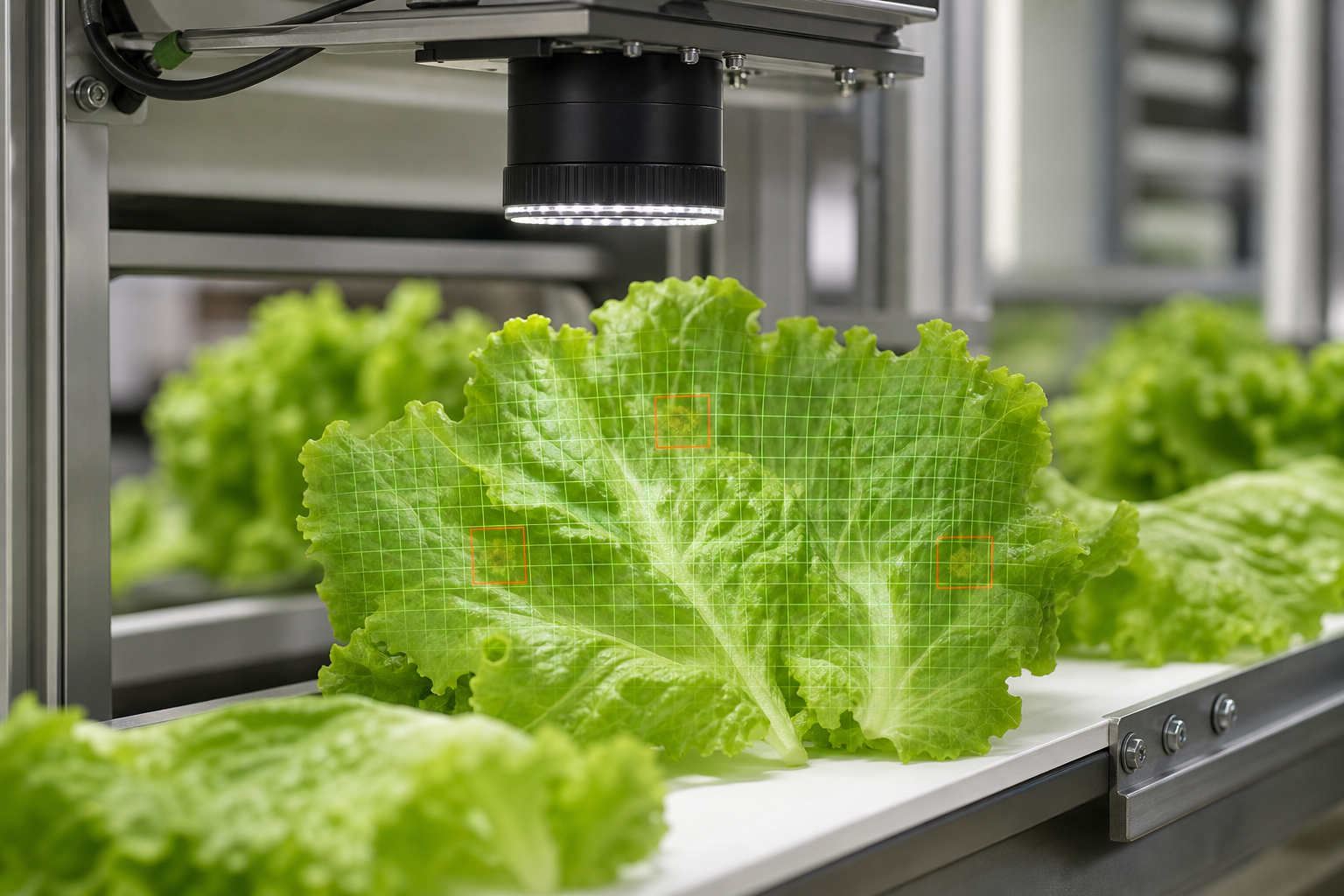
Overview.ai’s shredded lettuce benchmark is useful precisely because it stays closer to what cameras can inspect. In the company’s 2026 Taco Bell Cyclospora outbreak analysis, an OV20i sensor was used with a 20-region grid inspection approach to classify visible issues such as soil, decay, and foreign material after minutes of labeling rather than weeks of model training.[6] Those categories matter because they are contamination vectors and burden indicators before product moves deeper into wash or pack processes.
The boundary is important. Soil on lettuce is not Cyclospora. Decay is not Cyclospora. Foreign material is not Cyclospora. But each can be a reason to divert product, adjust upstream handling, inspect a supplier lot, or investigate sanitation. The operational value is earlier rejection or escalation of material that should not be allowed to disappear into a blended flow.
There is also a validation gap. The Overview.ai benchmark was an internal R&D test on retail lettuce, not a published validation at commercial production-line speed in an operating facility.[6] A grower evaluating this type of inspection should ask for line-speed performance, false-reject and false-accept behavior, lighting robustness, sanitation compatibility, lot traceability integration, and how model changes are versioned. Fast labeling is valuable. It is not the same thing as a validated food safety critical control.
Sensor fusion is where weak signals become decisions
The more interesting AI layer is not the dashboard that shows one abnormal reading. It is the layer that connects water quality drift, environmental changes, equipment state, inspection rejects, lot movement, sanitation timing, and test results. In a lettuce operation, those signals do not carry equal weight every day. A free-chlorine anomaly during a stable production period is one thing. The same anomaly alongside rising defect rejects, a maintenance event, and a recent sanitation deviation deserves a different response.
This is where predictive analytics can shorten the distance between “something moved” and “someone acted.” The model does not need to declare a pathogen. It needs to rank the event, notify the responsible person, associate the alert with affected lots, and preserve the record. If product is already harvested, the system should make it easier to hold the right batch instead of widening the hold because no one trusts the data.
Good sensor fusion also avoids a common failure in food safety technology: beautiful monitoring with no authority. An alert that no one owns is just delayed paperwork. The implementation design has to name the reviewer, the escalation rule, the product-disposition options, and the evidence needed for release. In an audit, the question is not whether the farm had AI. The question is whether the farm’s records show controlled response to a plausible risk pathway.
Planted Detroit shows the right posture
Planted Detroit is a useful practice example because the public description does not treat indoor production as a charm against risk. The operation has been described as using USDA Harmonized GAP+, weekly water and harvest testing, and UV filtration, and its COO stated plainly that “our risk isn’t zero.”[2] That sentence does more for confidence than a page of indoor-farm mythology.
The pattern is what matters. Certification supplies the documented system. Weekly water and harvest testing supply microbial reality checks. UV filtration addresses a water-pathway control. Monitoring and analytics can then sit inside a food safety program instead of pretending to replace one. That is the difference between a technology stack and a defensible assurance system.
The industry’s own institutional behavior points in the same direction. The CEA Alliance was founded in 2019 to develop documented food safety standards for indoor growers, reflecting the sector’s recognition that structural advantages still require formal protocols.[7] If enclosure were enough, the industry would not need standards tailored to controlled-environment production.
The counterexample still matters
BrightFarms’ 2021 Salmonella outbreak is the necessary caution. It was traced to an indoor controlled-environment agriculture operation despite the advantages of enclosed production.[8] The organism was not Cyclospora, and the case should not be overgeneralized into a claim that indoor farms are broadly unsafe. Its value is narrower and sharper: controlled environments can still fail, and a buyer should never accept facility design as a substitute for testing, certification, and corrective-action records.
That counterexample also keeps AI claims in proportion. A farm can have sensors, cameras, UV treatment, and analytics and still need microbial testing. Testing is slower and less glamorous than real-time monitoring, but it answers a different question. Monitoring asks whether the process is drifting toward risk. Testing asks whether a sample shows evidence that a microbial hazard is present. In food safety assurance, those questions reinforce each other; they do not cancel each other out.
What to require from an AI-enabled indoor lettuce supplier
A procurement review should start with mapped controls, not software names. The supplier should be able to show which risk pathway each layer addresses, which parameters are monitored, what thresholds trigger action, and how affected product is identified. If the supplier cannot connect a sensor alert to a lot, a hold, and a release decision, the monitoring layer is not yet an assurance layer.
- Water treatment: documentation for UV-C, filtration, sanitation, recirculation controls, and any validation evidence used to justify the treatment design.
- Water monitoring: real-time or high-frequency records for relevant parameters, alert thresholds, drift history, calibration, and corrective actions.
- Vision inspection: defect classes, camera location, reject rules, model versioning, line-speed validation, and evidence that operators review exceptions.
- Analytics: how environmental, water, inspection, sanitation, and lot data are joined; who receives escalations; and how product disposition is recorded.
- Certification and testing: USDA Harmonized GAP+, PrimusGFS, GFSI-recognized certification where applicable, plus routine microbial testing that is not replaced by AI outputs.
The strongest suppliers will be specific about uncertainty. They will not claim optical Cyclospora detection from a lettuce image. They will not present vendor dashboards as independent validation. They will distinguish an internal benchmark from commercial production evidence. They will show how an alert becomes a documented operational decision.
That is the defensible deployment claim for indoor lettuce supply chain Cyclospora prevention in 2026: AI can reduce risk pathways and shorten response time when it is layered across water, inspection, and operations data. It cannot make risk zero, and it cannot replace microbial testing or certification protocols. The farms worth trusting are the ones that use the technology and still keep the audit file ready.
References
- CDC surveillance data, CDC
- Cyclospora Outbreak 2026: Causes & Vertical Farming Fix, Vertical Farming Blog
- Michigan Department of Health and Human Services Cyclospora reporting, MDHHS
- UV-C treatment of recirculating hydroponic nutrient solution controls microbial contamination while maintaining crop growth, Scientific Reports, 2024
- Elevating Vertical Farming with Advanced Water Quality Solutions, KETOS
- The 2026 Taco Bell Cyclospora Outbreak: Inspection Gaps in Fresh-Cut Lettuce, Overview.ai
- How Indoor Farmers Manage Food Safety Risks, Indoor Ag-Con / CEA Alliance
- BrightFarms 2021 outbreak archives, CDC/FDA outbreak archives
Comments
Join the discussion with an anonymous comment.