
A CDC-tracked norovirus outbreak is not just a medical event on a cruise ship. It is a moving inventory problem with a clock attached. Guests stop eating the way the sailing forecast expected. Crew members who would normally receive, move, cook, clean, count, and serve inventory may be isolated or short-handed. Sanitation routines consume more product. A port call can change. The plan built before departure starts losing contact with the ship’s actual demand.
That is why the recent Vessel Sanitation Program data matters to supply chain teams. The CDC listed 16 cruise ship gastrointestinal illness outbreaks in 2024, with 1,894 passengers and 245 crew affected. In 2025, the count rose to 23 outbreaks, described by the cited sources as the highest in more than a decade. For 2026, the CDC count stood at 7 outbreaks as of July 15, a mid-year snapshot that should not be read as a full-year trend because norovirus activity often peaks from November through April. Individual outbreak attack rates in the 2024-2026 window ranged from 2.4% to 13.8%, wide enough to turn a normal hotel load into a live exception file.[1]
The year-to-year signal also comes with a warning label. In April 2025, all full-time civilian Vessel Sanitation Program staff were laid off, while about 12 U.S. Public Health Service officers remained. Cruise Hive later reported that inspections increased 39%, from 197 in 2024 to 273 in 2025, but Food Poison Journal cautioned that fewer investigators could mean fewer detected outbreaks rather than fewer actual outbreaks.[2][3] For a planner, that ambiguity is not academic. If surveillance inputs are inconsistent, a model may be learning from a partially visible disruption record.
What breaks after the outbreak notice
The first demand shift is usually in food and beverage, though not in one clean direction. A ship may reduce self-service touchpoints, change buffet operations, push more controlled service, and see passengers favor packaged, simple, or in-room options over normal dining patterns. That does not simply reduce consumption. It redistributes work across galleys, room service, stewarding, waste handling, and stores.
The second shift is faster-moving consumables. Disinfectants, gloves, masks, bags, paper products, linens, and medical supplies move differently once isolation and enhanced sanitation routines begin. These are not glamorous SKUs, but they are the items that expose whether a vessel has real consumption visibility or only end-of-voyage reconciliation.
The third shift is labor capacity. A case count among guests changes service demand; a case count among crew changes the ship’s ability to execute the response. In one 2025 Seabourn Encore outbreak cited by KSBW, 2.8% of passengers and 5.4% of crew were reported ill.[4] That asymmetry matters because crew illness removes people from receiving, sanitation, food prep, inventory counts, and guest service at the same time those functions are under pressure.
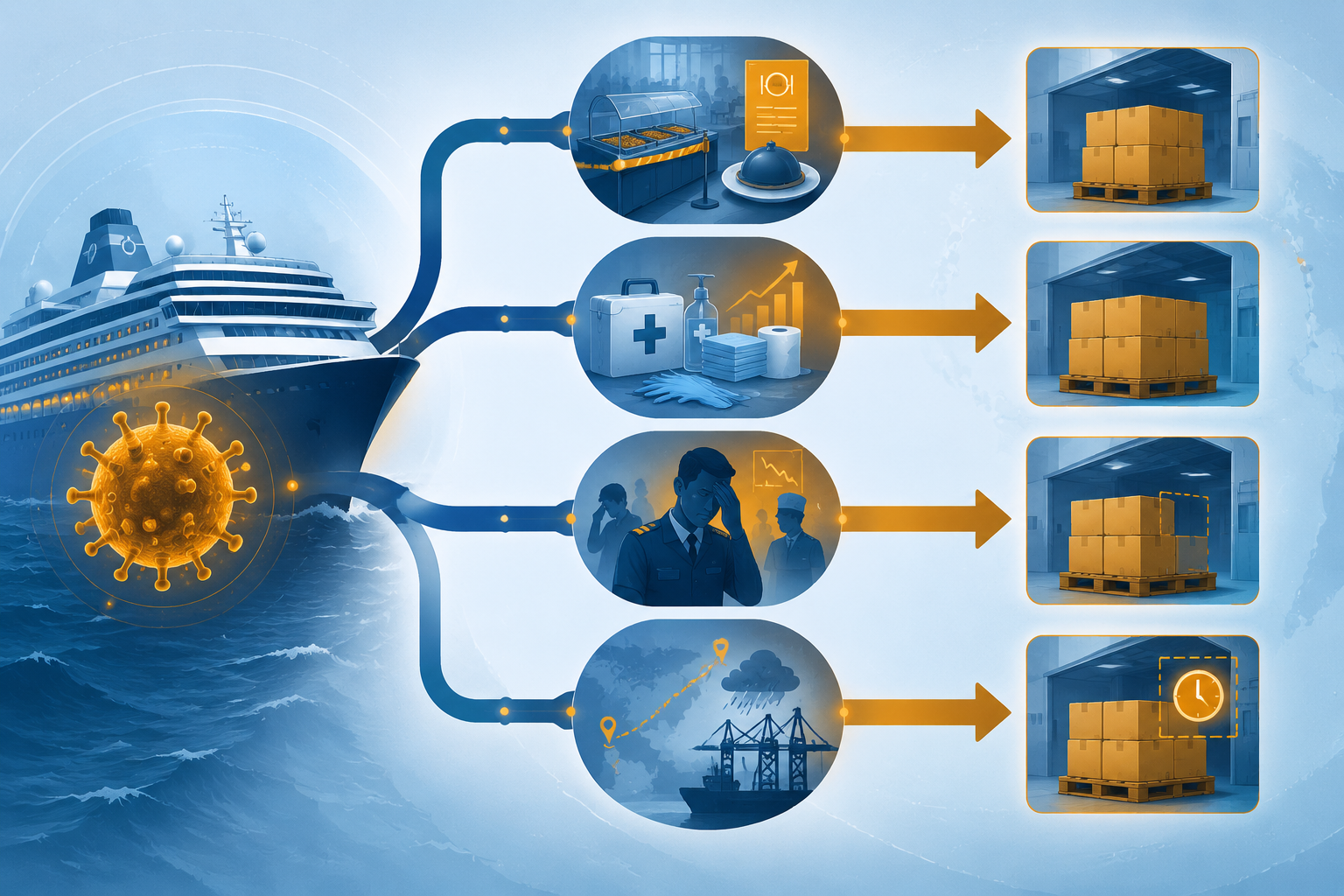
The fourth shift is itinerary risk. Provisioning plans are built around loading windows, port assumptions, vendor cutoffs, and onboard storage limits. A skipped port can leave the ship with too much of the wrong product, too little of the next critical item, or a rushed substitution plan. Forbes cited a Grand Turk gastrointestinal outbreak example from 2013 in which 6 cruise ships skipped the port, illustrating how a health incident can become a port operations cascade rather than a single-vessel exception.[5]
That is the practical shape of the disruption CDC norovirus data can help frame: not a mysterious black-swan event, but a repeatable pattern of demand distortion, execution loss, and replenishment uncertainty. The hard part is sensing it early enough, and with enough SKU-level fidelity, to act before the next loading decision is already locked.
Where AI demand sensing fits
MSC Cruises offers the clearest example of AI being applied to the cruise-specific forecasting problem rather than to a generic procurement dashboard. At Seatrade Cruise Global 2026, MSC executives described using AI to forecast food and beverage needs by itinerary, guest profile, nationality, age, and seasonal event data, with expansion planned into hotel supplies, uniforms, and retail.[6]
Those inputs map well to normal cruise hospitality demand. A seven-night sailing with one guest mix, one itinerary, and one seasonal calendar will not consume like another. Age mix changes beverage, dining, and amenity patterns. Nationality mix can change cuisine preferences and breakfast behavior. Itinerary changes affect whether guests eat lunch onboard or ashore. Seasonal events can pull demand toward particular categories. A model that absorbs those patterns can give buyers and shipboard teams a better starting load than a static spreadsheet carried forward from a previous sailing.
During an outbreak, that starting point is still valuable because the ship is not improvising from zero. If the forecast already knows the sailing’s baseline food and beverage profile, planners can compare outbreak-period consumption against a more realistic expectation. The model does not need to “predict norovirus” in the dramatic sense to help. It can detect that room-service demand is pulling away from the itinerary norm, that packaged items are moving faster than expected, or that sanitation stock is no longer tracking the voyage plan.
Carnival Corp.’s MAST program points to the enterprise layer of the same problem. According to the Seatrade report, Carnival is using forecasting models to harmonize procurement across 8 brands. Kevin Muhich, Carnival’s chief procurement officer, put the dependency plainly: “accuracy in the data infrastructure is key to enabling everything downstream with supply chain.”[6]
That distinction matters. A brand-level procurement model can improve buying discipline, supplier leverage, and category visibility before any outbreak occurs. But outbreak response depends on whether the model can see the ship-level facts that appear after departure: what was actually received, what was substituted at the pier, what was consumed by outlet, what was transferred internally, what was wasted, and what is now blocked by crew availability or port timing.
| Operational signal | Why it matters during an outbreak | What AI can use if the data exists |
|---|---|---|
| Food and beverage consumption by outlet | Dining demand shifts away from the pre-voyage pattern | Variance from itinerary- and guest-profile baseline |
| Medical and sanitation item movement | Cleaning and isolation routines accelerate specific consumables | Early depletion alerts and replenishment priorities |
| Crew availability | The people needed to receive, clean, cook, and count may be unavailable | Execution-capacity constraints in replenishment plans |
| Port and itinerary changes | Skipped or delayed calls change loading assumptions | Alternative provisioning scenarios and supplier timing |
| Receiving and substitution records | The ship may not have what the purchase order says it has | More accurate onboard inventory position |
Earlier alerts are useful, but they are not magic
The more ambitious promise is risk prediction before the operational snap is visible in stores. Stan Schmal of Lufthansa Industry Solutions said AI can predict supply chain disruption risks “two hours before they happen,” allowing proactive re-provisioning. The same Seatrade coverage also characterized cruise industry use of that capability as underdeveloped.[6]
That should be read as capability evidence, not proof that cruise operators can already prevent the cascade. Two hours can matter when a truck is still outside the terminal, a substitute vendor can still be called, or a purchasing team can still adjust the next port load. Two hours matters less if the ship has already sailed, the next call is skipped, the supplier feed is not integrated, or the onboard count is sitting on a clipboard.
For outbreak response, the strongest AI use case is therefore not a single forecast. It is a loop: baseline demand before departure, exception detection during the sailing, risk scoring against the next loading opportunity, and revised purchasing or transfer decisions before the next operational window closes. Cruise operators already plan around constrained space, perishability, customs rules, and port timing. AI helps when it shortens the lag between the ship’s real condition and the shore-side decision.
The data layer is still the weak seam
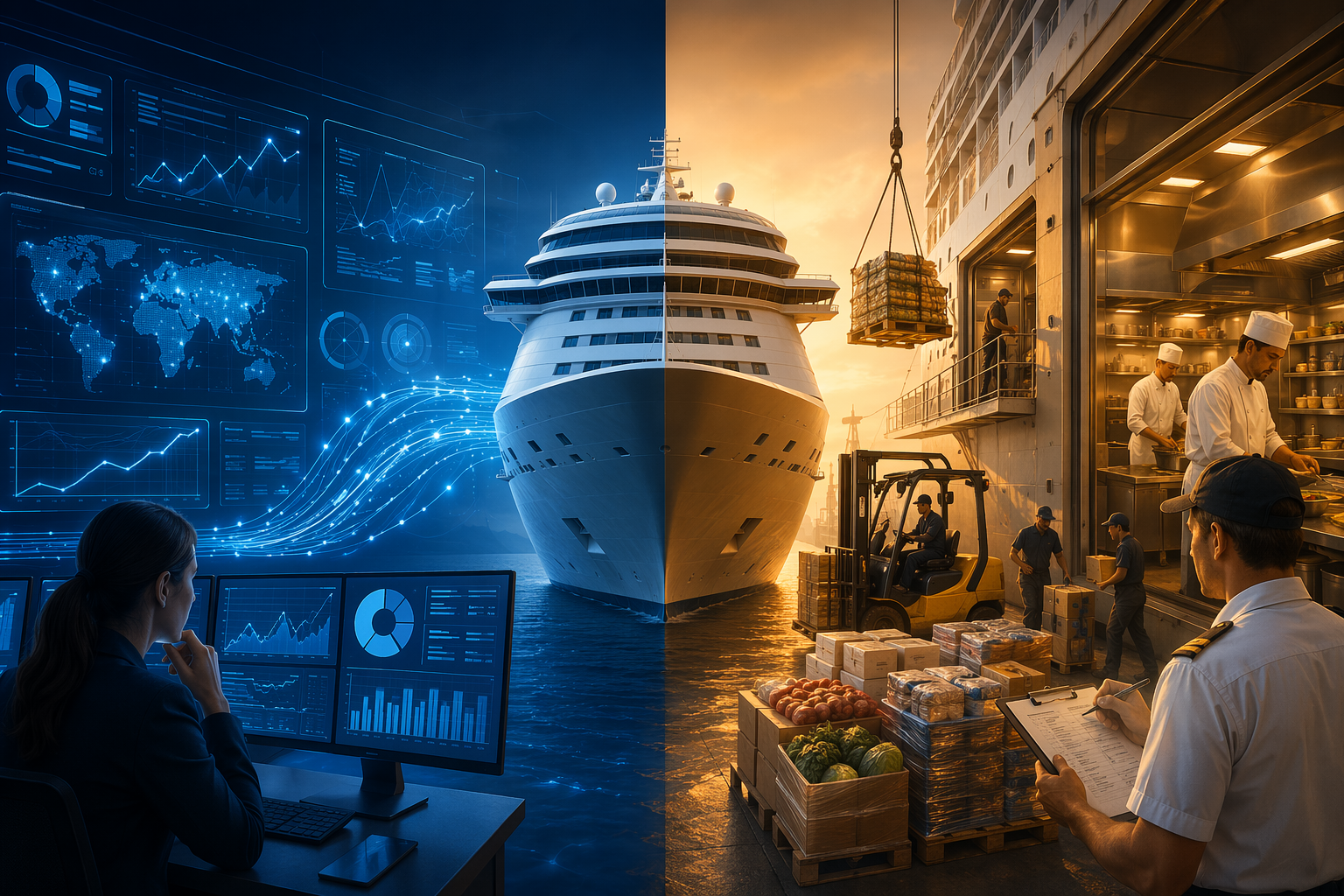
The most important quote from the Seatrade reporting is not the one about prediction. It is Paolo Raia of MSC Cruises describing why the technology underperforms in cruise operations: “the gap that I see is the data, because AI works very well when you provide qualitative data. At the moment, the cruise industry is not there.” He pointed specifically to handwritten checklists, non-integrated supplier systems, and the need to digitize receiving and consumption tracking before AI can deliver.[6]
That is the place where the model stops being the main story. If receiving is manual, the system may not know whether the pier-side substitution actually arrived. If suppliers are not integrated, shore-side planners may not see constraints until a buyer calls. If consumption is captured late or at too high a level, the model cannot distinguish a normal guest-preference swing from an outbreak-driven shift. If crew capacity is not represented in the planning data, the replenishment plan may assume work can be done by people who are no longer available.
Poor data also blurs accountability. A forecast can be blamed for a stockout that began as a missed receiving scan, a vendor substitution, a delayed internal transfer, or a port change. In cruise operations, those differences matter. The fix for one is better model tuning. The fix for another is supplier integration. Another requires mobile receiving. Another requires a different onboard process for tracking transfers and waste. Calling all of them “forecast error” is a comfortable way to avoid the work.
The CDC data has a similar constraint at the surveillance layer. Outbreak counts give planners a credible stress-test record, but they are not a perfect measure of operational risk. The 2026 count is incomplete as of mid-July. Staffing changes complicate comparison. Detected outbreaks are not necessarily the same as actual outbreaks. An AI tool that treats the public count as a clean probability table will be more confident than the evidence allows.
What cruise operators can reasonably expect now
The practical expectation for AI in this use case should be narrower than the sales language and stronger than the skeptic’s shrug. It is credible for itinerary-level food and beverage planning. It is credible for comparing actual consumption against a better baseline. It is credible for procurement harmonization across brands and categories. It is credible for earlier disruption alerts when the relevant feeds are timely enough.
It is less credible as a self-contained outbreak control system. The model does not walk the dock, verify the pallet, notice the substitution, clean the buffet line, or count the crew members missing from stores. It can only work with the operational truth the cruise line captures and connects.
For supply chain teams evaluating predictive inventory tools, the useful questions are blunt:
- Does the model receive actual onboard consumption data during the voyage, or only after voyage close?
- Can it distinguish planned inventory from received inventory after pier-side substitutions?
- Are supplier availability, port timing, and alternate provisioning options integrated into the same decision flow?
- Can medical, sanitation, hotel, and food demand be viewed together when an outbreak changes all of them at once?
- Does the planning process account for crew capacity, not just product quantity?
Those questions are less exciting than “Can AI predict the next disruption?” They are also closer to the loading dock. A cruise ship under norovirus protocols does not need a model that sounds prescient in a conference room. It needs a planning system that knows what is onboard, what is moving faster than expected, what cannot be replenished at the next port, and which team still has the capacity to execute the change.
The current evidence supports a bounded conclusion. AI demand sensing can help cruise lines absorb norovirus-driven supply chain shocks, especially in food and beverage forecasting, procurement harmonization, and earlier disruption alerts. But without digitized receiving, real-time consumption tracking, supplier integration, and reliable outbreak surveillance inputs, the models remain partially blind in exactly the hour executives most want them to perform.
References
- Cruise Ship Outbreak Updates, Centers for Disease Control and Prevention
- CDC cruise ship inspectors laid off amid outbreaks of norovirus, CBS News
- How CDC Layoffs Have Impacted Cruise Ship Inspections One Year Later, Cruise Hive
- Cruise ship outbreaks, KSBW
- Cruise Line Rankings: CDC Inspections Show Most And Least Healthy, Forbes, January 3, 2025
- Cruise lines playing catchup with AI to help supply chain needs, Seatrade Cruise
Comments
Join the discussion with an anonymous comment.