
The cleanest case for AI consumer sentiment demand forecasting is not a mature SKU with three years of weekly POS history. It is the seasonal launch that arrives with a campaign calendar, a shipment deadline, a retailer asking for a commitment, and almost no sales history worth trusting. In that situation, the baseline model is mostly borrowing from analogs, promotion mechanics, and planner judgment. If reviews, social chatter, survey responses, and brand mentions start moving before sell-through appears, they are not a decoration on the forecast. They may be the first demand signal with any current customer behavior in it.
That is where sentiment deserves attention. A controlled food-and-beverage study reported that adding social media sentiment and engagement data improved forecast accuracy by 42% for a seasonal promotion with no historical baseline.[1] The number matters because the test resembles a real planning problem: short window, limited history, and a promotional demand curve that a POS-only model cannot learn from itself. It does not prove that sentiment improves every forecast by that amount. It says the signal can be useful when the usual historical anchor is weak.

The broader evidence points in the same direction, but with an important distinction. McKinsey-related analysis cited by Kearney says AI-powered forecasting that incorporates external signals such as sentiment, weather, and economic indicators can reduce forecast errors by 20–50% and decrease product unavailability by up to 65%.[2] That is evidence for external-signal forecasting, not sentiment by itself. Weather may be carrying the lift in one category, local events in another, and sentiment in a third. A demand planning team should not use that range as a blanket business case for a social-listening feed.
What Sentiment Adds That POS History Cannot
Consumer sentiment data is useful because it arrives in a different form and often on a different clock than transactions. POS shows what was bought after availability, price, placement, and promotion already shaped the outcome. Sentiment can show what people are noticing, comparing, rejecting, praising, or worrying about before that behavior settles into sales.
That does not mean every spike in conversation is demand. A viral complaint can raise mentions while lowering purchase intent. A celebrity post can create attention without repeat sales. A retailer out-of-stock can create frustrated reviews that look like negative product sentiment even though latent demand is strong. The forecasting value comes when the signal is tied to the right entity, time window, product attribute, and demand question.
| Planning situation | Why sentiment may help | Planning caution |
|---|---|---|
| New product launch | There is little or no SKU-level sales history, so early customer language can help distinguish awareness from rejection or enthusiasm. | Compare against analog-based and attribute-based cold-start models, not against an empty baseline. |
| Seasonal or promotional item | Demand forms quickly, and social engagement may move before POS data is complete enough to recalibrate. | Separate campaign-driven chatter from purchase intent. |
| Short-lifecycle goods | Historical patterns decay quickly, especially in trend-sensitive categories. | Use short aggregation windows and monitor signal fatigue. |
| Volatile category | Sentiment may catch emerging shifts that a model trained on prior sales underreacts to. | Check whether the same shift is already visible in search, availability, or price data. |
| Stable repeat item | The signal may add little beyond a tuned model using POS, promotion, seasonality, and inventory constraints. | Do not add pipeline cost unless backtesting shows marginal lift. |
The mistake is treating sentiment as a universal accuracy upgrade. For a stable, high-volume replenishment item, a well-tuned model already has plenty of clean demand history. If the SKU sells predictably every week and the main forecast drivers are price, distribution, promotion, and seasonality, sentiment may only add noise. The right comparison is not sentiment versus a naive spreadsheet. It is sentiment versus the best current model the planning team can actually run.
Where The Accuracy Lift Is Most Believable
New product introductions are the most obvious fit. The planning team is being asked to place inventory before the product has enough demand history. Traditional approaches borrow from predecessor products, product attributes, launch tier, channel plans, and expert overrides. Sentiment can add another early read: whether consumers are talking about the specific item, which attributes they mention, whether comments are favorable or hostile, and whether that language is changing after sampling, influencer coverage, retail display, or media spend.
The important phrase is “another early read.” Sentiment should not replace SKU similarity, promotion modeling, or planner review. It should become a feature that competes in backtesting. If sentiment improves forecast error for the launch cohort after controlling for campaign timing, distribution, and comparable-product behavior, it has earned a place. If it only explains the forecast after the fact, it belongs in a postmortem, not in replenishment logic.
Seasonal promotions are the second strong fit because the forecast window is unforgiving. By the time POS data proves the baseline was too low, the supplier may have missed the production slot or the retailer may have reallocated space. The 42% F&B result is persuasive for this reason: the study setting involved a seasonal promotion with no historical baseline, exactly the kind of case where a leading signal can matter operationally.[1]
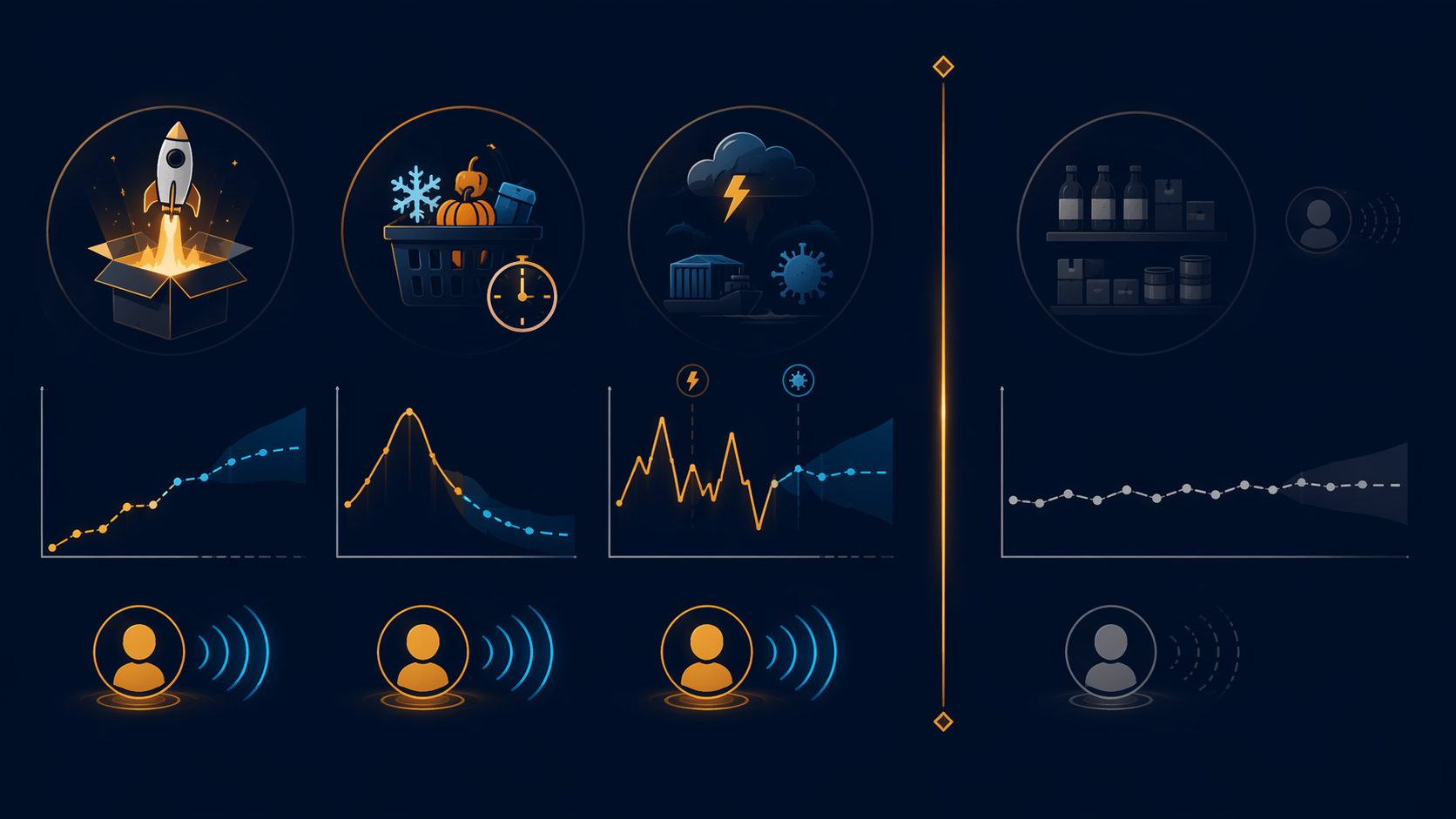
Short-lifecycle goods have a similar problem, though the mechanics differ. The issue is not always zero history; it is that history goes stale quickly. Fashion, consumer electronics accessories, trend-led beauty, limited-time food products, and entertainment-linked merchandise can all move faster than a monthly consensus process. Sentiment features can help the model detect that last month’s demand curve is losing relevance, especially when product attributes or competitive comparisons start showing up in consumer language.
Volatile categories are the hardest to judge because sentiment can be both signal and smoke. A negative review wave may precede a demand drop. It may also be caused by a supply issue, a recall, a competitor promotion, or a news event that is already affecting sales through another path. Forecasting teams need to treat sentiment as a correlated leading indicator until testing shows otherwise. The model can use the correlation; the S&OP deck should not pretend it has proved causation.
The Enterprise Evidence Is Useful, But Not Clean Proof
Enterprise examples show that sentiment can be part of production demand-sensing systems. Unilever has been described as using an AI demand-sensing platform that integrates POS, weather, events, and social media signals, with reported outcomes including a 30% forecast-error reduction, a 15% safety-stock reduction, and about $300 million in annual holding-cost savings.[3] Those figures should be handled carefully: the holding-cost claim is reported through a secondary source citing a DocShipper report, not directly from audited Unilever financials.[3]
The Unilever example is still relevant, but not because the reported savings number should carry the business case. Its value is production plausibility. A large CPG environment can combine social signals with POS, weather, and event data in a demand-sensing workflow. What the public material does not cleanly isolate is how much of the improvement came from sentiment versus other external variables, data latency improvements, model changes, or process discipline.
P&G is described in the same source as using AI-powered forecasting that ingests real-time social media sentiment alongside POS and economic data to predict new product launch demand and optimize replenishment at the store-SKU level.[3] That aligns with the strongest use case: launch planning and granular replenishment under uncertainty. Walmart has also been described as using AI with sentiment signals for store-level demand forecasts.[4] These cases support feasibility, not a guaranteed lift for every planning environment.
How Sentiment Becomes A Forecast Feature
The hard part is not buying a sentiment score. The hard part is making that score correspond to the item, attribute, location, and time bucket the forecast actually uses. A comment that says “the new mango flavor tastes artificial” is not useful to a demand model until the pipeline knows the brand, product, flavor, sentiment direction, sentiment intensity, source, timestamp, market, and relationship to the SKU hierarchy.
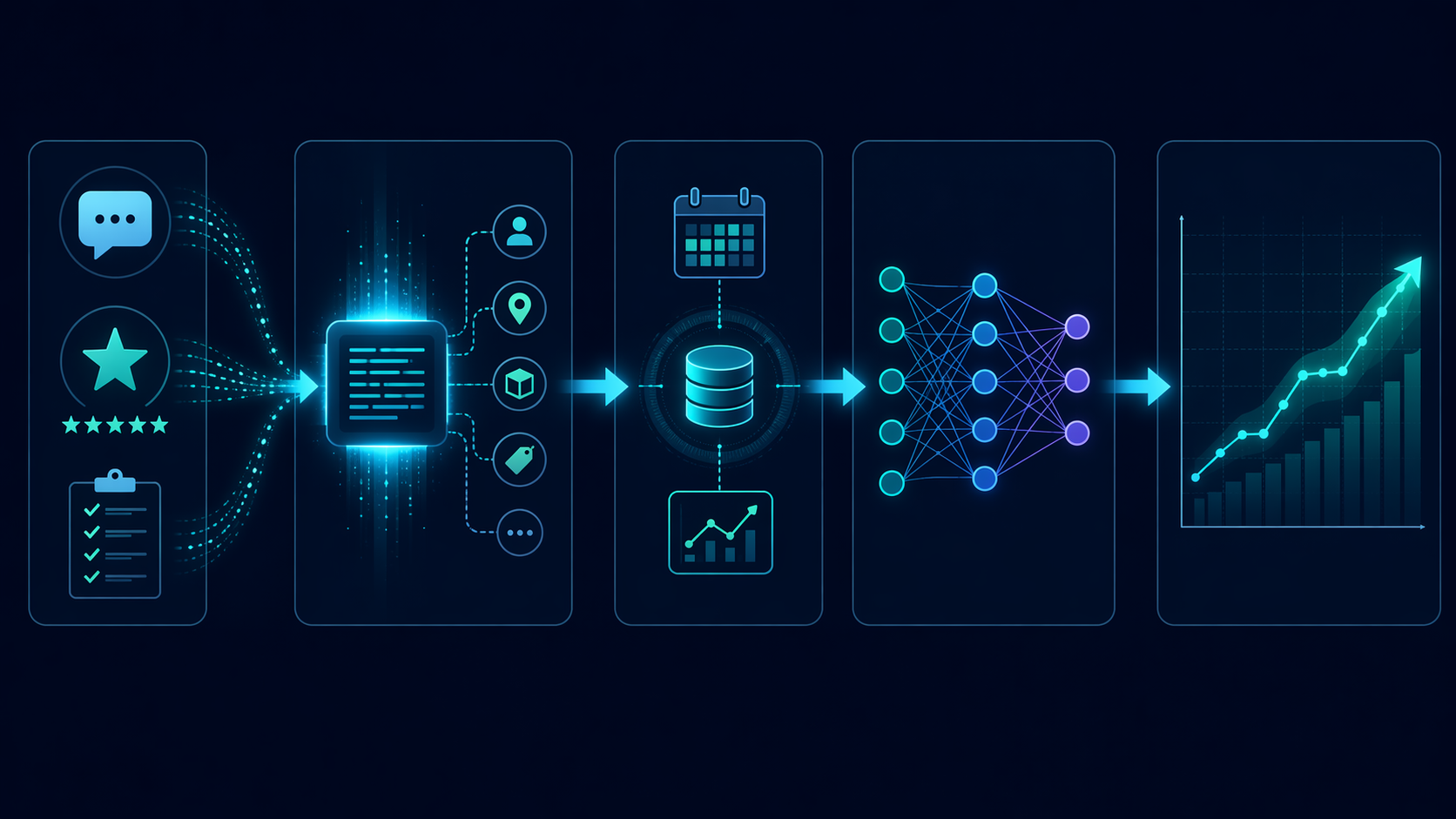
A practical pipeline usually starts with ingestion from social media, reviews, surveys, customer-service text, and brand mentions. Natural language processing then classifies sentiment as positive, negative, or neutral, often with an intensity score. More useful systems also extract entities and attributes: product names, competitor names, package sizes, colors, flavors, ingredients, defects, delivery complaints, and usage occasions. Oracle’s AI demand forecasting material and MIT Sloan Management Review’s discussion of pairing people and AI both point toward this broader pattern: external signals become useful when they are structured, matched, and incorporated into forecasting workflows rather than simply displayed as dashboards.[5][6]
After NLP, the signal has to be converted into time-series features. A planning team might aggregate positive review intensity by SKU-week, negative social mentions by product family-day, attribute-level complaint share by region, or sentiment momentum over a rolling window. The specific design depends on the forecast grain. A store-SKU-day model needs different aggregation and latency than a national monthly S&OP forecast.
Those features can feed several model types. A classical ARIMA model can include sentiment as an exogenous variable. Gradient boosting can learn nonlinear interactions between sentiment, promotion, price, distribution, and recent sell-through. LSTM-style sequence models can use sentiment histories alongside sales histories when there is enough data volume to justify the complexity. The architecture is less important than the validation design: the team needs to know whether adding sentiment improves out-of-sample forecast error at the decision horizon that matters.
The Matching Problem Usually Gets Underestimated
Entity matching is where many neat demos become messy planning work. Consumers do not write in item-master language. They use nicknames, abbreviations, old product names, retailer-specific names, competitor comparisons, and vague phrases such as “the blue one” or “the travel size.” If the pipeline maps that language to the wrong SKU, the model learns a false signal with confidence.
Attribute extraction matters for the same reason. A positive comment about packaging may not imply repeat demand if the taste reviews are negative. A negative delivery complaint may reflect carrier performance, not product preference. A demand model that treats all negative text as negative product sentiment can push the forecast in the wrong direction.
Latency also has to match the operating decision. If sentiment is being used for launch replenishment, daily or near-real-time processing may matter. If it is supporting monthly assortment planning, a slower but cleaner pipeline may be acceptable. The wrong latency standard creates either unnecessary cost or a signal that arrives after the buy decision has already been made.
What To Measure Before Trusting The Lift
A sentiment pilot should be judged on marginal lift, not on whether the sentiment dashboard looks convincing. The control model should already include the basics: POS or shipments, seasonality, promotions, price, distribution, inventory constraints, and known events where available. If sentiment only beats a weak baseline, the result says little about production value.
- Test by use case, not by enterprise average. Launches, seasonal promotions, short-lifecycle products, and stable replenishment items should be scored separately.
- Use the decision horizon that planners actually need. A signal that improves same-week fit may not help a six-week production commitment.
- Compare against the current best model, including planner overrides if those overrides are part of the real process.
- Measure forecast error and service or inventory consequences. A small accuracy gain may matter if it reduces stockouts on constrained launches; it may not matter for a low-risk stable item.
- Track false positives. Conversation spikes that do not convert to demand are a cost, especially if they trigger excess inventory.
Planner behavior should be part of the test. If the model raises a sentiment-driven exception and planners override it every time, the output is not trusted. If planners accept it blindly because it has an AI label, the process is worse. The useful middle ground is visible evidence: which sentiment features moved, which products or attributes they refer to, how those features performed in prior backtests, and what confidence the model assigns to the forecast change.
Vendor Options Do Not Remove The Implementation Work
C3 AI, o9 Solutions, Oracle SCM, SAP IBP, and AWS Forecast can all sit somewhere in the conversation about AI demand forecasting platforms, demand sensing, or ML forecasting infrastructure. The practical question is narrower: can the platform ingest the sentiment sources the business cares about, map them to the planning hierarchy, create time-aligned features, expose the driver logic, and run validation against the existing forecast process?
Sentiment integration varies widely by implementation. In some environments it is a configured external feature feed. In others it is a custom NLP and data-engineering layer feeding a planning platform. The public enterprise examples that look most credible are not simple plug-ins; they are broader demand-sensing programs combining multiple signals, data governance, planning-process changes, and model monitoring.
That distinction matters for cost. The model may be the cheaper part. Ingestion rights, source coverage, spam filtering, language handling, entity resolution, SKU hierarchy mapping, time-zone alignment, missing-data rules, and exception design can consume more effort than the forecasting algorithm. A team that cannot maintain those pieces should not expect a sentiment feature to remain reliable after the pilot deck is finished.
When Sentiment Is Not Worth Adding
There are cases where the right answer is to leave sentiment out. Stable repeat items with clean sales history, regular promotion patterns, good availability data, and low demand volatility may not benefit enough to justify another external signal. The forecast can become harder to explain without becoming materially better.
It is also a poor fit when the available sentiment data does not match the product or market. Brand-level social buzz may be too coarse for SKU-level replenishment. Review data may be too sparse for low-volume items. Social media may overrepresent a narrow customer segment. Survey sentiment may arrive too slowly for demand sensing. These are not philosophical objections; they are forecast-design constraints.
The causality issue should stay visible throughout. Sentiment can help a model anticipate demand shifts even when it does not cause them, but the business response changes depending on the explanation. A demand spike from genuine product enthusiasm may call for more inventory. A demand spike from panic-buying after a supply rumor may require allocation discipline. A negative sentiment spike caused by delivery delays should not automatically reduce the product forecast.
The Investment Test
Consumer sentiment is worth piloting when the category has a real leading-signal problem: cold-start launches, short promotional windows, short product lifecycles, or volatility that historical sales models underread. It is also worth piloting only when the organization can support the unglamorous work: source governance, NLP scoring, entity and attribute extraction, feature engineering, backtesting, planner review, and monitoring after deployment.
The standard should be simple. Add sentiment if it beats the current model by enough, at the right decision horizon, to change inventory, production, allocation, or replenishment decisions. Do not add it because people are talking about the product. In demand planning, conversation is not demand until the pipeline proves that it improves the forecast.
References
- AI in Demand Forecasting, yvonnebadulescu.com
- The role of artificial intelligence to improve demand forecasting in supply chain management, Kearney
- AI-Driven Demand Sensing: Lessons from Unilever and Amazon for the Supply Chain, AI in the Chain, 2025-10-13
- AI-driven demand sensing reduces stockouts and waste, C5i
- AI demand forecasting, Oracle
- Pair People and AI for Better Product Demand Forecasting, MIT Sloan Management Review
Comments
Join the discussion with an anonymous comment.