
The stockout usually starts before the stockout report exists. Search volume climbs for a size, a color, or a region. Cart additions move faster than completed orders. Wishlists, local weather, and social demand start pointing in the same direction. In the sources reviewed here, those signals can precede purchase conversion by roughly 24–72 hours, while traditional allocation systems often wait for depletion, scheduled review, or a batch transfer cycle before acting.[1][2]
That gap is where inventory allocation AI for ecommerce becomes operationally interesting. The claim is not that a model knows the future with certainty. The stronger claim is simpler: if a system can see demand pressure forming earlier across channels and locations, it can recommend or trigger inventory movement before a warehouse, store, or regional ecommerce pool is visibly short.
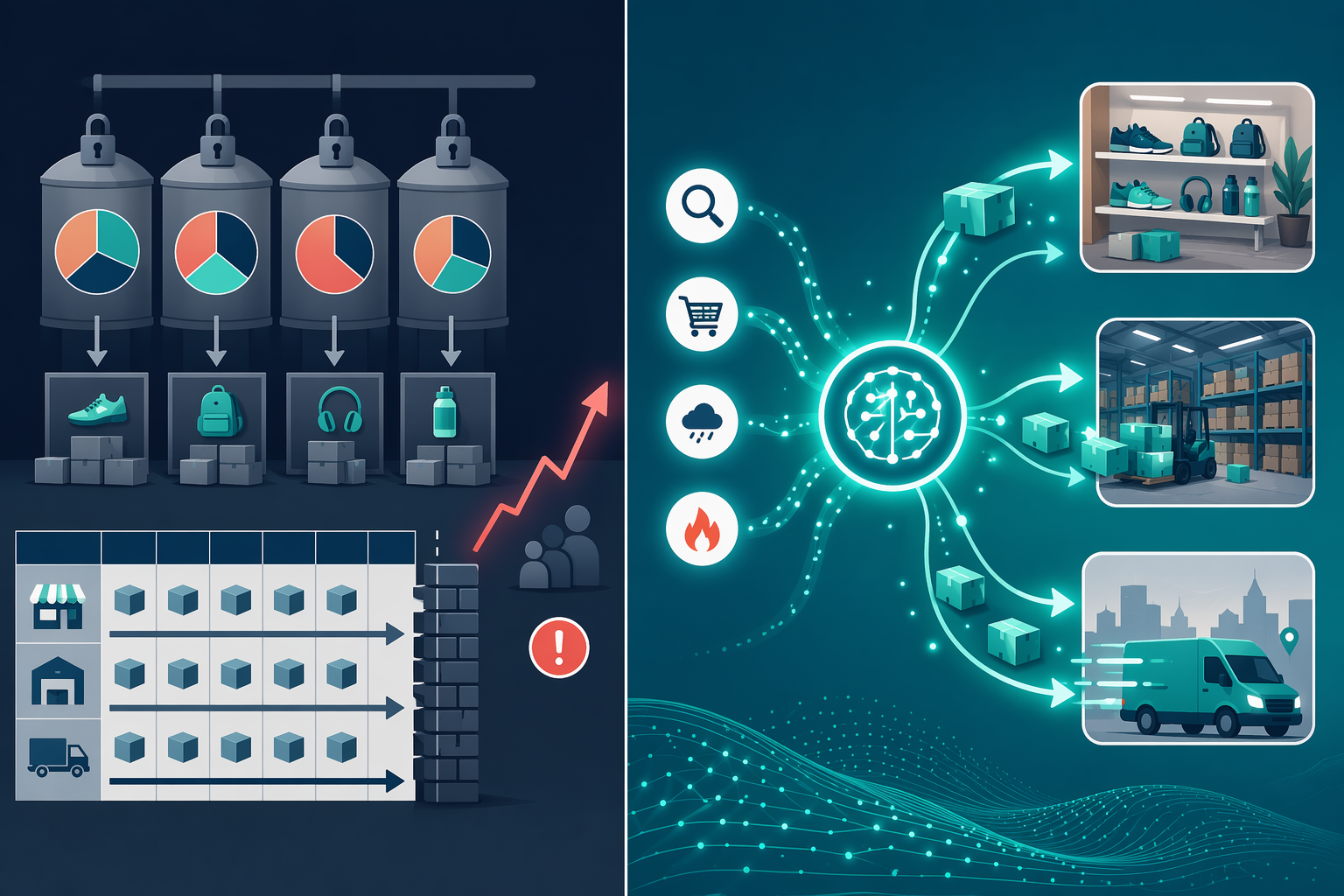
Traditional allocation and AI-driven allocation are not just two software styles. They run on different clocks. Fixed-percentage allocation asks how inventory should be split based on a rule, a plan, or a prior demand curve. Batch-based replenishment asks what changed since the last review. AI allocation asks where demand is forming now, whether local inventory can absorb it, and which movement decision reduces the chance that demand arrives where product is not available.
What AI Allocation Sees Before Depletion
In operational terms, AI inventory allocation ingests demand signals, compares pressure across channels and locations, and recommends dynamic positioning. The inputs can include ecommerce searches, cart additions, wishlist activity, social trend movement, weather signals, recent sales, local inventory, service constraints, and transfer feasibility. The output is not a forecast slide; it is an allocation or transfer decision that changes where inventory sits.
This matters most in networks where inventory can technically fulfill demand, but not from the right place at the right time. A national ecommerce pool may still look healthy while one region is burning through a popular SKU. A store network may hold enough aggregate units while the locations exposed to current demand are already thin. A replenishment meeting can truthfully say, “we had inventory,” and still leave the ecommerce team explaining lost carts.
Demand forecasting and demand sensing sit upstream of this decision. Forecasting estimates what demand is likely to be; sensing updates that view as live signals arrive. Allocation is where those signals become a placement decision. For readers separating these layers, the related use-case reference on AI demand forecasting in CPG and retail is the upstream companion, while CPG manufacturer demand sensing AI covers the signal-detection layer more directly.
Why Fixed Allocation Misses Ecommerce Demand Shifts
Fixed allocation rules are useful when demand patterns are stable enough that yesterday’s split remains a reasonable proxy for tomorrow’s need. They break down when the ecommerce signal moves faster than the review cycle. A weekly or periodic allocation batch can be technically disciplined and still arrive late.
The failure mode is rarely dramatic at first. A SKU sells a little faster in one geography. Paid traffic or organic search shifts toward a product variant. Weather changes the regional relevance of a category. Social attention lifts one item before sales fully register. By the time purchase data confirms the pattern, the best inventory may already be committed, too far away, or trapped behind transfer lead times.
| Allocation clock | What triggers action | What operators inherit |
|---|---|---|
| Fixed percentage | Predefined split by channel, region, store, or warehouse | Inventory may remain in the planned location even after demand shifts |
| Periodic batch review | Scheduled replenishment or transfer cycle | Demand signals can age before anyone approves movement |
| Depletion-based trigger | Inventory falls below a threshold | The stockout risk is already visible by the time action starts |
| AI demand-signal allocation | Live pressure from search, cart, wishlist, sales, weather, and other signals | Inventory can be repositioned before depletion becomes the primary signal |
The important distinction is not “manual bad, automated good.” Many retailers have strong planners and carefully maintained rules. The problem is timing. If the system waits for the inventory balance to prove that a location is short, the planner is already working inside a narrower set of options: expedite, transfer, substitute, cancel, or watch conversion drop.
The FLO Case: Availability, Stockouts, and Lost Sales
The most useful public case in the reviewed material is FLO, the footwear retailer. In an invent.ai case study, FLO reported product availability improving from 71% to 94%, stockouts falling from 15% to 3%, lost sales declining by 12%, revenue increasing by 2.7%, and fulfillment speed improving by 17% after deployment.[3]

Those numbers are worth taking seriously because they map to the actual allocation mechanism. Availability is the direct measure: did the product become buyable where demand appeared? Stockouts are the failure condition allocation is supposed to reduce. Lost sales show the commercial consequence of being unavailable. Fulfillment speed matters because an allocation system that improves availability only by pushing product through slow transfers may simply move the pain to delivery promise and warehouse execution.
The case is also vendor-published. That does not make it useless; it does mean the evidence should not be treated like an independently audited benchmark. The useful reading is narrower: in a large footwear retail environment, an AI allocation deployment was associated with materially better availability, fewer stockouts, lower lost sales, and faster fulfillment, using metrics that a retail operator can recognize and challenge during diligence.[3]
FLO is especially relevant to ecommerce allocation because footwear is unforgiving at the variant level. Aggregate inventory can look healthy while the demanded size-color-location combination disappears. That is exactly where fixed percentages tend to hide trouble. A size run sitting in the wrong local pool does not help the cart that is converting somewhere else.
Transfer Speed Is Part of the Allocation Result
Allocation quality is often discussed as if the decision ends when the system identifies the better location. It does not. If the recommendation requires a transfer that takes too long to approve, pick, ship, receive, and expose to sale, the early signal advantage can disappear.
Boyner, another invent.ai-published example, reported a 4.8% sales increase from AI-driven transfer optimization and said inter-warehouse stock transfer time was reduced to under 1 hour.[4] The sales figure should be read as a case result, not a universal promise. The transfer-time detail is the more operationally revealing point: allocation AI only prevents stockouts if the organization can turn a signal into movement quickly enough.
That is where ecommerce and store networks overlap. A product may be available in one node, sellable from another, and needed in a third. The allocation system’s job is not only to choose a destination. It has to account for whether the movement is feasible inside the window where demand still exists.
How Far the Evidence Extends
The broader evidence base points in the same direction, though the sources vary in independence and precision. Articles citing a 2,800-store retail chain deployment reported a 28% reduction in excess inventory costs, a 34% improvement in stock availability, and $89 million in working capital optimization.[5] SR Analytics described a retailer case in which network inventory fell by 18% while fill rates rose from 89% to 96%.[6]
These cases support a practical conclusion: AI allocation is not only about adding stock to avoid stockouts. In stronger deployments, the system improves placement so the same network can carry less inventory in the wrong places while improving service where demand is forming. That is a different business case from simply raising safety stock.
McKinsey-style benchmarks are often used to frame the upside of AI supply chain adoption: 15% lower logistics costs, 35% lower inventory levels, and 65% higher service levels among AI adopters in cited summaries.[7] Those figures are directionally useful but should be kept in context because the original methodology and sample details were not independently verified in the reviewed materials. They are not a substitute for allocation-specific evidence.
A vendor-reported Willow Commerce claim that businesses using smart allocation strategies achieved a 40% boost in inventory turnover and a 25% profitability improvement is even less suitable as a planning benchmark because the reviewed material did not identify independent source support.[8] It can indicate how vendors frame the value proposition, but it should not anchor an ecommerce business case.
What Metrics Should Tie Back to the Mechanism
The cleaner way to evaluate inventory allocation AI for ecommerce is to ask whether each claimed improvement can be traced to earlier or better positioning. Availability should improve because inventory is closer to demand. Stockouts should fall because demand signals trigger action before depletion. Lost sales should decline because fewer carts reach an unavailable product. Excess inventory should fall because product is not overprotected in slow nodes. Transfer decisions should speed up because the system narrows the planner’s decision set earlier.
- Availability: whether customers can buy the product in the channel and location where demand is active.
- Stockouts: whether the system reduces the moments when demand exists but sellable inventory is unavailable.
- Lost sales: whether prevented stockouts translate into retained revenue, not just cleaner inventory reports.
- Excess inventory: whether better placement reduces stranded or overprotected units.
- Transfer cycle time: whether recommendations become executable movement before demand moves on.
This is also where ROI diligence belongs. A retailer should not lift FLO’s 12% lost-sales reduction or another deployment’s availability gain into a spreadsheet without checking network similarity, SKU complexity, transfer constraints, and signal availability. For a broader vendor-evaluation frame, the related analysis of C3 AI demand forecasting ROI patterns is a better place to separate case-study claims from investment assumptions.
Where Ecommerce Teams Should Be Careful
Most of the stronger public evidence comes from retail-store-heavy environments. FLO operates a large store network, and the 2,800-store case is explicitly a store-chain deployment.[3][5] That matters because store networks create both the problem and the opportunity: inventory is distributed across many nodes, demand varies locally, and transfers can materially change sellable availability.
Pure-play DTC and marketplace-only businesses may still benefit from the same mechanism, especially if they allocate across multiple warehouses, regions, fulfillment partners, or sales channels. But the cited outcomes should not be copied directly. A simpler network with fewer movable pools may have less upside from dynamic reallocation. A marketplace seller with limited control over fulfillment nodes may see the demand signal but lack the transfer authority to act on it.
The practical test is whether there is a real decision to improve. If demand signals arrive early but all inventory ships from one node, allocation AI may mostly refine replenishment priorities. If the network has multiple warehouses, stores, dark stores, or regional pools, earlier signal detection can change where units sit before the stockout becomes visible.
The Stakeholder Case for Evaluation
The strongest case for AI inventory allocation is not magical forecasting accuracy. It is earlier positioning across a multi-channel network. The system watches signals that traditional allocation often treats as background noise until they become sales, depletion, or an exception report. That earlier view gives planners more time to move inventory, protect availability, and avoid emergency reshuffling.
The documented outcomes are credible enough to justify evaluation for retailers and ecommerce operators with meaningful channel and location complexity. FLO’s availability improvement from 71% to 94%, stockout reduction from 15% to 3%, and 12% lost-sales reduction are the most concrete allocation-linked results in the reviewed material.[3] Boyner adds a useful transfer-speed example, while the 2,800-store and SR Analytics cases broaden the pattern around availability, fill rate, excess inventory, and working capital.[4][5][6]
The caution is equally clear. Much of the public proof is vendor-published, retail-store-heavy, or summarized without full methodology. For multi-node ecommerce operations, that is enough to open a serious evaluation. It is not enough to skip the harder question: whether the company’s own demand signals, transfer rules, fulfillment constraints, and inventory pools resemble the deployments producing the cited results.
References
- r4.ai demand signal latency framework, r4.ai
- C5i demand sensing content, C5i
- FLO footwear case study, invent.ai
- Boyner department stores AI-driven transfer optimization news article, invent.ai
- 2,800-store retail chain deployment articles, Toolio / AI Strategy Path
- SR Analytics retailer case, SR Analytics
- McKinsey cross-industry AI supply chain benchmarks, McKinsey
- Smart allocation strategies vendor blog, Willow Commerce
Comments
Join the discussion with an anonymous comment.