
A supply chain team looking at autonomous trucking in 2026 cannot stop at the question most vendors prefer: whether the truck can drive the lane. The harder question is whether the route plan can absorb the moments when the truck should not drive it. That is where recent autonomous-driving failure data becomes useful for supply chains. The test failures are not a reason to ignore autonomous freight. They are the operating manual hidden inside the safety deck.
The case for taking the technology seriously is no longer theoretical. California autonomous vehicle testing covered more than 9 million miles in 2025, with Waymo alone reporting 3.9 million driverless miles in the state data set.[1] Heavy Duty Journal’s 2026 review points to more than 15 million commercial autonomous trucking miles across the industry and reports 67% fewer accidents per million miles than human-driven trucks, while also noting that current systems still suspend operations in heavy precipitation, fog, snow, or ice.[2] For logistics planning, those two facts belong in the same sentence. Autonomous trucking has crossed the threshold from demo to dispatch conversation, but weather and failure handling still decide whether a weekly lane plan survives contact with the calendar.
The Disengagement Number Needs a Dispatcher’s Eye
Disengagement data is easy to misuse because the topline number looks cleaner than the operational reality underneath it. The 2025 California DMV data showed sharp improvement across the industry, with reported disengagement rates moving from roughly one per 50 miles in earlier periods to about one per 5,000 miles in the 2025 analysis.[1] That sounds like a simple readiness signal until the outlier is separated.
Beep, a low-speed shuttle operator rather than a highway freight operator, accounted for 84% of all disengagements while representing only 0.12% of miles in the California data.[1] A procurement team that treats the aggregate figure as a freight-corridor failure rate is already making a planning error. The better reading is narrower: the industry’s average has improved, but disengagement rates must be interpreted by vehicle class, operating design domain, route type, and testing context.
For a logistics director, that changes the due-diligence question. “How many disengagements per mile?” is not enough. The vendor should be able to show where they occurred, why they occurred, whether the truck was in construction, low light, precipitation, sensor occlusion, unusual traffic behavior, or planned testing, and how many would have interrupted a real freight move rather than a test run. A disengagement at a mapped handoff point is a nuisance. A disengagement on a weather-exposed interstate segment with no tractor recovery plan is a service failure.
| Failure Signal | What It Measures | Planning Consequence |
|---|---|---|
| Aggregate disengagement rate | How often autonomous control was interrupted across a reported test set | Useful only after separating vehicle type, route, operating domain, and outliers |
| Weather suspension | Whether the system can operate through heavy precipitation, fog, snow, or ice | Requires fallback capacity on seasonal or weather-exposed corridors |
| Hardware/software-caused incident share | Whether an AV-at-fault event came from the system rather than another road user | Requires vendor evidence on redundancy, diagnostics, and safe-state behavior |
| Object and mapping failures | Whether the system detects, classifies, and localizes the road scene correctly | Requires corridor screening for construction, debris, lighting, and map-change frequency |
Weather Is Not a Footnote
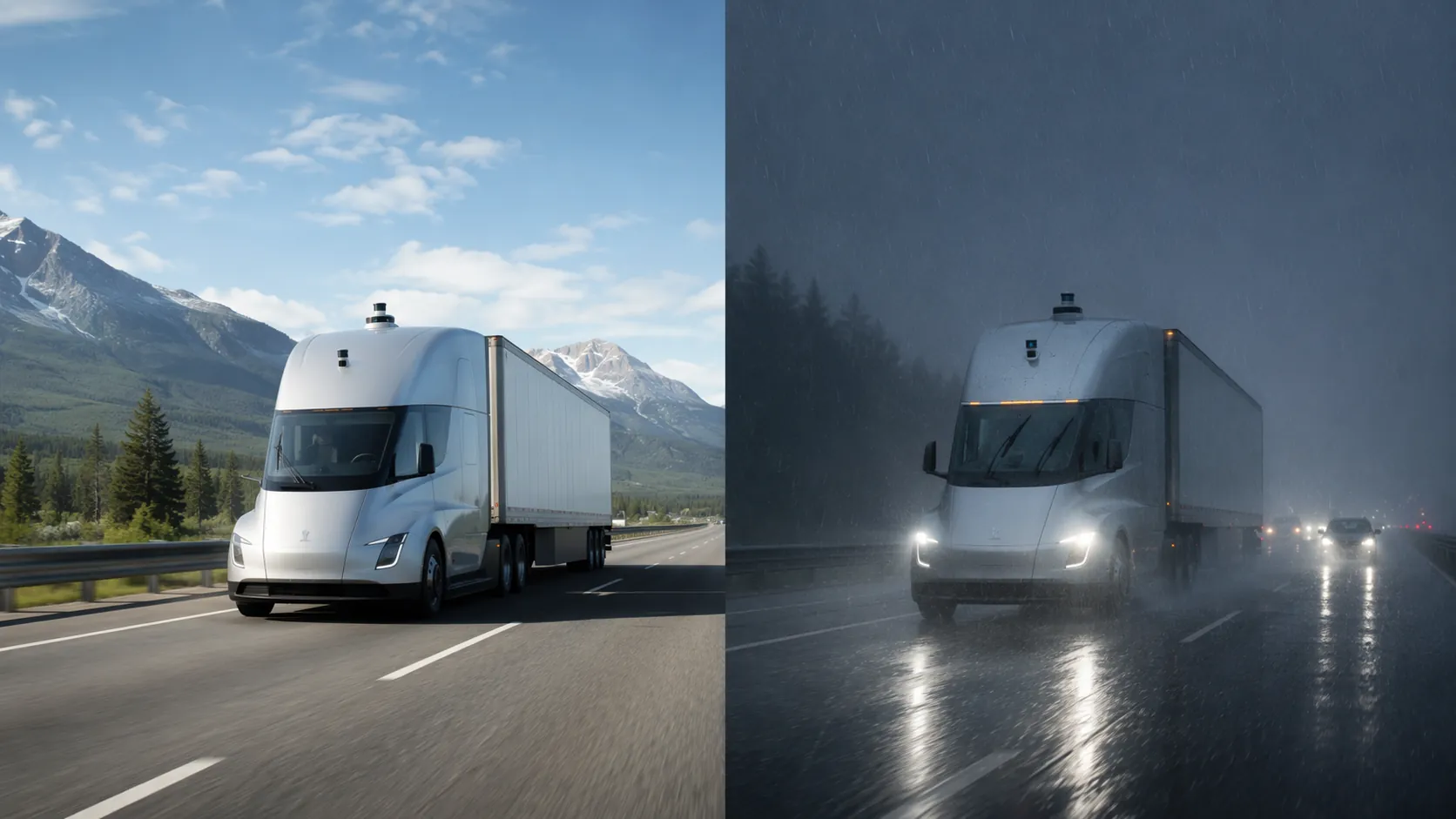
The weather ceiling is the most direct supply chain constraint because it converts a technical limitation into unavailable capacity. Heavy Duty Journal describes current autonomous trucking operability at roughly 85%, with operations suspended during heavy precipitation, fog, snow, or ice, and no Level 5 timeline available to remove that constraint.[2] That should not be treated as a bug that procurement can round away. It is a service-design boundary.
On a dry, well-mapped hub-to-hub lane, an autonomous tractor can be scheduled as primary linehaul capacity if the plan includes weather cutoffs and a human-driven substitute. On a corridor with seasonal fog, winter ice, frequent convective storms, or mountain weather, the same autonomous tractor becomes conditional capacity. It may still reduce cost or improve utilization on suitable days, but it cannot be the only way freight is expected to move.
That distinction matters because transportation plans fail at the margins. A planner does not need the truck to be perfect in every climate; the planner needs to know when to release the load, when to hold it, when to switch modes, and who pays for the exception. If a vendor cannot state weather suspension thresholds in operational language, the shipper is being asked to absorb an undefined delay risk.
System-Caused Incidents Are Small, but They Are the Ones Planners Must Understand
The available incident data does not support panic. In reported NHTSA autonomous vehicle incidents from 2021 through 2025, summaries based on the Standing General Order data counted 5,202 total AV incidents; among 2,052 multi-road-user incidents with narratives, AVs were solely at fault in 4%.[3][4] The same summaries report zero human fatalities caused by an AV in that period.[3][4] Those are important guardrails against treating every test failure as evidence that autonomous trucking is categorically unsafe.
The planning problem sits inside the smaller number. Among AV-at-fault incidents, 7.8% were attributed to hardware or software system failures.[3][4] The sources summarizing these figures are law firm and insurance-adjacent publications, and the underlying NHTSA Standing General Order data is self-reported, so completeness can vary. Even with that caveat, the signal is operationally relevant: some failures are not caused by another driver, a careless pedestrian, or a messy external scene. They originate in the autonomous system.
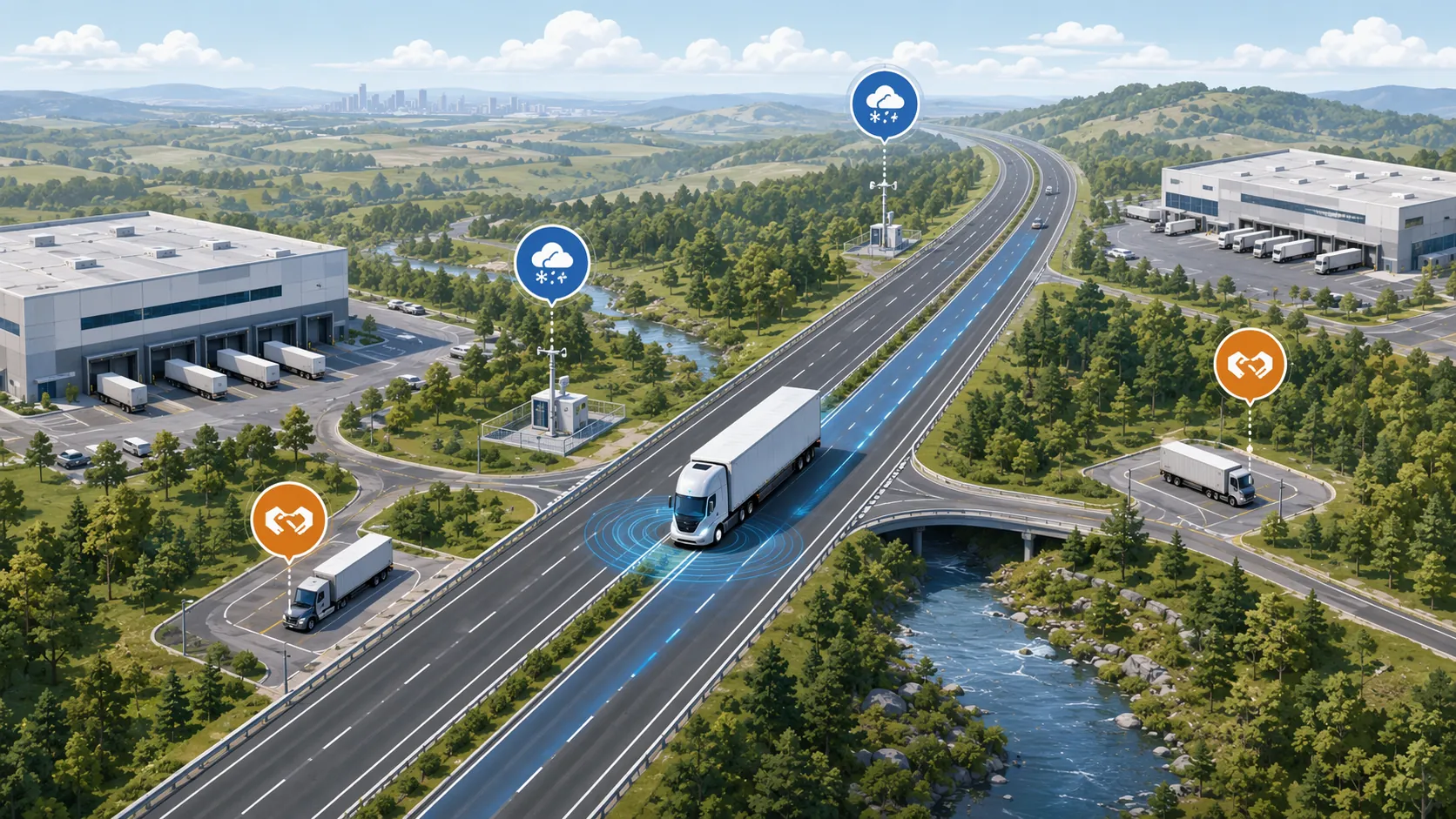
That does not make the use case unserious. It does mean a shipper should ask how the truck detects internal degradation before the route becomes a roadside problem. The practical checklist is not glamorous: sensor health monitoring, redundant braking and steering paths, safe-pullout logic, remote assistance escalation, maintenance inspection intervals, and a contractually defined recovery time when the system exits service. If the lane depends on a single autonomous movement making a fixed appointment, a system-caused fault is not just a safety metric. It is a missed dock door, a labor reschedule, and possibly a downstream stockout.
The Failure Modes That Matter on Freight Corridors
The most useful failure reports are not the ones that say an autonomous truck “failed.” They are the ones that say what the truck believed about the road when it failed. Testing analyses have repeatedly identified false obstacle detection, object misclassification, construction-zone mapping inaccuracies, LiDAR latency in degraded weather, and pedestrian detection gaps in low-light conditions as recurring autonomous trucking challenges.[5] Each one points to a different dispatch rule.
- False obstacle detection means the truck may brake for something that is not there. On a freight corridor, that risk is most relevant where abrupt braking creates rear-end exposure or blocks a constrained ramp, terminal approach, or work zone.
- Object misclassification means the system may misunderstand what it sees, including stationary vehicles or road debris. That pushes planners to scrutinize lanes with frequent shoulder activity, debris, emergency stops, or complex merge behavior.
- Construction-zone map errors mean the route the truck expects may not match the route that exists that night. A corridor with frequent lane shifts needs a map-update and roadwork-intelligence process, not just a prior successful test run.
- LiDAR latency in degraded weather means perception may slow or degrade when the logistics network is already under stress. That belongs in weather suspension rules, not in a general technology-risk paragraph.
- Low-light detection gaps matter around yards, ramps, rural crossings, and terminal-adjacent roads. A hub-to-hub plan should define where autonomous driving begins and ends, rather than assuming the full first-mile and last-mile environment is equally ready.
These are not all the same kind of risk. A weather-driven perception issue can be managed by a go/no-go rule before dispatch. A construction-zone map mismatch may require corridor intelligence close to departure. A false obstacle event may require safe-state behavior and following-distance assumptions. Grouping them under “AI failure” may help a slide deck, but it does not help a transportation desk decide whether to release freight at 8 p.m.
Where Autonomous Trucking Belongs in the 2026 Lane Plan
The acceptable use case in 2026 is bounded: hub-to-hub highway service on screened corridors, with weather suspension rules, fallback tractors, defined remote-assistance procedures, and recovery capacity near the lane. That is not a timid conclusion. It is the version of deployment that matches the evidence.
Commercial activity already supports that narrower view. Automotive Fleet reported that PepsiCo operates 35 driverless trucks commercially in Arizona, Aurora has surpassed 100,000 driverless miles and is delivering commercially, and Volvo is targeting full driverless operations in Q1 2027 with more than 300 trucks by the end of 2027.[6] Those benchmarks matter because they show the industry is not stuck in laboratory theater. They do not, by themselves, prove that every shipper can replace a human-driven network segment with autonomous capacity across all seasons and geographies.
A practical autonomous lane should pass a few tests before it enters the routing guide. The origin and destination should support clean autonomous handoff. The highway segment should have manageable construction volatility. Weather exposure should be low enough that fallback usage is occasional rather than routine. The freight profile should tolerate a planned mode switch when the system suspends. The carrier or technology provider should report disengagements by cause, not only by mile.
The unacceptable version is sole-mode dependency on a weather-exposed or operationally complex corridor. If the shipment must move regardless of fog, ice, lane shifts, emergency shoulder activity, or low-light terminal congestion, an autonomous truck can be part of the plan only if another mode can take over without improvisation. A truck that is safe enough to suspend in bad conditions is still a capacity gap if the shipper planned as if suspension would never happen.
Procurement Should Discount Timelines, Not Ignore the Market
The investment timeline has also become less forgiving. McKinsey’s 2025 autonomous vehicle expert survey of 91 respondents found that autonomous trucking development cost estimates had risen 50% to 60% over 2023 projections, that software development alone was expected to require more than $3 billion to reach market readiness, and that expected L4 trucking commercial viability had shifted from 2031 in the 2023 survey to 2032 in the 2025 survey.[7] The sample was small and geographically concentrated, with 43 respondents in Europe, 35 in North America, and 13 in Asia, so it should not be read as audited cost data. It is still a useful warning against buying a route plan on the assumption that every missing capability arrives next budget cycle.
For procurement, the implication is direct. A vendor’s commercial milestone should be separated from the shipper’s operational readiness threshold. A provider may be right that its system can run a corridor safely under defined conditions. The shipper still needs contract language for weather cancellations, disengagement reporting, recovery obligations, liability allocation, software-update disclosure, and minimum notice when an operating domain changes. The more a vendor asks to be treated like replacement capacity, the more it should be measured like a carrier with exception performance, not a technology company with a roadmap.
The best autonomous trucking pilots should therefore look a little boring. They should have clear geography, known handoff points, measured fallback usage, weather logs, incident narratives, maintenance findings, and service-level results compared with the human-driven alternative. A pilot that only reports miles completed has left out the part the transportation team has to live with.
A Deployment Rule That Matches the Evidence
Autonomous trucking belongs in 2026 supply chain planning, but as a constrained mode. It is suitable for disciplined hub-to-hub highway operations where the route has been screened, the weather rules are explicit, and fallback capacity is budgeted rather than wished into existence. It is not yet a replacement-capacity assumption for complex, weather-exposed, or exception-heavy lanes.
That is a positive conclusion, not a defensive one. A mode that can run safely inside known limits is valuable. The mistake is pretending the limits are temporary noise. In freight planning, a constraint that repeats often enough becomes part of the network design.
References
- Waymo Dominates California AV Test Data, EE Times.
- Autonomous Trucking 2026, Heavy Duty Journal.
- Autonomous Vehicle Accidents 2019-2024 Crash Data, Craft Law Firm.
- Autonomous Vehicle Accidents Statistics, TrialProven.
- Major Challenges in Autonomous Truck Market, GMInsights.
- 2026 Is an Inflection Point for Autonomy, If Policy Keeps Pace, Automotive Fleet.
- Future of Autonomous Vehicles Industry, McKinsey Center for Future Mobility.
Comments
Join the discussion with an anonymous comment.