
The useful question for AI autonomous driving crash risk in supply chain logistics is not whether autonomous trucks are safer in the abstract. It is whether a specific freight lane, operating window, hub geometry, and fallback plan produce a better risk profile than the human-driven alternative.
The best corridor-level number available points in a favorable direction: autonomous trucks are reported at 0.8 accidents per million miles versus 2.4 for human-driven trucks on designated corridors, a 67% reduction.[1] That is material enough for any logistics leader to investigate. It is also an industry aggregate whose underlying methodology has not been independently verified, so it should be treated as directional evidence rather than a settled actuarial table.
The harder part is that lower average crash rates do not erase scenario-specific risk. A matched case-control study published in Nature Communications found that automated driving system accident odds were 5.25 times higher than human-driven vehicles in dawn or dusk lighting and 1.99 times higher during turning maneuvers.[2] Those two findings matter more to a freight deployment plan than most broad national incident counts, because they change dispatch windows, terminal design, and where autonomy should hand off to local operations.

Start With the Corridor, Not the Truck
A designated autonomous freight corridor is a controlled operating domain, not a miniature version of the entire trucking network. The road geometry is known. The lane markings, ramps, shoulder behavior, weather exposure, communications coverage, and transfer points can be studied before the first shipment moves. That is why corridor performance can look meaningfully better than human driving while still leaving certain moments unresolved.
The safety case begins with risks that autonomy can remove or reduce. Fatigue-related incidents account for 13% of all human truck accidents in the available evidence, and those are eliminated when the driving task is performed by an autonomous system. Faster reaction times and rear-end reductions also contribute to the lower corridor accident rate reported by Heavy Duty Journal.[1]
That does not mean the remaining risk is randomly distributed. Once fatigue comes out of the system, other exposure points become more important: lighting transitions, turns, merge areas, construction changes, weather boundaries, blocked lanes, emergency vehicles, yard entrances, and the awkward seam between highway autonomy and facility operations. A procurement review that stops at accidents per million miles is leaving the most operationally useful evidence on the table.
| Evidence | What it supports | How a logistics team should treat it |
|---|---|---|
| 0.8 autonomous truck accidents per million miles vs. 2.4 for human-driven trucks on designated corridors | A meaningful net safety improvement on bounded freight lanes | Useful as directional corridor evidence; not a fully independent benchmark |
| 5.25x higher ADS accident odds at dawn/dusk | Lighting transition risk is operationally significant | Convert into dispatch-window and route-domain constraints |
| 1.99x higher ADS accident odds during turning maneuvers | Risk rises at intersections, turns, hub entrances, and transfer points | Convert into hub design, routing, and handoff decisions |
| Autonomous operations restricted to about 85% of conditions on primary freight corridors | Weather and environmental coverage remain planning constraints | Model service reliability, exception handling, and human fallback capacity |
Dawn and Dusk Are Dispatch Variables
A dawn/dusk odds ratio of 5.25 is not a footnote for the safety appendix.[2] In freight planning, it lands directly on appointment times, cutoffs, driverless departure windows, staging buffers, and whether a route should be allowed to run autonomously in both directions during the same operating plan.
Lighting transitions are also inconveniently common in trucking. A lane that looks clean at noon may behave differently when low-angle sun hits the windshield, shadows stretch across lane markings, and traffic density changes around commuter periods. The available evidence does not establish the precise mechanism behind the elevated odds, so it would be careless to label this as a pure AI perception failure. What it does establish is enough for planning: dawn and dusk are measurable exposure windows with higher observed ADS crash odds.
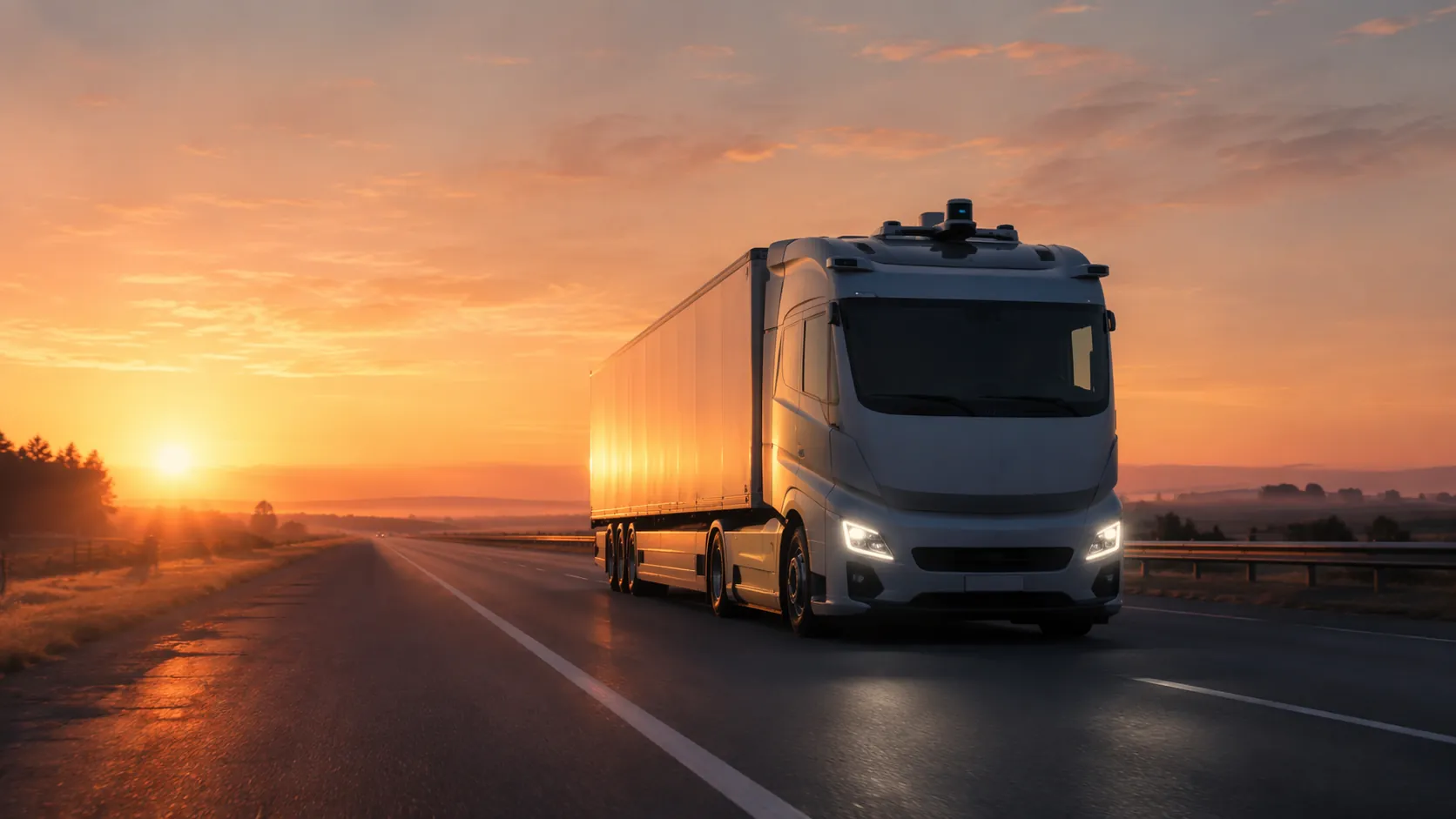
The practical response is not necessarily to reject the lane. It is to ask whether the freight promise depends on running through the risk window. If an autonomous move only works when the truck leaves a hub at 5:40 p.m. and reaches a complex interchange just as glare peaks, the safety case is weaker than the headline corridor average suggests. If the same lane can be scheduled outside that window with modest dock or inventory adjustments, the risk may be manageable.
This is where logistics operations have more leverage than consumer autonomy. Freight networks already schedule around appointment windows, detention risk, warehouse labor, temperature controls, curfews, and service-level commitments. Dawn/dusk restrictions can be built into the same planning layer, but only if they are explicit. If the autonomous vendor’s safety case does not show performance by time of day and lighting condition, the buyer is being asked to approve an average while operating in the tails.
Turning Risk Lives at the Edge of the Corridor
The 1.99x higher ADS accident odds during turning maneuvers points to a different kind of problem.[2] Long highway segments are not the same environment as hub entrances, frontage roads, industrial parks, crosswalks, gate queues, trailer lots, and tight right turns around concrete barriers. A Class 8 truck spends much of its autonomous value proposition on the open corridor, but the trip still begins and ends in places built for messy human coordination.
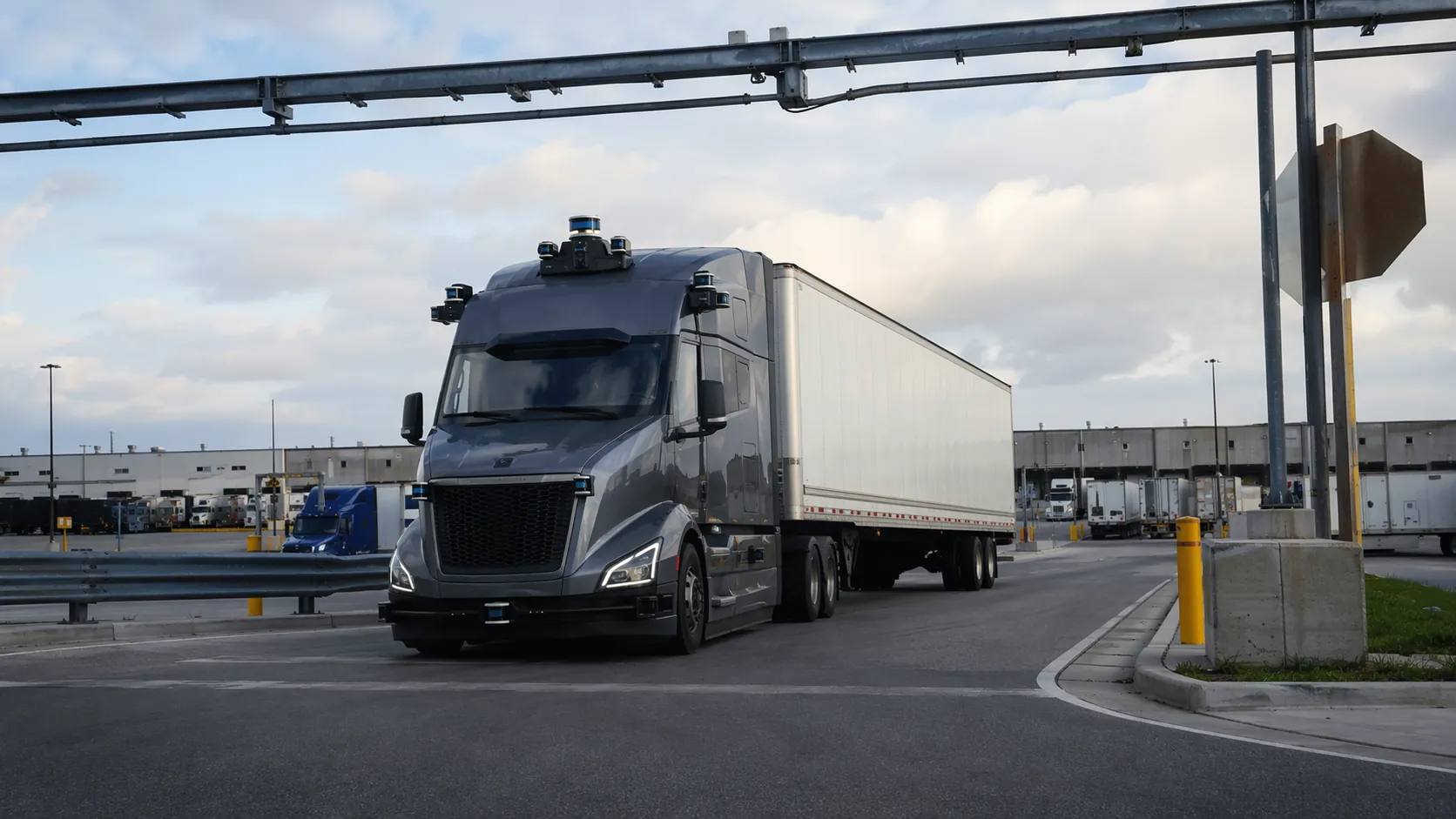
That boundary deserves more attention than it usually gets. A deployment plan can be excellent on I-45 and still weak at the last mile into a distribution campus. The relevant question is where the autonomous driving system actually begins and ends: at a highway-adjacent terminal, at a customer gate, at a staging yard, or all the way to a dock door. Each additional turn, mixed-traffic driveway, pedestrian area, and trailer maneuver changes the risk model.
Hub design becomes part of the safety system. A facility that expects autonomous trucks should reduce ambiguous interactions: dedicated autonomous entry lanes, clear separation from yard tractors, predictable stop points, high-quality markings, controlled pedestrian crossings, and sufficient turn radii. None of that makes turning risk disappear. It narrows the operating domain so the truck is not asked to solve a general urban-driving problem just to complete a corridor freight move.
Transfer points may be the cleaner early answer. An autonomous tractor can handle the designated long-haul segment, then hand off to a human driver or yard system for the facility-heavy portion. That may look less dramatic than end-to-end driverless freight, but it is often the more honest match between current evidence and operational exposure.
Do Not Mix ADAS Crash Statistics Into a Level 4 Freight Decision
One reason autonomous vehicle safety debates stay muddy is that they often mix systems that do different jobs. Level 2 advanced driver-assistance systems support a human driver. Level 4 automated driving systems perform the driving task within a defined operating domain. A logistics procurement decision about autonomous freight is primarily a Level 4 ADS decision, not a vote on every consumer driver-assistance feature currently on the road.
The distinction matters because widely circulated statistics can point in the wrong direction when categories are blended. FinanceBuzz cites 9.1 crashes per million miles for AVs versus 4.1 for humans, but the figure conflates Level 2 ADAS with Level 4 ADS.[5] That makes it a poor basis for evaluating driverless freight systems operating on designated corridors.
This does not mean unfavorable statistics should be ignored. It means they should be sorted before they are used. A lane approval memo should separate driver-assistance incidents, robotaxi operations, low-speed shuttle deployments, test vehicles with safety operators, and commercial driverless freight. Otherwise, the risk committee ends up debating a composite category that no vendor is actually selling and no operations team can actually manage.
What Passenger Robotaxi Data Can and Cannot Tell Freight Buyers
Waymo’s public safety data is useful, but only with a label on it. Through March 2026, Waymo reports 220.6 million rider-only miles, with 82% fewer injury-causing crashes and 94% fewer serious-injury-or-worse crashes compared with human benchmarks.[3] Those are substantial results, and Waymo publishes methodology details including underreporting corrections.
But passenger robotaxis on surface streets are not Class 8 trucks hauling freight on highway corridors. Vehicle mass, braking distance, route purpose, hub interfaces, road mix, and risk consequences are different. The Waymo data is a confidence signal that mature autonomy can outperform human benchmarks in a bounded domain. It is not a substitute for autonomous trucking crash data by lane, weather condition, lighting condition, maneuver type, and facility interface.
NHTSA Standing General Order incident data also needs careful handling. ConsumerShield’s 2026 aggregation reports 5,202 AV incidents through November 2025, with 7.4% resulting in injury and 1.2% in fatalities.[4] Those totals show that reported incidents are not theoretical, but they do not, by themselves, answer whether a specific autonomous freight corridor is safer than its human-driven baseline. Exposure matters: miles driven, road type, vehicle class, operating domain, and reporting criteria all shape the comparison.
How the Crash Data Changes the Deployment Plan
The right output from this evidence is not a generic yes or no. It is a lane-level operating-domain decision. The logistics team should be able to describe, in plain operational terms, where the autonomous system is allowed to drive, when it is allowed to drive, what conditions suspend autonomy, and who owns the freight when the plan leaves that domain.
- Route domain: define the exact highway segments, ramps, interchanges, frontage roads, and approach roads included in autonomous operation.
- Operating hours: model dawn and dusk as elevated-risk windows, not as ordinary schedule preferences.
- Hub boundary: decide whether autonomy ends at a transfer terminal, customer gate, staging yard, or dock-adjacent area.
- Turning exposure: count and review turns, uncontrolled intersections, tight entrances, pedestrian crossings, and mixed yard interactions.
- Weather coverage: plan exceptions for the roughly 15% of primary-corridor conditions outside current autonomous truck operating coverage.
- Fallback capacity: identify who moves the load when autonomy is suspended and how that affects service commitments.
Weather is easy to understate because it sounds like a temporary technology gap. Operationally, it is a reliability constraint. If current autonomous truck operations are restricted to approximately 85% of conditions encountered on primary freight corridors, the remaining share becomes a dispatch, capacity, and customer-service problem. A shipper still needs to know whether the freight will move when fog, heavy rain, dust, snow, glare, or sensor-obscuring conditions push the truck outside its approved domain.
The mitigation is not just better forecasting. It is designing the network so exceptions do not collapse the plan. That can mean holding human-driven backup tractors near transfer points, building longer appointment buffers during seasonal weather periods, excluding certain lanes until coverage improves, or pricing the service with the real cost of fallback capacity included.
The Questions a Lane Approval Should Answer
A serious autonomous freight proposal should not only show total miles and aggregate incidents. It should show how the system behaves in the conditions that will actually appear on the proposed lane. The minimum useful review is closer to a dispatch risk model than a technology brochure.
- What percentage of the planned miles occurs during dawn, dusk, or low-angle glare conditions?
- How many turning maneuvers occur under autonomy, and where are they located?
- Which parts of the route have been mapped, validated, and approved for driverless operation?
- What weather conditions suspend autonomy, and how often do those conditions appear on the lane?
- Does the vendor report incidents separately for ADS operation, safety-driver testing, remote assistance, and human fallback?
- Who is responsible for freight recovery, customer communication, and liability review when the vehicle exits its operating domain?
These questions are not designed to slow adoption for its own sake. They separate the lanes where autonomy is already a credible safety-improvement use case from the lanes where the average masks too much operational exposure.
What Remains Uncertain in Q3 2026
As of Q3 2026, the evidence is strong enough to support bounded deployments and still incomplete enough to punish overgeneralization. There is no public, independently verified dataset for autonomous Class 8 trucks at Waymo-like scale. The Heavy Duty Journal corridor comparison is useful, but it is an industry aggregate. The Nature Communications study is stronger on method, using a matched case-control design with 548 ADS accidents and 35,133 human-driven vehicle accidents, but its data is primarily from California and may not generalize cleanly to highway freight operations.[2]
The available data also does not isolate every AI decision-making failure from sensor, mapping, hardware, human interaction, or operating-domain issues. For logistics purposes, that distinction is often less important than knowing the condition in which risk rises. A fleet manager cannot rewrite the autonomy stack, but they can restrict dawn departures, redesign an entrance, move a handoff point, or keep a lane out of scope until the vendor can show evidence for the conditions that matter.
Commercial driverless trucking is also still narrow in practice. Aurora’s driverless operations were limited to one Texas corridor, Dallas-Houston on I-45, as of mid-2026. That kind of bounded rollout is not a weakness in itself. It is the form autonomous freight safety currently requires: prove the domain, constrain the exceptions, and expand only when the next lane has its own evidence.
A Bounded Procurement Judgment
Autonomous freight can be a credible safety-improvement use case on designated corridors. The reported 0.8 accidents per million miles versus 2.4 for human-driven trucks is too large to ignore, and removing fatigue from the driving task addresses a real source of human-truck crash risk.[1]
The deployment standard should be equally concrete. Do not approve autonomy because autonomous trucks are safer on average. Approve it when the lane-specific operating domain excludes or mitigates the conditions where crash odds rise: dawn and dusk lighting, turning maneuvers, complex hub approaches, weather outside coverage, and poorly defined handoff points.
For supply chain leaders, the decision posture is straightforward: treat autonomous trucking as a corridor-specific risk model, not a universal replacement for human trucking.
References
- Autonomous Trucking 2026, Heavy Duty Journal, 2026.
- Autonomous vehicles are safer than human drivers in most scenarios, Nature Communications, 2024.
- Safety Impact Data Hub, Waymo.
- Self-Driving Car Accidents and Trends, ConsumerShield, 2026.
- Self-Driving Car Statistics 2025, FinanceBuzz, 2026.
Comments
Join the discussion with an anonymous comment.