
The practical question behind AI safety in autonomous supply chain vehicles is not whether a truck can drive itself on a clean demonstration route. It is whether a fleet leader can put freight, insurance, customers, and the public behind that system and say the residual risk is understood well enough to manage.
The human baseline is already severe. NHTSA’s automated-vehicle safety page points to more than 4,000 fatalities each year in crashes involving large trucks in the United States, a reminder that conventional freight operations are not the safe default against which every new technology must prove perfection.[1] A meaningful safety case for autonomy does not have to show zero crashes. It has to show, within a defined operating domain, that the risk is lower, more predictable, and governable.
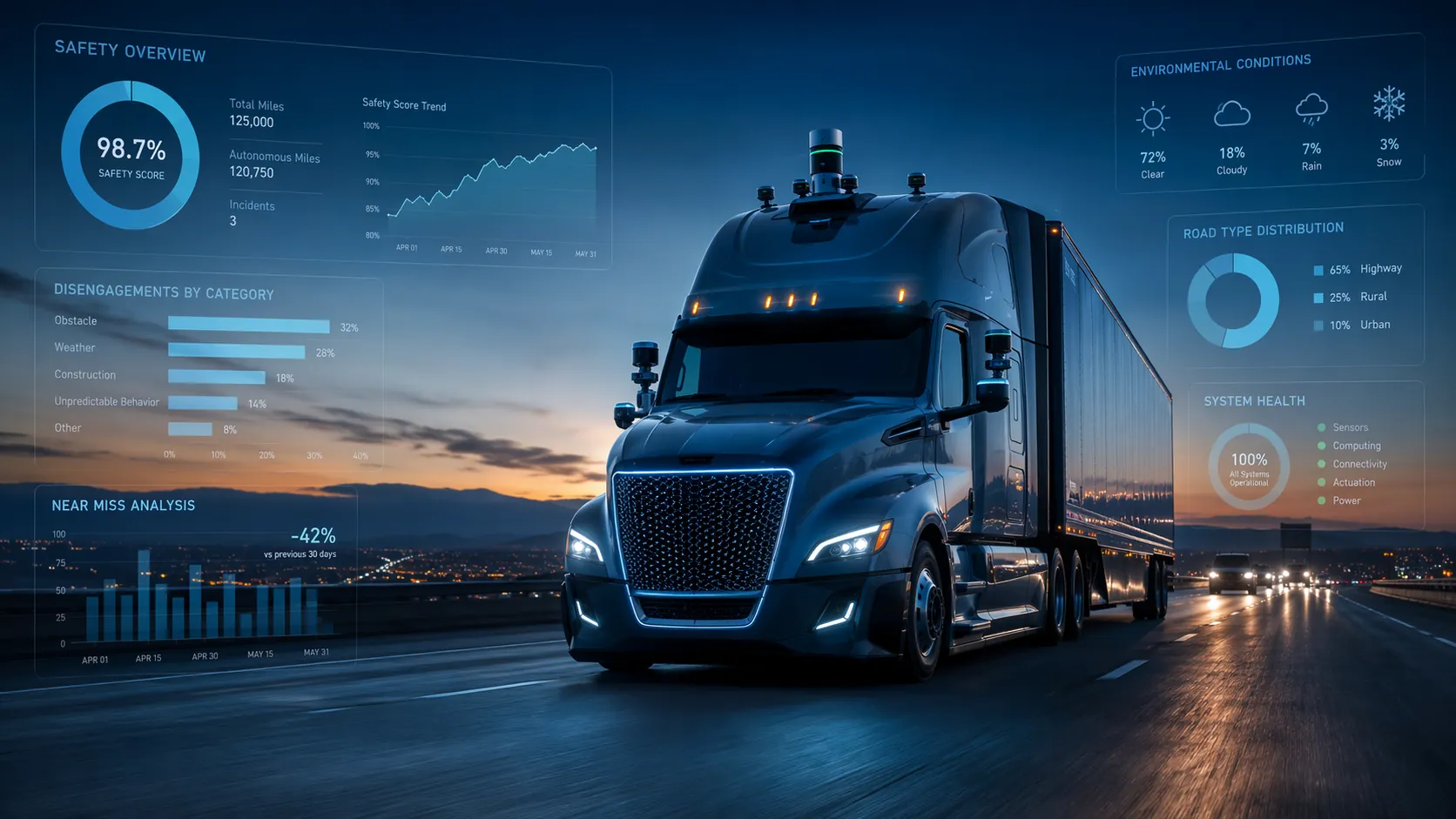
The strongest public evidence for that case comes from high-mileage autonomous passenger fleets, especially Waymo. Through March 2026, Waymo reported peer-reviewed safety impact data covering 220.6 million rider-only miles. Compared with human-driver benchmarks, the company reported 82% fewer any-injury crashes, 93% fewer pedestrian injuries, and 84% fewer cyclist injuries.[2] Those are not small deltas, and they are not merely claims that a sensor suite can perceive a lane marking. They point to fewer people being hurt per mile in real service.
Insurance data points in the same direction. A Swiss Re analysis cited in a ChainLaw review compared 25.3 million Waymo miles with human-driven vehicles and found 88% fewer property-damage claims and 92% fewer bodily-injury claims.[3] Claims data is not the same as a police crash database or a fatality investigation file, but for a fleet risk manager it matters because it captures the incidents that become costs, disputes, downtime, and injury files.
What the strongest data actually proves
The Waymo numbers support a narrow but important conclusion: in the operating domains where Waymo has accumulated large rider-only mileage, its autonomous driving system has produced substantially fewer injury-related crashes per mile than human benchmarks. That is a real safety signal. It is also not the same as proof that every autonomous supply chain vehicle, on every route, in every weather pattern, will outperform a professional truck driver.
The distinction matters because supply chain vehicles are not all scaled-up robotaxis. A Class 8 tractor-trailer has different mass, stopping distance, turning behavior, blind zones, tire failure consequences, and rollover dynamics. Sensor placement changes as well: a roof-mounted perception stack on a passenger car does not face the same geometry as sensors mounted around a tractor and trailer combination. A safety case that is convincing for passenger service in Phoenix, San Francisco, Los Angeles, and Austin still has to be re-examined for highway freight lanes, distribution yards, construction merges, rain, dust, and mixed traffic around loading areas.[2]
That does not make the passenger-vehicle data irrelevant. It shows that autonomous driving can, under real commercial deployment, reduce crash involvement rather than simply move the same risk into a computer. But the transfer to trucking is an engineering and operations argument, not a slogan. The correct question is what portion of that safety advantage survives when the vehicle is heavier, the route is longer, the roadside response is harder, and the operating domain is less forgiving.
Fault analysis also complicates the usual crash-count conversation. In an analysis of 2,052 ADS incidents from 2021 to 2025, TrialProven reported that autonomous vehicles were solely at fault in 4% of multi-vehicle collisions, while 83% were caused by other drivers; the same analysis reported zero human fatalities caused by an AV during that period.[4] That finding is useful, but bounded: the source notes that the dataset excludes narratives for 2,912 Tesla ADAS incidents, so it should not be read as a complete picture of all automation-involved crashes.[4]
| Evidence | What it supports | What it does not prove |
|---|---|---|
| Waymo 220.6M rider-only miles | Large-scale injury-crash reductions in deployed robotaxi operating domains | Equivalent safety rates for heavy-duty autonomous trucking |
| Swiss Re claims comparison over 25.3M Waymo miles | Lower property-damage and bodily-injury claim frequency in the analyzed fleet | Elimination of insurance, liability, or operational incident exposure |
| ADS incident fault analysis | Many reported multi-vehicle AV incidents are attributed to other road users | A complete account of all ADAS/ADS crash dynamics |
From fewer crashes to a different safety job
If autonomous vehicles reduce the most familiar driver-error categories, the fleet safety job does not disappear. It moves. Fatigue, distraction, impairment, and speeding may become less central in a driverless operating domain, but software behavior, sensor degradation, remote assistance, cybersecurity, and roadside recovery become first-order controls.
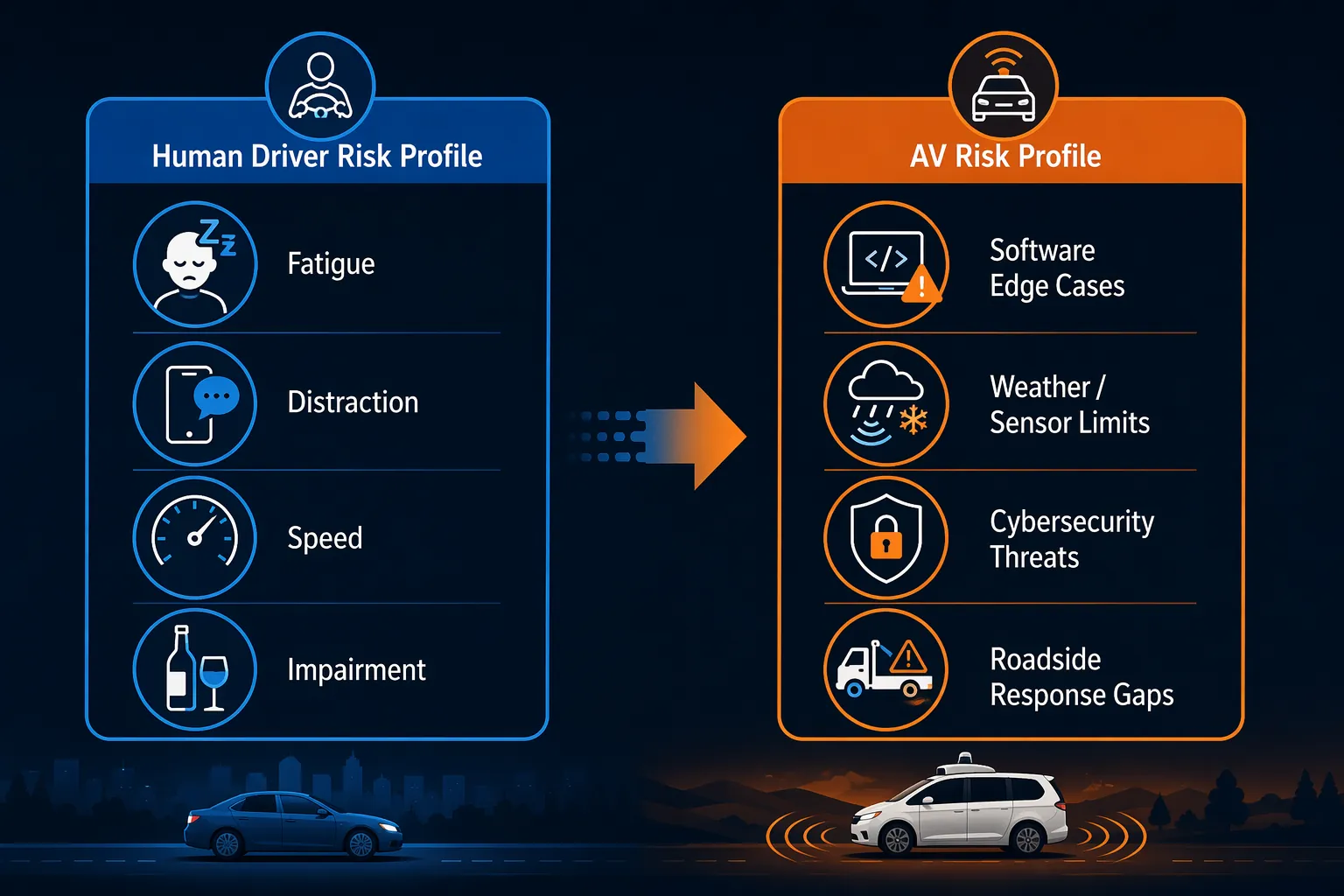
This is where procurement conversations often become too optimistic. A lower crash rate per mile is not a substitute for an incident playbook. A driver can smell smoke, feel a tire vibration, step out with triangles, talk to law enforcement, inspect visible damage, and make an imperfect but immediate judgment about whether the shoulder is safe. An autonomous truck cannot perform those physical tasks by itself. The absence of a fatigued human in the cab removes one class of risk and creates a different dependency on monitoring, dispatch, roadside contractors, first-responder protocols, and safe fallback behavior.
The public incident record gives concrete examples without needing to turn them into a verdict on the entire technology. Craft Law Firm’s analysis of NHTSA data counted 5,202 reported ADS/ADAS incidents in the United States through November 2025; 7.4% resulted in injury and 1.2% in fatality.[5] Those figures combine different technologies and use cases, so they cannot be treated as a clean autonomous-truck crash rate. They do show why incident governance has to sit beside performance claims.
Truck-specific incidents are thinner in the public record, but they are instructive. A Colorado personal-injury analysis cites a TuSimple barrier strike in April 2023 in which software commanded an unintended turn, and a May 2022 Waymo Via incident in which a human operator was injured after a vehicle was pushed off-road.[6] These are not proof that autonomous trucks are broadly unsafe. They are reminders that failure modes are not limited to the old categories of drowsiness, texting, or reckless speed.
The edge cases that matter for freight
Software edge cases deserve more attention than they usually get in business-case decks. The issue is not that software is inherently less trustworthy than a person. It is that an autonomous system can fail in ways that look unfamiliar to a safety department trained around driver behavior: object misclassification, perception latency, unusual work-zone geometry, conflicting lane cues, or an interaction with another road user that was rare in the training and validation environment.
Weather and environmental limits are part of the same problem. Rain, snow, dust, glare, standing water, and road debris can interfere with sensors or make the operating domain narrower than a route map suggests. Current deployments are concentrated in Sunbelt conditions such as Texas, Arizona, and California, so the available public performance record does not fully answer how the same systems behave in sustained winter conditions, mountain weather, or industrial sites with dust and occlusion.
For a fleet, this changes what a route approval should look like. The relevant question is not simply whether the autonomous system can complete the lane on a good day. It is whether the operator knows the weather thresholds, construction detour rules, remote-assistance triggers, minimum-risk maneuvers, tow and recovery procedures, and customer-site constraints before the truck leaves the terminal.
- Define the operating domain by road type, weather, time of day, traffic pattern, and customer-site conditions.
- Set explicit disengagement, fallback, and remote-assistance criteria before commercial loads move.
- Document who responds when the vehicle stops where a human driver would normally inspect, warn, or negotiate with authorities.
- Review software updates as safety-relevant changes, not routine IT maintenance.
- Treat cybersecurity as a vehicle safety control, especially where remote commands, fleet connectivity, and dispatch systems intersect.
Cybersecurity is not a separate department’s problem
Cybersecurity risk is easy to underweight because it does not look like the traditional fleet safety file. A hacked dispatch account, compromised update process, spoofed signal, or unauthorized access path can become a vehicle-control or routing problem. In a connected autonomous fleet, cyber exposure is part of the safety case, not merely a compliance appendix.
That does not mean every autonomous truck should be treated as if hostile control is imminent. It means safety review has to include access controls, update governance, incident escalation, vendor disclosure obligations, and recovery procedures. The most dangerous assumption is that because a vehicle has no driver, fewer people are involved in keeping it safe. In practice, more safety-critical decisions move into software release management, network monitoring, operations centers, and vendor contracts.
Delivery robots belong in a different risk bucket
Autonomous supply chain vehicles also include smaller delivery robots, but their risk profile should not be blended with heavy-duty trucks. Sidewalk robots interact with pedestrians, curb ramps, wheelchairs, pets, storefronts, and local sidewalk rules. A ScienceDirect study on sidewalk delivery robots addresses a category shaped by public-space interaction rather than highway stopping distance or tractor-trailer mass.[8] The safety governance questions still matter, but the consequence model is different.
For logistics operators, that means a warehouse-to-sidewalk pilot and an autonomous linehaul pilot should not share one generic “AV safety” checklist. They may use similar disciplines — operating-domain definition, incident reporting, software controls, and escalation — but the hazards, stakeholders, and acceptable mitigations differ.
Forward-looking benefits are useful, but they are not proof
There is a credible argument that autonomous trucking could produce large safety benefits if the technology scales in suitable domains. Aurora has cited a Steer Group-commissioned projection estimating that autonomous trucking could prevent 490 fatalities, 8,800 injuries, and 23,000 crashes annually by 2035, producing $9.4 billion in annual safety benefits.[7] The important words are “commissioned” and “projection.” This is a modeled future scenario, not retrospective evidence that today’s autonomous truck deployments have already achieved those outcomes.
A fleet leader can still use such projections. They help frame the size of the prize if high-performing autonomous systems replace riskier human-driven miles. But the decision to deploy should rest more heavily on actual operating-domain evidence, vendor safety cases, incident transparency, insurance treatment, regulator engagement, and the operator’s own ability to manage exceptions.
A bounded yes
The best public data supports a serious safety case for autonomous vehicles. Injury-crash and insurance-claim reductions in large robotaxi deployments are too substantial to dismiss as hype, and the human-driven truck baseline is too harmful to treat the status quo as morally neutral. For suitable routes, with a vendor willing to disclose its operating limits and an operator prepared to manage incidents differently, autonomous supply chain vehicles appear safe enough to justify defined, monitored deployments.
They are not safe enough to buy as a zero-incident technology. They are also not safe enough to evaluate only with legacy driver-safety checklists. The fleet that says yes needs a new safety file: one that starts with comparative crash evidence, then keeps going into software behavior, weather limits, cybersecurity, roadside response, and the exact conditions under which the vehicle is allowed to do the job.
References
- Automated Vehicles for Safety, NHTSA
- Waymo Safety Impact Data Hub, Waymo
- Safer Than Humans? What Crash Data From Robotaxis and Autonomous Vehicles Really Means for Road Safety, ChainLaw
- Autonomous Vehicle Accidents Statistics, TrialProven
- Data Analysis: Self-Driving Car Accidents [Updated 2026], Craft Law Firm
- Autonomous Trucks: Too Good to Be True?, Colorado Personal Injury
- Autonomous Trucking to Put $9 Billion Back in U.S. Consumers’ Pockets Annually by 2035, Aurora
- Sidewalk delivery robot study, ScienceDirect
Comments
Join the discussion with an anonymous comment.