
The most important shift in Apple’s AI chip supply chain story is not that Nvidia is winning AI. It is that Apple, after years of being treated as TSMC’s favored customer, reportedly had to hear that guaranteed priority would no longer be guaranteed. Industry reporting says Nvidia overtook Apple as TSMC’s largest customer by revenue in at least two quarters of 2025, and that TSMC CEO CC Wei told Apple in August 2025 it would face price increases and lose guaranteed priority access.[1]
TSMC does not disclose customer-specific revenue rankings, so this is still an estimate-driven view of the customer stack rather than a TSMC-published leaderboard. But the direction is hard to miss. TSMC’s high-performance computing revenue, pulled upward by AI demand, rose from 36% of total revenue in 2020 to 58% in Q4 2025, while smartphone revenue fell from 46% to 29% over the same period.[2] When that happens, procurement teams do not get to argue from brand prestige. They argue from wafer value, margin, capacity fit, and what the next customer is willing to pay.

That is the uncomfortable reversal behind Apple’s supply-chain pivot. Apple has not suddenly become a weak buyer. It still has scale, forecasting discipline, engineering intimacy with TSMC, and a history of committing early to advanced nodes. But priority is rented, not owned. If a supplier’s growth engine moves from phones to AI accelerators, the customer whose products defined the last cycle must decide which parts of its silicon portfolio truly need the old arrangement and which parts can be used to build leverage somewhere else.
Apple’s Exposure Is Narrower Than “TSMC Dependence” and More Dangerous
Saying Apple depends on TSMC is true, but too broad to be useful. The sharper issue is concentration at the leading edge. Nearly all leading-edge A-series and M-series chips are manufactured at TSMC Fab 18 in Tainan, Taiwan, a single facility on an island roughly 100 miles from mainland China.[2] Apple’s manufacturing purchase obligations to TSMC reached $56.2 billion in 2025.[2] That is not a casual vendor relationship; it is a production architecture.
A purchase obligation of that size buys attention, planning access, and commercial gravity. It does not automatically buy insulation from a mix shift inside the supplier’s own business. If the foundry sees AI/HPC as the higher-growth category, and if Nvidia and a handful of large infrastructure buyers can absorb leading-edge capacity with aggressive economics, Apple’s leverage becomes less absolute even while its spend remains enormous.
This is why Apple’s diversification should not be read as a public breakup with TSMC. The performance-sensitive work that defines iPhone, iPad, and high-end Mac products is still not easily portable. A-series and upper-tier M-series chips are tightly bound to process technology, design libraries, packaging assumptions, yield learning, software timing, and launch calendars. Moving that work for the sake of symmetry would be a procurement chart pretending to be an engineering plan.
The practical question is different: where can Apple qualify alternatives without putting the franchise product at avoidable risk, and where can the mere existence of a credible alternative change the commercial conversation with the incumbent supplier?
The Diversification Is a Portfolio Move, Not a Naïve Dual-Source Plan
In electronics sourcing, “dual source” often gets used too casually. Two suppliers on a slide are not the same thing as two qualified production paths. For advanced silicon, a second foundry usually means new design enablement, process tuning, IP validation, packaging qualification, test correlation, yield risk, reliability work, and a different set of failure modes. The cost is not just the quote delta. It is the organizational tax of carrying optionality before a crisis makes that optionality priceless.
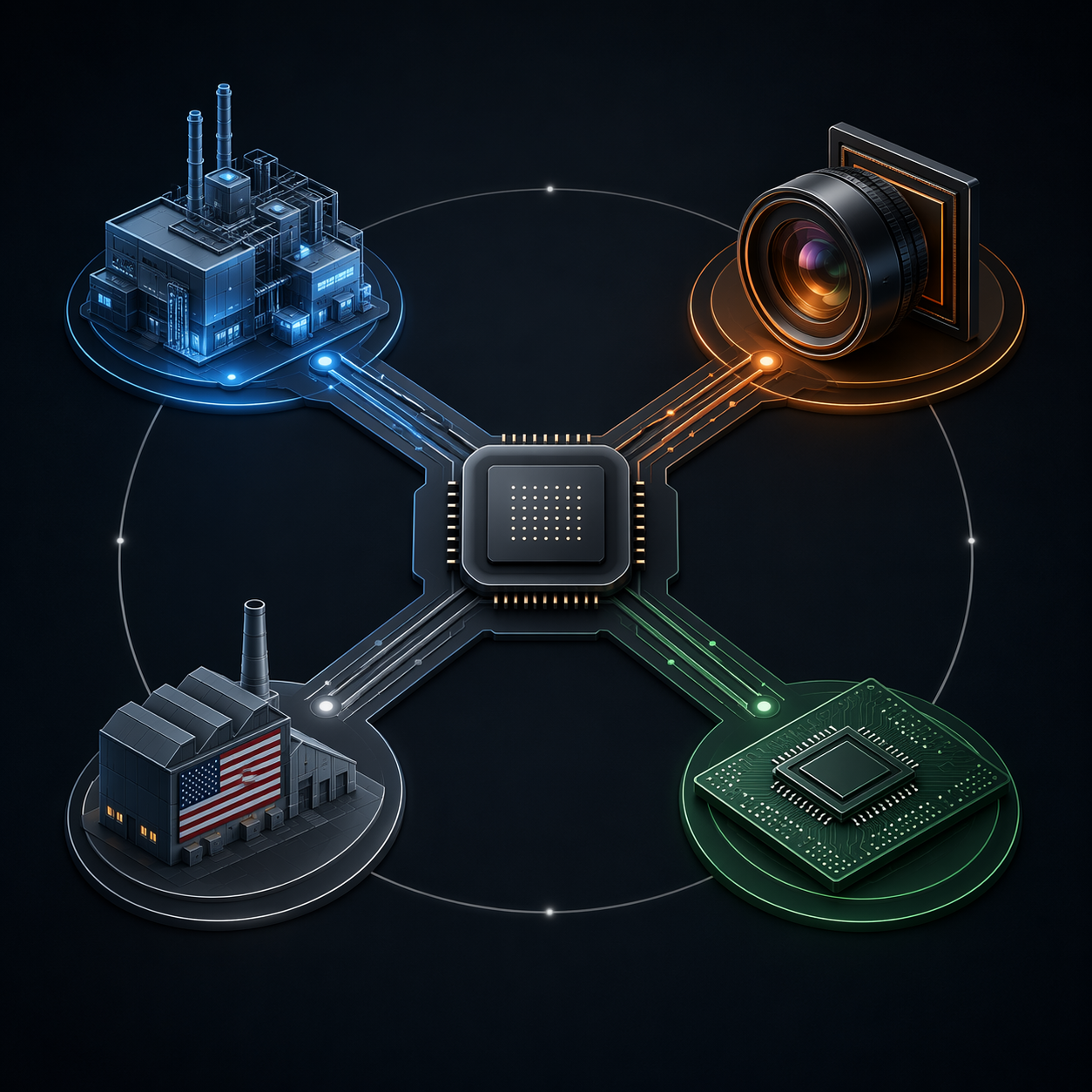
Apple’s apparent playbook is more disciplined than “move chips away from TSMC.” It keeps the most differentiated, performance-sensitive silicon close to the supplier that has already proven it can execute. Around that core, Apple appears to be building alternative paths for lower-risk processors, image sensors, US-based capacity, advanced packaging, and AI infrastructure silicon.
| Diversification leg | What it changes | Why it matters |
|---|---|---|
| Intel 18A-P evaluation for base M-series silicon | Creates a possible non-TSMC path for lower-risk Mac processors | Builds pricing and allocation leverage without immediately moving the most sensitive chips |
| Samsung Foundry CMOS image sensors in Austin | Adds a second major source outside Sony’s long-running iPhone sensor position | Diversifies a critical component without forcing an A-series foundry split |
| US manufacturing and packaging capacity | Adds regional optionality through Houston AI server work and expanded TSMC Arizona collaboration | Reduces exposure to a single geography, while still depending on proven partners |
| Project ACDC custom AI inference chips | Targets Apple Intelligence data-center workloads with Apple-designed silicon | Limits dependence on third-party data-center AI chips where Apple can justify vertical integration |
The table is useful only if the boundaries are respected. These legs do not carry equal technical risk, equal confirmation status, or equal strategic weight. Some are reported industry sourcing moves that Apple has not publicly confirmed. Some are publicly announced investment commitments that cover more than semiconductors. Some are about leverage, not imminent transfer.
Intel 18A-P Is a Leverage Test Before It Is a Volume Story
The reported Intel leg is the most symbolically important because it would be the first credible TSMC alternative for Apple silicon since Apple left Samsung for application processor manufacturing in 2016. SemiAnalysis reports that Apple is actively evaluating Intel’s 18A-P process for lower-risk base M-series silicon, with Intel offering pricing leverage against TSMC, optionality toward Intel 14A, and US-based wafer fabrication plus advanced packaging.[2]
That wording matters. “Evaluating” is not “awarding.” Apple has not publicly confirmed the 18A-P work as of July 2026, and Intel Foundry still has to prove timeline, yield, reliability, and volume execution at the scale Apple would require.[2] A procurement team can use a credible qualification program to change the commercial posture with an incumbent; it cannot ship a Mac on a process that misses yield targets because the sourcing strategy sounded elegant in a board deck.
The reason base M-series silicon makes sense as the test vehicle is that it sits in a different risk class from the leading-edge iPhone processor or the highest-end Mac chips. It is still important, but it is a more plausible place to absorb qualification complexity. If Intel clears the bar, Apple gains a real second path for part of the portfolio. If Intel does not, Apple still learns process maturity, packaging capability, commercial posture, and where Intel Foundry’s promise ends under Apple-grade scrutiny.
Samsung Sensors Diversify Without Touching the Processor Core
The reported Samsung move is quieter but operationally revealing. SemiAnalysis says Apple signed a strategic deal with Samsung Foundry to manufacture CMOS image sensors at Samsung’s Austin, Texas facilities, breaking Sony’s decade-long exclusivity on iPhone image sensors; SemiAnalysis estimates 150 million to 200 million sensors annually by 2027.[2] Apple has not publicly confirmed the arrangement, so it should be treated as supply-chain reporting rather than a corporate announcement.
If the reporting proves out, the logic is sound. Camera sensors are product-critical, but they are not the same category of foundry dependency as the A-series application processor. Diversifying a sensor path can reduce concentration, add US-based manufacturing exposure, and create supplier tension in a component family where Apple can manage performance through module design, software tuning, and qualification discipline.
This is what mature multi-foundry strategy usually looks like. It does not start by splitting the hardest chip in the portfolio. It starts where the company can afford qualification work, where the supplier base has credible process capability, and where the second source can matter even if it begins as partial volume.
US Capacity Is a Hedge, Not a Reshoring Victory Lap
Apple’s US investment commitment gives the diversification story a public anchor, but it needs careful handling. Apple announced in February 2025 that it would spend more than $500 billion in the United States over four years.[3] That commitment includes many categories beyond semiconductor supply chain, so it should not be reduced to a chip-sourcing number.
Still, the semiconductor-related pieces matter. Reporting on Apple’s AI infrastructure strategy points to an AI server factory in Houston, expanded collaboration with TSMC’s Arizona fabs, and Project ACDC, Apple’s effort to build custom AI inference chips for Apple Intelligence data-center workloads.[4] Together, these moves add regional optionality and infrastructure control without pretending that the entire advanced-node dependency can be lifted out of Taiwan on a convenient schedule.
The geopolitical logic is obvious even when it is not written into Apple’s public rationale. Fab 18’s location in Taiwan is part of the exposure profile, but there is no public record in the research base of Apple explicitly citing Taiwan Strait risk as the reason for these moves. A serious sourcing read does not need Apple to say it out loud. It only needs to avoid overstating what has been confirmed.
Apple Is Not Chasing Nvidia’s Data-Center Model
The supply-chain trap is to assume Apple’s answer to Nvidia must be a smaller version of Nvidia’s model. That is not how Apple’s silicon advantage has usually worked. Nvidia’s power in this cycle comes from data-center AI demand and the ecosystem that surrounds its accelerators. Apple’s strongest defensible position is closer to the device, where hardware, operating system, model deployment, privacy posture, and user experience can be optimized together.
The on-device numbers explain why Apple has room to choose a different fight. Apple’s M4 Neural Engine delivers 38 TOPS, and the A18 Pro delivers 35 TOPS, giving Apple one of the strongest on-device AI compute stacks in the consumer market.[5] That does not remove Apple from the AI infrastructure race, but it changes the sourcing objective. Apple does not need to mirror a hyperscaler’s accelerator procurement if it can move more inference close to the user and reserve custom data-center silicon for Apple Intelligence workloads that justify the control.
Project ACDC fits that pattern. The goal, as reported, is not to become a merchant GPU supplier or replace every third-party chip in the data center. It is to reduce dependence where Apple has enough workload specificity to design for its own needs.[4] That is vertical integration with a narrow business case, not an identity statement.
Meanwhile, the broader market is making supplier priority more expensive for everyone. Hyperscaler AI infrastructure capex reached about $650 billion in 2026, up 80% year over year, concentrating demand for advanced capacity among Nvidia and four hyperscalers.[6] A sourcing team that still assumes annual spend alone will secure allocation is working from the wrong cycle.
What Actually Transfers From Apple’s Playbook
Most companies cannot copy Apple’s supplier access, engineering bench, or cash commitments. That does not make the playbook useless. The transferable part is the segmentation discipline: decide which chips are truly differentiating, which components can tolerate an alternate path, which geography creates unacceptable interruption risk, and where custom silicon protects a product or infrastructure advantage.
- Keep the most performance-sensitive silicon with the supplier that can reliably execute, even if that supplier has become more expensive.
- Qualify alternatives first on lower-risk silicon or adjacent components where failure cost is lower and learning value is high.
- Treat regional capacity as interruption insurance, not as proof that geography risk has disappeared.
- Use custom silicon only where workload control, product differentiation, or infrastructure economics justify the design and supply-chain burden.
- Value a credible second source even before full volume transfer, because qualification itself can change pricing, allocation, and negotiation posture.
The hardest part is organizational patience. A real semiconductor alternate source is built years before it is needed. It asks engineering to spend time on a path that may never ship. It asks finance to accept option value that does not show up cleanly in unit cost. It asks executives to explain why the company is paying to reduce a risk that has not yet become a missed launch.
Apple appears to be doing that work now because the old leverage equation has changed. Nvidia’s rise at TSMC did not make Apple irrelevant. It made visible what was already true in allocation meetings: the best customer is the one that fits the supplier’s next margin pool, not always the one that built the last decade of volume.
The grounded lesson is not “copy Apple’s suppliers.” It is to make risk segmentation explicit before allocation pressure forces the issue.
References
- Nvidia overtakes Apple as TSMC's top customer, MacDailyNews/Culpan reporting, Jan 2026
- Apple-TSMC: The Partnership That Built Modern Semiconductors, SemiAnalysis, Jan 2026
- Apple will spend more than $500 billion in the U.S. over the next four years, Apple Newsroom, Feb 2025
- How Apple is Revolutionizing Supply Chain Management with AI Investments and Custom Infrastructure, Logistics Viewpoints, Sep 2025
- AI Chip Statistics 2026, SQ Magazine, May 2026
- AI Chip Statistics 2026, SQ Magazine, Jul 2026
Comments
Join the discussion with an anonymous comment.