
A below-normal Atlantic hurricane outlook is not a freight plan. NOAA’s 2026 outlook calls for a below-normal season, but NOAA also states that the outlook does not forecast landfalls; one landfalling storm can still create severe local damage and supply chain disruption.[1] That is the planning problem: the seasonal signal may be mild while the network exposure is not.
For hurricane supply chain disruption planning, the useful question is not whether a model can draw a better storm cone. It is whether earlier, more granular signals change a decision before the weekly S&OP call becomes an incident call. The practical capabilities fall into three jobs: pre-positioning demand and inventory, rerouting logistics as conditions change, and monitoring suppliers before the season starts.[2]

The Planning Move That Matters Most: Inventory Before Landfall
The strongest documented hurricane-specific case is inventory pre-positioning. In ClimateAi’s Hurricane Ian case study, a roofing materials producer used probabilistic hurricane forecasts to position inventory ahead of the storm and reported $15 million in incremental sales.[3] That number should stay in its lane: it is a single-company, single-event outcome from a vendor-published case study, not a benchmark for what every distributor or manufacturer should expect.
The mechanism is still worth taking seriously. Roofing demand after a hurricane is not evenly distributed across a region. It concentrates where wind, rain, flooding, insurance claims, contractor capacity, and accessible routes intersect. A probabilistic forecast can turn a storm path into regional demand risk before the exact landfall point is known. The planner’s decision is then concrete: move shingles, underlayment, fasteners, generators, or adjacent SKUs into the DCs and branches most likely to serve the affected counties.
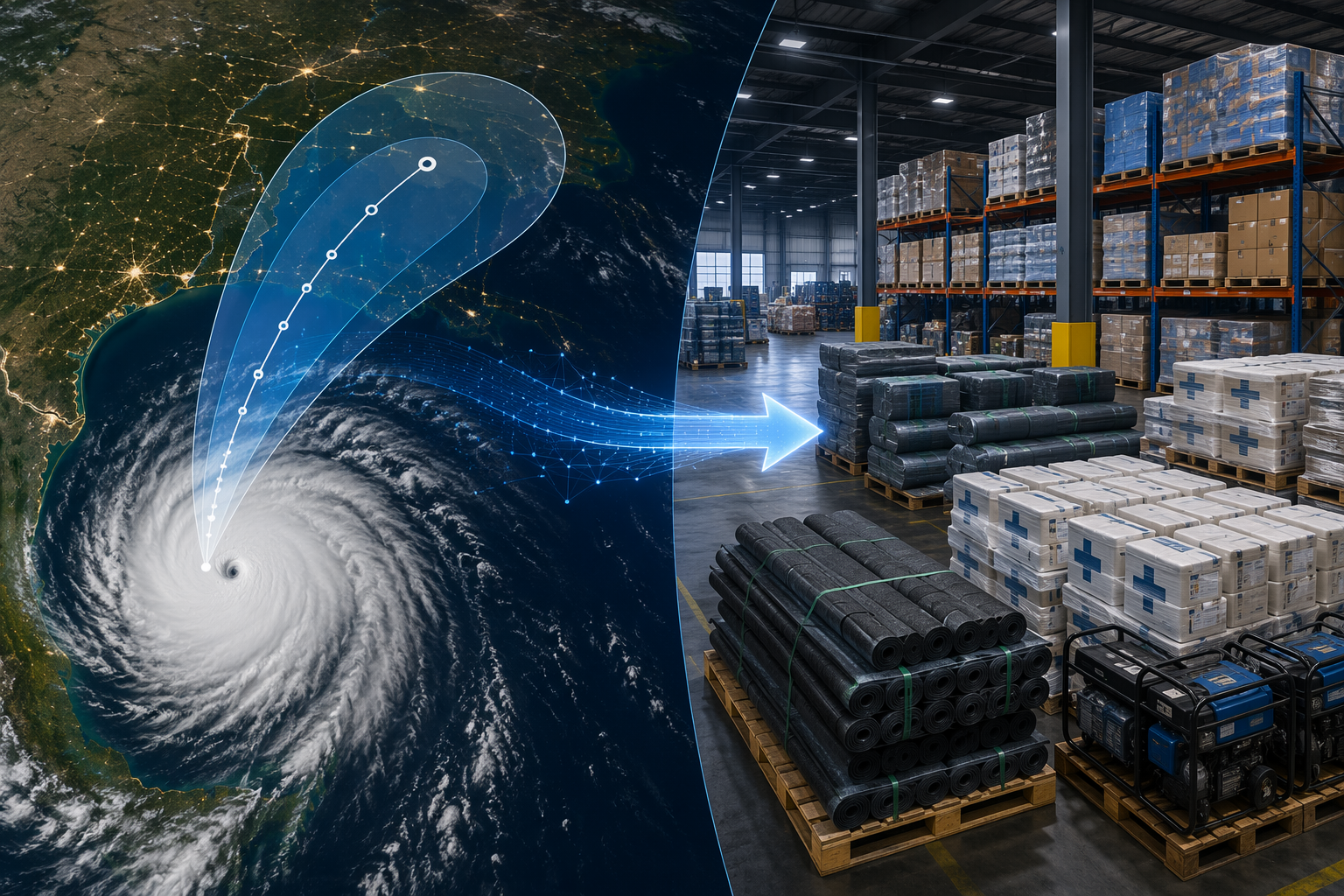
This is where AI changes the clock. Without a usable probability signal, many teams wait until the forecast narrows, then discover that the truck capacity, warehouse labor, and branch receiving windows have narrowed too. With a usable signal, the planner can make an imperfect but earlier allocation: raise stock in one Gulf Coast node, hold back inventory from a lower-risk region, or stage substitutes where primary SKUs are likely to run short.
That does not mean the model “knows” the storm. It means the business no longer treats all exposed nodes as equal. The forecast becomes a ranked operating assumption, and the inventory plan changes before certainty arrives.
| Capability | Planning horizon | Decision it should change | Evidence strength in hurricane use |
|---|---|---|---|
| Demand and inventory pre-positioning | Days to weeks before landfall | Which DCs, branches, and SKUs receive stock before demand spikes | Strongest: Hurricane Ian roofing materials case with reported $15M incremental sales |
| Supplier risk monitoring | Weeks to months before season or exposure window | Supplier contracts, safety stock, alternates, and sourcing posture | Strong: Hitachi Digital Observatory seasonal cyclone forecasting case |
| Logistics rerouting | As forecasts and conditions change | Lane choices, carrier allocation, facility cutoffs, and route exceptions | Useful but less hurricane-specific in the available evidence |
Why Static Hurricane Plans Break
A static plan usually assumes a few named facilities, a few alternate lanes, and a neat escalation path. Hurricanes punish that neatness. Forecast cones shift. Ports close before roads flood. Branches that looked like demand sinks become inaccessible. A DC outside the cone can still lose labor, power, or inbound supplier flow.
The disruption backdrop has also become harder to ignore. Resilinc reported that overall supply chain disruptions increased nearly 40% year over year in 2024, while extreme weather disruptions rose 119% and hurricanes or typhoons rose 101% in its EventWatchAI data.[4][5] Those figures do not prove that any one AI tool will work. They do explain why waiting for a clean forecast is a poor operating habit.
The upstream weather-model environment is improving as well. Reporting based on NOAA National Hurricane Center verification data said Google DeepMind’s GDMI outperformed traditional physics-based hurricane models for both track and intensity during the 2025 Atlantic season, and NOAA has separately described AI hurricane forecasting as an emerging capability area.[6][7] Supply chain systems still have to translate those signals into orders, inventory moves, and lane changes. Better weather input only matters operationally when it shortens the time between risk detection and planning action.
Supplier Monitoring Starts Before the Storm Has a Name
The Hitachi Digital Observatory case shows a different planning horizon. Hitachi’s project uses ClimateAi seasonal cyclone forecasts, described as looking up to six months out at 1 km resolution, to adjust supplier contracts and safety stock before hurricane season begins.[8][9] That is not emergency response. It is risk posture work.
The distinction matters because supplier exposure is often buried under tiering, contracts, and assumptions that were set months earlier. A component may not be hurricane-sensitive because the final assembly plant sits near the coast. It may be sensitive because a sub-supplier, packaging source, resin input, or specialty component sits in a cyclone-exposed region and has no realistic short-term substitute.
Seasonal AI forecasting gives planners a reason to revisit those assumptions before purchase orders harden. The useful actions are not abstract: renegotiate flexibility with a supplier, qualify an alternate, raise safety stock for a constrained part, split allocation across regions, or flag a component for executive review before the storm season compresses everyone’s options.
This is also where hurricane planning stops being only a transportation problem. Once the supplier map is joined with seasonal exposure, the risk discussion moves upstream into sourcing and inventory policy. A planner can still be wrong about the exact storm. The improvement is that the wrongness is bounded by a clearer view of which suppliers and materials deserve attention.
Rerouting Is the Execution Layer, Not the Whole Plan
Logistics rerouting gets plenty of attention because it is visible during the event: trucks move, loads are delayed, facilities close, and control towers light up with exceptions. AI can help by combining weather signals, shipment status, facility constraints, carrier capacity, and customer priority into faster lane decisions. That is a real capability, especially for teams already using a control tower AI application as the place where exceptions become dispatch or allocation decisions.
The evidence base, however, is thinner when narrowed specifically to hurricane rerouting. The available hurricane-specific material is stronger for inventory pre-positioning and supplier monitoring. Rerouting should be treated as the connective execution layer: it uses the same risk signals but acts later, when forecasts, road closures, port notices, carrier availability, and customer commitments are changing at the same time.
A practical rerouting workflow may be simple. Freeze or pull forward shipments into at-risk branches before a cutoff. Shift replenishment from a threatened DC to a safer node. Reassign carrier capacity toward priority lanes. Hold noncritical freight outside a projected impact area rather than sending it into a yard that may close. The model can rank choices; the planner still needs authority, playbooks, and carrier relationships to execute them.
For readers still defining the control tower layer, the difference between monitoring, recommendation, and autonomous execution is worth separating. A foundational supply chain control tower AI definition can help keep that architecture discussion distinct from the hurricane-risk use case.
How the Three Capabilities Fit Together
The cleaner way to evaluate AI hurricane planning is by sequence. Months out, supplier monitoring changes sourcing posture and safety stock. Days or weeks out, probabilistic forecasts change where inventory sits. As the storm approaches and hits, visibility and rerouting tools change which loads move, wait, or divert.
- Seasonal exposure: identify suppliers, materials, and regions that deserve contract or buffer changes before the season.
- Pre-landfall demand signal: convert probabilistic forecasts into inventory positioning for high-need SKUs and substitute products.
- Active-storm execution: use control tower visibility to adjust lanes, carrier allocation, facility cutoffs, and customer commitments.
- Post-event recalibration: compare actual demand, service failures, stockouts, excesses, and supplier misses against the assumptions used before the storm.
That sequence is more useful than treating “AI resilience” as one large software promise. Each capability has a different owner, lead time, and failure mode. Demand planning owns much of the pre-positioning question. Procurement and risk teams own supplier exposure. Transportation and customer operations own a large share of the rerouting burden. If those handoffs are not explicit, the model may produce a warning that no one has the budget or authority to act on.
The same pattern appears in adjacent weather-risk planning. Flood-risk AI, air-quality disruption planning, and other disaster-response workflows all depend on whether an environmental signal becomes an operational decision rather than a dashboard alert. ChainSignal’s related pieces on AI flood disruption planning and AI supply chain air quality risk follow that broader weather-to-action pattern.
What to Validate Before Buying
A vendor demo can make hurricane planning look smoother than it is. The proof should be tied to a decision record. Ask what the model knew, when it knew it, what recommendation changed, who approved the change, and what happened afterward. If the answer stays at the level of risk scores, the planning value is still unproven.
- For inventory: which SKUs, DCs, branches, and allocation rules changed because of the forecast?
- For suppliers: which contracts, alternates, buffers, or qualification priorities changed before the season?
- For logistics: which lanes, carriers, cutoffs, or shipment priorities changed before facilities became constrained?
- For governance: who can act on the recommendation when the forecast is still probabilistic?
- For measurement: does the post-event review compare the AI-informed plan against a credible baseline?
The Hurricane Ian roofing case is valuable because it connects forecast, positioning, and commercial outcome.[3] The Hitachi case is valuable because it shows supplier-risk work moving into the seasonal planning window.[8][9] Rerouting tools can be valuable too, but they should not be allowed to stand in for the earlier decisions that determine whether the right inventory and supplier options exist when the storm arrives.
AI does not remove hurricane uncertainty. It gives planners earlier, more granular signals that can be converted into inventory, logistics, and sourcing decisions before the scramble begins.
References
- NOAA predicts below-normal 2026 Atlantic hurricane season, NOAA
- Three Ways AI Can Help Companies De-Risk Supply Chains and Capture New Opportunities During Hurricane Season, ClimateAi
- Accurate Hurricane Forecasting Helps Roofing Materials Producer Come Out on Top, ClimateAi
- Global Supply Chains See Nearly 40% Annual Increase in Disruptions, Resilinc
- Resilinc Reveals the Top 5 Supply Chain Disruptions of 2024, Resilinc
- The future of forecasting? AI emerges as top hurricane model in 2025, ClickOrlando, March 31, 2026
- AI Hurricane Forecasting, NOAA National Weather Service
- Hitachi Global Supply Chain Risk Model, ClimateAi
- Hitachi and ClimateAi use AI to predict climate risks and strengthen supply chains, Hitachi Research & Development
Comments
Join the discussion with an anonymous comment.