
The phrase “AI for food supply chain outbreak detection” sounds like one buying category. It is not. In practice, it describes several different signals arriving at different points in the food system: a cluster of consumer complaints before an inspection, a pathogen image before a culture plate would be ready, a facility-risk score before a regulatory visit, or a traceback result before a recall team loses another day matching records.
That distinction matters because outbreak response decisions are rarely made with complete evidence. Someone has to decide whether to hold product, notify a customer, escalate to regulators, or keep production moving while the signal is still partial. Faster detection is useful only if the signal is specific enough, tied to a supply chain node, and backed by data the organization can actually access.
The stakes are large enough to justify better tools: foodborne illness affects an estimated 48 million people annually in the United States and 600 million globally, while the Consumer Brands Association has cited average recall costs above $10 million.[1] Those numbers do not mean every AI alert deserves operational action. They do explain why FSQA, traceability, and public-health teams keep looking for earlier signals than the traditional chain of illness report, interview, inspection, lab confirmation, and traceback.
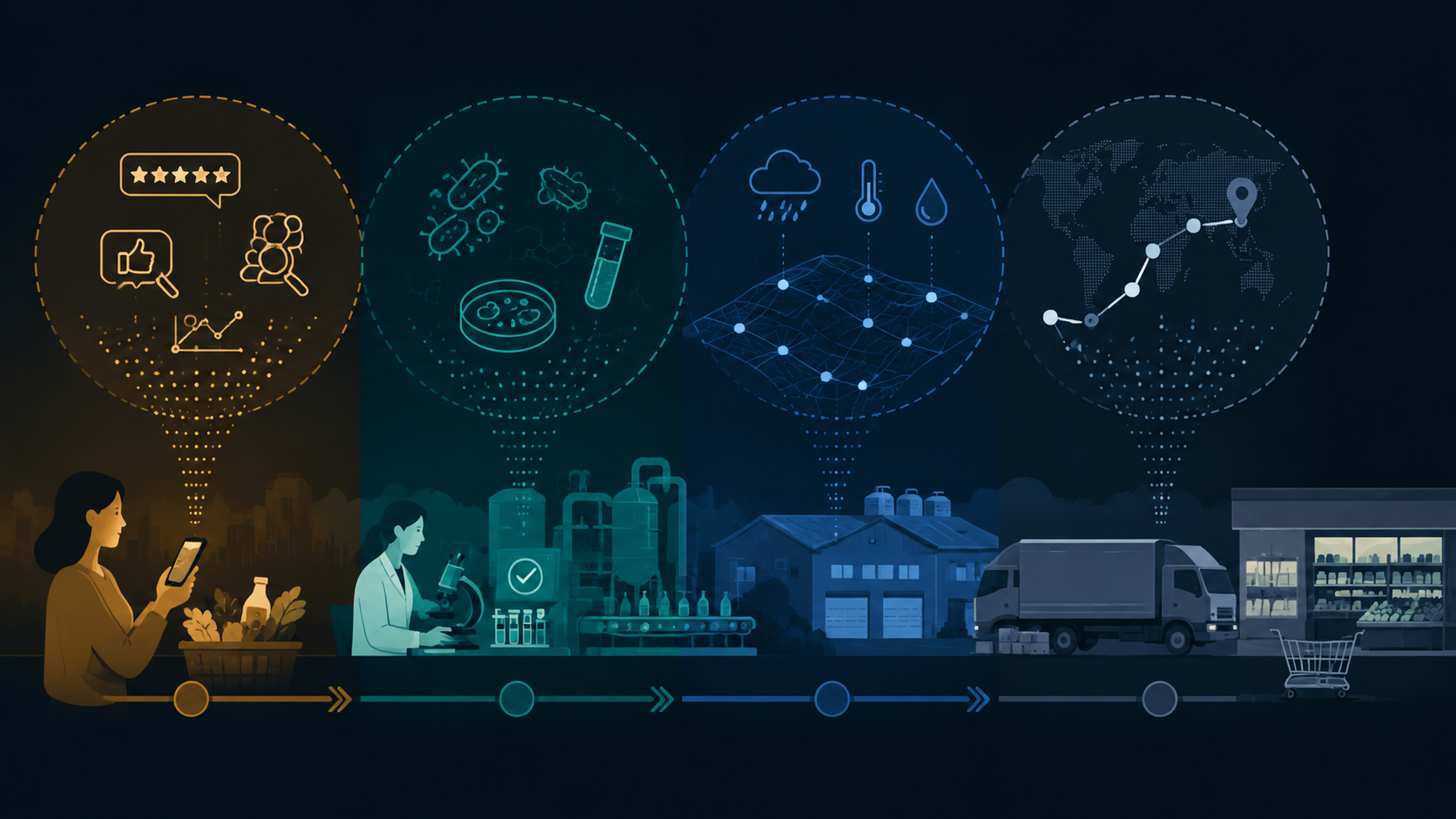
Four Detection Modalities, Four Different Decision Points
A useful outbreak-detection discussion starts by separating the signal from the software label. A restaurant-review model, a computer vision assay, a facility-risk algorithm, and a digital traceback platform may all use AI, but they do not answer the same operational question.
| AI modality | Where the signal appears | Typical data inputs | Operational question it helps answer |
|---|---|---|---|
| Digital signal mining | Consumer and public-health surveillance | Search behavior, restaurant reviews, social posts, complaint text, illness reports | Is there an unusual illness signal that official surveillance has not yet connected? |
| Rapid pathogen detection | Lab, production-adjacent testing, or sample-screening workflow | Microscopy images, assay outputs, colony morphology, sensor or imaging data | Can contamination be detected or ruled out earlier than conventional confirmation? |
| Predictive environmental risk modeling | Facilities, inspection prioritization, sanitation and environmental monitoring programs | Inspection history, environmental monitoring results, facility conditions, product and process risk factors | Which sites, lines, or conditions deserve attention before an outbreak is confirmed? |
| Traceback acceleration | Distribution, recall response, regulatory investigation, supplier-customer record exchange | Lot records, key data elements, shipment events, WGS links, supplier and customer transaction data | Where did affected product move, and which lots or nodes should be isolated? |
The better buying question is therefore not “Which AI tool detects outbreaks?” It is “Which signal do we need earlier, at which node, with which data, and who can act on it before confirmation is complete?”
Digital Signal Mining: Earlier Public Clues, Messier Evidence
Digital signal mining looks outside the plant and warehouse. It searches for outbreak clues in public or semi-public text: restaurant reviews, search queries, social media posts, complaint narratives, and other unstructured signals that may appear before a formal illness cluster is recognized.
The strongest benchmark in this category remains FINDER, a Google and Harvard model evaluated in Chicago and Las Vegas. In the published comparison, FINDER-flagged restaurants were linked to potentially unsafe food at 52.3% precision, compared with 22.7% for routine health department inspections.[2] That is a meaningful result because it measures a practical screening question: when limited inspection resources are available, which establishments should be looked at first?
It is also an older result. The 2018 study should not be used as proof that today’s enterprise platforms can automatically detect outbreaks across a company’s entire supply chain. It does show that noisy public data can outperform routine processes for a narrow prioritization task when the model, geography, and follow-up workflow are clearly defined.
The same direction continues in more recent public-health work. In 2025, the UK Health Security Agency reported an evaluation of AI for analyzing restaurant reviews to help detect and investigate foodborne illness outbreaks.[3] That type of model belongs beside, not above, official surveillance. A review or search signal can tell investigators where to look sooner; it cannot by itself identify a contaminated lot, prove causality, or justify a recall.
For food companies, the fit is clearest when consumer-facing signals matter: restaurant networks, foodservice brands, direct-to-consumer channels, and complaint-management teams with enough text volume to detect patterns. The harder fit is upstream manufacturing, where public illness language may be too far removed from the plant, supplier, or lot to support a fast operational decision.
Rapid Pathogen Detection Changes the Clock, Not the Whole Workflow
Rapid pathogen detection is a different use case. It does not infer illness from public language. It tries to shorten the time between sampling and credible contamination evidence.
Oregon State University reported in February 2026 that its deep learning model could detect bacterial microcolonies in 3 hours and eliminate misclassifications of food debris as bacteria, compared with conventional culture methods that typically take 24–72 hours.[4] The operational significance is obvious: a 3-hour screening window can land inside a production, hold-and-release, sanitation verification, or inbound-material decision in a way that a 24–72 hour culture result often cannot.
The caution is just as important. A research result, even a strong one, is not the same as a validated plant-wide deployment. Buyers still have to ask which organisms, matrices, sample types, lighting conditions, debris profiles, and confirmation rules the system has been tested against. A model that performs well in a controlled study may still need method validation, QA acceptance criteria, analyst training, and a clear escalation path before it can change release decisions.
This modality is most useful where time-to-result is the bottleneck. If a facility already has strong traceability but waits too long for microbial confirmation, rapid AI-assisted detection may reduce uncertainty earlier than another dashboard. If the facility lacks disciplined sampling, environmental monitoring, or lot segregation, faster image analysis will expose the same operational gaps sooner.
Predictive Risk Modeling Works Before Confirmation, So Governance Matters
Predictive environmental risk modeling sits upstream of confirmed illness. It uses patterns in inspection, facility, environmental, product, and process data to prioritize attention before a confirmed outbreak forces the issue.
Regulators are already moving in this direction. FSIS announced stronger Listeria measures in December 2024, including algorithmic triggers for identifying higher-risk facilities starting in January 2025.[5] FDA’s New Era of Smarter Food Safety Blueprint also calls for predictive analytics and root-cause analysis as part of a more digital, prevention-oriented food safety system.[6]
The important shift is not that an algorithm replaces inspection judgment. It is that facility-risk data becomes part of how scarce attention is allocated. A model may help decide which plant, line, product category, sanitation history, or environmental-monitoring pattern deserves earlier review. That can be valuable, but only if the organization knows what happens when the score changes.
The Institute of Food Technologists’ 2026 food safety AI framework—sense, detect, predict, decide, prove—is useful here because it separates signal generation from decision and evidence.[7] A predictive model may sense and predict risk; the organization still needs documented thresholds, human review, corrective-action rules, and proof that the intervention worked.
For a deeper treatment of the prediction layer itself, ChainSignal’s internal guide on how AI predicts food safety outbreaks in the supply chain covers model concepts in more detail. In this broader outbreak-detection use case, the main point is placement: predictive risk modeling belongs around facilities, inspection prioritization, and prevention programs, not in the same decision box as consumer NLP or pathogen imaging.
Traceback Acceleration Is the Most Infrastructure-Adjacent Use Case
Traceback acceleration is not always marketed as outbreak detection, but it is often where an outbreak response succeeds or stalls. Once illness, pathogen, or complaint evidence points to a product, investigators need to know where affected lots came from, where they went, and which adjacent lots may share risk.
FDA’s GenomeTrakr network gives this modality a strong public-health backbone. The whole-genome sequencing network has supported more than 1,643 public-health actions since 2013.[8] Genomic links can connect clinical, food, and environmental isolates with a level of specificity that older methods could not provide. AI does not replace that infrastructure; it can help organize, match, prioritize, and interpret the surrounding data.
Digital traceability systems aim to reduce the record-matching drag that slows recalls and investigations. In the best case, teams identify affected products in hours rather than days, because key events, lot relationships, and shipment records are already structured enough to query. That promise depends less on a clever model than on data discipline: consistent lot coding, supplier participation, clean transaction records, and a way to reconcile internal and external identifiers.
FSMA 204 is relevant because it pushes parts of the market toward a more standardized traceability data environment. The FDA Food Traceability Rule requires key data elements for certain foods, while Congress has directed enforcement not before July 20, 2028.[9] That timing gives companies room to build traceability as outbreak-response infrastructure rather than treat it as a compliance filing exercise in the final year.
This is the modality with the most obvious audit trail. It may not generate the first signal, but it can turn a suspected outbreak from a broad commercial freeze into a narrower product, lot, supplier, customer, or lane investigation. For buyers, the key test is whether the platform can map evidence to action fast enough: hold these lots, notify these customers, release these unaffected products, and preserve the records regulators will ask for later.
Maturity: Growing Evidence, Uneven Deployment
The market is past the demonstration stage, but it is not mature enough to treat “AI outbreak detection” as a single enterprise software category. The vendor ecosystem remains fragmented, with offerings spanning food intelligence platforms, traceability networks, laboratory and diagnostic companies, compliance tools, and analytics vendors. Names such as SGS FoodNexus, IBM Food Trust, iFoodDS, bioMérieux, and FoodReady illustrate the spread; they do not define a single comparable product class.
Research momentum is real. A 2026 npj Science of Food systematic review of 161 studies found that AI food safety publications rose from 1 in 2012 to 46 in 2023, while deep learning model usage increased from 22% to 43% of papers.[10] That supports an emerging-to-growing maturity assessment, not a conclusion that broad enterprise adoption is already routine.
The same review flags the limitations that matter most in outbreak work: sparse positive cases, class imbalance, data privacy concerns, and the need for explainable AI and federated learning approaches.[10] Those are not academic footnotes. Outbreaks are rare relative to normal production, confirmed positives are limited, and the most useful data often sits across companies, regulators, labs, and public-health bodies that cannot simply pool records into one training set.
Explainability also has a practical role. A model-generated alert may start a hold, inspection, customer call, or regulatory conversation. The team receiving that alert needs to know which variables drove it, whether the signal is new or recurring, what similar historical events looked like, and what evidence would confirm or downgrade the risk. A black-box score with no auditable trail leaves FSQA teams carrying the consequence without the record they need.
How to Match the Modality to the Weakest Signal
Selection should start with the slowest or least reliable signal in the current outbreak-response process. Different gaps call for different AI approaches.
- If complaints and public illness clues arrive before internal escalation, evaluate digital signal mining and NLP—but require a clear handoff to investigation, not just a sentiment dashboard.
- If microbial confirmation delays hold-and-release or sanitation decisions, evaluate rapid pathogen detection—but verify the method against the organism, matrix, and sample workflow you actually use.
- If facility risk is reviewed too late or too evenly across unequal sites, evaluate predictive environmental risk modeling—but define thresholds, review ownership, and corrective-action rules before launch.
- If recall scope takes too long to narrow, evaluate traceback acceleration—but audit lot, shipment, supplier, and customer data quality before expecting AI to compensate for missing records.
The strongest implementations will often combine modalities. A public complaint signal may trigger investigation, a rapid test may sharpen confidence, a facility-risk model may prioritize environmental review, and traceability may narrow the product hold. But each signal still needs its own evidence standard. Combining weak signals does not automatically create a strong one.
Buyers should press vendors on four points: whether the signal arrives before the traditional process would have caught it, whether it maps to a supply chain node, whether the required data can be accessed legally and reliably, and whether the organization can act on the warning without pretending it is final proof. That is where AI outbreak detection becomes useful: not as a promise to solve outbreaks, but as a way to reduce uncertainty early enough for better, documented decisions.
References
- Consumer Brands Association recall cost data. Consumer Brands Association.
- Google searches help identify restaurants that may be source of foodborne illness outbreaks. Harvard T.H. Chan School of Public Health.
- AI could help detect and investigate foodborne illness outbreaks. UK Health Security Agency, 2025.
- New AI model improves accuracy of food contamination detection. Oregon State University, February 2026.
- FSIS Listeria rule update. Food Safety and Inspection Service, December 2024.
- New Era of Smarter Food Safety Blueprint. U.S. Food and Drug Administration.
- Crawford's five-function AI framework. IFT Food Technology Magazine, June 2026.
- GenomeTrakr Network. U.S. Food and Drug Administration.
- FDA Food Traceability Rule. U.S. Food and Drug Administration.
- Industry-academic review of 161 AI food safety studies. npj Science of Food, 2026.
Comments
Join the discussion with an anonymous comment.