
Cargo theft has become too expensive for passive camera review. CargoNet reported 3,594 supply chain crime events in 2025, with estimated losses of $725 million, a 60% increase from 2024. The average theft value rose 36% to $273,990, and the pressure was not confined to one lane or one commodity: food and beverage theft rose 47%, metals rose 77%, and reported activity expanded beyond California into New Jersey, Indiana, and Pennsylvania.[1]
Verisk’s second-quarter 2025 reporting points in the same direction: organized groups are targeting high-value commodities and adapting their tactics across geographies.[2] That matters because a yard camera that only helps after a missing trailer is discovered is not a control; it is an archive. The current case for AI video analysis for supply chain security starts with that gap between exposure and response.
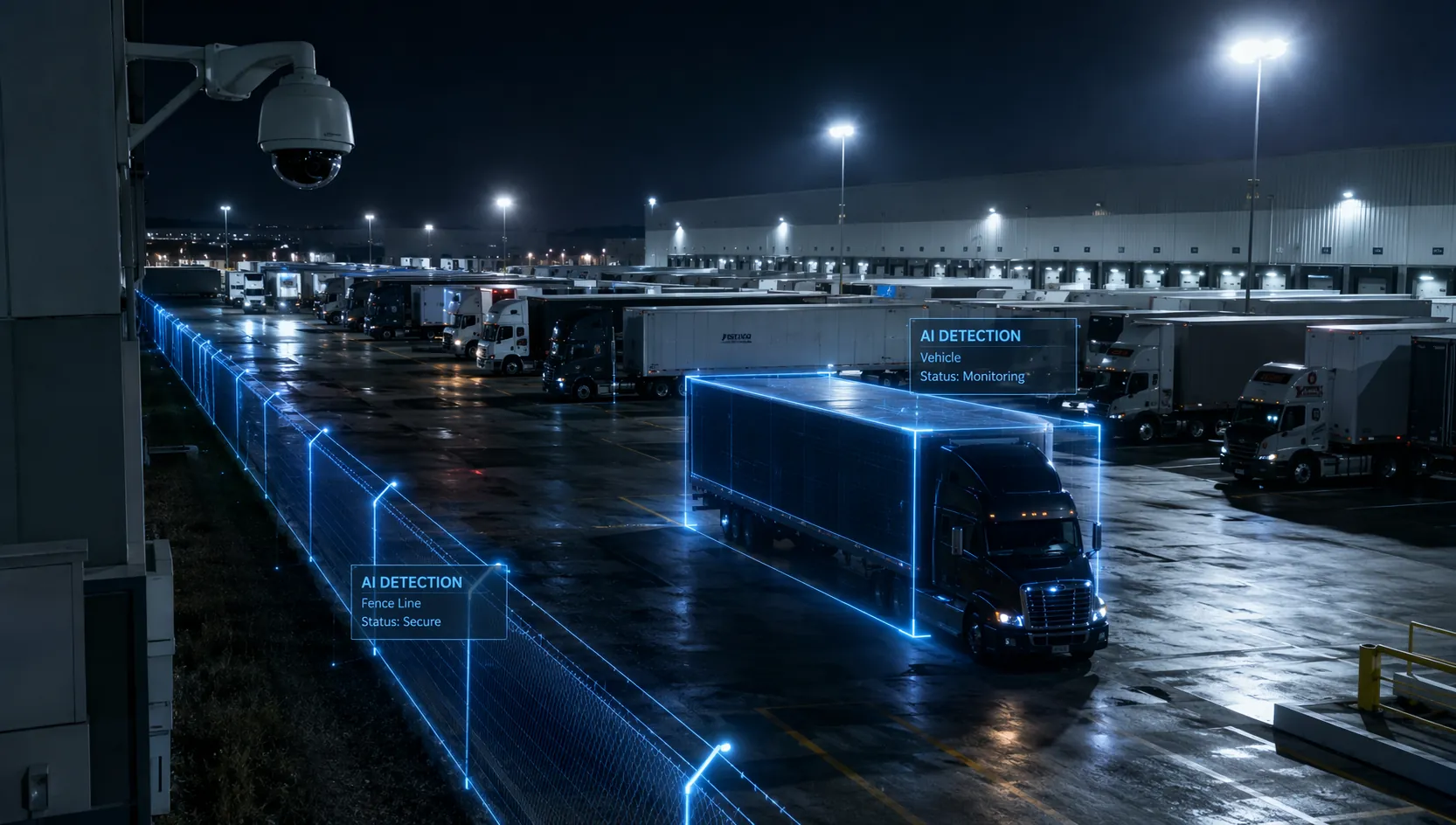
The strongest systems are not trying to make a security director watch more video. They are trying to turn the video already being captured at gates, docks, fence lines, warehouse aisles, and staging lanes into operating signals: a person crossing a perimeter after hours, a truck entering a controlled lane, a trailer door opened outside the expected handoff, a worker lingering where no work order explains the movement, or a smoke condition that needs escalation before the incident spreads.
From CCTV Evidence to Live Security Work
Traditional CCTV makes sense when the question is, “What happened?” Supply chain security increasingly needs the earlier question: “What is happening right now, and who needs to act?” AI video analysis changes the workflow by applying computer vision and machine learning to live camera feeds, then classifying activity that would otherwise sit unnoticed until someone has time to review footage.
That does not make every alert useful. Distribution yards are noisy places. Rain, headlights, blowing trash, animals, shadows, drivers cutting across lanes, and forklifts moving between doors can all look important to a basic motion sensor. The operational value comes from reducing that noise enough that a person can trust the queue. Hanwha Vision describes AI surveillance use cases that distinguish people, vehicles, and objects while supporting faster searches and event-based monitoring in logistics environments.[3] Scylla similarly frames AI warehouse surveillance around intrusion detection, access control, anomaly recognition, and real-time alerts rather than continuous human viewing.[4]
| Supply chain zone | What AI video analysis watches for | Why it changes the response |
|---|---|---|
| Perimeter fence and yard boundary | After-hours crossing, climbing, loitering, vehicle approach | Security can intervene while the person is still outside or near the fence line |
| Gate and guard shack | License plate match, vehicle class, face or badge mismatch where permitted | Access exceptions can be reviewed before the truck reaches the dock |
| Trailer rows and drop lots | Door opening, unexpected movement, person near staged cargo | Remote guards can verify the scene and escalate before a trailer leaves |
| Loading docks | Unusual handoff, person in restricted area, after-hours activity | Operations and security can connect video evidence to shipment events |
| Warehouse aisles | Unsafe movement, PPE issue, smoke, fire, restricted-zone entry | The same camera network can support security and safety monitoring |
The table looks neat. The real deployment rarely is. A facility may have old cameras pointed too high, blind spots between trailers, poor night lighting, no clean connection between the gate log and the video system, and a monitoring team that already ignores half the alarms because the old motion rules cried wolf for years. AI video analysis earns its budget only if it improves that working environment, not if it adds another wall of dashboards.
Where the System Actually Acts
Perimeter intrusion is the most direct use case because it has a simple security question: is someone or something crossing into a controlled area when they should not be there? AI models can classify a human, vehicle, or object and suppress some environmental false alarms that would otherwise waste monitoring time. TRASSIR describes AI-powered perimeter and access control for cargo theft prevention, including person and vehicle detection, license plate recognition, and automated alerts around restricted zones.[5]
In a yard, the difference between motion detection and useful detection is not academic. A camera that alerts on every headlight sweep will be muted. A system that identifies a person moving along a fence line at 2 a.m., tracks the event across cameras, and sends a verified clip to a remote guard has a chance to change the outcome. The important step is not that the algorithm “saw” something; it is that the event reached someone empowered to warn, dispatch, lock down, or call law enforcement.
Access control is a second layer, especially where a logistics site has regular carriers, temporary drivers, contractors, and visitors. License plate recognition can compare an arriving truck against expected appointments. Facial recognition or badge-related video workflows may be used in some environments, though workplace surveillance and biometric rules vary by jurisdiction and should be reviewed before deployment. The practical goal is to catch the mismatch: the right trailer with the wrong tractor, a known plate at the wrong hour, a person tailgating through a restricted door, or a driver bypassing the expected lane.
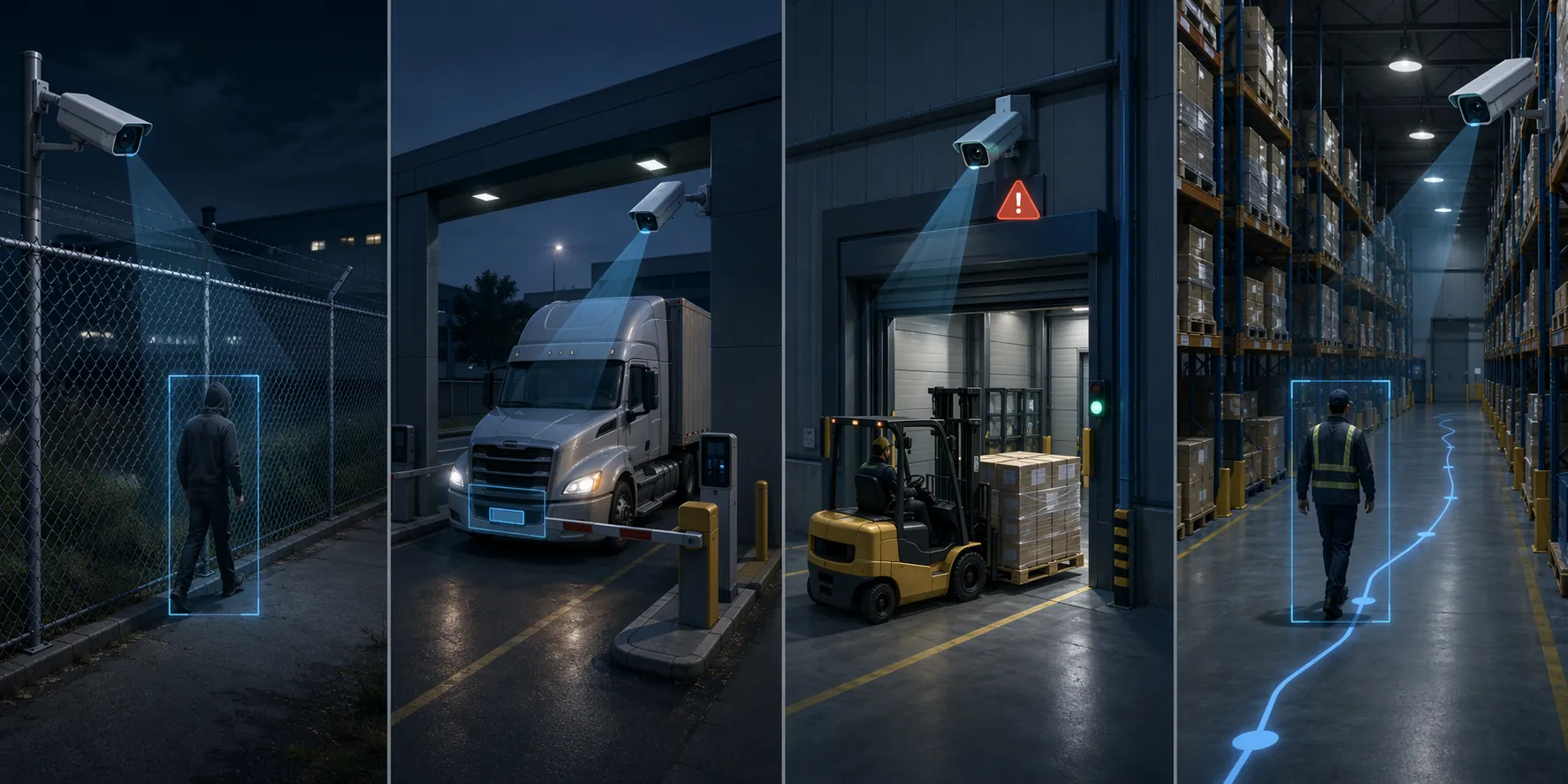
Behavior anomaly detection is more difficult to judge because “unusual” depends on the site. Loitering near a trailer row may be normal during a shift change and serious after the yard closes. A person walking against the expected flow may be a supervisor, a temp worker, or an intruder. This is where buyers should press vendors for configuration detail: which behaviors are pre-trained, which are rules the site must define, how the system learns normal patterns, and how exceptions are reviewed before they become nuisance alarms.
Remote guarding is where many of the pieces come together. Instead of staffing one guard to stare at a grid of feeds, AI pre-filters events and sends likely incidents to a remote operator. The operator verifies the clip, uses live audio or voice-down intervention if the site supports it, and escalates only when the situation warrants. For cargo yards, voice-down can matter because it creates contact before theft becomes removal. A loud, specific warning from a live operator is a different control than a camera recording quietly from a pole.
The ROI Case Is Operational, Not Decorative
The most useful ROI claims are not the broad ones about “smarter surveillance.” They are the ones that show which labor step changed, which escalation burden fell, and how quickly a verified incident reached a responder. Cloudastructure publishes logistics-focused outcomes including a 98% deterrence rate, about a 40% guard cost reduction, a shift from one guard per six cameras in traditional monitoring to one guard per 60 cameras with AI pre-filtering, and a 0.023% escalation rate, with AI resolving more than 99.9% of alerts without human intervention.[6]
Those figures are vendor-published operational results, not neutral industry benchmarks. They still help because they expose the business model behind the software. The savings are not magic; they come from changing the monitoring ratio, reducing false escalations, and moving human attention to verified events. A buyer should ask whether the facility’s camera coverage, incident volume, guard contracts, and escalation procedures resemble the conditions behind those results.
Cloudastructure also describes a yard perimeter breach case in which sub-30-second response helped prevent an estimated $27,000 loss.[6] That is the kind of example that should be read carefully. It does not prove every yard will avoid losses of that size, and it does not cover theft methods outside camera view. It does show the control sequence buyers should look for: detection, verification, intervention, escalation, and evidence capture while the event is still active.
A realistic ROI model for a distribution site should separate at least four buckets: avoided cargo loss, reduced guard or monitoring labor, faster investigation, and safety or compliance value. Avoided loss is the hardest to prove because it depends on what would have happened without intervention. Guard labor is easier to model if the site has current staffing costs and alert volumes. Investigation time can be measured by how long it takes to find the relevant clip, identify the vehicle or person, and package evidence for a claim, carrier dispute, or law enforcement report.
- Ask vendors to separate detection accuracy from deterrence claims; seeing an event and preventing a loss are not the same outcome.
- Compare monitoring ratios against the site’s actual camera count, lighting, blind spots, and after-hours risk.
- Require escalation-rate data by event type, not only an aggregate number across all alerts.
- Test response time from camera event to human action, not from alert generation to dashboard display.
- Confirm who owns evidence retention, export, chain of custody, and incident documentation.
Safety Expands the Business Case, With Limits
Security usually starts the conversation, but safety often strengthens the business case. OSHA figures cited by vendors put forklift-related harm at 85 fatalities and 34,900 injuries annually, while NFPA figures cited in the same materials point to 1,210 annual warehouse fires causing $155 million in average losses.[3][4] Cameras that already cover dock doors, aisles, charging areas, and staging zones may also detect PPE non-compliance, unsafe forklift movement, smoke, flame, or thermal anomalies where the right sensors are installed.
That does not mean every safety claim belongs in the same ROI column as cargo theft prevention. The available evidence is stronger for use-case capability than for independently measured safety outcomes at deployed logistics sites. A buyer can still evaluate safety monitoring as part of the investment, but the proof should be local: incident history, near-miss reporting, EHS review requirements, union or workforce consultation where applicable, and the process for correcting behavior without turning the system into a blunt workplace surveillance tool.
What AI Video Cannot See
Some supply chain losses happen in front of a camera. Others do not. Strategic cargo theft, documentation fraud, identity schemes, fictitious pickups, insider coordination, and handoff manipulation may leave video traces, but the decisive signal may sit in a transportation management system, bill of lading, broker communication, gate record, GPS feed, or access log. A camera can show who entered a lane; it may not know whether the pickup authority was fraudulent.
That is why the broader $35 billion annual supply chain loss figure attributed to Homeland Security Investigations should be handled carefully. It covers a wider loss environment than the portion addressable by video analysis alone.[7] The number is useful as a directional reminder that cargo theft is not a nuisance category. It is not a reason to assume cameras can solve every loss mechanism.
The same caution applies to market forecasts. AI video analytics is a real and growing software category, and Mordor Intelligence publishes market forecast work on it.[8] But a market-size chart does not answer whether a specific warehouse, cross-dock, rail-adjacent yard, or cold-chain facility should buy. For that, the buyer needs a site map, incident history, response model, integration plan, and a pilot that measures the right things.
The Vendor Landscape Is Real, but the Shortlist Should Start With Workflow
The market is no longer hypothetical. Hanwha Vision, Cloudastructure, Scylla, TRASSIR, Spot AI, Honeywell, Verkada, Milestone, and other providers now package video analytics, camera hardware, video management, remote monitoring, safety detection, or industrial security features for logistics and warehouse settings. The useful distinction is not which vendor has the cleanest demo clip. It is which one can support the buyer’s actual operating pattern.
A high-throughput cross-dock may care most about dock-door exceptions, visitor control, and shipment handoff evidence. A drop yard with known perimeter exposure may prioritize thermal cameras, fence-line analytics, and voice-down remote guarding. A food distributor may need stronger safety monitoring and cold-chain access discipline. A 3PL with multiple leased sites may care about deployment speed and centralized visibility across inconsistent camera estates.
Edge and hybrid deployment also matter. Hanwha’s materials describe edge AI use cases that process video closer to the camera, and sub-100-millisecond inference latency is one capability associated with edge or hybrid architectures.[3] Low latency is useful only if the rest of the chain keeps pace. A fast model feeding a slow escalation process is still a slow security system.
The Checks That Decide Whether the Investment Works
The first check is camera reality. Existing CCTV can often be reused, but “we have cameras” is not the same as “we have usable views.” Analytics need the right angle, resolution, lighting, field of view, and coverage continuity. A camera mounted for general awareness may be poor at reading plates. A camera that sees a trailer row may miss the fence gap behind it. A pilot should include the worst lighting, worst weather, busiest shift, and quietest after-hours window, not only a clean daytime test.
The second check is alert ownership. Every event type needs a named destination. A perimeter breach may go to a remote guard first, then local security, then law enforcement. A license plate mismatch may go to the gate team and transportation office. A dock anomaly may go to operations. A PPE exception may go to EHS or a supervisor. If nobody owns an alert, the system has only created a better-looking backlog.
The third check is integration. AI video analysis becomes more valuable when it can connect camera events to WMS records, access control, yard management, appointment scheduling, visitor management, incident management, and carrier documentation. Integration also introduces complexity: identity matching, retention rules, user permissions, API reliability, and exception handling when one system has stale or incomplete data.
The fourth check is privacy and labor compliance. Biometric identification, employee monitoring, audio intervention, retention of worker footage, and cross-border data access can trigger different obligations depending on jurisdiction. The EU AI Act and local workplace surveillance laws should be reviewed with legal and HR teams before the deployment design is locked. In the United States, requirements can still vary by state, contract, workforce setting, and customer obligations.
The fifth check is proof. A sensible pilot does not need to prove every promised use case at once. It should measure a few events that matter: false alarms per camera per night, verified incidents, response time from event to action, avoided dispatches, guard workload, investigation time, and evidence quality. The buyer should also record what the system missed, because missed events reveal camera placement, model limits, workflow gaps, or unrealistic expectations.
The Buyer’s Decision Point
AI video analysis is deployable now, and the theft environment makes it increasingly defensible as a mainstream supply chain security investment. The reason is not that “AI” upgrades a camera. The reason is that passive recording is poorly matched to distributed, fast-moving cargo theft exposure, while live detection, verification, voice-down intervention, and structured escalation can reduce the time between risk and response.
The case still depends on discipline. Vendor claims need to be verified against the facility’s own camera views, incident history, staffing model, and risk profile. Privacy and workplace surveillance obligations need review before biometric or employee-monitoring features go live. Integrations with WMS, access control, yard systems, and incident workflows need to be tested before the platform becomes another console that nobody checks at 2 a.m. The investment makes sense when it turns video into action inside the operation that already has to respond.
References
- 2025 Theft Trends, CargoNet
- Cargo Theft Surges 13% Year-Over-Year in Second Quarter 2025 as Organized Crime Groups Target High-Value Commodities, Verisk
- Hanwha Vision news article, Hanwha Vision
- How AI-Powered Video Surveillance Levels Up Warehouse Security, Scylla
- Preventing Cargo Theft with AI-Powered Perimeter and Access Control, TRASSIR
- Trucking & Logistics AI Surveillance, Cloudastructure
- The Supply Side: Cargo theft to rise 25% in 2025, $35 billion lost in supply chain, Talk Business & Politics
- Global AI Video Analytics Market, Mordor Intelligence
Comments
Join the discussion with an anonymous comment.