
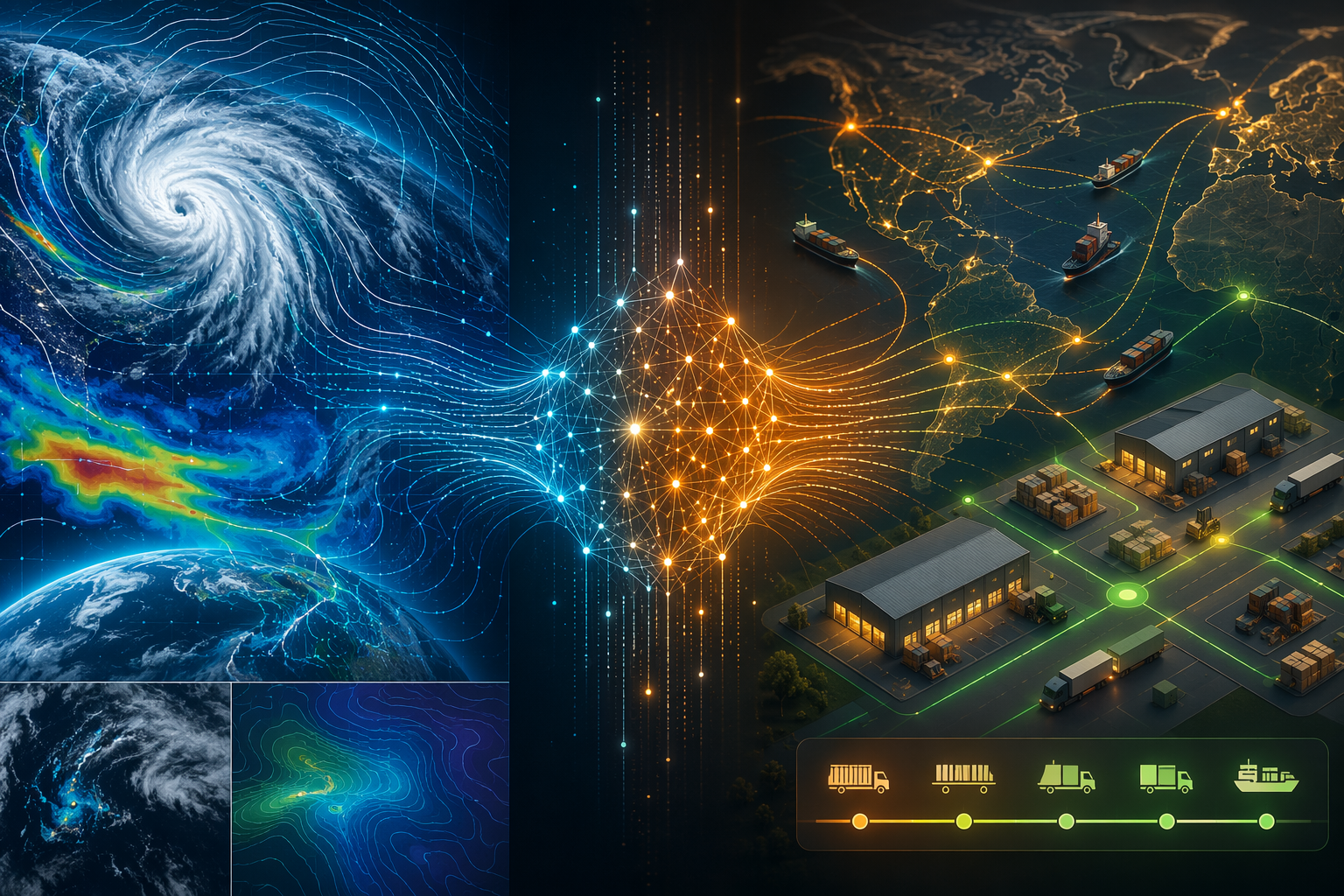
A hurricane forecast tells a planner that a storm may make landfall. AI supply chain weather forecasting tries to answer the next questions: which warehouses sit inside the disruption window, which lanes are likely to lose service, which SKUs will see demand move early, how long the surge may last, and whether inventory should move before order cutoff. That is a different job from being better at describing the atmosphere.
The useful version is not an isolated weather dashboard. It is a conversion layer between external weather signals and operating decisions. A forecast that arrives after carrier capacity is gone, supplier cutoff has passed, or labor has already been scheduled may still be meteorologically impressive. It is just late for supply chain work.
The Use Case Starts Where The Weather Forecast Ends
In a planning room, weather risk becomes real only when it changes a decision. The difference is visible in the unit of output. A conventional forecast may say that heavy rain is likely across a region. A supply chain weather model needs to say whether that rain threatens a harvest window, a refrigerated route, a supplier location, a construction-demand spike, a port dwell-time risk, or a retail replenishment cycle.
That distinction matters because the same weather event can create opposite actions in different parts of a network. A storm can depress store traffic in one category while pulling forward emergency repair demand in another. A heat wave can increase beverage demand, stress cold-chain capacity, and raise labor safety constraints at the same time. A wet harvest condition can look like a production-quality risk, not a logistics delay.
The practical question is not whether AI can forecast weather in the abstract. It is whether the model can convert weather into timing, duration, magnitude, exposed nodes, affected SKUs, route choices, procurement actions, and inventory positions before the relevant cutoff closes.
Why Weather Risk Now Gets Budget Attention
The urgency is not hard to justify. NOAA counted 28 billion-dollar weather and climate disasters in the United States in 2024, with total costs of $92.9 billion; Everstream also rated extreme weather as the highest-severity supply chain risk in 2026, at a 93% threat level in its risk outlook framing.[1]
Interos.ai, citing NOAA-linked analysis, put 94.5 million businesses at risk from extreme weather, describing that as a 48% year-over-year increase.[2] The Weather Company and Magid reported in 2024 that 90% of executives said weather affects operations, while 92% planned to increase or maintain investment in weather intelligence.[3]
Those numbers justify why the category is getting attention. They do not prove that any one platform works. Extreme-weather exposure is the demand signal for better tools; deployment evidence has to show something narrower and more operational.
How Weather Becomes A Supply Chain Impact Signal
The mechanism begins with weather data, but the value appears only after that data is joined to business context. A supply chain model may ingest atmospheric forecasts, satellite observations, radar, historical weather, supplier locations, warehouse nodes, transport lanes, lead times, SKU-level demand patterns, inventory positions, and order cutoff rules. The model then scores not just whether a location will see a weather event, but what that event is likely to do to a specific operating process.
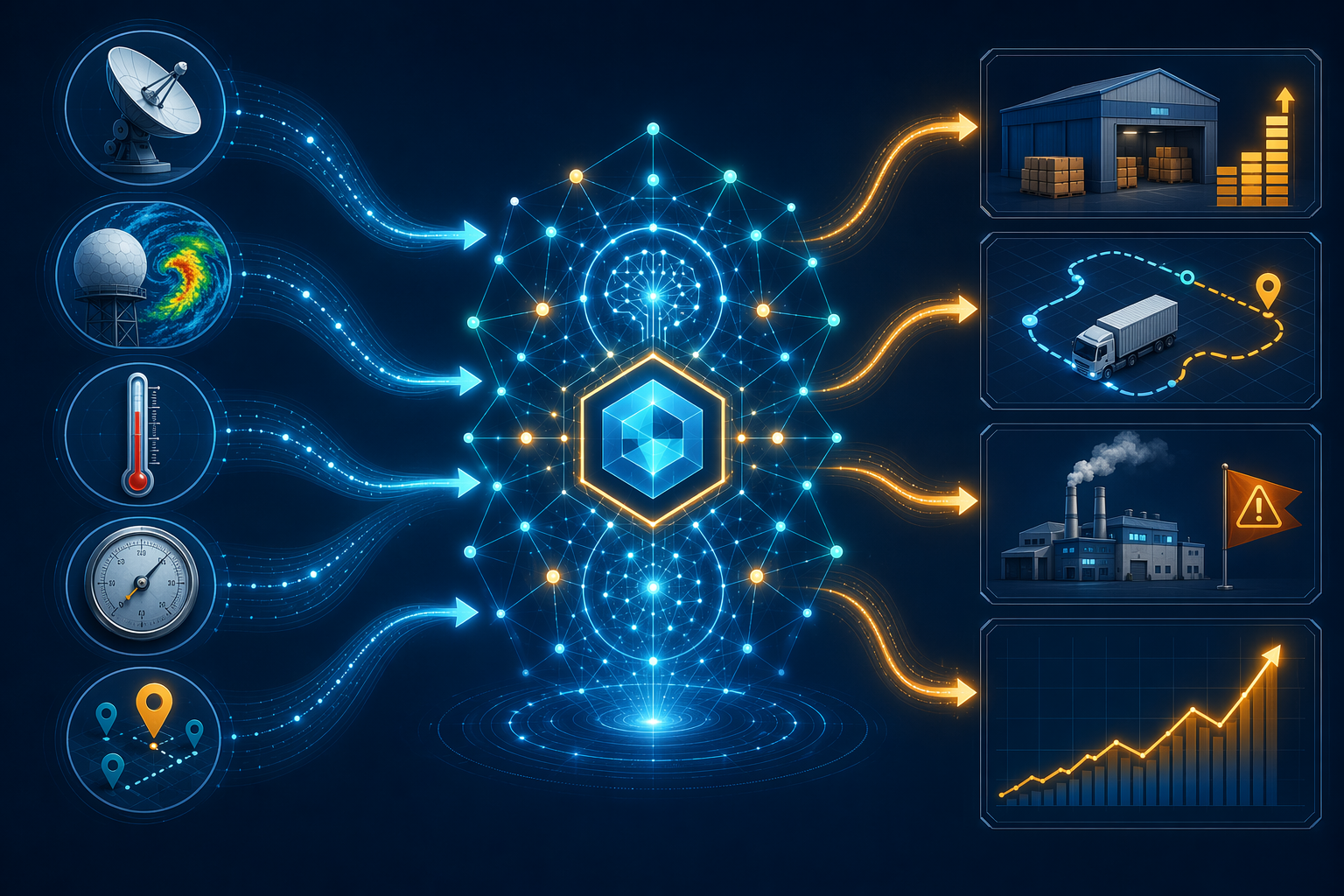
ClimateAi describes its FICE, or Fully Intelligent Climate Engine, as converting raw weather data into supply-chain-impact predictions, including the timing, duration, and magnitude of demand spikes and supply disruptions rather than only the likelihood of weather events.[4] That is the right center of gravity for this use case. The model's output needs to land in the planner's verbs: expedite, pre-position, defer, source alternate supply, move demand, reroute, increase safety stock, or do nothing.
The conversion usually has several layers:
- Weather signal: storm track, rainfall probability, heat intensity, wind, temperature, flood exposure, drought, or wet-harvest conditions.
- Network exposure: plants, suppliers, ports, DCs, stores, customer zones, or transport lanes inside the affected geography.
- Operational sensitivity: SKUs that sell differently, degrade, require temperature control, rely on exposed suppliers, or have fragile replenishment windows.
- Decision window: order cutoff, carrier tender time, labor schedule, supplier lead time, production freeze, or inventory transfer deadline.
- Action threshold: the point where expected impact justifies the cost of inventory, rerouting, overtime, alternate sourcing, or customer allocation.
This is where many weather-tech claims become too thin. A better rainfall forecast is useful, but the planner still has to know whether the affected SKU has substitute inventory nearby, whether the supplier is single-sourced, whether the route can be shifted without violating service commitments, and whether demand is likely to arrive before or after the storm. Without that context, the alert remains outside the operating system.
Different Vendors Emphasize Different Parts Of The Stack
IBM's Global High-Resolution Atmospheric Forecasting System, or GRAF, is described as a global 3-kilometer-resolution model updated hourly, including areas where traditional models do not run.[5] Spire's AI-WX and AI-S2S offerings emphasize proprietary satellite data and machine-learning models for extended-range weather prediction.[6] Everstream positions its NOAA-informed platform around supply chain risk intelligence, using weather models inside a broader disruption-monitoring workflow.[1]
| Vendor or platform | Primary role in the weather-to-impact chain | Where it is strongest |
|---|---|---|
| ClimateAi FICE | Converts weather and climate signals into supply-chain-impact predictions | Demand-spike windows, disruption timing, duration, and magnitude |
| IBM / The Weather Company GRAF | High-resolution global atmospheric forecasting | Granular weather visibility, including regions with weaker traditional model coverage |
| Spire AI-WX / AI-S2S | Satellite-informed AI weather prediction | Extended-range modeling supported by proprietary satellite observations |
| Everstream Analytics | Weather-informed supply chain risk intelligence | Mapping disruption risk to logistics, facilities, and network exposure |
| interos.ai | Multi-tier supplier and operational risk monitoring | Identifying exposed suppliers and triggering continuity actions |
| RELEX Solutions, Ambee ClimaChain | Weather-sensitive planning and climate-risk intelligence | Retail demand planning or environmental-risk use cases, depending on deployment |
The table is not a ranking. It is a reminder that buyers are not always shopping for the same capability. A logistics team may care most about lane-level weather and arrival risk. A retail replenishment team may care about category demand response. A procurement team may care about supplier exposure and lead-time protection. A platform can be strong in one layer and still require integration work before it changes planning behavior.
Deployment Evidence: Four Value Patterns, Not One Generic ROI Story
The public evidence base is still heavily vendor-reported. That does not make it useless; it does mean the claims should be read as deployment examples, not universal benchmarks. The strongest cases are useful because they show the decision that changed, not merely the model that ran.
Sales Capture: Roofing Demand Before Hurricane Ian
ClimateAi's roofing manufacturer case is the cleanest illustration of weather intelligence becoming a commercial action. The company reported $15 million in additional sales after pre-positioning roofing inventory ahead of Hurricane Ian.[7] The important part is not just that a hurricane was forecast. Roofing demand after a damaging storm is not mysterious. The value came from anticipating the demand window early enough to move product into position before competitors, logistics constraints, or cutoff times limited the response.
For a planner, this is the kind of case that matters because it ties the forecast to an action and then to a measurable outcome. The causal chain is still vendor-reported, but it is operationally plausible: identify storm impact area, estimate demand surge, move inventory, capture orders. That is much stronger evidence than a claim that the model predicted the storm track with higher atmospheric accuracy.
Avoided Loss: Wet Harvest Conditions At Advanta Seeds
ClimateAi also describes an Advanta Seeds deployment in which projected wet harvest conditions helped the company avoid hundreds of thousands to millions in losses from seed-quality damage.[8] This is a different value pattern. It is not about selling more into a weather-driven demand spike. It is about protecting product quality by reading weather risk against a biological and operational window.
That distinction should shape evaluation. A seed business does not need the same alert structure as a roofing-materials producer. It needs early warning tied to harvest timing, quality thresholds, grower coordination, and downstream availability. A generic severe-weather alert would miss the actual decision.
Supplier Continuity: Cooper University Health Care And Hurricane Idalia
Interos.ai's Cooper University Health Care example is more modest, and that is part of why it is credible. During Hurricane Idalia, the system identified three suppliers in the storm's path, enabling the health system to place orders before supplier cutoff.[2] There is no claim that AI removed the disruption or optimized the entire health care supply chain. The tool surfaced exposed suppliers early enough for a procurement action.
That is often the realistic win. In health care supply continuity, the value may be knowing which suppliers deserve a phone call before 6 a.m., which purchase orders should move before cutoff, and which categories need substitution review. The model does not need to be omniscient to be useful; it has to shorten the time between external threat and accountable action.
Routing Protection: Refrigerated Freight At Unilever
Everstream describes a Unilever use case involving optimized refrigerated truck routing for temperature-sensitive products based on weather intelligence.[9] This is not the same as demand forecasting or supplier-risk monitoring. The operating question is whether weather along a route threatens temperature control, service, spoilage, or cost enough to justify a different lane or timing decision.
Cold-chain weather intelligence is valuable when it reaches dispatch, transportation procurement, and exception management. If it remains a weather map reviewed by a risk team after the load is already tendered, the planning value has largely escaped.
What To Measure Before Calling It A Forecasting Win
Weather intelligence can improve revenue, cost, continuity, and service, but those are different scorecards. The Weather Company and Magid reported a 5% to 10% revenue-increase claim from effective weather intelligence, but that should be treated as directional unless the buyer can connect it to its own category, geography, decision cadence, and margin structure.[3]
A better internal business case usually starts with narrower measures:
- Demand response: incremental sales captured, stockout reduction, lost-sales avoidance, or promotion changes during weather-sensitive windows.
- Inventory action: days of inventory pulled forward, emergency transfers avoided, safety stock targeted to exposed nodes, or write-off risk reduced.
- Transportation outcome: reroutes executed before tender cutoff, temperature excursions avoided, late loads reduced, or premium freight contained.
- Procurement continuity: exposed suppliers identified, orders placed before cutoff, alternate suppliers activated, or single-source exposure escalated.
- Decision latency: time from weather signal to planner action, especially during overnight or weekend disruption windows.
This is also where secondary ROI figures need caution. Broad claims about AI lowering transportation cost or reducing supply chain errors can be useful for executive orientation, but they should not carry the business case unless the original study, scope, and category are clear. Weather-sensitive grocery demand during heat waves, refrigerated routing, seed harvest protection, and hurricane-driven roofing demand are not interchangeable operating environments.
The Integration Problem Is Usually Bigger Than The Model Demo
Most failed deployments will not fail because the weather model cannot draw a storm. They will fail because the organization cannot connect the alert to the data and authority needed to act. The platform may know a supplier is in the path of a hurricane, but the procurement team still needs open PO data, material criticality, approved alternates, cutoff rules, and a person authorized to order early.
The same issue appears in logistics. A lane-risk alert is useful only if it can reach transportation management early enough to retender, change mode, adjust appointment times, or protect a temperature-controlled shipment. If the TMS, ERP, control tower, and risk platform each hold a different version of facility, carrier, SKU, and inventory data, the model's confidence score becomes one more item in an exception queue.
Before procurement, planning, or logistics teams shortlist vendors, they should ask a simple operational question: what decision will this alert change, and which system of record must it touch for that change to happen? For a deeper deployment view, the implementation companion on how to operationalize AI weather for supply chain risk is the more useful next stop.
Forecasting Limits Still Matter
AI does not repeal chaotic weather dynamics. Atmospheric systems have fundamental predictability limits, and longer-range forecasts become less certain regardless of model sophistication. Machine learning can improve pattern recognition, resolution, update speed, data assimilation, and impact translation. It cannot turn a months-ahead operational forecast into certainty.
That boundary affects how the tool should be used. Near-term weather intelligence can support concrete actions such as pre-positioning inventory, ordering before supplier cutoff, rerouting refrigerated freight, or staffing a warehouse surge. Longer-range signals are better suited for scenario planning, supplier-risk review, seasonal inventory posture, and capacity discussions, where the organization can act on probabilities rather than precise event timing.
The practical risk is over-automation. If a platform turns uncertain weather into a single recommended action without showing exposed nodes, confidence, time window, and operational assumptions, planners will either distrust it or follow it blindly. Neither outcome is attractive when the consequence is excess inventory, missed sales, spoiled product, or a supplier escalation that should have happened yesterday.
Where AI Supply Chain Weather Forecasting Is Credible
The credible claim is specific: AI weather forecasting is becoming a usable supply chain risk capability when it translates weather into impact-specific predictions and connects those predictions to planning, logistics, procurement, and inventory decisions. The strongest examples show a changed action before a cutoff window: inventory moved before hurricane demand, harvest decisions adjusted before wet conditions damaged quality, orders placed before suppliers were constrained, and refrigerated routes optimized before temperature risk hit the load.
The weak claim is the one buyers should reject: that AI makes weather risk broadly predictable far into the future or that a vendor case study establishes a universal ROI benchmark. The model matters, but the operating connection matters just as much. A precise alert that cannot reach the right planner, with the right SKU and node context, before the decision window closes is still a stranded insight.
References
- Applying NOAA and AI Weather Forecasting Models to Supply Chains, Everstream Analytics
- Protecting Your Supply Chain from Extreme Weather: Steps to Minimize Risk, interos.ai
- Managing Supply Chain Weather Risks with Predictive Analytics and Real-Time Insights, The Weather Company
- Climate Risk and Supply Chain Risk Mapping, ClimateAi
- Forecasting the Weather with AI: Promise and Limitations, SupplyChainBrain
- AI-WX and AI-S2S Weather Models, Spire Global
- Accurate Hurricane Forecasting Helps Roofing Materials Producer, ClimateAi
- 5 Benefits Weather Intelligence, ClimateAi
- The Impact of Extreme Weather on the Supply Chain, Everstream Analytics
Comments
Join the discussion with an anonymous comment.