
Tornado aftermath does not look like a hurricane aftermath on a supply chain map. A hurricane often gives planners days to stage inventory, adjust ports, and warn customers. A tornado can leave one supplier untouched, cut the access road to the next one, knock out power in a narrow corridor, and make the first reliable damage picture arrive after the customer promise has already failed. That is why AI for supply chain disruption from tornado aftermath has to be judged by a harder standard than generic weather-risk software: does it compress the time between warning, impact, damage assessment, and operational decision?
The useful framework is not “be resilient.” It is predict, respond, recover. Those are three different jobs. Prediction is about facility-level exposure and supplier visibility before the season or before a storm. Response is about classifying disruption signals while roads, power, and communications may be unreliable. Recovery is about rerouting, alternate sourcing, and estimating when damaged capacity can return. The same dashboard should not be assumed to do all three well.
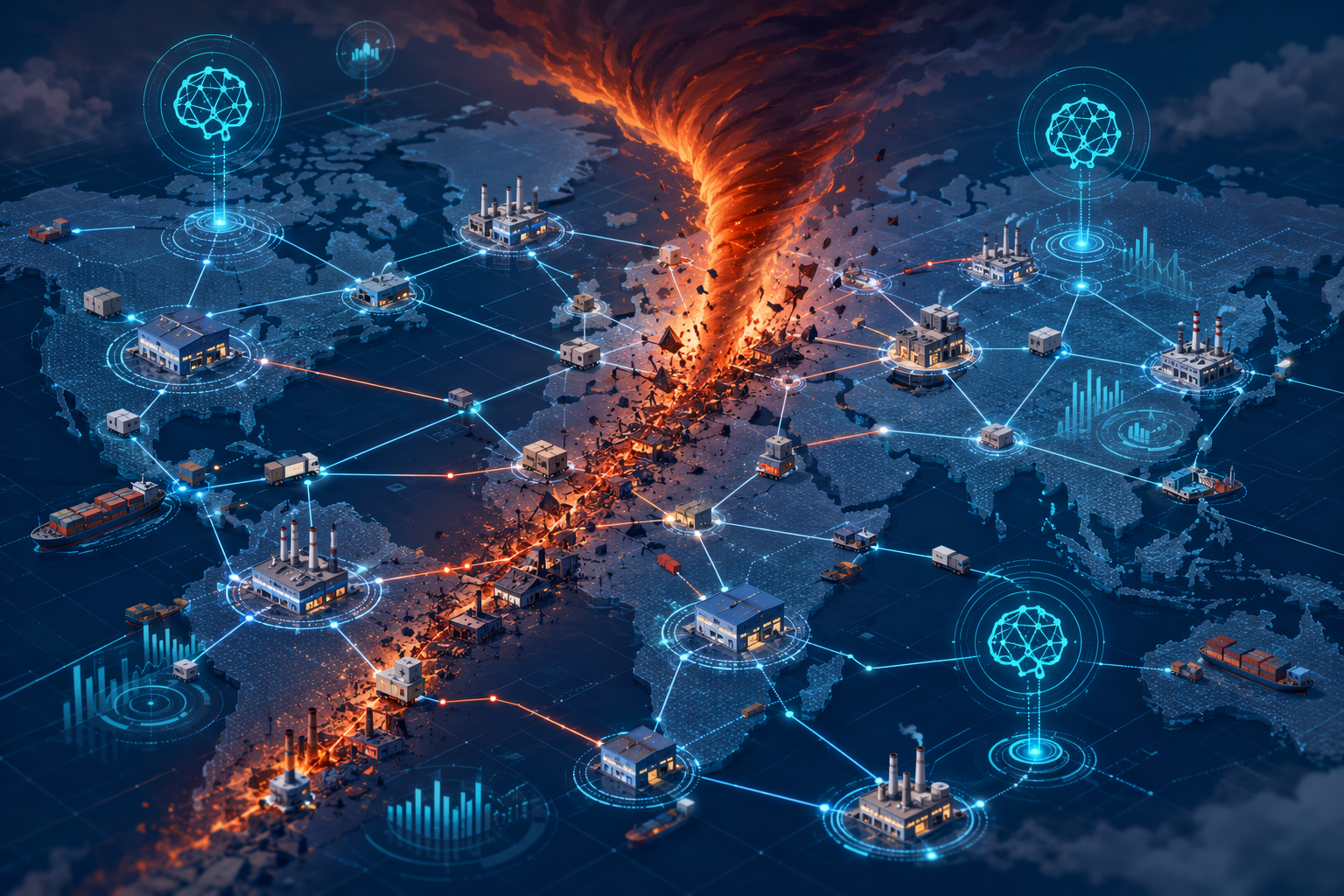
Why Tornadoes Break Generic Extreme-Weather Playbooks
The operational problem starts with time. Tornado warning windows can be sub-hour, which is not enough for the same kind of inventory repositioning or lane redesign that may be possible before slower-moving weather systems. The damage pattern is also concentrated rather than regional in the usual planning sense: a kilometer-wide corridor can decide whether a plant, sub-tier supplier, cross-dock, rail spur, or last-mile route is available while neighboring assets remain normal.
That produces awkward decisions. Procurement may need to know whether a second-tier supplier in the path makes a small molded part. Logistics may need to know whether the safest reroute adds hours or whether the destination has power. Customer teams may need to decide whether to protect a committed order or reallocate scarce inventory. The weather alert itself is only the start of the problem.
Broader weather-intelligence work is still relevant. Everstream describes the use of NOAA and AI weather forecasting models in supply chain applications, but tornado planning needs the forecast connected to facility points, lanes, and supplier dependencies quickly enough to change a decision, not merely decorate a risk map.[1]
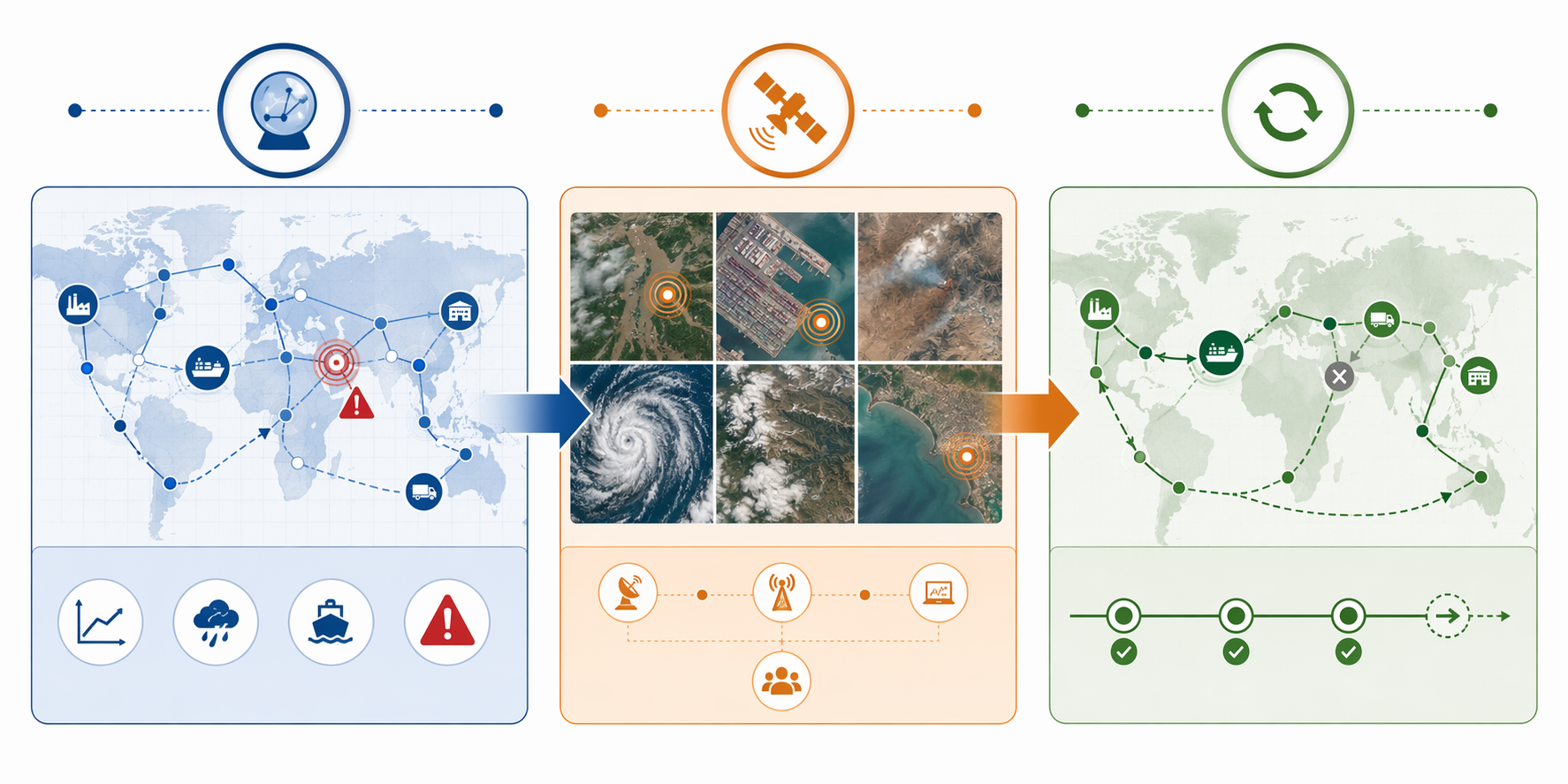
Phase 1: Predict the Exposure Before the Siren
The pre-event AI job is not to “predict the tornado” in a way that replaces meteorology. For a supply chain team, the better job is to predict which operational promises are exposed if a tornado warning becomes a confirmed damage corridor. That starts with supplier and facility mapping at a level that many companies still do not maintain cleanly: owned sites, contract manufacturers, key tier-one suppliers, critical sub-tier nodes, warehouses, transport lanes, and customer-facing commitments.
AI can help by matching supplier addresses, shipment histories, purchase-order dependencies, route data, and weather-risk layers into a facility-level exposure view. The useful output is not a red county on a map. It is a short list of sites and flows that matter: this supplier makes a single-sourced component; this DC supports a committed retail promotion; this lane crosses a likely outage area; this customer order has no substitute inventory nearby.
| Pre-event question | AI-supported output | Operational owner |
|---|---|---|
| Which facilities sit in tornado-prone regions? | Facility-level exposure score tied to supplier, plant, warehouse, and route data | Risk and network design |
| Which supplier dependencies would hurt fastest? | Tier-N dependency map with single-source and constrained-capacity flags | Procurement |
| Which shipments or promises are exposed this week? | Order, lane, and inventory view linked to alert zones | Logistics and customer operations |
| Which recovery options are credible? | Prequalified alternate sources, lanes, and stocking points | Procurement, transportation, and planning |
This phase has a data-plumbing caveat. Enterprise manufacturers and large 3PLs may already have enough master data, shipment telemetry, and supplier-risk information to make the model useful. Many midmarket firms do not. If supplier addresses are stale, if tier-two dependencies live in spreadsheets, or if transport data is visible only after invoice, the AI system will create a polished map with weak operational truth underneath it.
The pre-season standard should be simple: every high-consequence facility needs a current location, ownership, dependency, inventory, power, and lane profile. Without that, the response phase starts by hunting for facts that should already be known.
Phase 2: Respond While the Picture Is Still Incomplete
The during-event phase is where tornado response becomes least forgiving. The team may have weather alerts, carrier messages, utility outage reports, social posts, satellite or aerial imagery, supplier emails, and silence from the one site everyone needs to hear from. The job is to classify what is probably happening fast enough to take a reversible action: hold a shipment, divert a truck, move available inventory, alert a customer, or start alternate sourcing checks.
Two research lines matter here. The first is damage assessment from imagery. Texas A&M researchers developed an AI model intended to produce near-instantaneous tornado damage maps from satellite and aerial imagery, compressing work that currently depends on multi-day National Weather Service ground surveys into hours. The same research is reported as predicting repair costs and recovery timelines, which moves the model from “where was damage?” toward “what does the damage mean for operations?”[2]
That distinction is important. A damage polygon is useful, but a supply chain team needs to know whether the affected asset is a plant, a supplier, a road approach, a substation, or an empty field. The value appears when imagery-based damage maps are joined to the facility and lane graph built in Phase 1. Then the response room can stop arguing over whether an alert is relevant and start deciding which promise, route, or supplier constraint has changed.
The second research line is agentic disruption monitoring. A Cambridge University arXiv paper proposed a multi-agent AI framework for supply chain disruption monitoring and evaluated it across 30 synthesized disruption scenarios involving three automotive manufacturers. The framework achieved F1 scores from 0.962 to 0.991, with a mean response time of 3.83 minutes at $0.08 per analysis; the paper contrasts this with an industry average of about five days for human-led response.[3]
Those numbers are operationally interesting because minutes matter in a tornado scenario. They do not prove live tornado readiness. The scenarios were synthesized, not real tornado events, and automotive network structures are not the same as food, medical, retail, building products, or parcel networks. Still, the architecture points in the right direction: separate agents can ingest signals, classify scenario type, connect the event to exposed supply chain nodes, and recommend next actions for human review.
What a during-event AI workflow should actually do
- Detect: pull severe-weather alerts, geospatial impact data, outage information, route disruptions, supplier messages, and external news into one event record.
- Match: connect the event footprint to owned sites, suppliers, shipments, inventory, and customer commitments.
- Classify: separate likely facility damage, transport blockage, power outage, communications failure, labor-access issue, and demand-side disruption.
- Prioritize: rank decisions by consequence and time sensitivity, not by which alert arrived first.
- Escalate: route recommended actions to the accountable owner with the evidence trail attached.
This is also where human control matters. In a tornado response, a false “all clear” can release freight into a blocked area; a false “site down” can trigger unnecessary expediting and customer allocation. AI should narrow the decision set and preserve evidence provenance. It should not hide uncertainty behind a single confidence color.
Vendor-reported evidence suggests that these ideas are moving into production-like workflows, though the claims should be read as vendor-attributed rather than independently verified. TraxTech reports that AI-powered supply chain risk monitoring prevented more than 75 factory stoppages in a single year across a leading manufacturer’s network. The same source describes detecting Hurricane Helene’s impact on Auria Solutions’ water-jet cutting equipment vulnerability before landfall, enabling pre-positioned recovery actions.[4]
That case is not tornado-specific, and a hurricane gives more time than a tornado. Its relevance is narrower: risk monitoring can connect an external weather threat to a specific production dependency and trigger remedial work before the plant is already stopped. For tornadoes, the same logic has to run faster and tolerate a dirtier information stream.
Phase 3: Recover When the Damage Is Local but the Consequences Are Networked
Post-event recovery starts with a deceptively hard question: what is actually unavailable? A supplier may have an intact building but no power. A warehouse may have power but no safe road access. A carrier may be available but unable to reach drivers. A customer order may be physically possible to ship but no longer economically sensible if the route detour breaks the service promise.
This is where the Texas A&M work becomes more than a damage-mapping story. If imagery-based assessment can estimate repair cost and recovery timeline, a supply chain team can begin sequencing decisions around expected capacity return rather than waiting for every field report. That does not replace site confirmation. It gives the recovery room a starting estimate while maintenance, utility, insurance, and local emergency constraints are still being sorted out.[2]
AI-supported recovery then separates into three practical workstreams.
- Rerouting: dynamic routing models evaluate open lanes, carrier capacity, detour cost, delivery windows, fuel constraints, and customer priority.
- Alternate sourcing: supplier-risk models identify qualified substitutes, capacity limits, quality requirements, contract constraints, and likely onboarding time.
- Recovery-timeline prediction: damage, outage, labor, parts, and historical repair patterns feed estimates for when a facility or lane can support normal volume again.
The hard part is not generating options. It is rejecting options that look good in isolation and fail in combination. A substitute supplier may be qualified but dependent on the same damaged corridor. A reroute may avoid the tornado path but overload a carrier already assigned to recovery freight. A plant may restart before its inbound packaging supplier does. Recovery AI earns its place when it sees those collisions before the daily standup discovers them.
There is also a governance issue. Procurement owns supplier substitution. Logistics owns routing. Operations owns production restart. Finance may own expediting thresholds. Customer teams own promise changes. If the AI system recommends a recovery action without identifying the accountable owner and the trade-off, it has not reduced ambiguity enough.
What the Evidence Supports—and What It Does Not
The evidence base is promising, but uneven. Texas A&M’s model is reported research, not confirmed commercial integration into supply chain control towers. The Cambridge framework is a controlled experimental design using synthesized scenarios, not a field validation across real tornado disruptions. TraxTech’s stoppage-prevention data is vendor-published case evidence, useful but not independently verified from the material available.[2][3][4]
That does not make the tools speculative in the same way. Imagery-based damage detection addresses a known bottleneck: waiting days for ground assessment when operational decisions are due in hours. Agentic monitoring addresses another bottleneck: humans manually reconciling fragmented signals across weather, supplier, logistics, and news sources. Vendor cases show that external-risk monitoring has entered operational workflows. Those are different evidence categories and should be bought, piloted, and governed differently.
The market pressure is real enough to justify the work. Interos, using NOAA data, reported 30.8 million more businesses at risk from extreme weather in 2025 than in 2024, a 48% year-over-year increase, and cited $182 billion in financial impact in 2024.[5] Resilinc reported that supply chain disruption notifications were up 38% year over year in 2025 and that extreme weather events were up 33%.[6] Those figures are broader than tornadoes, but they explain why executive teams are asking for better weather-linked supply chain decisions.
For tornadoes, the buying question should stay narrower: can the tool shorten the time from alert to exposed-node identification, from impact to credible damage picture, and from damage picture to executable reroute or sourcing decision? If it cannot answer those three questions separately, it is probably selling general resilience language into a tornado-specific failure mode.
A Practical Operating Model for Tornado AI
The operating model should assign each phase a different evidence standard and owner. Before the season, risk and procurement teams need completeness: enough supplier and facility data for exposure scoring to mean something. During the event, logistics and resilience teams need speed with provenance: fast classification, visible uncertainty, and escalation paths. After the event, operations, procurement, and customer teams need feasible options: reroutes, substitutions, and recovery estimates that account for constraints outside the damaged site.
| Phase | Main AI role | Decision it should improve | Evidence standard |
|---|---|---|---|
| Predict | Map exposure across facilities, suppliers, lanes, and inventory | Which nodes and promises need preplanned contingencies | Data completeness and facility-level accuracy |
| Respond | Fuse alerts, imagery, outage, supplier, and logistics signals | Which actions must be taken while the situation is uncertain | Speed, classification quality, and visible provenance |
| Recover | Estimate damage consequences and evaluate options | Which reroutes, suppliers, and restart plans are feasible | Operational validity and accountable ownership |
Midmarket firms do not need to imitate an enterprise control tower on day one. They do need to know where the limits are. A company without tier-N supplier visibility should not expect AI to discover critical dependencies during a tornado warning. A company without route-level data should not expect dynamic rerouting to be more than a carrier phone tree with a nicer interface. A company without an escalation model should not expect agentic monitoring to decide who can approve a customer allocation.
Tornado disruption is a distinct operational problem because it compresses warning, impact, assessment, and recovery into a timeline that punishes generic playbooks. The strongest AI value is not a universal resilience promise. It is the disciplined use of different tools for different jobs: predict the exposed nodes before the storm, respond to fragmented signals while the picture is incomplete, and recover through options that are constrained by real damage, real capacity, and real ownership.
References
- Applying NOAA and AI Weather Forecasting Models to Supply Chains — Everstream Analytics
- With AI, post-tornado assessments could be 'near-instantaneous' — SmartCitiesDive, May 2025
- Automating Supply Chain Disruption Monitoring via an Agentic AI Approach — arXiv, 2026
- AI-Powered Supply Chain Risk Management Prevents 75 Factory Stoppages — TraxTech
- Protecting Your Supply Chain from Extreme Weather — interos.ai
- Supply Chain Disruption Is Accelerating into 2026 — Resilinc
Comments
Join the discussion with an anonymous comment.