
A tornado does not have to shut down a whole region to break a logistics plan. It only has to cut the wrong road, damage the wrong distribution center, or knock out the supplier that everyone assumed was safely upstream. In 2023, U.S. tornado damages were reported at $1.38 billion; a March 2024 outbreak was cited at $5.9 billion in losses and included the destruction of a Dollar Tree distribution center in Marietta, Oklahoma.[1] For a control room, that is not an abstract weather statistic. It is dock appointments that no longer matter, trailers headed toward a facility that cannot receive, inventory promises made against stock that may not move, and customers learning about the disruption after the network already has.

That is the practical test for tornado event logistics disruption AI. The useful question is not whether a model can describe a storm. It is whether the system can connect a weather signal to exposed lanes, facilities, carriers, suppliers, inventory positions, and customer commitments while there is still time to change the plan.
The answer in Q3 2026 is promising, but not fully proven. AI can already support tornado-relevant workflows: severe-weather monitoring, facility geofencing, route exposure checks, multi-tier supplier risk scoring, disruption classification, and response recommendations. The strongest structured evidence shows minutes-scale automated disruption analysis in synthetic supply chain scenarios. What the available research does not show is a documented real-world deployment where an AI system predicted a tornado-specific logistics disruption days in advance, triggered mitigation, and then had its result independently measured against the actual event.
Where AI Enters The Tornado Logistics Problem
A tornado warning by itself is too blunt for logistics. A transportation planner needs a narrower chain of consequence: which active loads cross the risk zone, which terminals are in the path, which alternate lanes still have carrier capacity, which warehouses may need labor rescheduled, which orders require a revised delivery promise, and which upstream suppliers could create a second disruption several days later.
AI becomes useful when it shortens that chain. A severe-weather feed may indicate a convective threat. A geospatial layer can map the threat against facilities, yards, routes, rail ramps, and customer delivery points. A supply chain graph can show whether the exposed node is a single warehouse, a Tier-1 supplier, or a dependency several tiers away. A routing engine can compare alternatives. A workflow layer can send the right exception to transportation, procurement, warehouse operations, or customer service rather than dropping a generic storm alert into everyone’s inbox.
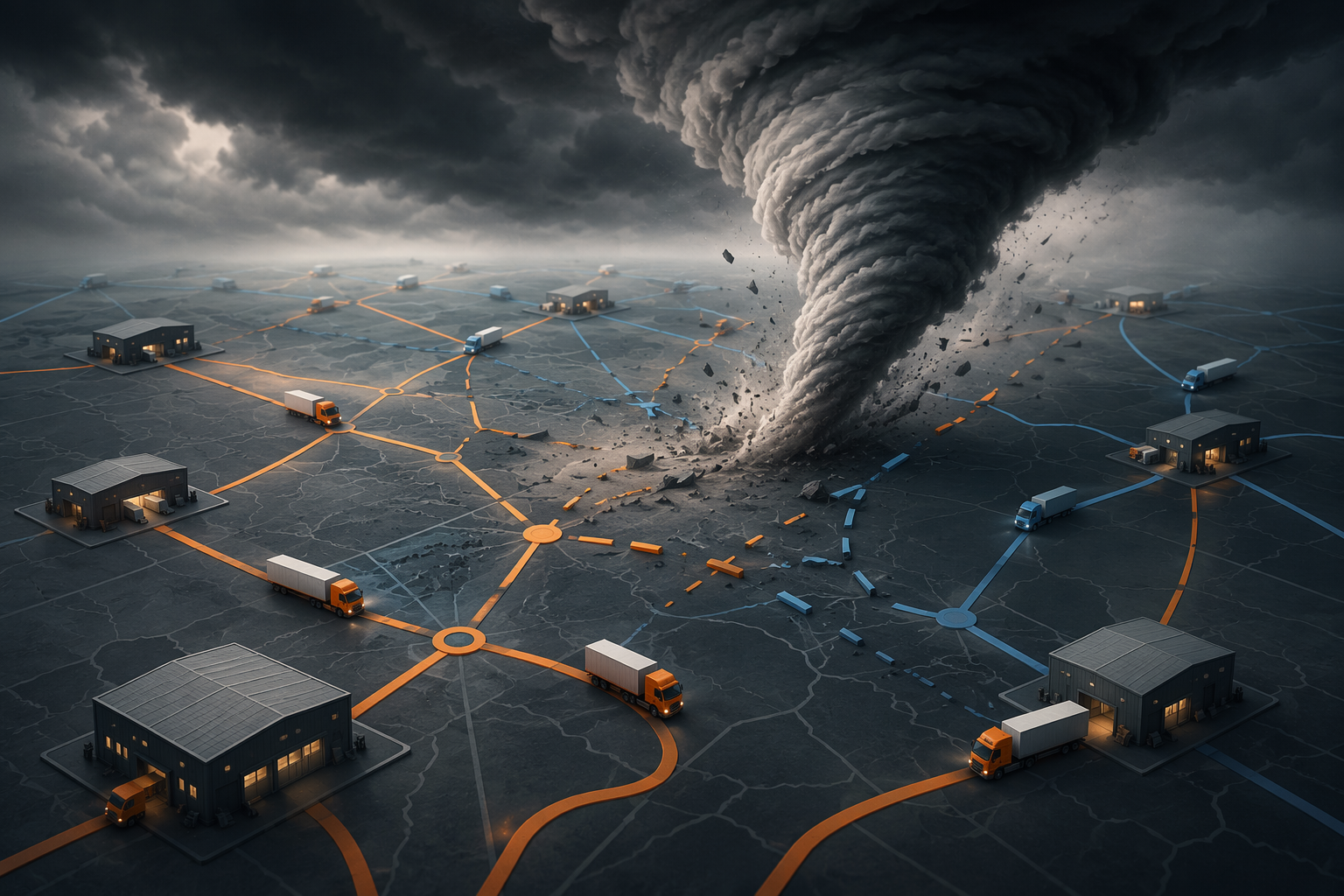
The practical workflow usually looks less like a single prediction and more like a live exception engine:
- Ingest weather intelligence, including severe-weather forecasts, alerts, and nowcasting signals.
- Overlay the weather footprint on logistics objects: facilities, lanes, yards, ports, intermodal ramps, suppliers, and customers.
- Classify the disruption type and severity so the team does not treat every alert as equal.
- Trace direct and multi-tier exposure across supplier and transportation paths.
- Generate response options, such as pre-positioning inventory, changing a carrier instruction, rerouting around a corridor, holding a load, or resetting an order promise.
- Update the assessment as the storm track, facility status, carrier availability, and road conditions change.
This is why the phrase “days in advance” needs careful handling. AI may identify a tornado-relevant severe-weather risk days ahead. It may also flag a likely logistics exposure before manual teams complete their assessment. But tornado formation, local damage, and exact path impacts remain highly specific. A responsible system should express confidence and consequence separately: one score for the weather threat, another for operational exposure, and a third for action priority.
The Strongest Evidence Is The Agentic Workflow, Not A Tornado Case Study
The most useful evidence in the current research base is the Cambridge arXiv paper on automating supply chain disruption monitoring with an agentic AI approach. It evaluated a seven-agent framework across three automotive manufacturers and 30 synthesized disruption scenarios. The system performed disruption classification, multi-tier path mapping, Tier-1 risk scoring, and response analysis, reporting a mean end-to-end disruption analysis time of 3.83 minutes against an approximately five-day industry baseline, at about $0.08 per disruption event.[2]
Those numbers matter because tornado logistics response is often lost in the gap between alert and consequence. If a team needs days to connect a weather event to exposed suppliers and lanes, the window for useful action can close before the assessment is complete. A minutes-scale analysis does not make the storm predictable in every operational detail. It does change the tempo of the room. Transportation can look at alternate corridors before the linehaul plan hardens. Warehouse leaders can decide whether to extend receiving hours or pause inbound trailers. Customer service can separate orders that need a revised promise from orders that are merely near a weather headline.
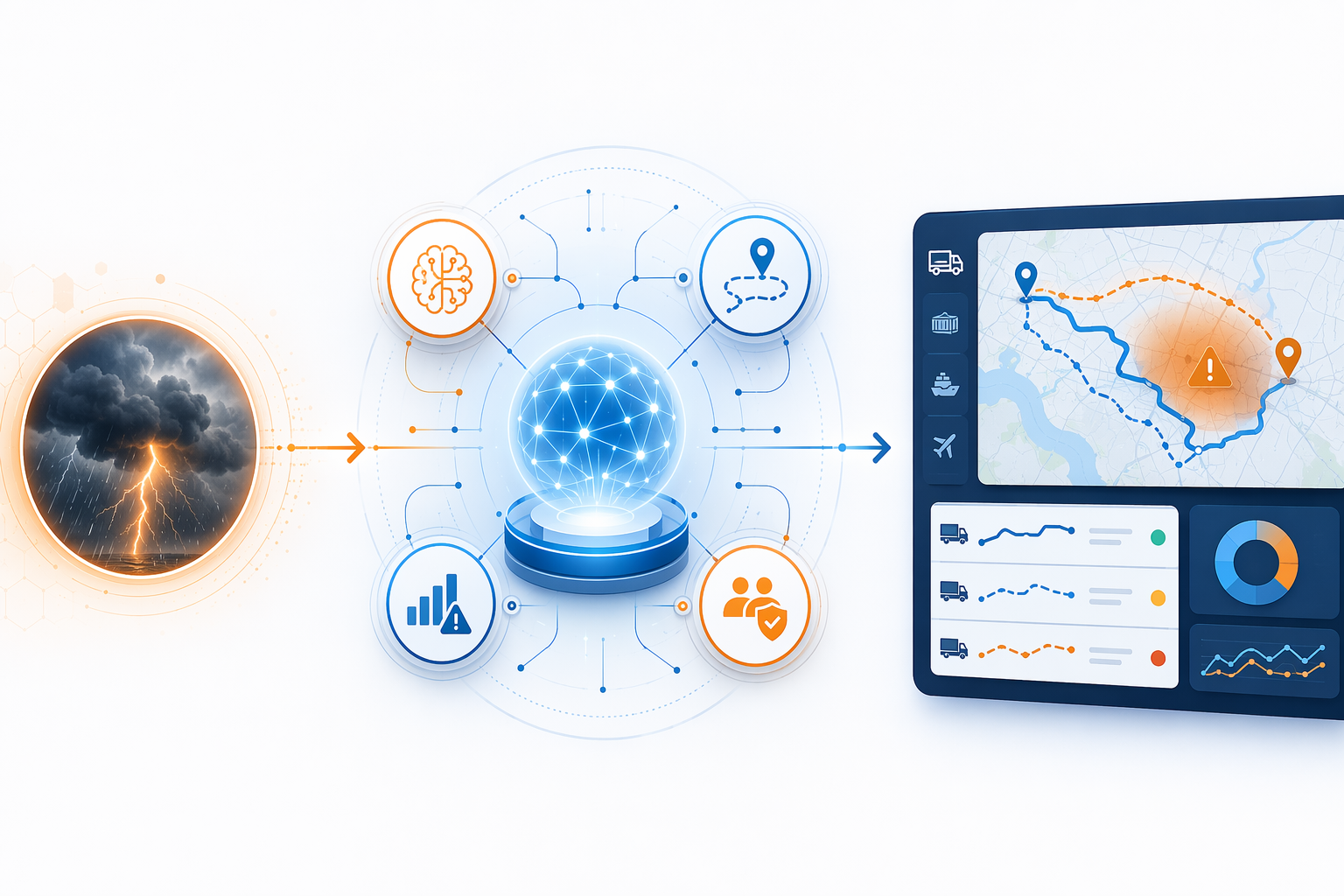
The Cambridge paper also reported F1 scores from 0.962 to 0.991 across disruption classification, multi-tier path mapping, and Tier-1 risk scoring.[2] In a logistics setting, that is more relevant than a broad AI accuracy claim because each function corresponds to an operational handoff. Classification tells the control tower what kind of event it is handling. Path mapping shows which part of the network is touched. Tier-1 scoring helps procurement and planning decide whose phone rings first. The response-time result then tells management whether the process can happen inside an operational decision window.
The limitation is just as important. These were synthesized scenarios, not measured tornado deployments. The sample covered three automotive manufacturers, not a broad cross-section of retail, grocery, 3PL, or parcel networks. The benchmark supports the claim that agentic AI can automate disruption analysis with impressive speed and structured outputs. It does not prove that the same system has predicted tornado damage to a live distribution network or that its recommendations improved service levels during an actual tornado outbreak.
What The Agents Would Actually Have To Do
For tornado event logistics disruption AI to be operationally credible, the agentic flow has to touch the objects a logistics team controls. A weather-intelligence agent may detect that severe storms could affect a corridor. A network-mapping agent then identifies the distribution centers, supplier sites, and active loads inside or near that footprint. A dependency agent checks whether the exposed facility is a primary ship point for high-priority SKUs or a backup node with manageable substitution. A routing agent tests whether reroutes create new problems, such as driver-hours exposure, delivery appointment misses, or congestion on the alternate corridor. A communications agent prepares different instructions for carriers, warehouse leaders, procurement, and customer-facing teams.
That division of labor is not cosmetic. Tornadoes are operationally asymmetric. A broad regional risk label may include dozens of safe nodes and one catastrophic failure. The system has to distinguish between a lane that is merely near the storm path, a facility that may need staffing changes, a supplier whose interruption threatens production, and a customer promise that should be reset before the missed delivery becomes a service failure.
| AI function | Operational object | Decision it can change |
|---|---|---|
| Severe-weather detection | Storm footprint, forecast zone, alert area | Start monitoring specific nodes and corridors |
| Geospatial exposure mapping | Facilities, yards, active loads, lanes | Hold, reroute, or resequence shipments |
| Multi-tier path mapping | Suppliers, plants, inventory dependencies | Escalate procurement risk and substitute supply where possible |
| Risk scoring | Nodes, suppliers, lanes, orders | Prioritize response instead of treating all alerts equally |
| Response recommendation | Carrier instructions, staffing plans, customer promises | Move from awareness to changed execution |
What Is Proven, What Is Adjacent, And What Is Still Missing
The evidence for tornado event logistics disruption AI currently sits in layers. The first layer is the impact case: tornadoes and severe weather create real logistics losses. The second is adjacent capability: vendors and AI systems can forecast weather-related cargo risk, ingest large disruption data streams, and issue operational alerts. The third is benchmark evidence: agentic systems can automate supply chain disruption analysis very quickly in synthetic scenarios. The missing layer is the one a buyer would most like to see: independently documented tornado-specific deployments with before-and-after operational outcomes.
| Evidence layer | What it supports | What it does not prove |
|---|---|---|
| Tornado damage and facility-loss examples | Tornadoes can create high-consequence supply chain disruption | That AI predicted or mitigated a specific tornado logistics event |
| Severe-weather logistics intelligence | Weather risk can be translated into cargo, route, and network alerts | That every tornado impact can be forecast days ahead at facility-level precision |
| Agentic disruption-monitoring benchmarks | AI can compress multi-step disruption analysis from days to minutes in tested scenarios | That the benchmark has been validated on actual tornado events |
| General AI supply chain performance claims | AI may reduce errors or lost-sales exposure in broader supply chain contexts | That tornado-specific ROI has been measured |
Everstream Analytics describes 14-day weather-related cargo impact forecasts, which is directly relevant to early logistics planning even though the available material is not a tornado-specific validation study.[3] The Weather Company positions predictive analytics and real-time insights as tools for managing supply chain weather risk.[4] AccuWeather discusses minimizing tornado impact on supply chain and logistics through weather alerting and risk communication.[5] These capabilities belong in the conversation because they feed the first part of the workflow: weather-to-network awareness.
They should not be treated as proof that AI can reliably predict the exact logistics outcome of a tornado days in advance. Forecasting a severe-weather environment, alerting a facility, estimating cargo exposure, and proving avoided logistics loss are different claims. The first can be valuable without establishing the last.
The Johnson & Johnson example is useful but should be handled cautiously. A World Certification Institute article says Johnson & Johnson’s AI system identified 85% of major supply disruptions an average of seven days before impact.[6] That is the kind of lead-time figure logistics leaders want, but the cited article discloses AI-assisted production and the available sources do not provide a primary Johnson & Johnson source. It supports a provisional point: enterprise AI systems may detect major disruption risk before impact. It should not be overextended into a verified tornado-specific benchmark.
There is also a broader reason logistics teams are paying attention. Maersk reported that 65% of global logistics decision-makers cite extreme weather as the top driver for improving supply chain visibility.[7] Weather is not a peripheral exception category anymore; it is a visibility requirement. But that statistic measures decision-maker sentiment, not AI effectiveness.
From Forecast To Changed Load Plan
A workable tornado-AI process starts before a warning polygon is issued. Several days out, the system may flag a severe-weather setup across a region where the company has distribution centers, cross-docks, suppliers, or dense delivery commitments. At that stage, the action is not a full reroute. It is watch-list creation: exposed facilities, critical lanes, at-risk appointment windows, and loads that would be expensive to recover if they enter the wrong corridor.
As the threat window tightens, the system should move from awareness to pre-decision. Transportation planners can identify shipments that have routing flexibility and separate them from loads that must continue unless a hard closure occurs. Warehouse managers can check whether inbound trailers should be accelerated, delayed, or reassigned. Procurement can review whether a supplier in the risk zone feeds a plant or customer commitment with little buffer. Customer operations can prepare revised promises for orders whose delivery windows depend on exposed nodes.
During the event, prediction gives way to exception handling. The system needs to ingest changing alerts, road status, facility availability, carrier updates, and order impacts. A good recommendation is not simply “avoid the storm.” It may be “hold these three inbound categories until the receiving site confirms power and staffing,” or “reroute only loads with delivery windows after the risk period because earlier loads will miss appointment times either way.” The value is in narrowing the queue.
After the event, the same data trail supports recovery. Which facility is offline? Which suppliers missed pickups? Which customers need fresh estimated arrival times? Which inventory is stranded in a safe but unhelpful place? AI can help order these questions, but authority still matters. If the control tower can see the risk and cannot change the carrier instruction, the staffing plan, or the customer promise, the alert has not become resilience. It has become documentation.
Dynamic Routing Helps, But It Is Only One Piece
Weather-related transportation exposure is large enough to justify serious automation. Available logistics research cites 23% of all U.S. road delays as weather-related and annual trucking industry costs of $2 billion to $3.5 billion.[8] For a tornado outbreak, dynamic routing can keep trucks away from damaged corridors, flooded roads, power outages, and blocked approaches to a facility. It can also stop a well-intended reroute from creating a new late delivery by ignoring hours-of-service, appointment availability, or congestion.
Still, routing is not the whole disruption. A truck can be successfully rerouted to a distribution center that has no power. A supplier can be outside the tornado path but unable to ship because its outbound carrier terminal is affected. A customer order can survive the transportation leg and fail because inventory was allocated from the wrong node. Tornado AI has to reason across transportation, facilities, suppliers, and commitments, not just road geometry.
This is where agentic disruption monitoring is a better fit than a standalone map alert. A routing model can answer where else a truck might go. A supply chain disruption agent should ask whether sending it there still satisfies the operating plan.
How To Read Vendor Claims In This Use Case
Vendor capabilities are easiest to evaluate when they are mapped to the workflow instead of compared as broad resilience promises. Weather intelligence providers can improve the signal entering the system. Visibility platforms can connect that signal to shipments, carriers, and facilities. Agentic AI layers can automate classification, dependency mapping, risk scoring, and recommended actions. Execution systems determine whether the recommendation becomes a changed route, changed appointment, changed labor plan, or changed customer commitment.
Project44’s AI Disruption Navigator is described as ingesting more than 8 billion data sources, a scale claim relevant to disruption visibility rather than tornado-specific proof.[6] Everstream’s weather-related cargo forecasts belong in the early-warning layer.[3] The Weather Company and AccuWeather belong in the weather-alerting and predictive-insight layer.[4][5] None of those examples, in the available sources, closes the evidentiary gap by showing a measured tornado logistics deployment with operational results.
A logistics leader shortlisting tools should therefore ask traceability questions: What weather signal enters the model? Which facilities, lanes, suppliers, and orders does it map against? Does it distinguish direct exposure from multi-tier dependency? How are recommendations approved? Can the system show what changed because of the alert? And after the event, can the team compare the recommendation against actual damage, delays, service misses, and avoided exceptions?
The Responsible Q3 2026 Conclusion
Tornado event logistics disruption AI is not mature in the way parcel tracking, transportation visibility, or weather alerting are mature. The available evidence does not yet support a clean claim that AI systems routinely predict tornado-specific logistics disruptions days in advance and prove avoided loss in live networks.
It does support a more useful and more disciplined claim. AI can make tornado-relevant logistics monitoring faster by linking severe-weather intelligence to facilities, lanes, suppliers, and commitments. Agentic approaches can compress disruption analysis from a manual multi-day cycle to minutes in structured synthetic tests. Adjacent weather-intelligence vendors can provide earlier and richer signals. For operations teams, that combination is already worth examining because the decision window in a tornado event is short and the consequences are uneven.
The maturity judgment is therefore emerging, not established. The response-time logic is compelling. The adjacent evidence is credible. The tornado-specific proof base is still thin. The next step for the category is not louder prediction language; it is documented event-level traceability from alert, to exposed logistics object, to changed decision, to measured outcome.
References
- Preparing Your Supply Chain for the 2025 Tornado Season, Falvey Insurance Group
- Automating Supply Chain Disruption Monitoring via an Agentic AI Approach, Cambridge arXiv
- Weather-Proof Your Logistics Operations, Everstream Analytics
- Managing Supply Chain Weather Risks with Predictive Analytics and Real-Time Insights, The Weather Company
- Minimizing Tornado Impact on Your Supply Chain and Logistics, AccuWeather
- From Reactive to Proactive: How AI-Driven Supply Chains Weather Every Storm, World Certification Institute
- 5 Ways Severe Weather Disrupts Supply Chains, Maersk, July 21, 2025
- Mitigating Weather and Natural Disaster Risks in Logistics, WSI
Comments
Join the discussion with an anonymous comment.