
The hard part of tariff scenario planning in 2026 is not getting an executive to ask for a scenario. That part is easy. The hard part is answering by Friday with numbers that finance, procurement, trade compliance, logistics, and planning can all defend.
In the current policy environment, static exposure analysis is too slow for the work being asked of it. KPMG’s 2026 supply chain trends frame tariff volatility as structurally persistent rather than a temporary cycle, and the early-to-mid 2026 environment has already forced teams to revisit assumptions around post-ruling exposure, replacement tariff mechanisms, and shifting legal frameworks.[1] Any Q3 2026 analysis needs the same caveat the planning team needs in its model: tariff rates and frameworks may change after the analysis is published.
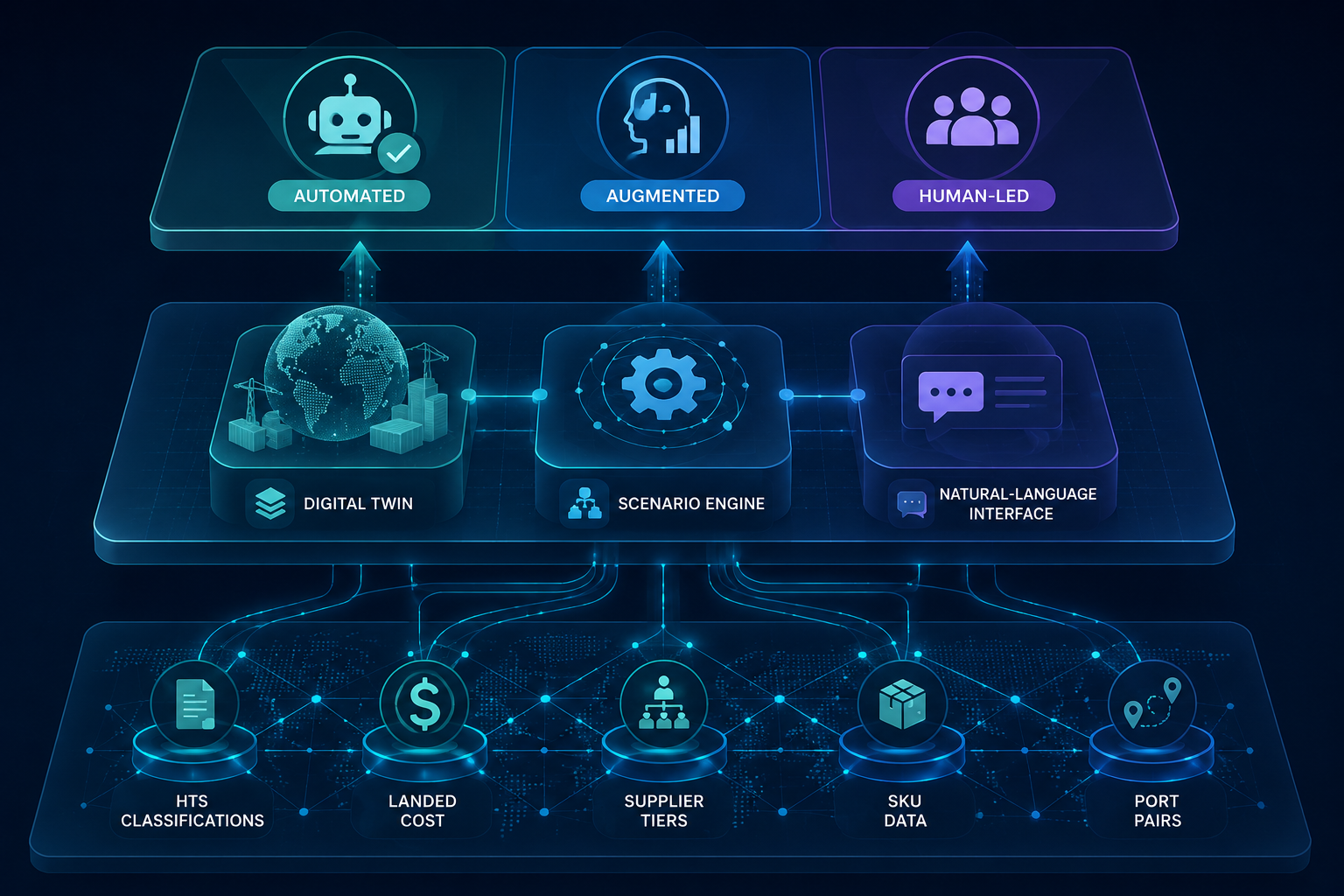
That is where AI for tariff scenario planning in the supply chain becomes useful, but only in a specific order. AI can compress the analysis window, surface combinations a manual workbook will miss, and make what-if questions easier to ask. It cannot rescue an organization that has not connected HTS classification, landed cost, supplier tiers, SKU data, factory options, logistics lanes, and policy assumptions. If those inputs are inconsistent, the interface may look clean while the answer remains unfit for a sourcing or customer commitment decision.
Start With The Operating Failure, Not The AI Layer
A tariff fire drill usually begins with a deceptively simple question: what is our exposure if this rate changes? In practice, that question immediately breaks into smaller questions that sit in different systems and different departments.
- Trade compliance needs to know whether the HTS classification is current and whether any assumptions are under review.
- Procurement needs to know which suppliers, sub-suppliers, and factories are actually tied to the affected SKUs.
- Logistics needs to know which port pairs, modes, and routing options are being modeled.
- Finance needs landed cost impact, margin exposure, cash timing, and refund or duty recovery implications.
- Planning needs to know whether the modeled alternative can support demand, inventory targets, and customer service commitments.
A spreadsheet can answer part of that once. It struggles when the question becomes continuous: what changes if the tariff mechanism shifts, the supplier changes country of origin, a port pair becomes constrained, and the business wants to preserve service on the highest-margin SKUs? Gartner benchmark figures cited by CXTMS indicate that companies embedding risk-sensitive metrics with AI models saw 28% faster response rates and 19% shorter recovery cycles, but the statistic is reported through a vendor article rather than independently traced here to the original Gartner report.[2] Treat it as directional evidence for why response speed matters, not as a blanket promise that installing a tool produces the result.
Build The Connected Data Foundation First
The minimum viable foundation for AI-powered tariff scenario planning is not a lake of everything. It is a connected set of tariff-relevant objects with ownership, refresh rules, and exception handling. The goal is to make a policy assumption travel cleanly through product, supplier, factory, lane, cost, and customer impact.
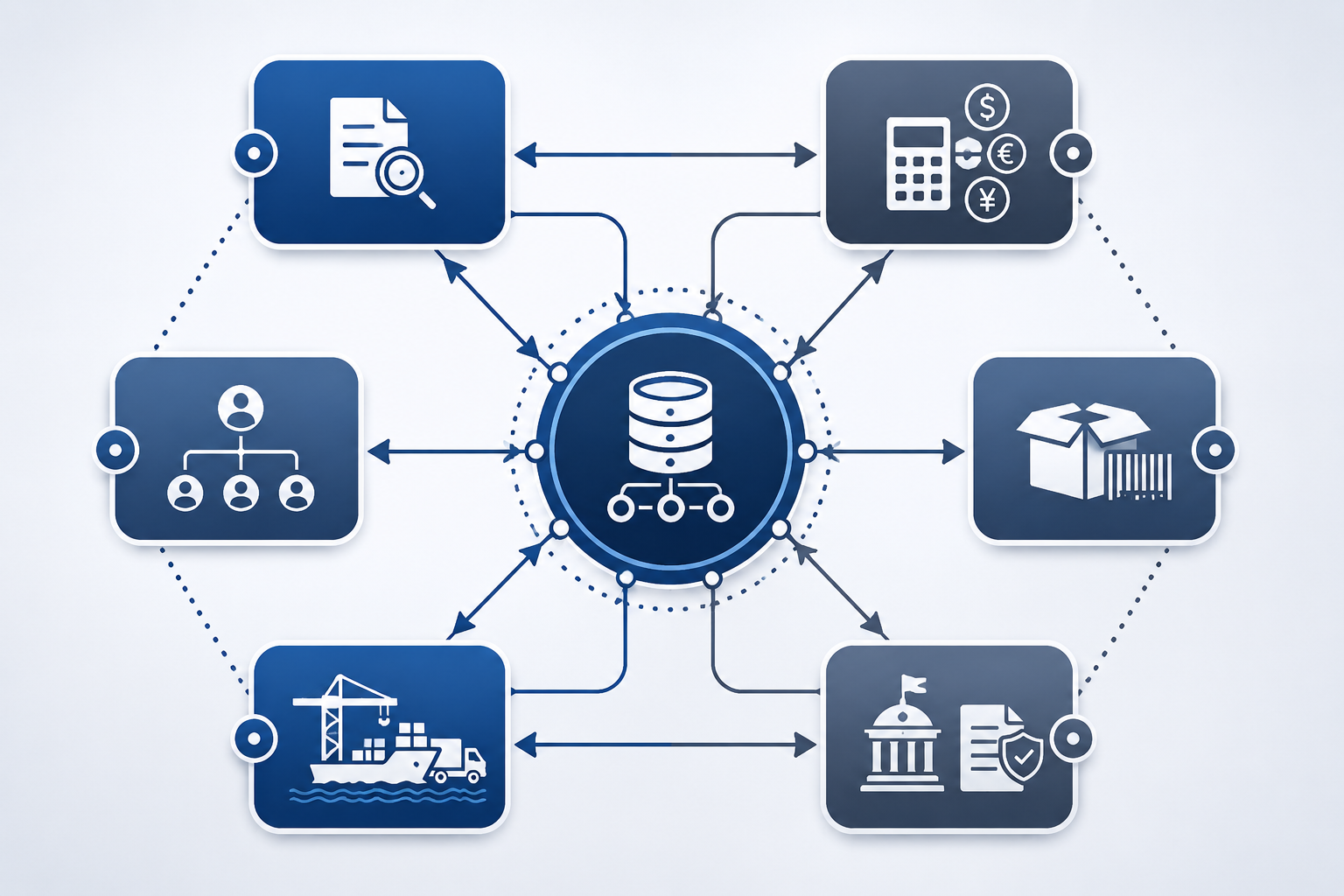
HTS Classification Quality
HTS classification is the first dependency because the tariff scenario is only as credible as the duty logic attached to the product. In too many organizations, classification quality is treated as a compliance file rather than a planning input. That separation becomes expensive when planners model exposure from SKU master data while trade compliance later corrects the applicable code, exclusion, or interpretive assumption.
For scenario planning, classification records need more than a code field. They need effective dates, review status, confidence level, source of determination, pending rulings or disputes where relevant, and a named owner. The model should be able to distinguish a stable classification from one under review. Those two records should not carry the same decision weight.
Landed Cost Visibility
Tariff exposure is rarely a clean percentage applied to purchase cost. A useful scenario needs the landed cost stack: product cost, duty, brokerage, freight, insurance, port and handling charges, inland movement, inventory carrying implications, and any known recovery mechanism. If the landed cost calculator sits outside planning, teams end up debating whether the scenario shows a customs impact, a margin impact, or a service-adjusted cost impact.
This is one reason digital twin claims need careful inspection. A digital twin that cannot trace tariff assumptions into landed cost by SKU, sourcing point, and lane is not yet a tariff scenario capability. It may still be useful for network visualization, but it will not carry an executive conversation about price action, supplier shifts, or customer allocation.
Supplier-Tier And Factory Mapping
Supplier master data usually tells the business who is paid. Tariff scenario planning needs to know where the product is made, which factory can make it, what capacity constraints apply, and whether a proposed alternative changes country of origin, quality risk, lead time, minimum order quantity, or customer qualification status.
The supplier tier question matters because tariff exposure can sit below the direct supplier. If the direct supplier assembles in one country but critical inputs originate elsewhere, the sourcing option may not reduce exposure as much as the first-level record suggests. The model does not need omniscience on day one, but it does need to show where supplier-tier visibility is known, partial, or missing. Otherwise, AI recommendations can look more certain than the data permits.
SKU, Factory, And Logistics Joins
The RELEX coconut beverage example is useful because it shows the modeling burden in concrete terms: more than 100 SKUs, more than 15 factories, and 127 ocean freight port pairs were involved in tariff-aware optimization work.[3] That is the kind of scale where manual scenario work becomes both slow and brittle. It is also the kind of scale where a missing product-location relationship or stale port pair assumption can distort the answer.
The important lesson from that case is not that every company needs the same optimization model. It is that tariff scenario planning becomes a network problem as soon as the business asks for alternatives. A sourcing shift changes flow. A flow change changes freight, lead time, and service risk. A service risk changes inventory. If those joins are not built before the AI layer is added, the model will optimize whichever slice of the network is easiest to read.
| Data object | Why it matters for tariff scenarios | Minimum readiness test |
|---|---|---|
| HTS classification | Determines which tariff assumptions can be applied to each product | Each affected SKU has a current code, owner, effective date, and review status |
| Landed cost | Turns duty exposure into margin, cash, and pricing impact | The cost stack can be viewed by SKU, supplier, factory, lane, and scenario |
| Supplier and factory mapping | Shows whether alternative sourcing is real or theoretical | The model separates supplier-of-record from manufacturing location and capacity |
| Port pair and logistics data | Captures routing, freight, lead time, and service consequences | Scenario outputs change when lanes, ports, or modes change |
| Trade policy assumptions | Connects legal and regulatory change to operational impact | Assumptions carry effective dates, source notes, and uncertainty flags |
Then Map The Technology Stack To The Data
Once the foundation is connected, the technology stack becomes easier to evaluate. CXTMS describes a four-layer architecture for AI tariff scenario simulators: digital twin, landed cost calculator, multi-variable scenario engine, and natural-language what-if interface.[2] That is a useful spine, provided it is treated as an architecture to test rather than a product category to buy.
Digital Twin
The digital twin represents the supply chain network: SKUs, sourcing points, factories, lanes, ports, distribution nodes, inventory positions, lead times, and constraints. In tariff planning, its job is not to produce an attractive network map. Its job is to let a planner ask what physically and commercially changes when the business moves volume, changes a source, or absorbs a duty increase.
For readers who already use a supply chain control tower AI capability, the digital twin layer may already be partially present. The gap is often that control tower visibility has not been connected to tariff classifications, duty logic, or landed cost simulation.
Landed Cost Calculator
The landed cost calculator translates network changes into financial consequences. It should support scenario-specific duty rates, country-of-origin assumptions, freight changes, and cost-to-serve impacts. It should also preserve version history, because tariff analyses are often revisited after a policy clarification, refund opportunity, or executive decision.
A European electronics firm cited in Supply Chain Management Review reportedly improved landed cost performance by 11.6% and restored on-time delivery to 97% using digital twin tariff simulation.[4] That case is helpful because it includes both a cost and service outcome. It is still a single reported case, not evidence that every digital twin implementation will produce the same result.
Multi-Variable Scenario Engine
The scenario engine is where AI and optimization start to matter. It should test combinations that a manual process would struggle to keep aligned: tariff rate changes, sourcing shifts, production constraints, supplier qualification, freight rate movement, port capacity, demand priority, inventory policy, and customer service targets.
This is also where predictive analytics in supply chain management connects with prescriptive planning. Predictive signals may estimate demand, lead time, or disruption probability; the tariff scenario engine has to convert those signals into choices the business can act on.
Natural-Language What-If Interface
A natural-language interface can be valuable, but it belongs at the top of the stack, not at the beginning of the implementation. The promise is straightforward: a finance leader or planning director can ask, in plain language, what happens if a tariff rate changes or if volume moves from one source to another. The risk is equally straightforward: if the interface does not expose assumptions, confidence, and data gaps, it can make a fragile answer easier to circulate.
The better test is not whether the interface can answer a question. It is whether the user can drill from the answer back to the HTS assumption, supplier mapping, landed cost build, logistics lane, and demand or service trade-off that produced it.
Design For The Post-Ruling Workflows The Business Actually Runs
The EY post-ruling actions cited in CXTMS and Business Insider are a useful way to pressure-test whether the capability is operational or merely analytical: preserve refund rights, model replacement tariff exposure, stress-test supply chain shifts, synchronize cross-functional response, and build continuous monitoring loops.[2] Those are not five separate dashboards. They are five jobs the planning capability needs to support.
| Post-ruling action | What the scenario capability must support |
|---|---|
| Preserve refund rights | Versioned assumptions, duty paid records, classification traceability, and documentation links |
| Model replacement tariff exposure | Rapid comparison of legal or policy mechanisms against SKU, origin, and landed cost data |
| Stress-test supply chain shifts | Supplier, factory, lane, inventory, service, and cost constraints in the same scenario |
| Synchronize cross-functional response | Shared scenario definitions so finance, procurement, compliance, and planning do not model different realities |
| Build continuous monitoring loops | Policy, cost, supplier, and logistics updates that trigger scenario refreshes instead of quarterly rebuilds |
The monitoring loop is the piece that turns tariff response from a fire drill into an operating capability. A quarterly workbook asks, “What changed since last time?” A continuous loop asks, “Which assumption changed, which SKUs are affected, which scenarios are now stale, and who needs to review the consequence?”
This is where many implementations underinvest. They fund the model but not the operating rhythm around the model. Someone still has to decide which tariff notices trigger review, how quickly supplier-origin changes must be reflected, who validates HTS updates, and which scenario outputs are approved for executive use.
Set Governance Before Automation Expands
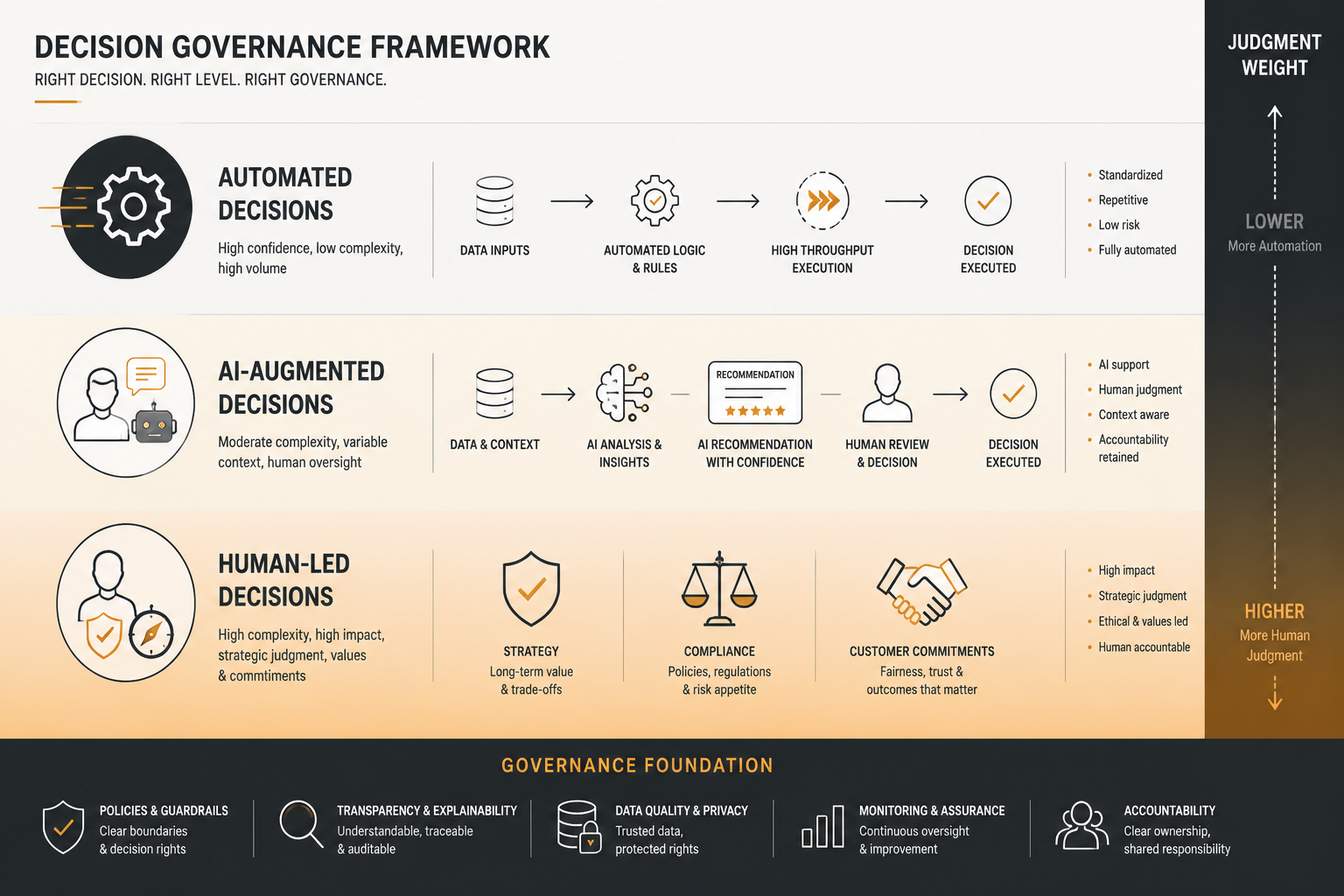
AI tariff planning needs decision governance because not every recommendation should travel at the same speed. A decision-domain framework discussed by aiinthechain separates supply chain decisions into automated, AI-augmented, and human-led domains.[5] That distinction is especially useful for tariffs because a recommendation can be mathematically attractive and still create compliance, commercial, or customer risk.
Automated Decisions
Automation belongs where the decision is frequent, low-risk, bounded by clear rules, and reversible or easily reviewed. In tariff scenario planning, that may include refreshing exposure dashboards when an approved rate table changes, flagging SKUs whose classifications are missing review dates, routing scenarios to the right owner, or recalculating landed cost using validated inputs.
The automation rule should be boring by design: no new supplier commitment, no customer promise, no compliance interpretation, and no financial booking should be made purely because a model produced a lower-cost scenario. Automated tasks should reduce clerical delay and surface exceptions; they should not quietly create sourcing strategy.
AI-Augmented Decisions
AI-augmented decisions are where most tariff scenario planning value will sit. The model can rank alternatives, show cost-service trade-offs, identify affected SKUs, estimate exposure ranges, and recommend which scenarios deserve review. A human decision-maker still evaluates whether the recommendation is commercially and operationally acceptable.
Examples include proposing a temporary sourcing split, recommending inventory pre-build for selected SKUs, comparing port pair alternatives, or identifying which customers may require price or allocation discussion. If inventory positioning is part of the response, the tariff model should connect to the same logic used for multi-echelon inventory optimization rather than treating inventory as an afterthought.
For augmented decisions, the governance question is not simply who approves. It is what evidence must accompany the recommendation. A usable AI recommendation should show the baseline, the changed assumptions, the affected SKUs and customers, the cost and service impact, the confidence level, the data gaps, and the escalation path.
Human-Led Decisions
Human-led decisions remain necessary when the consequence extends beyond the scenario boundary. Changing strategic suppliers, requalifying factories, passing costs to customers, altering country-of-origin strategy, entering a legal interpretation, or making public commitments should not be delegated to the model.
The model can still improve these decisions by narrowing the field. Instead of asking executives to choose from a dozen inconsistent spreadsheets, the team can bring three governed scenarios: absorb, pass through, or re-source; each with margin impact, service risk, compliance assumptions, implementation timing, and unresolved data issues. That is a different conversation from “the AI says we should move volume.”
| Decision type | Good candidates | Governance requirement |
|---|---|---|
| Automated | Data refreshes, exception flags, recalculations using approved assumptions | Clear thresholds, audit trail, and owner notification |
| AI-augmented | Scenario ranking, sourcing split options, inventory and routing recommendations | Human approval with visible assumptions, confidence, and data gaps |
| Human-led | Supplier strategy, customer commitments, compliance interpretations, pricing posture | Cross-functional review and executive decision rights |
How To Judge Readiness
A practical readiness test is to run one tariff event from policy assumption to decision packet. Choose an affected product family, not the whole enterprise. Then test whether the organization can produce a scenario that finance, procurement, compliance, logistics, and planning can all review from the same baseline.
- Define the policy assumption with effective date, source, uncertainty, and owner.
- Map affected HTS classifications to SKUs and flag classifications under review.
- Connect SKUs to supplier, factory, country-of-origin, and available capacity records.
- Calculate landed cost impact by SKU, lane, and scenario, including freight and service implications.
- Run alternative sourcing, routing, pricing, or inventory scenarios with explicit constraints.
- Classify each recommended action as automated, AI-augmented, or human-led before it is acted on.
The pass-fail criteria should be operational. Can the team explain why the scenario changed? Can trade compliance see the classification assumption? Can procurement tell whether the supplier alternative is qualified? Can finance reconcile the landed cost movement? Can planning see the service consequence? If the answer is no, the next investment is probably not a more conversational interface.
Vendor material can help structure the work, but it should not be mistaken for an implementation guarantee. CXTMS provides a useful architectural pattern, RELEX provides a concrete scale example, and the SCMR electronics case provides outcome metrics. All three sit within a source base that includes vendor-authored or vendor-adjacent framing, so the safer use is to borrow the operating pattern and test it against your own data, decision rights, and policy exposure.
AI can compress tariff exposure analysis from weeks to hours. The compression comes after the unglamorous work: connected data, traceable assumptions, scenario engines tied to real constraints, and governance that knows when to automate, when to augment, and when to put the decision in front of people accountable for the consequence.
References
- 2026 supply chain trends, KPMG, 2026, link
- AI Tariff Scenario Simulators: What-If Modeling for Trade Policy in Supply Chain 2026, CXTMS, link
- Navigating Tariff-Driven Supply Chain Disruptions, RELEX Solutions, link
- Beyond Resilience: How AI and Digital Twins Are Rewriting the Rules, Supply Chain Management Review, link
- Tariffs, Freight Rates, and AI: Why Supply Chains Need Real-Time Scenario Planning, aiinthechain.com, June 3, 2026, link
Comments
Join the discussion with an anonymous comment.