
AI spend analysis for procurement has become the odd success story that still has trouble leaving the pilot room. Among procurement organizations already using AI, 78% use it for advanced spend analysis, making it the most widely adopted AI procurement application in APQC’s reporting; the same source says 80% of adopters saw improved data quality as a benefit.[1] Deloitte’s 2025 Global CPO Survey points in the same direction from the demand side: 53.44% of CPOs ranked spend analytics as the top GenAI use case.[2]
Then the production numbers arrive and cool the room. The Hackett Group’s 2026 procurement research says 49% of procurement teams have piloted AI, but only 4% have achieved large-scale deployment.[3] Gartner’s 2025 CPO leadership research gives the most familiar reason: 74% of procurement leaders say their data is not AI-ready.[4] That is the real shape of the use case in 2026: high recognition, many pilots, clear value signals, and a stubborn gap between a promising classification demo and a governed spend intelligence process people will actually use.
The point is not that AI spend analysis is overhyped. It is one of the cleaner AI applications in procurement because the work is already painful, repetitive, and well understood: collect spend data, normalize suppliers, map categories, identify leakage, and decide where category managers should look next. The weak point is usually earlier than the model. It sits in supplier master records, invoice descriptions, GL codes, PO coverage, contract metadata, and the taxonomy choices that decide what a dollar of spend is allowed to mean.
What AI Spend Analysis Actually Does
AI spend analysis uses machine learning, natural language processing, and increasingly generative or agentic interfaces to turn procurement and finance records into classified, searchable, explainable spend intelligence. In ChainSignal’s use-case taxonomy, it belongs in the Source/procurement category because it supports sourcing decisions, category planning, supplier consolidation, compliance review, and savings discovery rather than contract execution or supplier performance monitoring.
In practical terms, the system takes data from ERP, accounts payable, purchase order, contract, supplier master, card, and sometimes expense systems. It then cleans and normalizes the records, classifies spend into a procurement taxonomy, enriches suppliers and categories with additional context, and surfaces patterns that a category team can review. Good outputs are not just dashboards. They are ranked opportunities: tail-spend consolidation, off-contract buying, duplicate suppliers, price variance, fragmented demand, savings leakage, maverick spend, preferred-supplier noncompliance, and category benchmarks.

The better systems do not require a procurement analyst to know every supplier by memory, but they still need procurement judgment. A model can infer that “IBM Corp,” “International Business Machines,” and a local reseller may belong in a related technology supplier view. A category manager still has to decide whether the spend should be treated as software, professional services, hardware, managed services, or a bundled commercial relationship for sourcing purposes. That judgment changes the recommendation.
The Operating Chain Behind the Dashboard
Domo describes AI spend analysis as a sequence that can compress a traditional two-to-three-month analysis cycle into one to two weeks when the work follows a structured path: data preparation, cleansing, taxonomy design, classification, and play identification.[5] That time compression is plausible only if the middle of the process is taken seriously. “Upload the ERP export and ask the AI” is not the operating model.
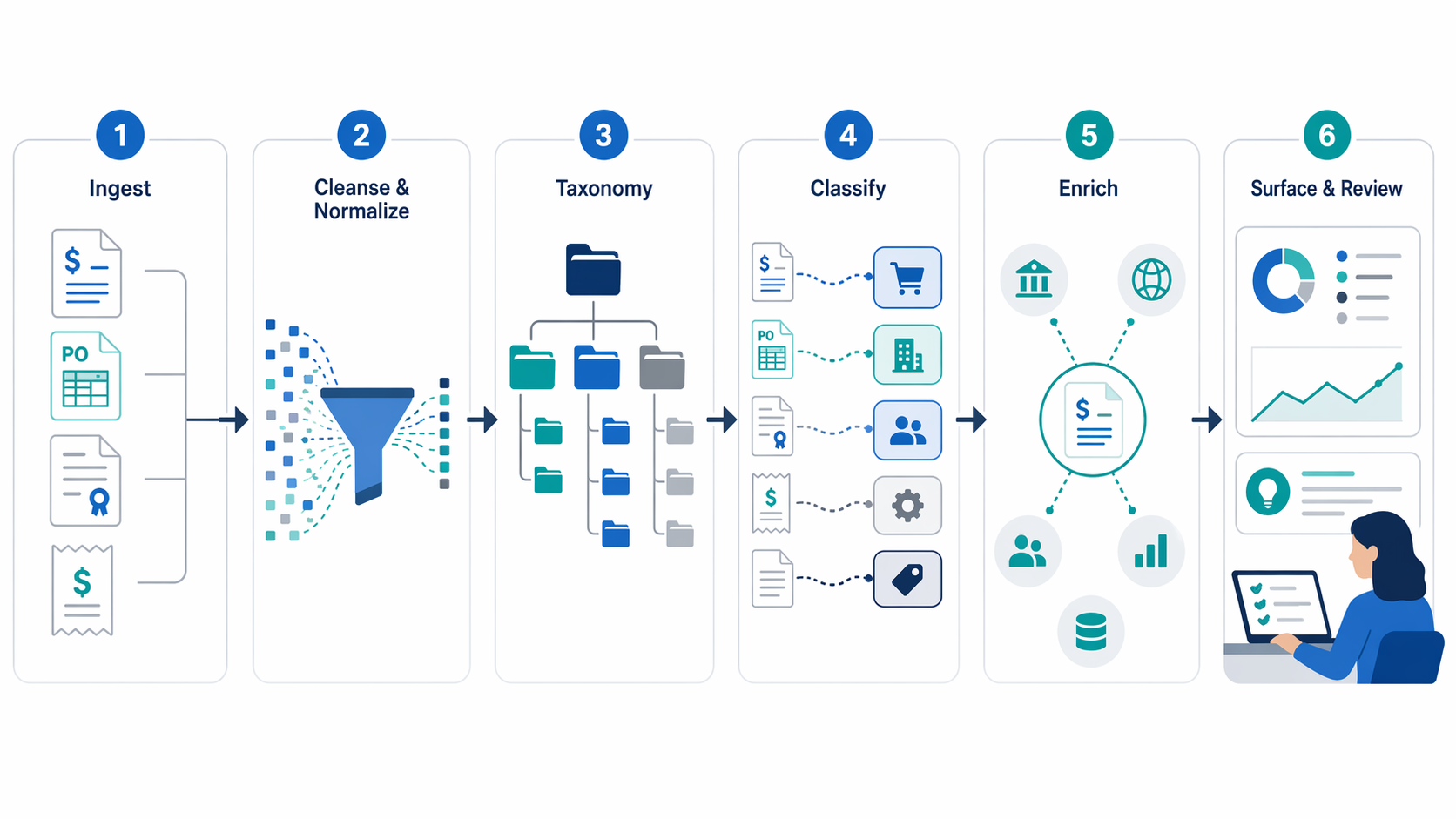
| Stage | What Happens | Where Teams Usually Underestimate the Work |
|---|---|---|
| Ingest | Pull supplier, invoice, PO, contract, payment, card, and ERP records into a common environment. | Data fields arrive with different formats, owners, refresh cycles, and missing values. |
| Cleanse and normalize | Standardize supplier names, units, currencies, dates, descriptions, GL codes, and entity references. | Supplier identity resolution is harder than matching exact names; parent-child relationships and resellers matter. |
| Build or adapt taxonomy | Define the category hierarchy used to classify spend and compare opportunities. | Generic taxonomies often look complete but fail to reflect how the organization actually sources. |
| Classify | Assign spend to categories using rules, models, natural language cues, supplier history, and human feedback. | Accuracy claims mean little unless the categories are relevant and exceptions are reviewed. |
| Enrich | Add supplier, category, contract, market, diversity, risk, emissions, or benchmark context. | External context can improve decisions, but it can also create false confidence if lineage is unclear. |
| Surface and review | Generate savings, compliance, consolidation, leakage, and benchmark opportunities for humans to validate. | Procurement teams need workflow ownership, not only dashboards. |
GEP’s explanation of AI spend analytics emphasizes the same mechanics: spend classification, supplier normalization, enrichment, and pattern detection are separate but connected tasks.[6] The distinction matters because a procurement team can have a respectable classifier and still produce weak recommendations if supplier normalization is sloppy. If “Acme Industrial,” “ACME Ind.,” and “Acme Safety Products” remain separate suppliers, the dashboard may miss consolidation leverage. If they are merged too aggressively, it may invent leverage that does not exist.
Taxonomy is the control system. It decides what categories exist, how granular they are, what belongs together, and what should stay separate for sourcing, compliance, or reporting. A finance taxonomy built around GL accounts may be sufficient for budget control but too blunt for sourcing. A very detailed procurement taxonomy may support category strategy but become brittle if invoice descriptions are sparse. ScienceDirect’s 2025 work on AI spend classification treats taxonomy design and classification technique as tightly linked problems, not as separate administrative chores.[7]
This is where many implementations quietly lose credibility. A generic taxonomy can make a slide look mature because it contains all the obvious categories: IT, facilities, logistics, professional services, marketing, MRO. But a category manager does not source from a generic tree. They need distinctions that match supplier markets, contract structures, specifications, and demand owners. Temporary labor and consulting may both sit under services in a finance view, but they behave differently in a sourcing event. SaaS, implementation services, and cloud consumption may all touch the same technology supplier, but they do not create the same savings levers.
The taxonomy also sets the terms for model governance. If the team cannot explain why a transaction was mapped to a category, it cannot easily defend a savings recommendation to finance or a supplier consolidation plan to a business unit. Human-in-the-loop review is not a ceremonial approval step at the end. It is how procurement teaches the system which classification mistakes are tolerable, which ones distort strategy, and which ones could create compliance or reporting risk.
Why the Readiness Gap Persists
The readiness gap is partly technical, but it is not only a data-engineering problem. Procurement data is scattered because procurement work is scattered. One business unit buys through a catalog, another through free-text POs, another through AP exceptions, another through corporate card spend. Some contracts sit in a CLM system; others live as PDFs in shared folders. Supplier master data may be owned by finance, onboarding by procurement, payment details by AP, and category definitions by a center of excellence that does not control local buying behavior.
That structure explains why Gartner’s 74% data-not-ready figure should not be read as a temporary inconvenience.[4] AI spend analysis asks procurement to combine records that were not created for the same analytical purpose. The invoice line may describe what was billed, the PO may describe what was requested, the contract may describe what was negotiated, and the supplier master may describe who was paid. The model can help reconcile those views, but it cannot remove the need to decide which source wins when they conflict.
The counterintuitive part is that the AI program can improve the data while using it. APQC reports that 80% of AI procurement adopters saw improved data quality.[1] That does not mean poor data is harmless. It means a well-run implementation exposes duplicates, missing attributes, inconsistent naming conventions, unused category codes, and classification drift in ways that a static spreadsheet exercise often does not. The data cleanup is not merely a prerequisite; it becomes one of the benefits, provided someone owns the remediation.
This also explains the pilot-to-production chasm. A pilot can succeed on a bounded data extract, a cleaned sample, or a category with an engaged owner. Production has to survive monthly refreshes, new suppliers, ERP changes, regional exceptions, approval workflows, and finance challenges to the savings number. Hackett’s finding that only 4% of procurement teams have reached large-scale AI deployment is less surprising when production is defined that way.[3]
What Value Has Been Reported
The savings evidence is real enough to take seriously and bounded enough to treat carefully. Suplari says automated spend analysis can produce 6% to 12% annual cost savings on addressable spend.[8] That is a vendor-published benchmark, so it should not be converted into a universal business case. Addressable spend, category mix, contract coverage, baseline data quality, and execution authority all matter. A team that finds leakage but cannot influence demand or renegotiate terms has identified value, not captured it.
Raindrop Systems publishes more specific customer examples. It cites Workwear Outfitters achieving 400% ROI on $120 million in managed spend, and World Market achieving a 75% efficiency improvement, 50% cycle-time reduction, and 90% spend under management.[9] Those figures are useful because they show the kinds of outcomes procurement and finance teams track: ROI, cycle time, efficiency, and spend coverage. They are still case-study evidence, not a distribution of outcomes across all buyers.
Thinklytics frames the value around material-cost reduction, estimating 8% to 20% total material cost reduction, first-three-use-case implementation costs of $220,000 to $480,000, and supplier-price benchmarking that can identify six-figure savings in the first 90 days.[10] That is a consulting benchmark rather than a neutral audit. Its usefulness is in forcing a cost side into the discussion. AI spend analysis is often sold through savings potential, but production requires integration, taxonomy work, data remediation, change management, and review capacity.
McKinsey’s procurement AI material estimates 25% to 40% efficiency improvement potential through agentic AI in procurement.[11] That figure is broader than spend analysis alone, but it signals why spend intelligence is becoming an entry point for more automated procurement workflows. Once spend is classified, normalized, and explainable, it can feed category strategy, sourcing event design, supplier risk review, contract compliance checks, and budget conversations.
The improvement curve appears stronger when organizations scale. Hackett reports that 76% of organizations see at least 25% improvement in key metrics as AI adoption scales.[3] That does not prove spend analysis alone caused the improvement. It does reinforce the implementation lesson: the value case changes when AI is connected to processes and governance rather than left as an isolated analytics experiment.
Where Vendors Fit
The AI spend analysis vendor landscape is not one clean category. Some products grew out of procurement suites, some out of spend analytics, some out of consulting assets, and some out of newer AI-agent workflows. The right shortlist depends less on the best demo and more on the buyer’s starting point: ERP complexity, procurement suite footprint, data maturity, category depth, and whether the team wants a standalone spend intelligence layer or a broader source-to-pay platform.
| Vendor or Platform Type | Examples | Best Fit |
|---|---|---|
| Procurement suite with embedded AI | Coupa, Ivalua, JAGGAER | Organizations that want spend analysis connected to sourcing, contracts, supplier management, and procurement workflows. |
| Spend analytics and classification specialist | SpendHQ, Sievo, Suplari, GEP | Teams that need deeper classification, enrichment, supplier normalization, category visibility, or spend-under-management improvement. |
| Procurement intelligence or consulting-backed platform | McKinsey Spendscape | Large enterprises that want benchmark-led category intelligence and advisory support around operating model change. |
| Mid-market procurement operations platform | Procurify | Teams that need purchasing control and visibility without the footprint of a large enterprise suite. |
| AI-agent-native or emerging workflow layer | SpendKey and similar emerging players | Organizations testing agentic interfaces for analysis, question answering, opportunity triage, or guided procurement workflows. |
Coupa is usually evaluated when spend analysis needs to sit near sourcing optimization, supplier management, and broader business spend management. GEP is relevant where classification, normalization, and enrichment are central buying criteria. Ivalua’s IVA capabilities bring the agentic conversation into suite-based procurement workflows. JAGGAER belongs in enterprise source-to-pay evaluations where spend visibility needs to connect with supplier and sourcing processes. Suplari, SpendHQ, and Sievo are closer to the spend-intelligence conversation, with Sievo also relevant where emissions analytics and sustainability reporting sit near spend data. Procurify is more likely to appear in mid-market control and purchasing visibility discussions. McKinsey Spendscape is a different kind of choice: less a point tool, more an analytics and category intelligence environment supported by consulting expertise. Emerging tools such as SpendKey are worth watching where the buyer wants AI agents to help interrogate spend and route recommendations.
A practical evaluation should ask vendors to show the unpolished middle: how supplier entities are matched, how category confidence is scored, how exceptions are routed, how taxonomy changes are governed, how refreshes work, how ERP and AP data are reconciled, and how savings opportunities move from dashboard to owner. A confident answer about model accuracy is not enough if the team cannot inspect the data lineage behind a recommendation.
Implementation Risks That Deserve Early Attention
The first risk is data quality, but that phrase is too broad to be useful unless it is broken down. Procurement teams should look for duplicate suppliers, missing parent-child relationships, free-text descriptions, weak PO coverage, inconsistent units of measure, incomplete contract references, poor category history, regional ERP differences, and payment records that do not map cleanly to sourcing ownership. Each defect has a different operational consequence.
- Duplicate supplier records can understate consolidation leverage or overstate supplier fragmentation.
- Weak invoice descriptions can push classification toward supplier-level assumptions that fail for diversified vendors.
- Generic category trees can hide the difference between finance reporting and sourcing actionability.
- Disconnected contract data can make off-contract spend look unknowable rather than measurable.
- No workflow owner can leave validated opportunities sitting in a dashboard with no sourcing action.
The second risk is taxonomy overreach. Teams sometimes try to design the perfect global taxonomy before the first useful analysis. That can stall the program. The better starting point is usually a taxonomy that is good enough for priority categories, clear about what it does not yet cover, and governed well enough to improve. Precision matters most where decisions will be made: strategic categories, high-spend suppliers, regulated areas, sustainability reporting, and compliance-sensitive categories.
The third risk is integration with legacy systems. Spend analysis pilots often work from extracts. Production needs refresh logic, data ownership, exception handling, and security controls. If the ERP team, AP team, procurement operations, and category managers do not agree on source-of-truth rules, the AI layer becomes another reconciliation surface rather than a trusted analytical layer.
The fourth risk is change resistance, and it is not always irrational. Category managers may distrust a recommendation if they have seen past dashboards misclassify suppliers. Finance may challenge savings numbers if baselines are unclear. Business stakeholders may resist consolidation if the analysis ignores service requirements. The review process has to let people correct the system without turning every exception into a manual research project.
MIT’s 2025 State of AI in Business report found that 95% of enterprise GenAI pilots deliver no measurable ROI.[12] That is not a procurement-specific statistic, so it should not be used as proof that procurement AI pilots fail at that rate. It is still a useful warning. A pilot that produces impressive answers but does not change a sourcing decision, compliance workflow, or category plan will struggle to show measurable value.
A Readiness Test Before Vendor Selection
Before evaluating AI spend analysis vendors, procurement leaders should be able to answer a few operating questions. The answers do not need to be perfect. They need to be explicit enough that the vendor evaluation tests the real environment rather than a cleaned-up sample.
- Which spend sources will be included first: ERP, AP, PO, contract, card, expense, or all of them?
- Who owns supplier master cleanup, and who can approve supplier hierarchy changes?
- Which taxonomy will be used for the first release, and where will local or category-specific exceptions be allowed?
- Which categories will be judged on savings, compliance, consolidation, cycle time, or data quality rather than a generic ROI target?
- Who reviews low-confidence classifications, and how is reviewer feedback captured for future refreshes?
- How will a surfaced opportunity become a sourced event, renegotiation, policy change, or supplier-management action?
A useful pilot should not try to prove that AI can classify a neat spreadsheet. It should prove that the organization can move from messy records to trusted recommendations through a repeatable operating chain. That means testing the system on real supplier ambiguity, real category disputes, real ERP constraints, and real human review capacity.
For teams still comparing procurement AI use cases, ChainSignal’s 8 High-Impact AI Use Cases in Procurement provides the broader maturity benchmark. The companion article on AI supplier risk scoring and spend analysis is useful when risk context needs to sit beside category visibility. If the main concern is whether the underlying data can support production, start with the Data Readiness Assessment for AI Procurement Automation. For teams past the use-case decision and into rollout planning, the AI in Procurement Implementation roadmap is the more relevant next step.
The Practical Judgment
AI spend analysis is not waiting mainly for better AI. The models are already good enough to make this the most common procurement AI use case among AI adopters.[1] The limiting factor is whether procurement can create a trustworthy chain from raw spend records to governed recommendations. Data cleansing, taxonomy design, supplier normalization, enrichment, and human review are not implementation details around the edge. They are the implementation.
That makes the business case both more modest and more durable than the usual demo suggests. Teams with addressable spend, category ownership, and disciplined data stewardship can reasonably pursue savings, cycle-time reduction, better spend coverage, and improved data quality. Teams that skip the preparation may still get an impressive dashboard. They are less likely to get a recommendation that finance, category managers, and business stakeholders trust enough to act on.
References
- 10 Use Cases and 5 Key Benefits of AI in Procurement, APQC / Supply & Demand Chain Executive.
- 2025 Global CPO Survey, Deloitte, 2025.
- 2026 Procurement Key Issues, The Hackett Group, 2026.
- 2025 Leadership Vision for Chief Procurement Officers, Gartner, 2025.
- AI Procurement Spend Analysis, Domo.
- Artificial Intelligence in Spend Analytics, GEP.
- AI spend classification techniques, taxonomy design, ScienceDirect, 2025.
- Automated Spend Analysis: The Easy Way, Suplari.
- AI Procurement ROI: CFO Business Case, Raindrop Systems.
- AI Procurement Material Cost Reduction 2026, Thinklytics.
- AI in Procurement: From Spend Analytics to Procurement Intelligence, McKinsey.
- State of AI in Business, MIT, 2025.
Comments
Join the discussion with an anonymous comment.