
Why Architecture Matters for AI Performance in Supply Chain
When a supply chain leader evaluates an AI platform, the natural instinct is to compare feature lists: Does it offer demand sensing? Multi-echelon inventory optimization? Supplier risk scoring? These questions matter, but they miss a more fundamental variable — the architecture underneath those features.
The artificial intelligence supply chain market is projected to grow from $10.29 billion in 2026 to $44.7 billion by 2031, according to Mordor Intelligence, a compound annual growth rate of 34.12%. Machine learning alone captured 37.30% of market share by technology in 2025. Yet the top five vendors control less than 20% of total revenue, signaling a fragmented landscape where architectural differences are not just theoretical — they translate directly into measurable differences in implementation speed, data integration depth, and return on investment.
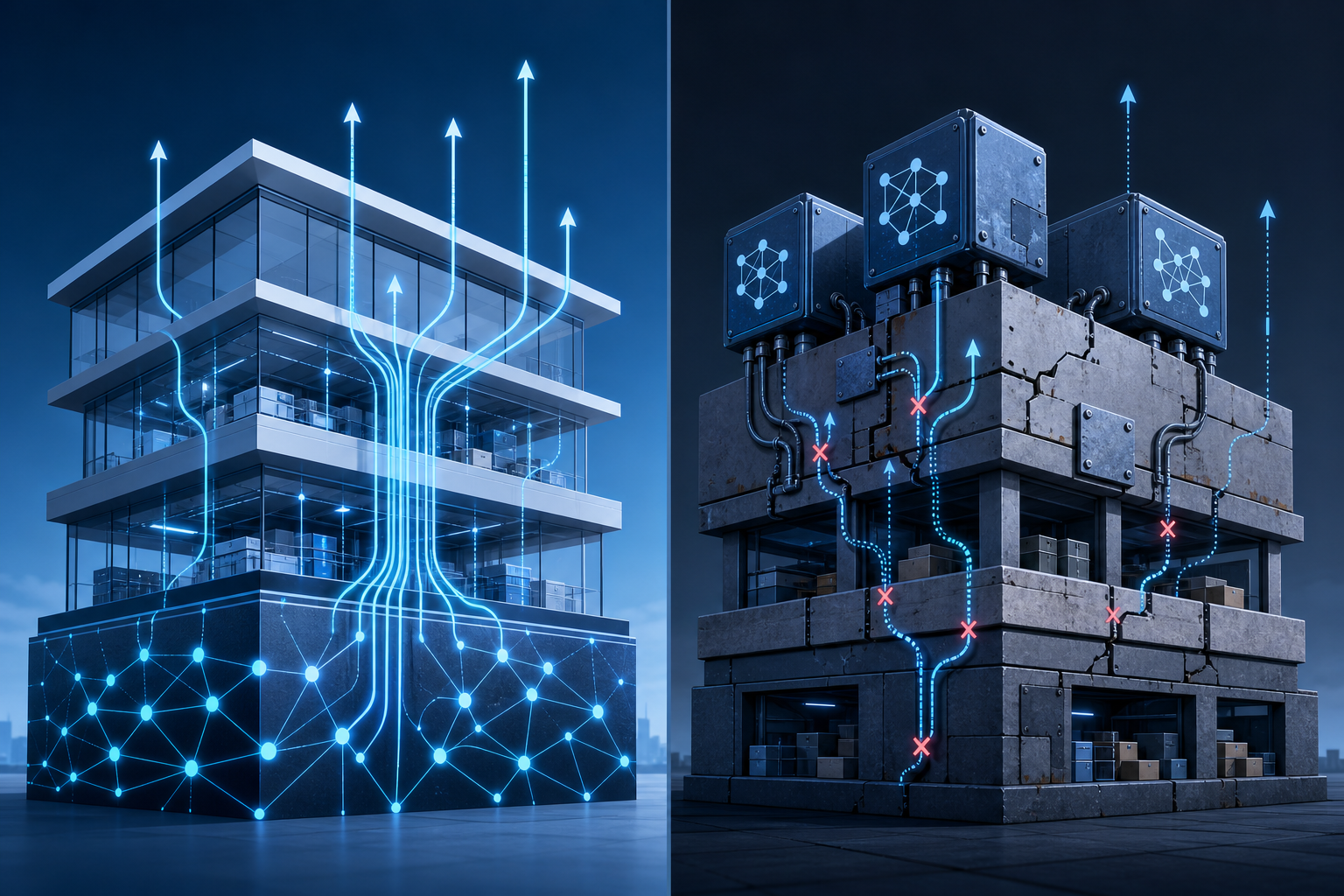
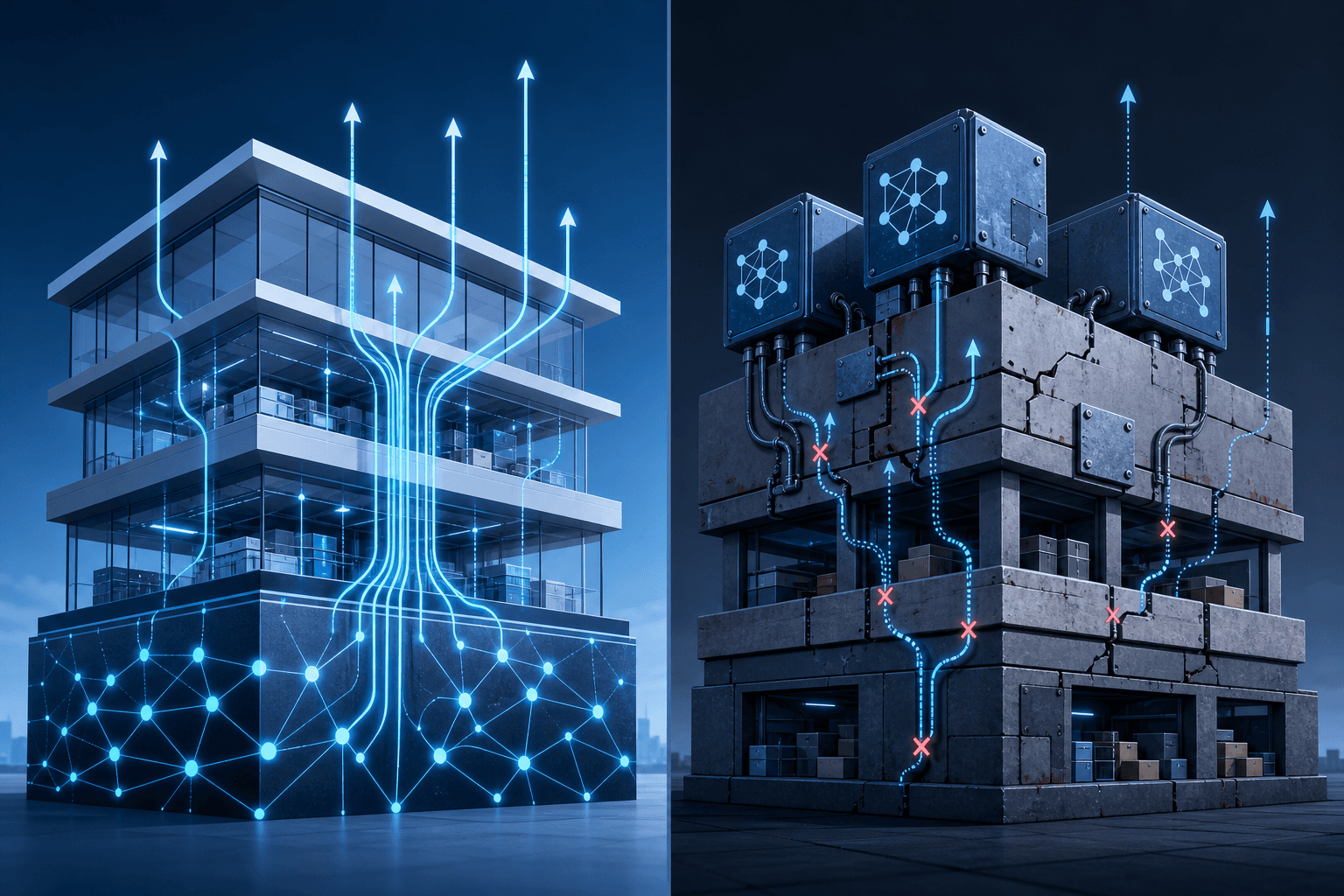
The core thesis of this article is straightforward: Not all supply chain AI companies are architecturally equal. A critical distinction separates platforms that were built on graph-based data models and machine learning from inception — what we call AI-native platforms — from legacy planning and execution systems that added AI features on top of codebases assembled through years of acquisitions. This architectural distinction has measurable consequences, and buyers who ignore it risk selecting a platform whose AI capabilities are constrained by the very foundation they run on.
Defining AI-Native vs. AI-Enhanced: The Architectural Distinction
The difference between AI-native and AI-enhanced platforms is not about which vendor has more data scientists or a longer AI roadmap. It is about whether the platform's data model and processing engine were designed from the ground up to support machine learning workloads, or whether AI capabilities were layered onto an existing transactional system.
What Makes a Platform AI-Native
AI-native platforms share several architectural characteristics:
- Graph-based or unified data models that connect demand, supply, inventory, and revenue planning in a single environment, rather than stitching together separate modules.
- Real-time or near-real-time data ingestion and processing, enabling continuous planning cycles rather than batch-driven updates.
- Machine learning models that are trained and served on the same data platform where planning occurs, eliminating data movement and latency.
- APIs and data access patterns designed for AI consumption from the start, not retrofitted onto transactional interfaces.
o9 Solutions exemplifies this approach. The company built its platform on a proprietary graph-based data model called the Enterprise Knowledge Graph, which connects demand, supply, and revenue planning in a single environment, according to Viewpoint Analysis. This is not a feature — it is a fundamental architectural choice that allows o9 to run machine learning models across all planning dimensions without the data reconciliation overhead that plagues modular systems.
Kinaxis RapidResponse enables continuous, connected planning across demand, supply, inventory, and capacity simultaneously. Its in-memory engine processes changes in real time, allowing planners to see the impact of a demand shift on inventory positions and supplier commitments within seconds. This architecture has earned Kinaxis 11 consecutive years as a Gartner Magic Quadrant Leader, per multiple sources.
Relex, focused on retail and CPG demand planning and inventory optimization, similarly built its platform around a unified data model that ingests point-of-sale data, promotion calendars, and supply constraints into a single forecasting engine. Altana uses an AI-built knowledge graph that covers more than 50% of global trade, mapping multi-tier supplier relationships for enterprises, logistics providers, and government agencies.
What Defines an AI-Enhanced Platform
AI-enhanced platforms are typically the result of decades of organic development and strategic acquisitions. Their core transactional systems — order management, warehouse management, transportation management — were built for deterministic processing, not probabilistic machine learning. AI capabilities were added later, often through acquiring AI startups and integrating their technology into the existing stack.
According to Deposco's November 2025 analysis, platforms built through acquisitions carry technical debt that impacts AI performance and data access. When AI needs real-time data from disparate modules acquired from different vendors, it works with incomplete information. The result is that AI models trained on a subset of available data produce less accurate forecasts and slower response times.
Blue Yonder, which reported $1.3 billion in annual recurring revenue for fiscal year 2023 and processes $25 billion in daily machine workloads, is a prominent example. Its AI capabilities are substantial — the company has invested heavily in machine learning and acquired several AI-focused companies. But the underlying architecture evolved from a supply chain planning and execution platform that was not originally designed for AI-native workloads. Similarly, SAP IBP and Oracle SCM have added AI features to their planning modules, but these features operate within the constraints of their broader ERP ecosystems.
| Dimension | AI-Native Platforms | AI-Enhanced Platforms |
|---|---|---|
| Data model | Unified graph or in-memory model from inception | Modular, assembled through acquisitions |
| AI integration | ML models trained and served on the same platform | AI features layered onto transactional systems |
| Data access | Real-time, cross-functional data access | Siloed across modules, requires reconciliation |
| Planning cycle | Continuous, event-driven | Batch-driven, periodic |
| Technical debt | Minimal — built for AI from the start | Significant — legacy codebases constrain AI performance |
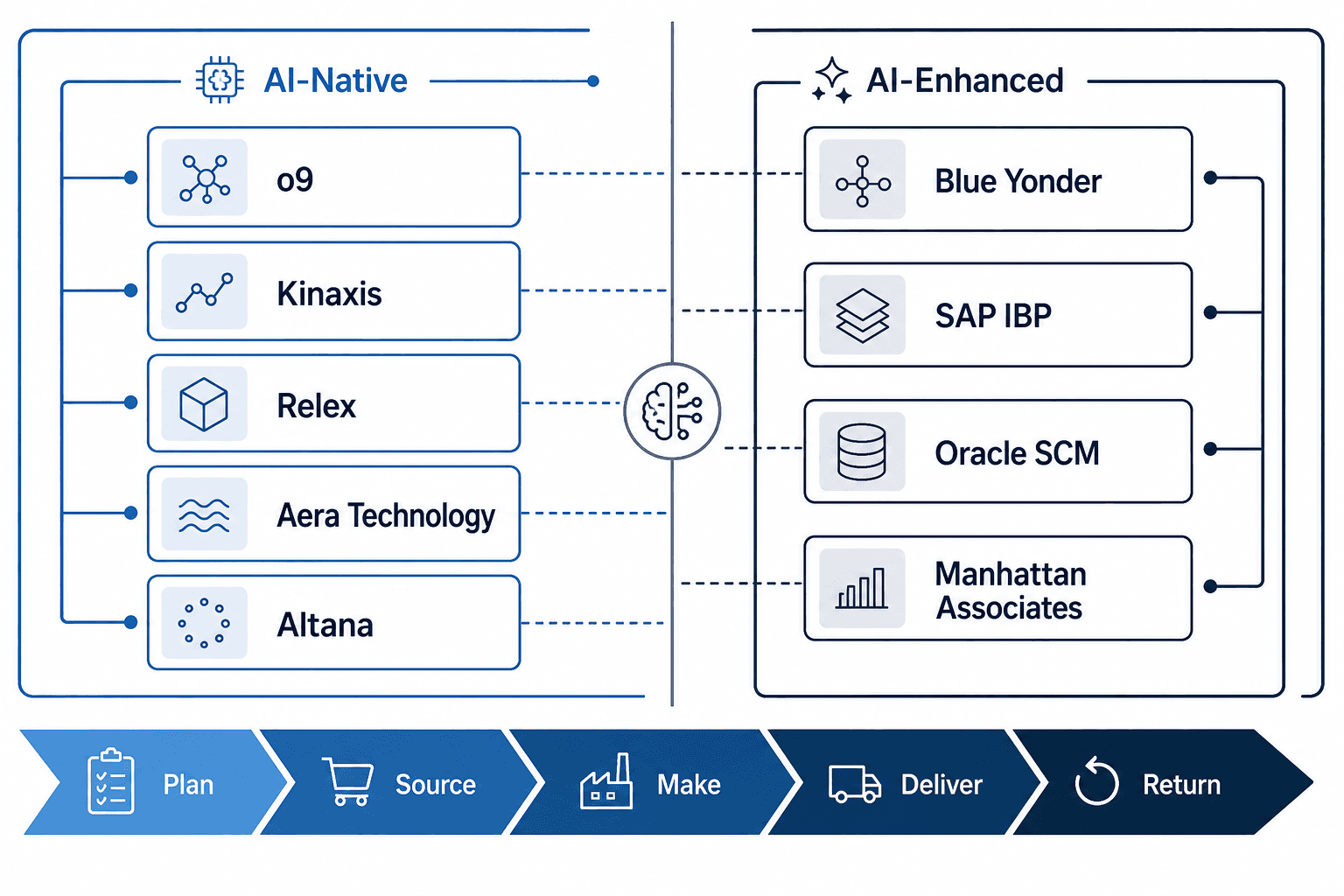
| Representative vendors | o9, Kinaxis, Relex, Aera Technology, Altana | Blue Yonder, SAP IBP, Oracle SCM |
Evaluation Criteria: What to Look for When Assessing AI Supply Chain Platforms
When evaluating AI supply chain platforms, buyers should look beyond feature checklists and assess the architectural characteristics that determine whether AI can deliver on its promise. The following criteria are designed to help enterprise architects and supply chain leaders distinguish genuine AI-native capabilities from AI-enhanced features that may be constrained by legacy infrastructure.
1. Data Architecture: Integrated vs. Siloed
The single most important determinant of AI performance is whether the platform's data model is integrated or siloed. According to McKinsey research cited by Deposco, companies with integrated data foundations spanning planning, execution, and analytics deliver 2-3 times greater ROI than disconnected solutions. This is not a marginal improvement — it is a fundamental multiplier on AI investment.
Ask vendors: How does your platform connect demand, supply, inventory, and financial planning data? Is there a single data model, or do these functions live in separate modules that require data reconciliation? How long does it take for a change in one planning dimension to be reflected across all others?
2. AI Transparency and Explainability
AI-native platforms typically provide greater transparency into how models arrive at recommendations because the data and the model live on the same platform. AI-enhanced platforms, where models may be running on separate infrastructure or consuming data from multiple sources, often produce recommendations that are harder to trace back to specific inputs.
Ask vendors: Can you show me the specific data points that drove a particular forecast or recommendation? How do you handle model drift? What governance mechanisms are in place for AI-generated decisions that affect inventory positions or supplier commitments?
3. Integration Complexity and Implementation Timelines
Implementation timelines are a strong signal of architectural complexity. Deposco reports that implementation timelines of 6-18+ months signal architectural complexity, unexpected cost implications, and delayed AI value delivery. AI-native platforms, with their unified data models and API-first design, typically deploy faster because they do not require extensive data integration and reconciliation work.
Ask vendors: What is the typical implementation timeline for a company of our size and industry? What are the top three factors that could extend that timeline? How much of the implementation effort is data integration vs. configuration?
4. Total Cost of Ownership (TCO)
License fees represent just 20-30% of true TCO, according to Deposco. The remaining 70-80% comes from implementation, integration, data migration, training, and ongoing maintenance. AI-enhanced platforms with complex, multi-module architectures tend to have higher TCO because each integration point and data reconciliation step adds cost.
| Cost Component | AI-Native Platforms | AI-Enhanced Platforms |
|---|---|---|
| License fees | 20-30% of TCO | 20-30% of TCO |
| Implementation | 3-6 months typical | 6-18+ months typical |
| Data integration | Minimal — unified data model | Extensive — multiple data sources to reconcile |
| Training and change management | Moderate | Higher — more modules to learn |
| Ongoing maintenance | Lower — fewer integration points | Higher — more systems to maintain |
Profiles of AI-Native Companies: Evidence of Architectural Advantage
The following profiles illustrate how AI-native architecture translates into measurable performance advantages. Each company's architectural choices are documented with specific evidence from the research sources.
o9 Solutions: Enterprise Knowledge Graph
o9's proprietary Enterprise Knowledge Graph is the foundation of its AI capabilities. By connecting demand, supply, and revenue planning in a single graph-based environment, o9 eliminates the data reconciliation overhead that plagues modular systems. This architecture allows machine learning models to operate across all planning dimensions simultaneously, producing forecasts that reflect the full complexity of the supply chain rather than isolated functional views.
The practical consequence: o9 customers can run what-if scenarios that span demand shifts, supplier disruptions, and inventory policy changes in a single session, with results that reflect the interconnected nature of their supply chains. This is not possible on platforms where demand planning, inventory optimization, and supplier management live in separate modules with different data models.
Kinaxis: Continuous Connected Planning
Kinaxis RapidResponse enables continuous, connected planning across demand, supply, inventory, and capacity. Its in-memory engine processes changes in real time, allowing planners to see the impact of a demand shift on inventory positions and supplier commitments within seconds. Kinaxis achieved $483.1 million in revenue and has been an 11-year consecutive Gartner Magic Quadrant Leader, ranking #1 in Supply Chain Digital's platform rankings.
The architectural advantage here is the in-memory processing engine that eliminates batch processing delays. When a demand signal changes — a retailer cancels a promotion, a competitor launches a product — Kinaxis recalculates the entire supply-demand balance in real time, not at the next scheduled batch run. This is a direct consequence of building the platform around continuous planning rather than periodic planning cycles.
Altana: AI-Built Knowledge Graph for Global Trade
Altana uses an AI-built knowledge graph that covers more than 50% of global trade, mapping multi-tier relationships for enterprises, logistics providers, and government agencies. The platform analyzes 2.8 billion shipments, 500 million companies, and 850 million facilities, according to Landbase. Altana achieved unicorn status through a $200 million investment with a $322 million Series C.
The most striking evidence of Altana's architectural advantage comes from a Fortune 10 automaker deployment. According to a monday.com comparison published in May 2026, the automaker reported a 7,000% increase in sub-tier supplier visibility within four weeks of deployment. This level of visibility — mapping suppliers multiple tiers deep across the supply chain — is only possible with a graph-based architecture that can ingest and connect disparate data sources at scale.
Aera Technology: Decision Intelligence on Existing Systems
Aera Technology takes a different approach. Rather than replacing existing ERP and supply chain systems, Aera sits on top of them, using AI to augment and automate decisions. According to Viewpoint Analysis, Aera describes itself as a Decision Intelligence platform that uses AI to augment decisions rather than replacing platforms.
This is a third architectural path — not AI-native in the sense of replacing legacy systems, but AI-native in the sense that the decision intelligence layer is built from the ground up for machine learning. Aera's architecture is designed to consume data from existing systems, apply AI models, and return recommendations or automated actions without requiring those systems to be rebuilt.
Profiles of AI-Enhanced Platforms: Honest Assessment of Trade-Offs
AI-enhanced platforms are not without strengths. They offer breadth of functionality, deep ERP integration, and established customer bases. But buyers should understand the architectural trade-offs that come with these platforms.
Blue Yonder: Scale and Investment, but Architectural Constraints
Blue Yonder reported $1.3 billion in annual recurring revenue for fiscal year 2023 and processes $25 billion in daily machine workloads. The company has invested heavily in AI and machine learning, acquiring several AI-focused companies and building substantial ML capabilities. Its AI features include demand forecasting, inventory optimization, and transportation planning.
However, Blue Yonder's architecture evolved from a supply chain planning and execution platform that was not originally designed for AI-native workloads. The company has grown through acquisitions, and its platform reflects this history. According to Deposco, platforms built through acquisitions carry technical debt that impacts AI performance because AI needs real-time data access across modules acquired from different vendors.
For a detailed architectural comparison between Blue Yonder and Kinaxis, see Blue Yonder vs. Kinaxis: A Supply Chain Planning Platform Comparison for Enterprise Buyers. That article examines the architectural differences between these two specific platforms in greater depth.
SAP IBP and Oracle SCM: ERP Ecosystem Depth
SAP Integrated Business Planning (IBP) and Oracle SCM Cloud benefit from deep integration with their respective ERP ecosystems. For organizations already running SAP or Oracle ERP, these platforms offer the advantage of native data connectivity — no additional integration layer required.
The trade-off is that these platforms are constrained by the architecture of the ERP systems they sit on. SAP IBP, for example, operates within SAP's broader ecosystem, and its AI capabilities are limited by the data structures and processing models of that ecosystem. Oracle SCM similarly inherits the architectural characteristics of Oracle's cloud infrastructure.
Both vendors are adding AI features — SAP with its Joule AI copilot embedded throughout its cloud solutions, and Oracle with AI capabilities in its SCM modules. But these features operate within the constraints of the underlying ERP architecture, which was designed for transactional processing, not machine learning.
Comparing Outcomes: Implementation Speed, ROI, and Forecast Accuracy
The architectural differences between AI-native and AI-enhanced platforms translate into measurable differences in outcomes. The following table summarizes the available data across key dimensions.
| Outcome Metric | AI-Native Platforms | AI-Enhanced Platforms | Source |
|---|---|---|---|
| Implementation timeline | 3-6 months typical | 6-18+ months typical | Deposco, Nov 2025 |
| Forecast error reduction | Up to 50% | Varies by module | McKinsey (via Intellias, May 2026) |
| ROI from integrated data | 2-3x greater | Baseline | McKinsey (via Deposco) |
| License fees as % of TCO | 20-30% | 20-30% | Deposco, Nov 2025 |
| Sub-tier supplier visibility | 7,000% increase in 4 weeks (Altana) | Limited to direct suppliers | monday.com, May 2026 |
| Transportation cost reduction | 5-10% | 5-10% | Deposco, Nov 2025 |
| Delivery reliability improvement | Up to 20% | Up to 20% | Deposco, Nov 2025 |
Comments
Join the discussion with an anonymous comment.