The Scale of the Problem: 40% of AI Sales Forecasting Implementations Fail in Year One
Supply chain and revenue operations leaders are pouring millions into AI sales forecasting platforms, yet the returns are far from guaranteed. According to industry analysis cited by Oliv AI, approximately 40% of AI sales forecasting software implementations fail to deliver measurable ROI within the first 12 months. For organizations already running lean planning teams and facing pressure to reduce forecast error, that failure rate represents a significant operational and financial risk.
The pattern is familiar to anyone who has been through a failed tool rollout: initial enthusiasm gives way to frustration as predictions consistently miss the mark, sales teams revert to manual spreadsheets, and the platform becomes an expensive data graveyard. This is not a niche problem. It affects companies of all sizes, across industries, and it is the primary reason many supply chain leaders remain skeptical about AI-driven pipeline forecasting.
This failure rate is not isolated to sales forecasting. A similar dynamic plays out across supply chain AI projects more broadly. For a deeper look at the systemic causes behind predictive analytics failures in supply chain contexts, see our analysis on why 73% of predictive analytics projects fail and the five root causes that undermine them.
Dirty Data Is the #1 Cause: 63% of Failures Traced to CRM Data Quality
When implementation post-mortems are conducted, one cause surfaces far more frequently than any other: poor CRM data quality. According to Oliv AI's analysis of over 1,000 forecasts across more than 50 companies, 63% of failed AI sales forecasting implementations can be traced directly to dirty CRM data. This includes incomplete deal records, outdated contact fields, incorrectly tagged pipeline stages, and stale close dates.
The mechanism is straightforward but devastating. Machine learning models — no matter how sophisticated — learn from the data they are fed. If that data is incomplete or inaccurate, the model's predictions will be unreliable. The MarketsAndMarkets analysis puts it bluntly: "Implementing sophisticated AI on poor data foundation produces sophisticated garbage predictions." Within weeks of deployment, users lose trust in the system. Once trust erodes, adoption collapses, and the implementation fails.
- Incomplete deals: Missing opportunity values, unclear stages, or absent product line details
- Outdated contact fields: Stale phone numbers, bounced emails, or contacts who have changed roles
- Incorrectly tagged stages: Deals marked as "closed won" that are still in negotiation, or "disqualified" deals that were actually lost
- Stale close dates: Opportunities with close dates that have passed without being updated
This is not the same as the data quality challenges faced in inventory optimization or demand planning. CRM pipeline data is entered manually by sales representatives, often under time pressure and with subjective judgment. Standardized data entry and governance are essential, but many organizations lack the processes to enforce them. The result is a data foundation that is fundamentally unsuited for AI training.
Why Legacy Platforms (Einstein, Clari, Gong) Cannot Fix the Data Issues They Inherit
Many organizations assume that deploying a more advanced AI forecasting tool will automatically solve their accuracy problems. In practice, legacy platforms like Salesforce Einstein Forecasting, Clari, and Gong inherit the data quality issues of the CRM systems they sit on top of. They do not fix the underlying data — they train on it.
Salesforce Einstein Forecasting, for example, applies machine learning models directly to existing Salesforce data. If that data is 60% incomplete — a scenario that is not uncommon in organizations with loose data governance — the resulting predictions will be unreliable. The platform cannot distinguish between a deal that was genuinely lost and one that was simply never updated. It cannot fill in missing opportunity values or correct misclassified stages.
| Capability | Legacy Platforms (Einstein, Clari, Gong) | AI-Native Platforms |
|---|---|---|
| Data cleansing approach | One-time project or manual cleanup | Continuous, automated capture and enrichment |
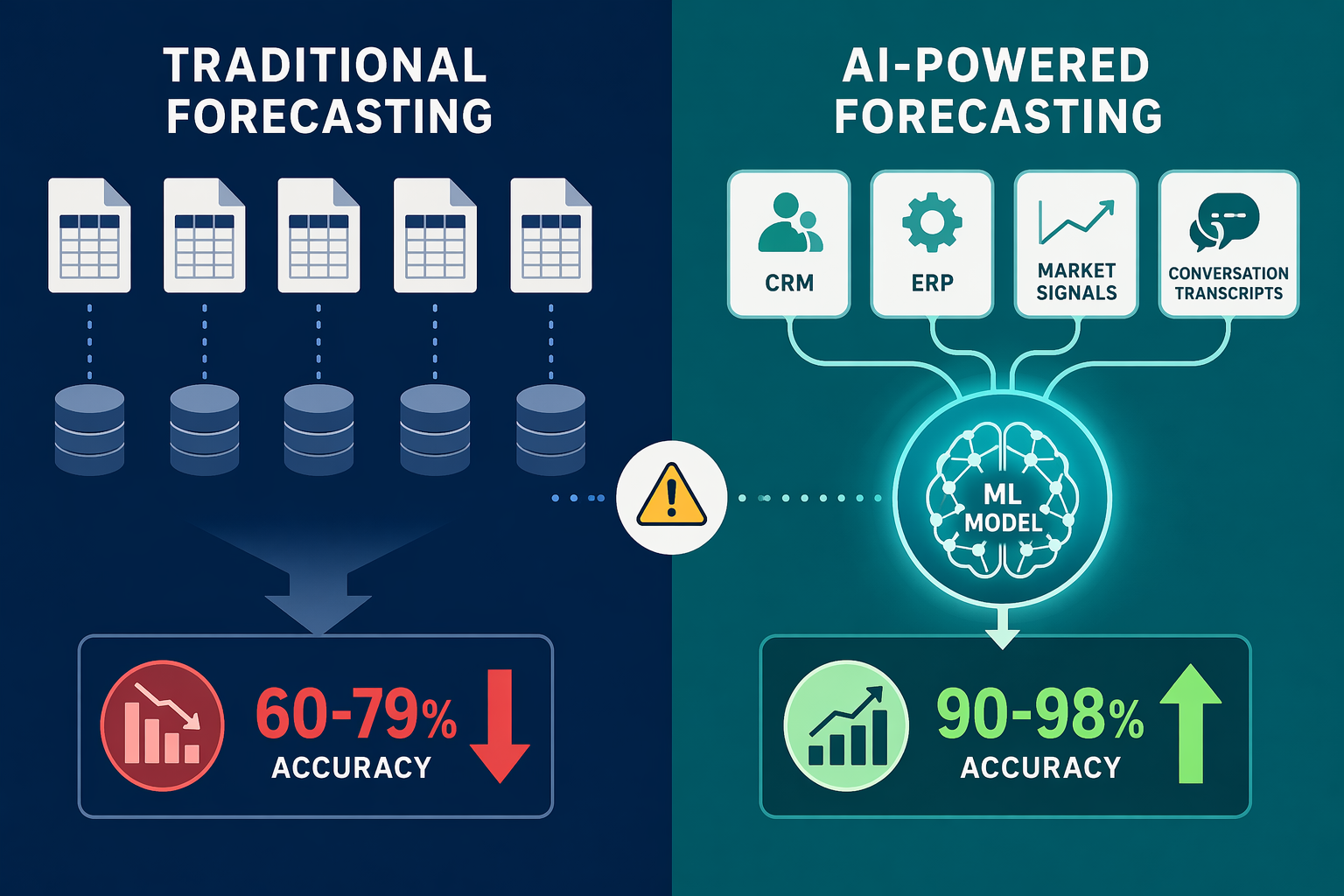
| Accuracy range | 60–79% (Gartner 2024 survey) | 90–98% (Oliv AI analysis) |
| Implementation timeline | 3–6 months | 2–4 weeks |
| Pricing (typical) | ~$500/user/month (Gong+Clari stacked) | $80–150/user/month |
| Data source dependency | Relies on manual CRM entries | Activity-based intelligence (auto-capture) |
The cost of stacking multiple tools — using Gong for conversation intelligence and Clari for forecasting, for example — can reach approximately $500 per user per month. That is a significant investment for a system that still depends on the quality of manually entered CRM data. Organizations that take this route often find themselves paying more for less reliable predictions.
How Generative AI-Native Architectures Address Data Quality Through Autonomous Capture and Enrichment
A newer generation of AI-native sales forecasting platforms takes a fundamentally different approach to the data quality problem. Instead of training on whatever data happens to exist in the CRM, these platforms use autonomous agents — such as CRM Manager, Pipeline Tracker, and Data Cleanser agents — to continuously capture, enrich, and maintain clean CRM data as a background process.
The key architectural difference is activity-based intelligence. Rather than relying on sales representatives to manually log every interaction, these platforms track client interactions across email, calendar, and communication platforms automatically. This means deal stages are updated based on actual activity, close dates reflect real conversations, and opportunity values are adjusted as scope changes — all without manual input.
- CRM Manager agent: Continuously scans for incomplete records, missing fields, and stale data, then triggers enrichment workflows
- Pipeline Tracker agent: Monitors deal progression through stages based on actual activity signals, not manual stage updates
- Data Cleanser agent: Identifies and corrects common data quality issues — duplicate records, misclassified stages, outdated contacts
- Activity intelligence engine: Captures client interactions across email, calendar, and communication platforms without manual logging
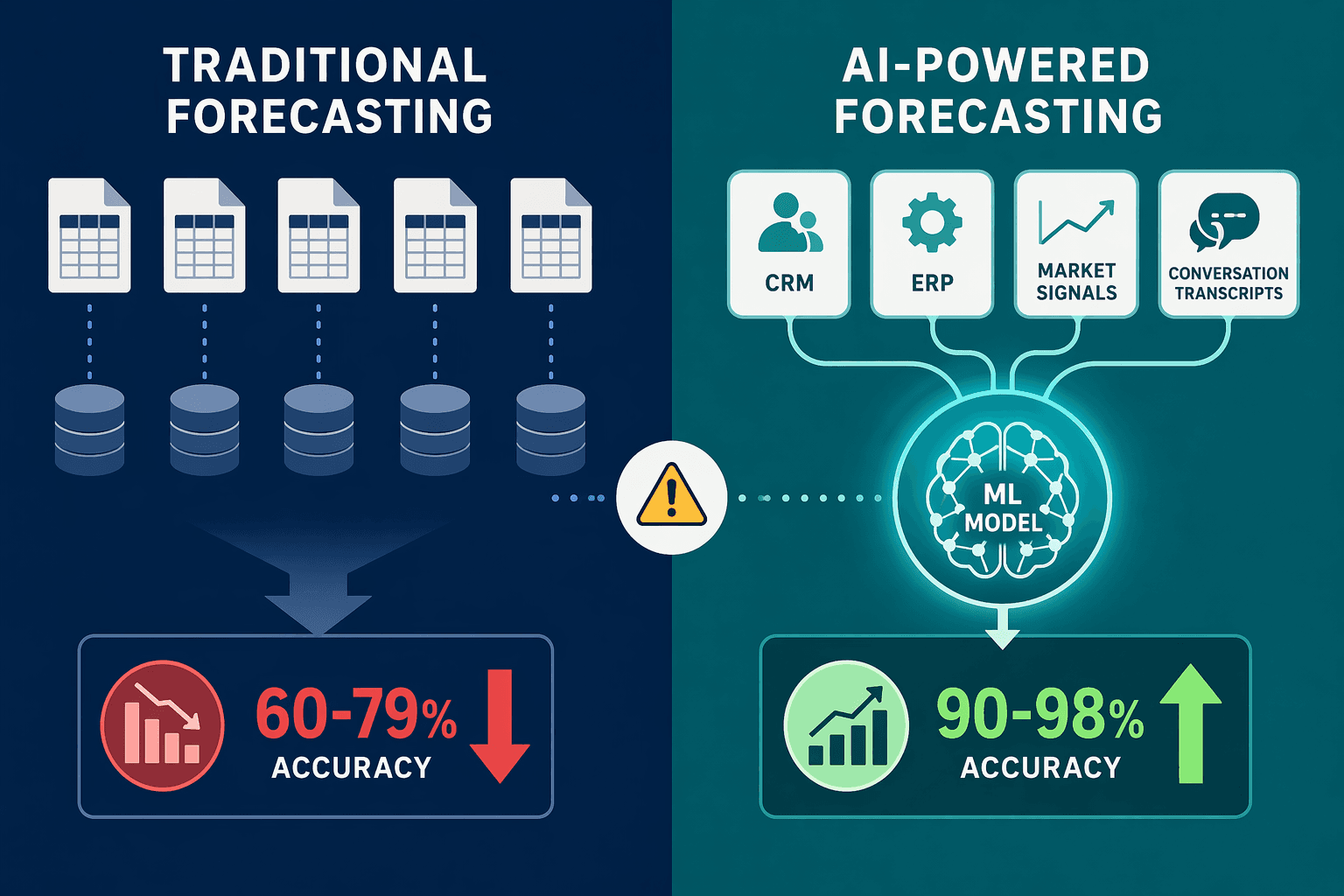
The impact on implementation timelines is substantial. Legacy platforms typically require 3 to 6 months to deploy, largely because data cleansing and preparation is a manual, upfront project. AI-native platforms, by contrast, can be operational in 2 to 4 weeks because data hygiene is built into the platform's ongoing operation rather than treated as a prerequisite.
The accuracy results are correspondingly better. While traditional manual forecasting and legacy AI platforms typically deliver 60–79% accuracy (per Gartner's 2024 survey), AI-native platforms that combine autonomous data capture with machine learning forecasting can achieve 90–98% precision, according to Oliv AI's analysis. The Sopro research further confirms that 86% of AI-using sales teams report a positive return within the first year of adoption.
Implementation Roadmap: From Data Audit to Full Deployment in 90 Days
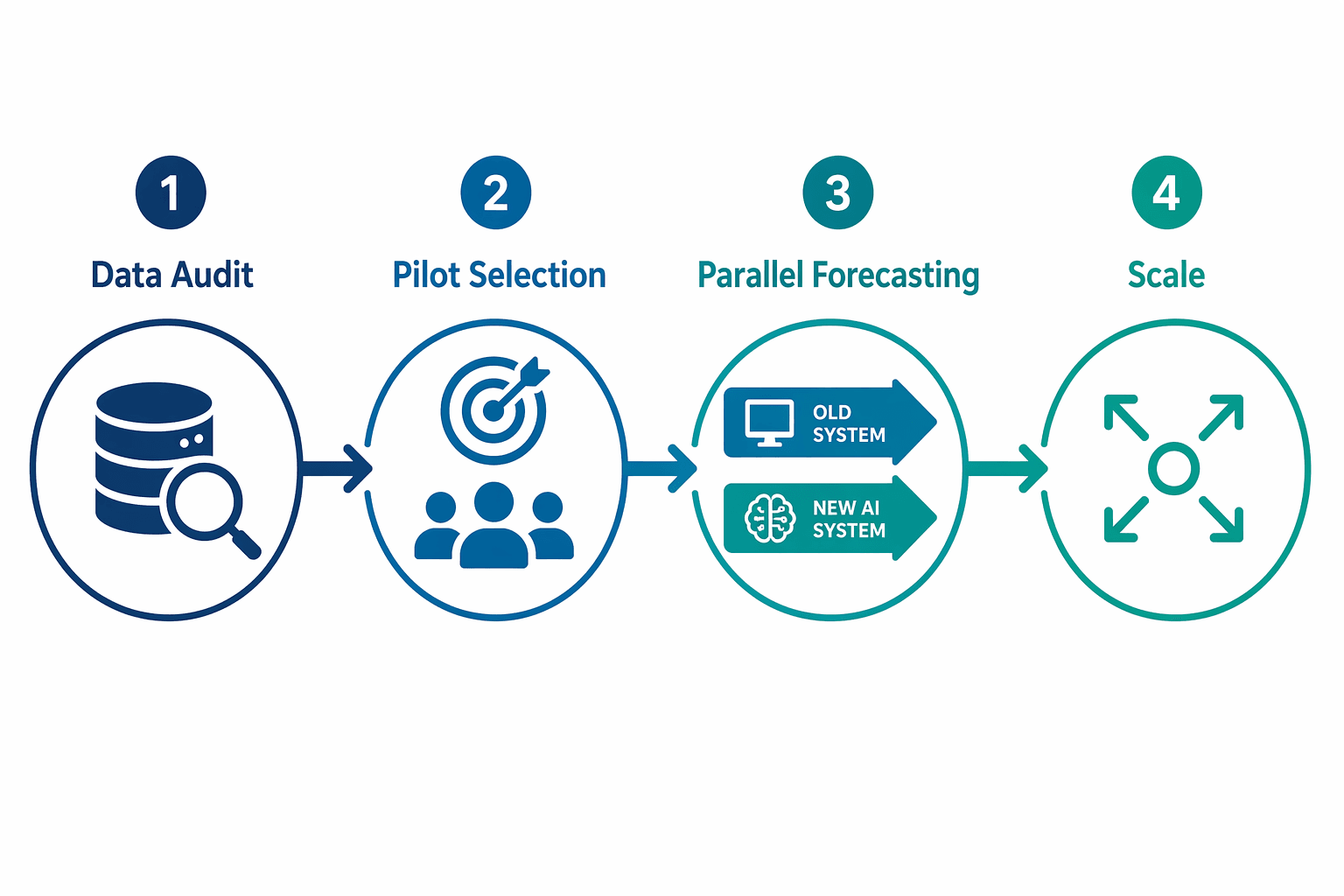
Organizations that want to avoid the 40% failure rate need a structured approach to implementation. The following 90-day roadmap, adapted from the Forecastio improvement methodology, provides a phased path from data audit to full deployment.
| Phase | Duration | Key Activities | Success Criteria |
|---|---|---|---|
| 1. Data Audit | Weeks 1–2 | Assess CRM completeness, stage accuracy, field hygiene, and close-date reliability. Identify the top 5 data quality issues. | Baseline data quality score established. Clear list of data issues to address. |
| 2. Pilot Selection | Weeks 3–4 | Choose a small, predictable sales segment (e.g., one region or product line). Define accuracy metrics (MAPE, sMAPE). | Pilot scope defined. Baseline accuracy measured for the selected segment. |
| 3. Parallel Forecasting | Weeks 5–8 | Run AI predictions alongside existing manual forecasts. Compare results weekly. Identify discrepancies and root causes. | AI predictions match or exceed manual forecast accuracy for 4 consecutive weeks. |
| 4. Scale | Weeks 9–12 | Expand to full pipeline. Establish ongoing data governance processes. Train team on AI-native workflows. | Full pipeline coverage. Accuracy maintained or improved at scale. |
The data audit phase is the most critical. Organizations should measure accuracy using standard metrics like Mean Absolute Percentage Error (MAPE) and Symmetric Mean Absolute Percentage Error (sMAPE), as recommended by Forecastio. Common causes of poor accuracy include stale deals, incorrect close dates, and incomplete CRM data — the classic "garbage in, garbage out" problem.
For a broader perspective on how this implementation roadmap fits into an organization's overall AI maturity journey, see our practical AI maturity roadmap for supply chain leaders, which covers the stages from pilot to P&L impact.
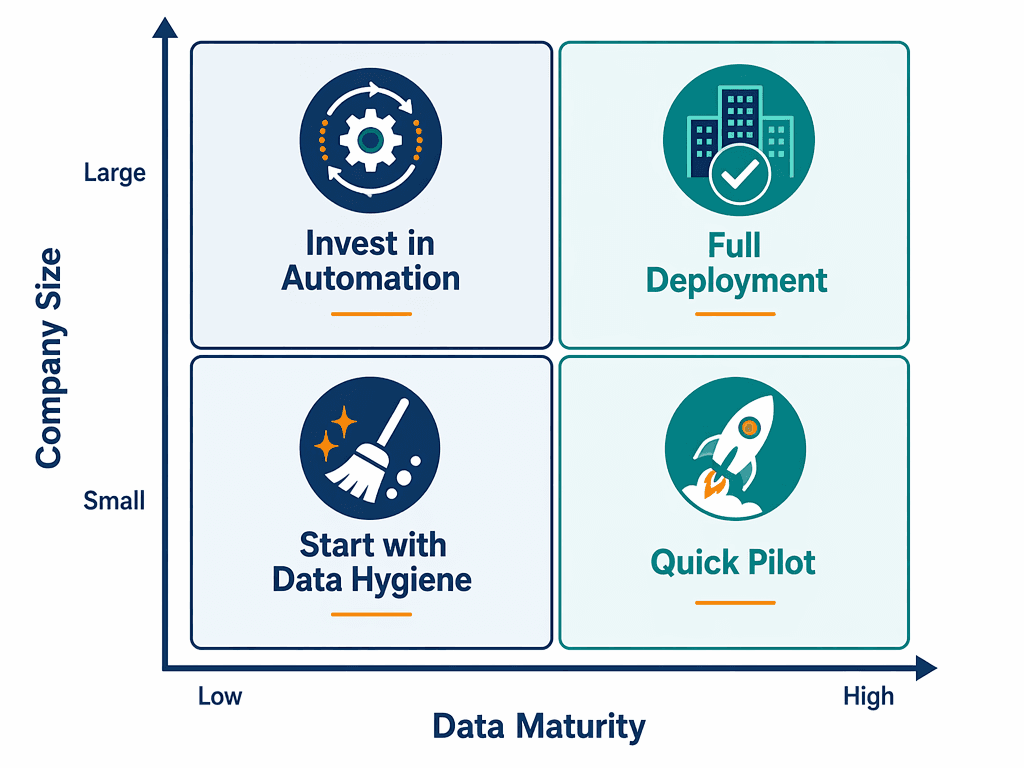
Decision Framework: Choosing the Right Approach by Company Size and Data Maturity
Not every organization needs the same approach. The right strategy depends on two variables: company size (which correlates with pipeline complexity and budget) and data maturity (which determines how much cleanup is needed before AI can deliver value).
Comments
Join the discussion with an anonymous comment.