

The usable benchmark for ai sales forecasting software in 2026 is not the largest number on a vendor slide. For CRM-pipeline revenue forecasting, a realistic enterprise expectation is roughly 70–85% accuracy at a 30-day horizon and 65–75% at a 90-day horizon, with AI/ML systems reducing forecast variance from the ±25–35% band common in manual rep roll-ups to about ±8–15% in benchmarked AI/ML comparisons.[1] That improvement is large enough to change operating decisions. It is not large enough to treat every 95% accuracy claim as transferable to next-quarter enterprise revenue.
The distinction matters because a forecast number becomes more than a dashboard metric once finance, sales, and planning teams start using it. A cleaner 30-day commit forecast can steady cash expectations, reduce late-quarter escalation, and give supply planning a better demand signal. A weak 90-day forecast can do the opposite: push hiring ahead of revenue, overstate pipeline coverage, or send the wrong signal into downstream planning. For readers comparing sales-side and demand-side use cases, this article is about CRM pipeline revenue prediction, not SKU-level inventory demand forecasting; that boundary is covered more fully in AI Sales Forecasting vs. AI Demand Forecasting: What Supply Chain Leaders Need to Know Before Buying Software.

The benchmark range buyers can actually use
The cleanest way to read the current evidence is by separating method improvement from absolute accuracy. The Optifai benchmark, based on 939 companies across Q1–Q3 2025, places AI/ML forecast variance at ±8–15%, compared with ±25–35% for manual rep roll-ups.[1] That is the number a RevOps leader can use in a business case: not “AI will make forecasting perfect,” but “AI may cut the forecast error band by a material amount if the inputs are fit for purpose.”
That same reading is consistent with the broader market signal that very high forecast accuracy is unusual across sales organizations. Gartner’s benchmark is commonly cited as finding that only 7% of sales organizations achieve 90%+ forecast accuracy, with median B2B forecast accuracy sitting in the 70–79% range.[2] The useful implication is not that strong performance is impossible. It is that 90%+ should be treated as an achieved operating condition, not a default assumption at purchase.
| Forecasting approach or condition | Benchmark signal | How to use it in evaluation |
|---|---|---|
| Manual rep roll-ups | ±25–35% variance | A reasonable baseline for organizations still relying on rep judgment, spreadsheet consolidation, and manager negotiation |
| AI/ML sales forecasting | ±8–15% variance | A realistic improvement band when CRM data and opportunity history are usable |
| Median B2B forecast performance | 70–79% accuracy | A sanity check against assuming every organization can immediately operate above 90% |
| Top-tier 90%+ performance | Reached by a small minority of organizations | A stretch benchmark that requires scrutiny of horizon, data quality, and measurement method |
The field still lacks a single authoritative, vendor-independent benchmark study that standardizes horizon, sales motion, CRM quality, and accuracy definition across tools. That does not make the available data useless. It means buyers should avoid compressing several different measurements into one tidy claim. A 30-day opportunity-level prediction, a 90-day regional revenue forecast, and a full-quarter enterprise commit number are not the same forecasting problem.
Accuracy decays as the forecast horizon stretches
The most common mistake in evaluating ai sales forecasting software is asking for “the accuracy number” without asking “at what horizon?” Across the benchmark cluster in the research brief, short-horizon performance is consistently stronger: about 85–90% at 30 days, 75–80% at 60 days, and 65–75% at 90 days, with accuracy decaying roughly 5–8 percentage points per month as uncertainty compounds.[1]

At 30 days, the model is reading a pipeline that is already in motion
A 30-day forecast has structural advantages. Late-stage opportunities have more activity history, buyer engagement is easier to observe, close dates are less theoretical, and sales managers usually know which deals are truly in play. Under those conditions, high accuracy claims can be technically plausible, especially if the CRM has been cleaned and the vendor is measuring a narrow forecast population.
This is where some 95%+ claims should be placed: not dismissed, but contained. A vendor may be accurately reporting performance for a short-horizon, cleaned-data, well-instrumented forecast. The problem begins when that number is allowed to stand in for every pipeline segment, every region, every product line, and every forecast horizon.
At 60 days, opportunity quality starts to separate from pipeline volume
The 60-day view is where inflated pipeline coverage often starts to show. Deals that looked plausible at the beginning of the quarter may not have advanced. Buyer committees may have gone quiet. Close dates may have moved without corresponding changes in stage, next step, or probability. AI can help by detecting patterns that manual roll-ups miss, but it is still forecasting from recorded signals. If the activity trail is thin or stale, the model has less to work with.
At 90 days, enterprise forecasting becomes a business-process test
By 90 days, the forecast is no longer only a model test. It is also a test of pipeline discipline, sales-cycle stability, deal inspection quality, and whether teams update CRM records when reality changes. The 65–75% benchmark range for 90-day sales forecasts is not a sign that AI has failed. It reflects the fact that the model is now looking across more unresolved events: budget approval, legal review, procurement timing, competitor movement, rep behavior, and executive intervention.
A buyer evaluating vendors should therefore ask for horizon-specific backtesting. The relevant comparison is not “vendor forecast versus spreadsheet forecast” in the abstract. It is 30-day, 60-day, and 90-day performance against the same historical periods, using the same opportunity population, with the same definition of accuracy.
CRM data quality often predicts accuracy better than model sophistication
The less glamorous benchmark is also the one that prevents the most disappointment: CRM data hygiene. HubSpot/Prospeo/Forecastio-style findings cited in the research brief place CRM data decay at 2.1% per month, estimate that up to 70% of B2B databases can become unreliable within a year, and report that cleaning CRM data alone can improve forecast accuracy by up to 30%.[3] Those figures are not a side note. They explain why two companies can buy similar AI forecasting capabilities and see very different results.
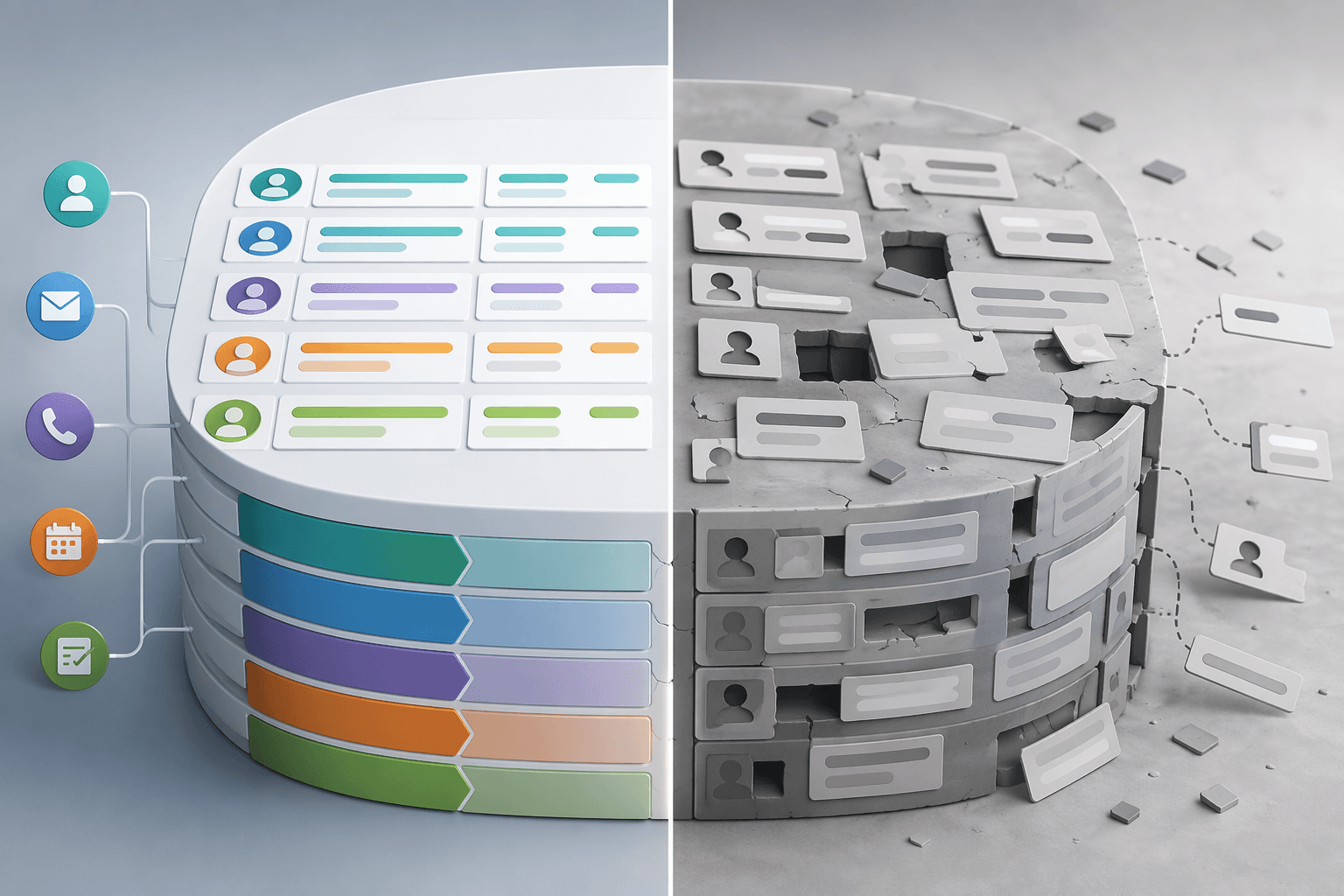
Forecasting systems learn from what the business records. If opportunity stages are used inconsistently, if close dates are rolled forward without explanation, if next steps are missing, if inactive deals remain open, and if activity data does not reflect actual buyer engagement, the model inherits the mess. More sophisticated algorithms may detect some inconsistencies, but they cannot reliably infer every missing buying signal from a hollow record.
This is why CRM readiness should be part of the benchmark, not a separate implementation chore. Before accepting a vendor’s accuracy estimate, buyers should know what portion of opportunities have complete required fields, how often close dates are changed, how stale late-stage opportunities are handled, whether historical losses are coded consistently, and whether sales activity data is actually captured. The deeper treatment of this failure mode belongs in Why 63% of AI Sales Forecasting Implementations Fail — and How Supply Chain Leaders Can Avoid the Data Quality Trap, but the practical point is simple: dirty CRM data compresses the difference between an expensive AI system and a disciplined spreadsheet.
| CRM condition | Likely forecasting consequence |
|---|---|
| Close dates repeatedly pushed without stage movement | The system may overestimate near-term revenue and understate deal slippage |
| Late-stage opportunities with no recent buyer activity | The model may treat nominal pipeline as healthier than it is unless inactivity is weighted properly |
| Inconsistent opportunity stages across teams | Cross-region or cross-segment accuracy becomes difficult to compare |
| Missing loss reasons or weak historical outcome data | Win-probability learning is constrained because the model sees outcomes without enough context |
| Duplicate or stale account and contact records | Engagement signals can be fragmented or attached to the wrong selling context |
How to read 95%+ vendor accuracy claims
Aviso and Oliv-style claims in the 95–98% range should be read as best-case or condition-specific evidence rather than universal enterprise benchmarks. Aviso has published implementation and ROI material around predictive sales forecasting, while Oliv discusses improving sales forecast accuracy with AI and cites high accuracy potential.[4][5] Those materials are useful for understanding what vendors believe their systems can achieve, but they are not the same as a standardized, independent benchmark across messy CRM histories and 90-day enterprise forecasts.
The right question is not whether the number is “real.” It may be real for a defined test set. The question is whether the conditions match the buyer’s operating environment. A 95% figure based on cleaned CRM data, short-horizon opportunities, selected deal profiles, or a narrow forecast definition should not be used to promise the CFO 95% accuracy across all next-quarter revenue.
A useful vendor evaluation should therefore request the measurement method behind the claim:
- What forecast horizon was measured: 30, 60, 90 days, or something else?
- Was accuracy measured at the opportunity level, team level, region level, or total revenue level?
- Were stale, missing, or duplicate CRM records excluded before testing?
- Was the backtest run on all historical opportunities or only on opportunities with sufficient data?
- Was the comparison made against manual rep commits, manager-adjusted forecasts, or final actual revenue?
- How did the vendor treat slipped deals, renewals, expansions, and multi-quarter enterprise opportunities?
For broader shortlisting, vendor feature coverage belongs in a different decision layer. A landscape view such as AI Sales Forecasting Software Vendor Landscape 2026: A Supply Chain Buyer's Guide can help compare platform positioning, but accuracy claims still need to be normalized by horizon and data condition before they enter a business case.
Adoption does not prove forecast impact
AI adoption has moved faster than measurable enterprise impact. McKinsey’s Global Survey reports that 63% of respondents say their organizations regularly use AI, while 39% report measurable EBIT impact at the enterprise level.[6] That gap is a useful caution for sales forecasting buyers. Using AI in the forecast process is not the same as reducing forecast variance in a way finance can bank on.
In sales forecasting, the gap usually appears in ordinary operating details. A pilot may show strong accuracy on a clean segment, but the enterprise rollout includes legacy CRM fields, inconsistent opportunity definitions, rep resistance, regional sales-cycle differences, and forecast meetings that still reward negotiation over signal quality. The software can improve the forecast only if the business is willing to let the model expose weak pipeline rather than use it as another slide in the roll-up.
What benchmark to put in the business case
A defensible 2026 business case for ai sales forecasting software should use a range, not a single promise. The strongest starting assumption is that AI/ML can reduce forecast variance materially versus manual roll-ups, with the Optifai benchmark pointing to ±8–15% AI/ML variance compared with ±25–35% for manual methods.[1] Then the business case should split expected accuracy by horizon: strongest at 30 days, weaker at 60 days, and meaningfully more uncertain at 90 days.
| Evaluation question | Practical benchmark stance |
|---|---|
| What should we expect at 30 days? | Roughly 70–85% enterprise-wide is defensible; 85–90% may be possible in cleaner, narrower conditions |
| What should we expect at 60 days? | Roughly 75–80% is a reasonable benchmark band when data quality is adequate |
| What should we expect at 90 days? | Roughly 65–75% is more realistic than assuming 90%+ across the enterprise |
| What improvement matters most? | Reduction in variance versus manual roll-ups, especially if it changes finance, hiring, inventory, or capacity decisions |
| What should be tested before purchase? | Historical backtesting on the buyer’s own CRM data, split by horizon, segment, region, and forecast type |
For supply chain leaders, the sales forecast also needs translation into downstream demand and capacity planning. Better CRM-pipeline accuracy can improve the signal that planning teams receive, but it does not replace demand forecasting methods that operate at product, customer, channel, or SKU level. The handoff between the two is discussed in How AI Sales Forecasting Connects to Demand Planning, while demand-side accuracy expectations belong in AI Demand Forecasting Accuracy: What Supply Chain Leaders Can Expect in 2026.
The buyer’s benchmark should be operational transferability: whether a vendor can show what happens to 30-day, 60-day, and 90-day forecasts on the buyer’s own data, under the buyer’s actual sales motion, with a measurement method finance accepts. AI sales forecasting software is worth evaluating because a move from ±25–35% manual variance toward ±8–15% AI/ML variance can matter a great deal. It should be bought against horizon-specific accuracy, CRM readiness, and transparent backtesting—not against the largest headline number available.
References
- Sales Forecast Accuracy Benchmark, Optif AI.
- Gartner forecast accuracy benchmark, Gartner via multiple sources.
- AI Sales Forecasting Accuracy, Prospeo.
- Predictive Sales Forecasting: Real-World Implementation and ROI, Aviso.
- Improve Sales Forecast Accuracy with AI, Oliv AI.
- McKinsey Global Survey, McKinsey.
Comments
Join the discussion with an anonymous comment.