
The hard part of AI for river cruise logistics disruption planning begins before the disruption is visible to passengers. A water-level forecast changes overnight. The itinerary team starts looking at bridge clearances, docking alternatives, and excursion timing. At the same time, the vessel is already moving toward a turnaround window in which produce, linen, hotel stores, waste handling, crew movements, and buses have to meet a quay that may not be the quay in yesterday’s plan.
That is why river cruise logistics cannot be treated as a smaller version of ocean-cruise logistics. ShermansTravel cited an industry-consensus estimate that 5–10% of river cruises are affected by high- or low-water disruptions, with low-water risk concentrated in mid-to-late summer and high-water risk tied to spring snow melt; the range is useful as a problem-size marker, not as a precise operating statistic for every river or season.[1] A Rhine plan, a Danube plan, and a Seine plan do not carry the same water-level exposure.
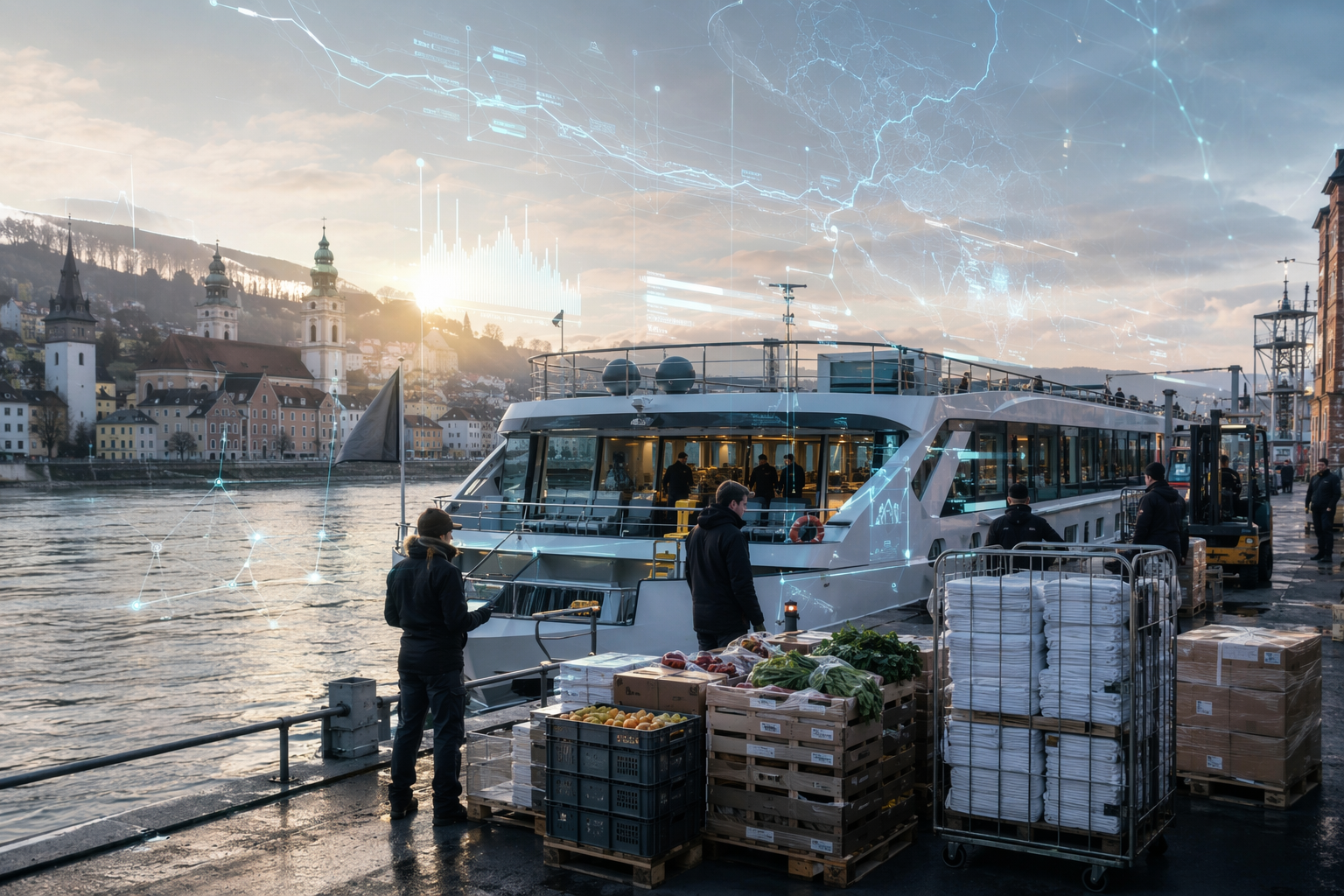
The business case for earlier disruption planning is stronger than it used to be. Technavio’s 2025 river cruise market analysis reports that operators using AI-driven weather forecasting and river-depth monitoring can reduce itinerary disruptions by up to 50% compared with fleets without such systems.[2] That figure is large enough to deserve executive attention. It is also a gated-report summary, so the public material does not let operators inspect sample size, methodology, or what counted as a disruption. It should be treated as attributed analysis, not as independently verified proof.
Even with that caveat, the direction is credible. AI adds value when it combines weather signals, river-depth readings, itinerary constraints, supplier availability, port access, and onboard inventory early enough for people to change the plan before the only remaining choices are apology letters and emergency coach transfers. Prediction is useful only if it arrives while there is still room to resequence provisioning, substitute a supplier, change an embarkation port, or adjust the passenger communication plan.
What Makes River Cruise Disruption Planning Different
Ocean vessels usually work with larger terminals, deeper inventories, and fewer provisioning points relative to voyage length. River vessels work through a chain of smaller ports where the logistics plan may change with river conditions, mooring availability, local traffic, and excursion timing. The problem is not simply that the ship is smaller. It is that the vessel, supplier network, and guest itinerary are more tightly braided.
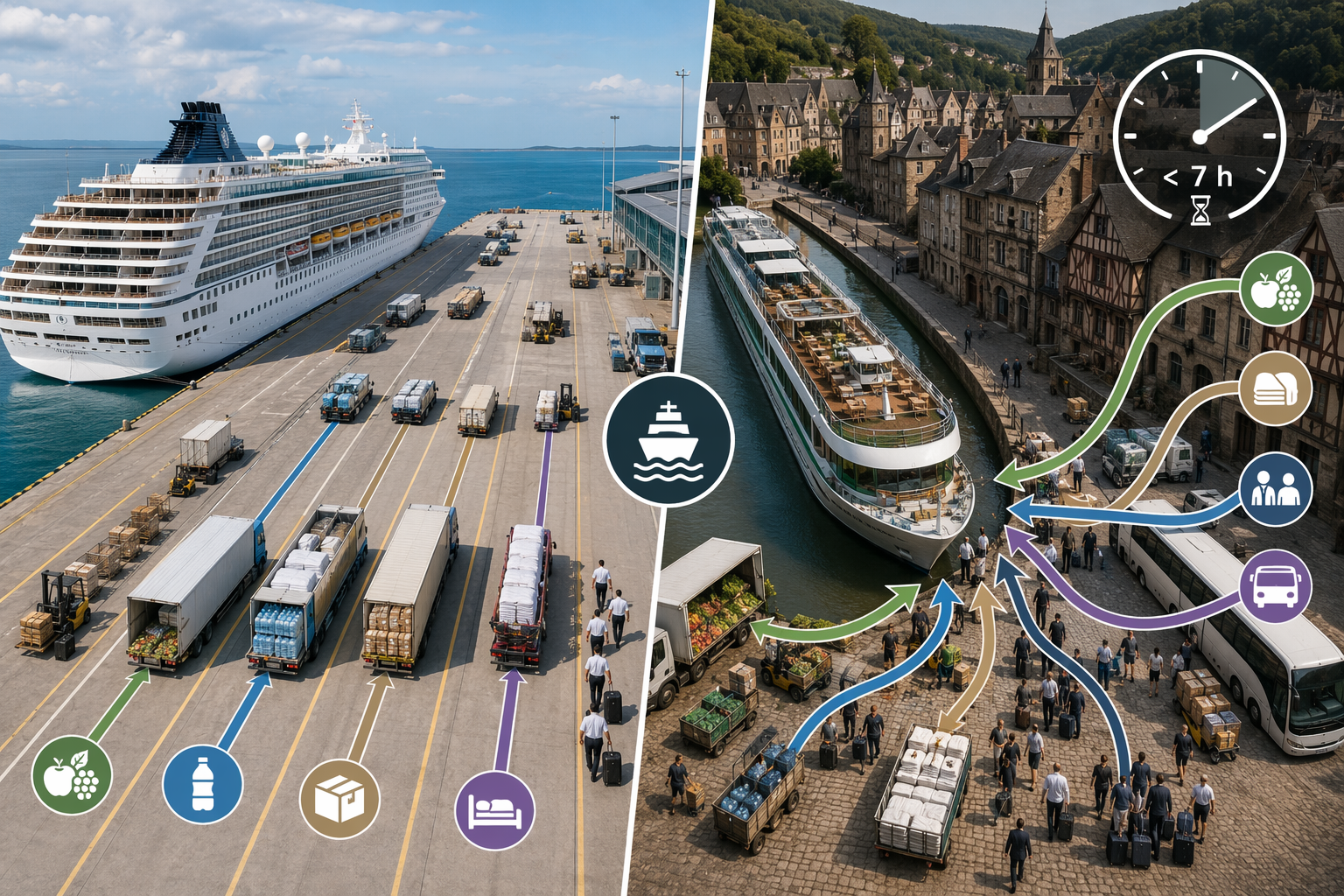
A sub-7-hour turnaround window is not just a short operating period. It is a compression point. If a low-water forecast forces a vessel swap, the linen plan changes. If the embarkation port changes, passenger transfers and hotel stores may move in opposite directions. If a produce supplier can only deliver to the original quay, purchasing needs a substitute before the galley begins the next menu cycle. One delayed confirmation can push the hotel manager, port agent, and logistics desk into manual triage.
This is where generic supply chain AI often sounds too clean. A control tower that flags risk is not enough. River cruise operators need planning logic that understands which provisioning tasks can move to the next port, which items must board before guests arrive, which suppliers are certified for substitution, which excursions depend on specific landing points, and which passenger communications have to go out before people leave home.
For operators already evaluating broader supply chain weather disruption planning, river cruising is the sharper edge of the same problem. Weather does not merely delay a truck or raise a transport cost. It can make yesterday’s port call operationally wrong.
The Useful AI Is Upstream of the Model
The model receives most of the attention, but the supplier data pipeline carries the work. A predictive system has to know the current itinerary, the forecast river condition, the vessel’s stock position, the next feasible replenishment ports, and the status of suppliers who can actually deliver there. If those inputs arrive late, or arrive as text messages, scanned forms, and end-of-day spreadsheets, the prediction may be technically impressive and operationally useless.
A practical river-cruise disruption stack starts with a small number of data streams that change decisions:
- River condition signals: water level, flow, weather forecast, temperature, and river-section alerts.
- Itinerary constraints: planned ports, alternate ports, bridge and lock constraints, excursion dependencies, and passenger transfer implications.
- Vessel readiness: onboard inventory, minimum stock levels, waste capacity, cabin-turn status, and crew availability.
- Supplier capability: certified products, delivery windows, port coverage, substitution rules, cold-chain limits, and confirmation status.
- Decision ownership: who can approve a port change, supplier substitution, passenger notice, or revised loading sequence.
Only after those streams are reliable does AI begin to do something different from ordinary alerting. It can compare disruption scenarios, rank feasible alternatives, and show the cost of waiting. It can surface that Port B solves the depth problem but breaks linen delivery, while Port C preserves hotel operations but requires earlier passenger transfer communication. The planner still decides. The system earns its keep by narrowing the decision before the window closes.
| Planning Question | Data Needed Before AI Helps | Operational Decision It Supports |
|---|---|---|
| Can the vessel continue as planned? | Water-level forecast, vessel draft, bridge and lock constraints | Hold itinerary, reroute, swap vessel, or adjust sailing segment |
| Where should replenishment move? | Alternate port access, supplier coverage, delivery windows | Resequence loading or shift replenishment to a later port |
| Which supplies are at risk? | Onboard stock, consumption forecast, confirmed orders | Prioritize critical hotel, F&B, and guest-service items |
| Who must be notified first? | Passenger transfer impact, excursion dependencies, crew schedule | Trigger revised communications and staffing actions |
Ocean Cruise AI Is a Signal, Not a Shortcut
Large cruise operators are already moving AI into supply chain work. At Seatrade Cruise Global 2026, coverage of a supply chain AI panel reported MSC expanding AI predictive ordering from food and beverage into hotel supplies, uniforms, and retail, alongside Carnival’s AI supply chain investments.[3] That matters because it shows procurement and logistics leaders are no longer treating AI as a distant analytics experiment.
But river cruise logistics leaders should be careful about what transfers. Predictive ordering for a large ocean fleet can improve demand planning and replenishment discipline. It does not automatically solve the density of a river turnaround where a vessel may need to change port sequence because a river section becomes marginal. The ocean examples validate investment direction. They do not remove the need to model river-specific constraints.
The most important sentence from that Seatrade discussion was not a capability claim. MSC procurement and logistics director Paolo Raia said the cruise industry “is not there” on data quality, pointing to ship-side reliance on hand-written checklists and a lack of certified digital data from suppliers.[3] That is the constraint river operators should take seriously. A model cannot infer supplier readiness from a clipboard that arrives after the truck has missed the loading slot.
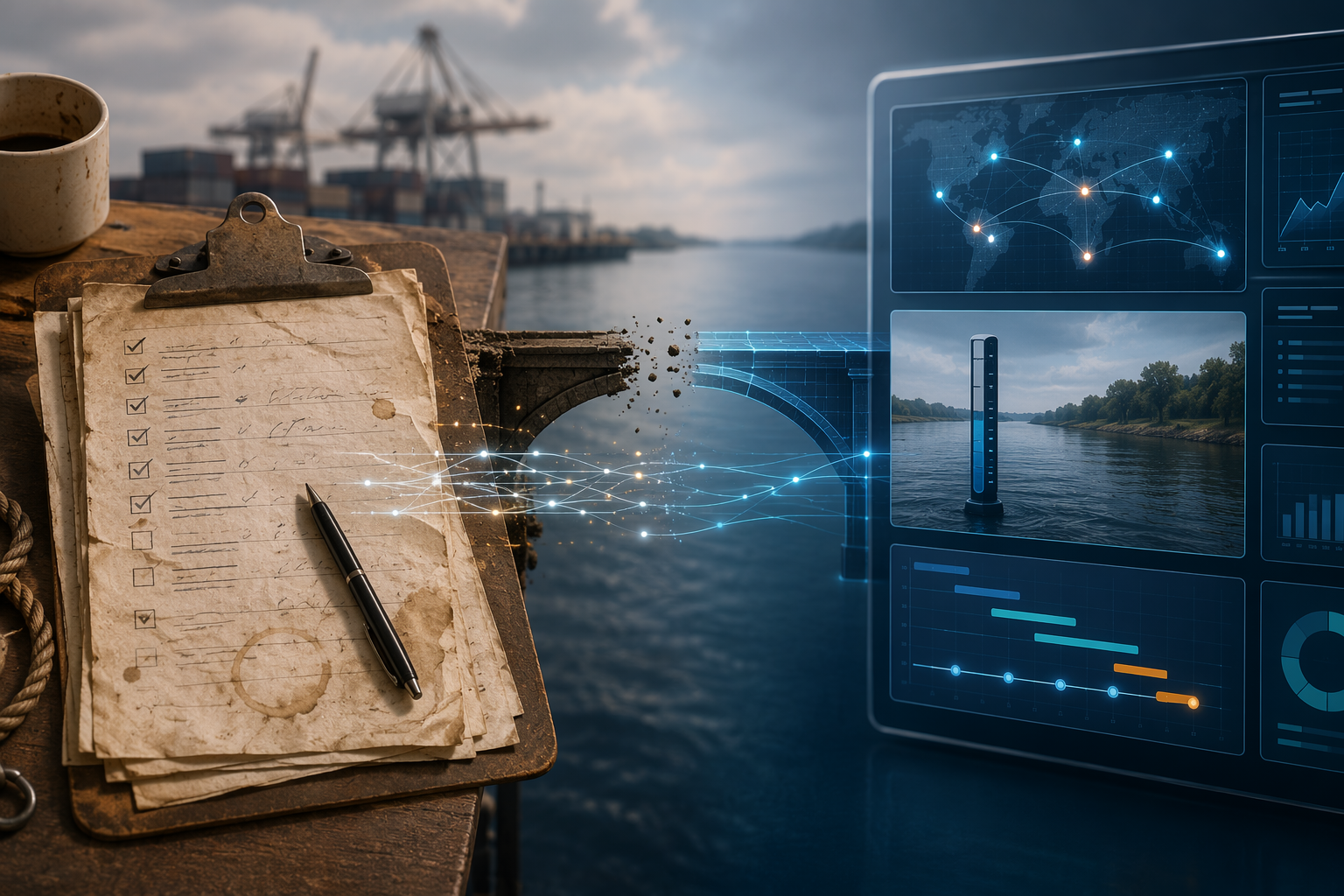
Vendor platforms are starting to describe the right kind of function. Mobi.ai, for example, markets a cruise-specific disruption response and recovery module that rapidly re-optimizes itineraries and resource allocations when conditions change.[4] That is relevant to the planning pattern, but it is vendor-described capability. The public material does not establish independently verified river-cruise outcomes, so it should not be used as proof that a particular reduction level has already been achieved in river operations.
The River Data Pipeline Has to Reach the Quay
The closest operational analogy is not always another cruise line. OpenTug’s barge transportation work describes IoT sensors collecting real-time water level, temperature, and flow data, uploading that information to the cloud for predictive analytics.[5] Barges and river cruise vessels are not the same business, but the data architecture is instructive: the waterway itself becomes a live input, not a static route assumption.
A river cruise operator would need that same discipline across its port network. The river-depth feed must connect to the itinerary plan. The itinerary plan must connect to supplier call-offs. Supplier confirmations must connect to inventory risk. Passenger operations must receive enough warning to adjust transfers and excursions without creating a second disruption through late communication.
This is where implementation becomes slower than the sales deck. Supplier records have to be standardized. Port coverage has to be mapped by actual delivery capability, not just by contracted region. Substitution rules need to be certified in advance, especially for food, beverage, laundry, and guest-facing items. Cutoff times have to be real, not optimistic. If a supplier’s system can confirm an order but cannot confirm loading, dispatch, and arrival risk, the AI still lacks the information that matters inside a turnaround.
The useful implementation question is not “Do we have AI?” It is “Can the system know, before 06:00, whether the 10:30 loading plan still works?” For a disruption model, stale supplier data is not a clerical weakness. It is a planning failure.
A Readiness Path That Does Not Start With Full Automation
Most operators will not jump from spreadsheets to autonomous disruption response. A more defensible path is narrower:
- Digitize the critical supplier file: products, ports served, delivery windows, substitution approvals, contact paths, and confirmation status.
- Connect river-condition feeds to itinerary risk: water-level forecasts, known seasonal exposure, and thresholds that trigger review.
- Map stock sensitivity by vessel: what can wait, what can move ports, and what fails guest service if missed.
- Run AI recommendations in advisory mode: show alternative plans, confidence, missing data, and operational trade-offs.
- Measure decisions, not dashboards: earlier supplier substitution, fewer emergency transfers, fewer late itinerary notices, and lower manual escalation load.
That path also fits how trust is actually built. Lufthansa Industry Solutions AI director Stan Schmal told the Seatrade panel that logistics teams have used the same Excel applications for 30 years and that the transition needs “a psychologist, not a technologist.”[3] The point is not that operators are resistant by nature. It is that people who carry the consequence of a failed loading plan will not hand over judgment to a tool whose inputs they cannot inspect.
The maritime sector is not closed to AI influence, provided the decision structure remains credible. Riviera Maritime reported that 73% of maritime professionals were comfortable with AI influencing routing decisions as long as human validation remains.[6] For river cruise disruption planning, that suggests a sensible first operating model: AI proposes, flags missing data, and ranks alternatives; the logistics director, nautical team, hotel manager, and port agent validate the decision.
The same boundary matters in more advanced agentic AI logistics disruption response. Bounded automation can reorder tasks, draft supplier messages, or generate scenario options. It should not silently change a passenger-impacting itinerary or approve a noncertified supplier substitution because a model found an elegant route through bad data.
Where the 50% Claim Becomes Plausible
Technavio also projects the river cruise market to grow at a 15.5% CAGR to USD 5.74 billion by 2030, which raises the pressure to scale operations without scaling disruption overhead at the same rate.[2] Growth does not prove AI effectiveness. It does make manual exception handling more expensive, because every additional itinerary adds supplier dependencies, port decisions, and passenger communication paths.
The “up to 50%” disruption-reduction claim becomes plausible only under specific operating conditions. The operator needs water-level and weather signals early enough to act. It needs supplier confirmations that reflect real delivery capability. It needs inventory data that shows which items are operationally critical. It needs playbooks that let teams approve a reroute, supplier substitution, or port resequencing without starting from a blank page.
If those conditions are absent, AI may still produce forecasts, but the organization will remain reactive. A dashboard can say the river section is becoming risky. It cannot make a port-side supplier answer faster, certify a substitute retroactively, or tell the hotel manager whether tomorrow’s cabin-turn materials are already on the truck unless those facts are digitized and current.
For logistics leaders building an investment case, the most honest ROI frame is operational time bought before the crisis hardens. Earlier warning can reduce itinerary repair work. Faster supplier substitution can protect onboard service. Better port sequencing can prevent unnecessary emergency loading. Better passenger timing can reduce the cost of late notices and improvised transfers. Broader supply chain AI use case ROI benchmarks can help structure the business case, but river cruise operators still need measures tied to their own turnaround and itinerary failure points.
The Decision Threshold
AI-driven predictive disruption planning is defensible for river cruise operators because the disruption pattern is frequent enough, seasonal enough, and operationally expensive enough to merit investment. The case is strongest where water-level exposure intersects with short turnaround windows and multi-port provisioning.
The first implementation question is narrower than most vendor conversations make it sound: can supplier, port, vessel, and river-condition data be digitized and refreshed fast enough to matter before a sub-7-hour turnaround closes? If that data pipeline exists, or can be built port by port and supplier by supplier, AI can move disruption planning from reactive itinerary repair to predictive response.
If port-side reality is still traveling through handwritten checklists, delayed confirmations, and local knowledge that never enters the system, the model will be starved of the inputs that make the 50% reduction claim operationally believable.
References
- Your River Cruise Was Affected by High/Low Water Levels—Now What? — ShermansTravel, 2022.
- River Cruise Market Growth Analysis - Size and Forecast 2026-2030 — Technavio.
- Cruise lines playing catchup with AI to help supply chain needs — Seatrade Cruise News.
- AI Solutions for Cruise Lines — Mobi.ai.
- Planning for Disruption in Barge Transportation — OpenTug.
- How AI optimises voyage planning through turbulent seas — Riviera Maritime, November 2025.
Comments
Join the discussion with an anonymous comment.