
An AOG event is not expensive because an aircraft has generated an alert. It becomes expensive because the aircraft is unavailable while maintenance, materials, suppliers, logistics, records, and operations try to converge on one workable answer. Depending on the operation and disruption, a grounded aircraft can cost roughly $10,000 to $150,000 per hour, which is why the delay between diagnosis and part movement matters as much as the diagnosis itself.[1]
That is the useful starting point for AI in airline maintenance and supply chain incident response. Predictive maintenance can catch more failures before they become groundings. Incident response automation matters when prevention is incomplete, late, or uncertain. The value is in the bridge: taking a maintenance signal and turning it into part identification, inventory search, supplier validation, logistics routing, documentation, and an escalation path maintenance control can actually use.

The alert is only the first handoff
A predictive maintenance alert usually enters the airline through a technical channel: sensor data, fault codes, trend monitoring, inspection findings, or a maintenance program rule. The system may estimate failure probability, recommend a task, or generate a work order. Vendor-published aviation MRO figures claim AI can reduce unscheduled removals by 35%, reduce AOG events by 40%, and compress work order generation from 2–6 hours to under 5 minutes.[2]
Those numbers are useful as directional signals, not as settled proof across every airline fleet, maintenance program, and supplier base. The more important operational question is narrower: after the work order exists, does anything happen outside the maintenance system?
A technically accurate alert can still leave the materials desk with the hard part of the job. Which part number is required? Is the alternate approved? Is the component available in serviceable condition, not just visible in inventory? Is there a tagged unit at the right station, or is it sitting somewhere that will miss the maintenance window? If the item must move across borders, are the documents ready? If the first supplier looks available but carries operational risk, who sees that before the aircraft is already waiting?
This is where disconnected AI tools disappoint. A dashboard that predicts a failure and then leaves the next three phone calls, two system searches, and one compliance check to humans has improved awareness, not response. In AOG work, awareness is only valuable when it shortens the path to a release plan.
What the AOG response bridge has to do
The bridge between maintenance and supply chain does not need to be mysterious. It has to move a signal through the same sequence experienced AOG teams already know, but with less dead time between steps.
| Workflow point | What AI can accelerate | What still needs control |
|---|---|---|
| Maintenance or sensor signal | Detect abnormal trends, fault patterns, or repeat removals | Engineering rules, confidence thresholds, and false-positive handling |
| Work order trigger | Draft task scope and connect the alert to maintenance planning | Human review for safety, deferral logic, and operational priority |
| Part identification | Map the task to part numbers, alternates, effectivity, and configuration constraints | Approved data, interchangeability rules, and records accuracy |
| Inventory and supplier search | Search owned stock, pooled inventory, repair channels, and approved suppliers | Serviceable condition, certification, location, and commercial terms |
| Risk and availability check | Flag supplier, route, or lead-time risk before a sourcing decision is made | Risk tolerance, substitution decisions, and escalation authority |
| Logistics routing | Compare transport options against aircraft return-to-service timing | Customs, hazmat, station constraints, and cost approval |
| Documentation and compliance | Assemble required records, tags, approvals, and transaction history | Regulatory accountability and final release controls |
| Escalation to maintenance control | Return a ranked plan with timing, constraints, and unresolved decisions | Operational judgment on aircraft routing, swaps, or continued disruption recovery |
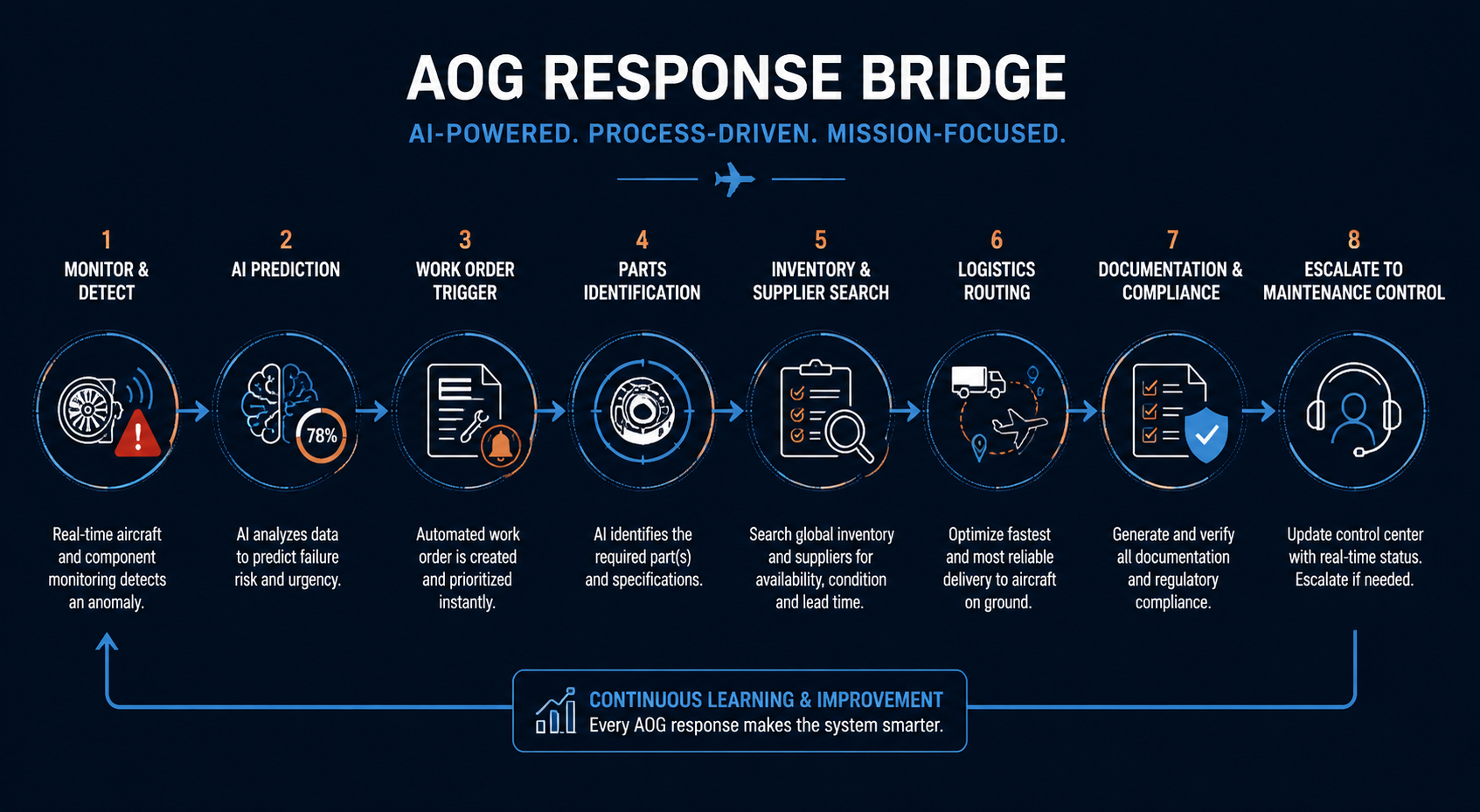
The fragile point is the middle: part identification through logistics routing. Maintenance systems can identify a technical need, and procurement systems can hold supplier and inventory data, but the AOG clock runs during the translation. A bearing, valve, actuator, pump, avionics unit, or engine-related component is not simply “needed.” It has to be the right configuration, acceptable under the aircraft records, physically reachable, commercially authorized, and movable within the available operating window.
A connected system changes the first hour of the event. Instead of waiting for a planner to finish the work order, a buyer to search stock, a supplier desk to confirm availability, and a logistics coordinator to price routes in sequence, the system can start those checks in parallel once the maintenance signal reaches a defined threshold. The output should not be a vague “part available” message. It should be a ranked response: part A is in owned stock at one station but misses the cutoff; part B is available through an approved supplier with paperwork pending; part C is more expensive but can reach the aircraft before the planned release window.
Prevention and response are different jobs
Predictive maintenance earns attention because avoided groundings are cleaner than recovered groundings. If an airline can remove a component during scheduled downtime instead of after dispatch disruption, the saving is real. The difficulty is that predictive maintenance does not eliminate the need for AOG response. Some failures arrive without enough warning. Some alerts are ambiguous. Some parts that should have been available are delayed, quarantined, missing documentation, or trapped in a supplier bottleneck.
That distinction affects how AI investments should be judged. Predictive maintenance alone answers, “What is likely to fail?” Spare parts forecasting answers, “What should we stock or position?” Supplier monitoring answers, “Where might availability or delivery risk emerge?” AOG incident response asks a different question: “Given this aircraft, this fault, this time window, and this network, what is the fastest compliant path to return to service?”
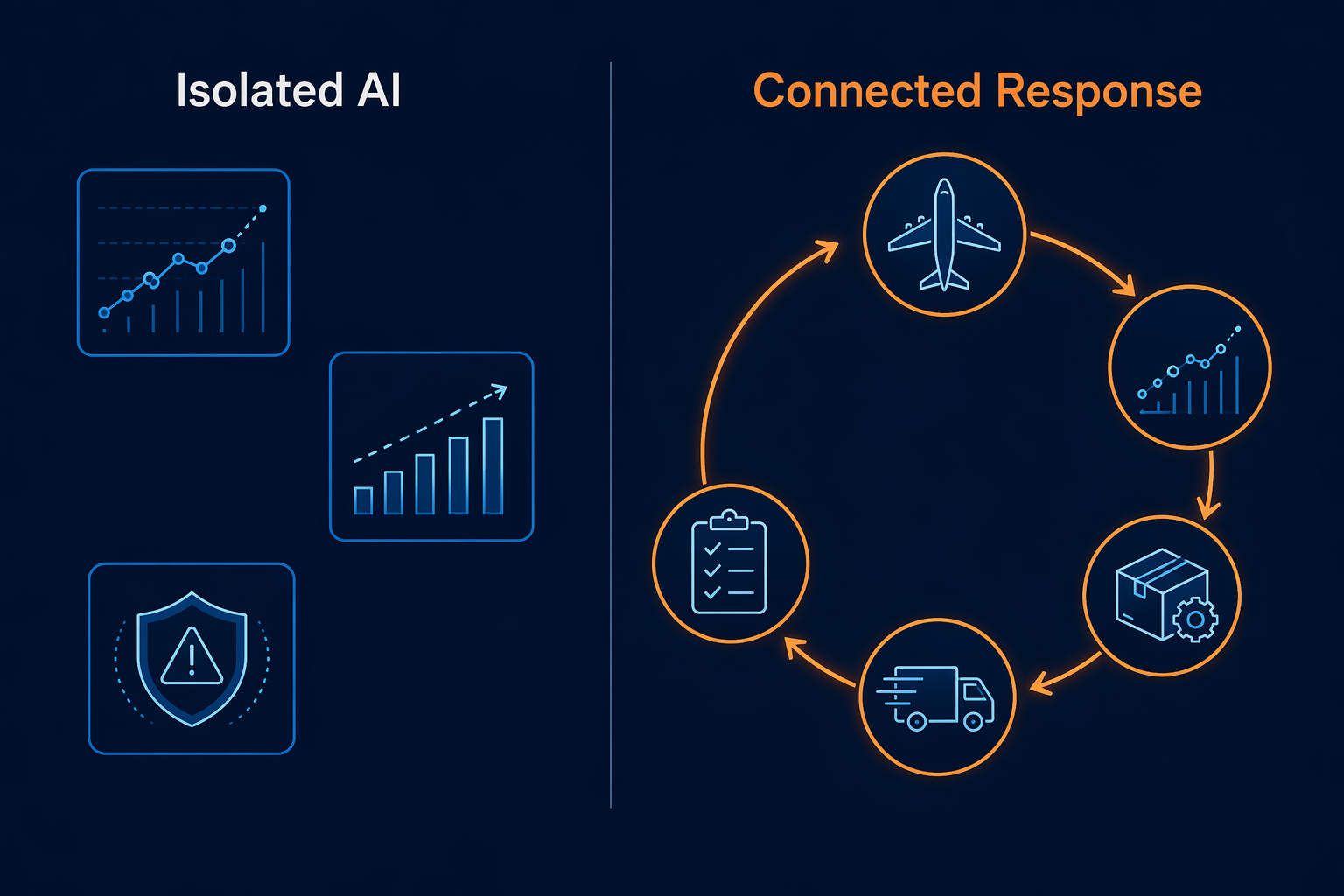
The isolated tools can each be valuable. Vendor-published materials report spare parts demand forecasting accuracy above 85%, a 22% reduction in parts spend, and 3.2x ROI within 18 months for mid-size MRO operations.[2] Those figures point to why airlines are interested, but they do not prove that a given system can manage an AOG event under pressure. Forecasting accuracy does not automatically produce a courier booking. A lower parts budget does not automatically produce a serviceable unit at the grounded aircraft. A work order generated in minutes still has to trigger sourcing, documentation, and movement.
The connected loop is more demanding because it crosses ownership boundaries. Maintenance control may own the technical decision. Materials may own the part search. Procurement may own supplier engagement. Logistics may own routing. Quality and records may own documentation. Operations may decide whether to hold, swap, cancel, or reposition the aircraft. AI helps most when it reduces the friction between those groups without hiding the decisions that must remain accountable.
Why the bridge matters more in 2026
AOG response has always been urgent, but the supply conditions around it have become less forgiving. IATA and Oliver Wyman estimated that aviation supply chain issues impose an $11 billion cost burden, including $4.2 billion in delayed fuel savings, $3.1 billion in higher maintenance costs, $2.6 billion in excess engine leasing, and $1.4 billion in extra spares inventory.[3] This is a modeled estimate, not an audited bill, but it describes the pressure airlines feel when fleet plans, shop visits, engines, and parts do not line up.
The aircraft side of the problem is also tighter. IATA has described a record fleet age of 15.2 years and a shortfall of more than 5,000 fuel-efficient replacement aircraft, while also identifying AI as one of four strategic priorities for supply chain resilience in 2026.[4] Older fleets do not automatically mean every aircraft is unreliable, but they do tend to increase the importance of maintenance planning, component availability, and repair capacity. When replacement aircraft are late, the existing fleet has to keep producing capacity.
That changes the meaning of speed. A faster AOG response is not just a local save on one tail number. It protects a schedule that may already have fewer spare aircraft, longer repair queues, and less slack in the parts network. If the first sourcing answer fails, the second answer has to arrive quickly enough to matter.
Supplier risk cannot stay outside the event
Supplier risk is often treated as a planning discipline, but AOG exposes it as an incident response problem. Interos reports that only 7% of organizations continuously monitor risk across critical suppliers.[5] The immediate consequence is familiar: a buyer may find a supplier match in the system before anyone has checked whether that supplier, lane, region, sub-tier dependency, or logistics path is deteriorating.
Continuous monitoring does not guarantee availability, and it should not be sold as if it does. Its practical value is earlier disqualification and faster escalation. If a supplier option is technically approved but commercially risky, the AOG team needs to know before it builds the return-to-service plan around that option. If a route is likely to miss the cutoff, logistics should be comparing alternatives while maintenance is still refining the task scope.
Sourcing flexibility still has to respect approval boundaries
Airlines rarely have only one sourcing lever. Owned inventory, pooled stock, repair exchanges, OEM channels, surplus markets, approved distributors, and PMA parts can all enter the discussion depending on the component and operator policy. IATA’s 2025 PMA survey finding that 74% of airlines use PMA parts to mitigate supply chain challenges is best read in that limited sense: PMA can be one flexibility lever, not a universal answer for every aircraft, part, or contract environment.
AI can help by presenting approved alternatives with their constraints attached. The distinction matters. In an AOG event, a fast but noncompliant answer is not an answer. A useful system should show whether an alternate part is approved for the aircraft configuration, whether the airline permits it, whether the required documentation is available, and whether the commercial terms create later exposure. The objective is not to widen sourcing blindly; it is to widen the search without losing control of effectivity, records, and release requirements.
What a connected response looks like before the aircraft reaches the gate
Consider a hypothetical inbound aircraft with a monitored component showing a deteriorating trend. The useful AI workflow does not wait for the aircraft to block in and the troubleshooting clock to start. Once the signal crosses the airline’s threshold, the system drafts the likely task, identifies candidate parts, checks effectivity, searches inventory, reviews supplier and route options, and prepares the documentation packet for human review.
Maintenance control still decides what can be deferred, what must be inspected, and what work is authorized. But the materials desk is no longer starting from a blank search. It can see which part options are realistic, which ones are blocked by condition or paperwork, which supplier response is still pending, and which logistics route matches the maintenance window. Operations can make a better aircraft-routing decision because the return-to-service estimate is tied to actual supply chain actions rather than hope.
The same workflow helps after an unexpected failure. The prediction may have failed or never existed, but the incident response layer can still compress the sourcing and logistics cycle. That is an important distinction. AI does not need to foresee every AOG event to be useful in AOG response. It needs to reduce the time wasted after the event is recognized.
The practical benchmark
The strongest benchmark for AI in this use case is not prediction accuracy by itself. Prediction accuracy matters, but an airline does not recover the aircraft with a probability score. It recovers the aircraft when the right maintenance action, part, supplier, shipment, documentation, and operational decision come together soon enough to change the outcome.
That is why the handoff deserves more attention than the dashboard. The people accountable for an AOG event need fewer disconnected alerts, fewer manual searches, fewer late surprises about stock or supplier risk, and a faster path from diagnosis to part movement. AI’s best contribution is to reduce the dead space between a maintenance signal and a supply chain action while keeping compliance and human accountability visible.
Groundings will not disappear. Failures will still arrive late, parts will still be constrained, and some plans will still collapse under operational reality. The useful question is whether the system coordinates maintenance, sourcing, logistics, supplier risk, and documentation quickly enough for maintenance control to act before the AOG clock has already done most of the damage.
References
- AOG (Aircraft on Ground), Ironback.ai, 2026.
- Top AI Use Cases in Aviation MRO 2026, OxMaint, 2026.
- How to Revive Aircraft Supply Chains to Accelerate Delivery, Oliver Wyman, 2025.
- IATA Identifies Four Priorities to Address Aviation Supply Chain Challenges, Airport Industry-News.
- Airlines, Interos.ai.
Comments
Join the discussion with an anonymous comment.