
The recall decision is already made. Now the clock belongs to logistics: which lots are affected, which shipments carried them, which warehouses still have inventory, which customers received product, and which system can stop the next move before the network makes the recall larger.
This is where AI for product recall logistics becomes useful or useless. If it only adds a dashboard on top of the same manual hunt through ERP, MES, WMS, supplier portals, transportation records, and customer files, it has not changed the recall. If it can unify lot-level evidence, predict the affected scope, and push containment into execution systems, it can turn a slow investigation into an operational stop order.
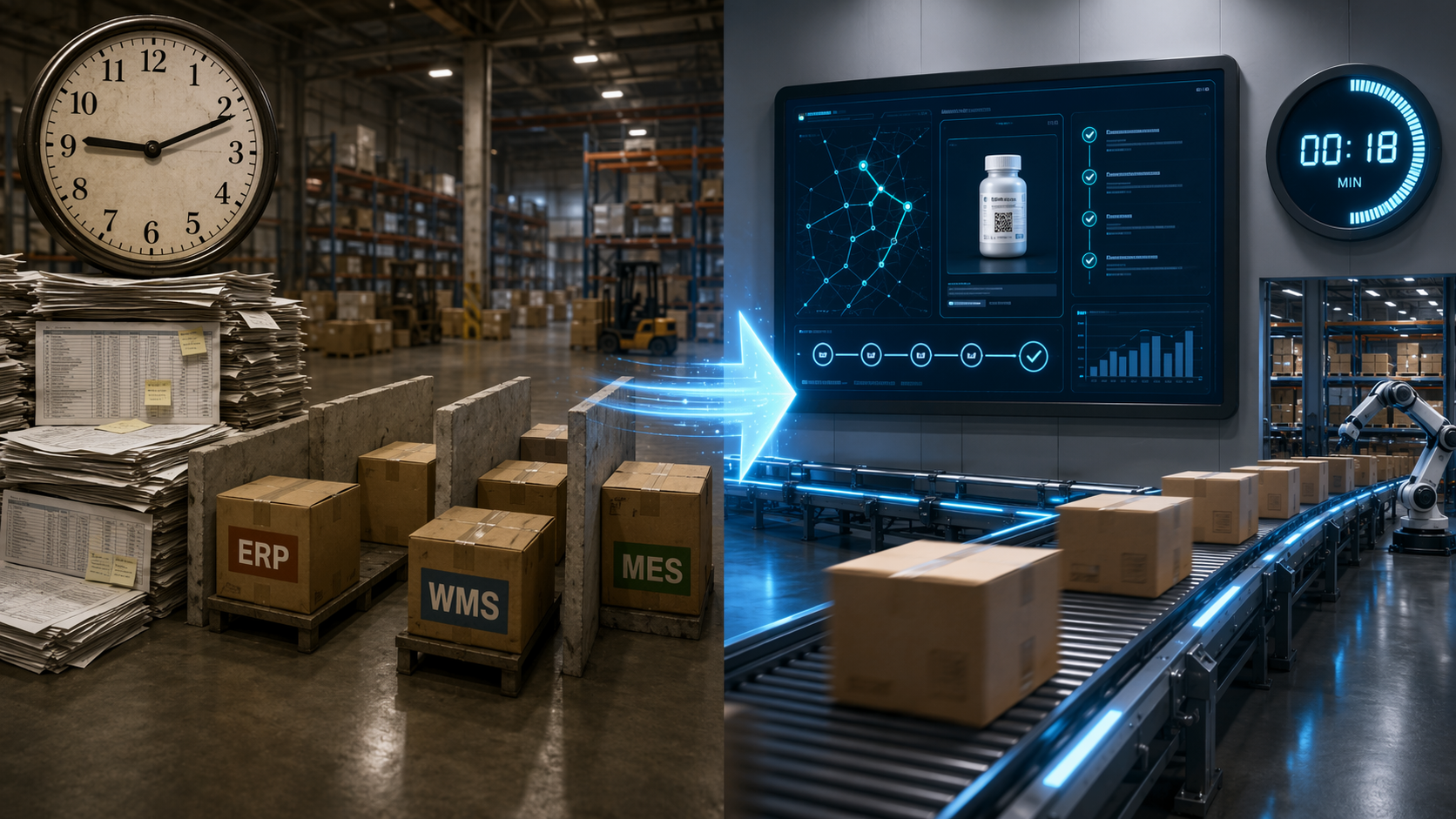
The pressure is not theoretical. CRC Group reported 3,232 recall events in 2024 across FDA and CPSC activity, a recent operating environment in which recall response is not an occasional edge case for many product companies.[1] In food, the often-cited direct cost benchmark remains about $10 million per recall, while Lumafield cites research indicating that 52% of recalls exceed that level and roughly 1 in 20 surpass $100 million.[2] Those numbers matter, but they are not the main operational problem. The first problem is that product keeps moving while people are still reconciling records.
The Traceability Bottleneck Starts After the Decision
In a manual recall, the team is usually not waiting for one missing file. It is waiting for several ordinary systems to answer the same question in incompatible ways. ERP may know purchase orders and customers. MES may know production runs. WMS may know inventory locations and movements. Supplier portals may hold raw-material lot details. Transportation or 3PL systems may show outbound status. None of those systems was necessarily designed to produce one clean, defensible recall scope under time pressure.
iFactory, using vendor-originated benchmarks and citing GMA data, describes a manual single-batch trace as requiring 8.2 hours and a multi-batch trace as requiring 18.7 hours. The same source says 68% of facilities miss a 4-hour traceability window.[3] That 4-hour reference needs a boundary: the FDA Food Traceability Rule’s record request timing applies to foods covered by the Food Traceability List, not universally to every product recall. Still, the benchmark usefully points to the same constraint quality and warehouse teams recognize: manual aggregation can consume the response window before containment is complete.
| Recall task | Manual execution pattern | AI-assisted execution pattern |
|---|---|---|
| Find affected lots | Analysts compare ERP, MES, WMS, and supplier records by export, query, email, and spreadsheet | The system queries connected lot, batch, serial, inventory, and shipment records from one traceability layer |
| Set recall scope | Teams infer exposure by matching raw material, production timing, and distribution records manually | AI models rank affected lots, shipments, and customers using commonality, timing, and distribution overlap |
| Stop product movement | Warehouse leads receive instructions after scope is reviewed and manually freeze locations or SKUs | Containment workflows quarantine inventory, block picks, change routing, and trigger notifications |
| Prove decisions later | Emails, screenshots, spreadsheets, and system notes are assembled after the event | A timestamped audit trail records inputs, recommendations, approvals, and containment actions |
What AI Actually Has to Connect
The first job is not prediction. It is data plumbing at lot level. A recall system has to connect finished goods back to production runs, production runs back to raw or component lots, those lots forward into shipments, and those shipments into inventory positions, stores, distributors, customers, or returns channels. If that chain breaks, the model can produce a confident answer that nobody should trust.
iFactory frames its recall automation around querying 4 to 6 disconnected systems, including ERP, MES, WMS, and supplier portals, and says manual data aggregation can account for 80% of recall response time.[3] Treat that as a vendor-reported directional claim rather than an independent industry average. It is still the right place to look. The practical value of AI in recall logistics depends less on whether the screen says “AI” and more on whether the trace graph is complete enough to answer: from this suspect ingredient, component, batch, line, date range, or supplier lot, where did finished product go?
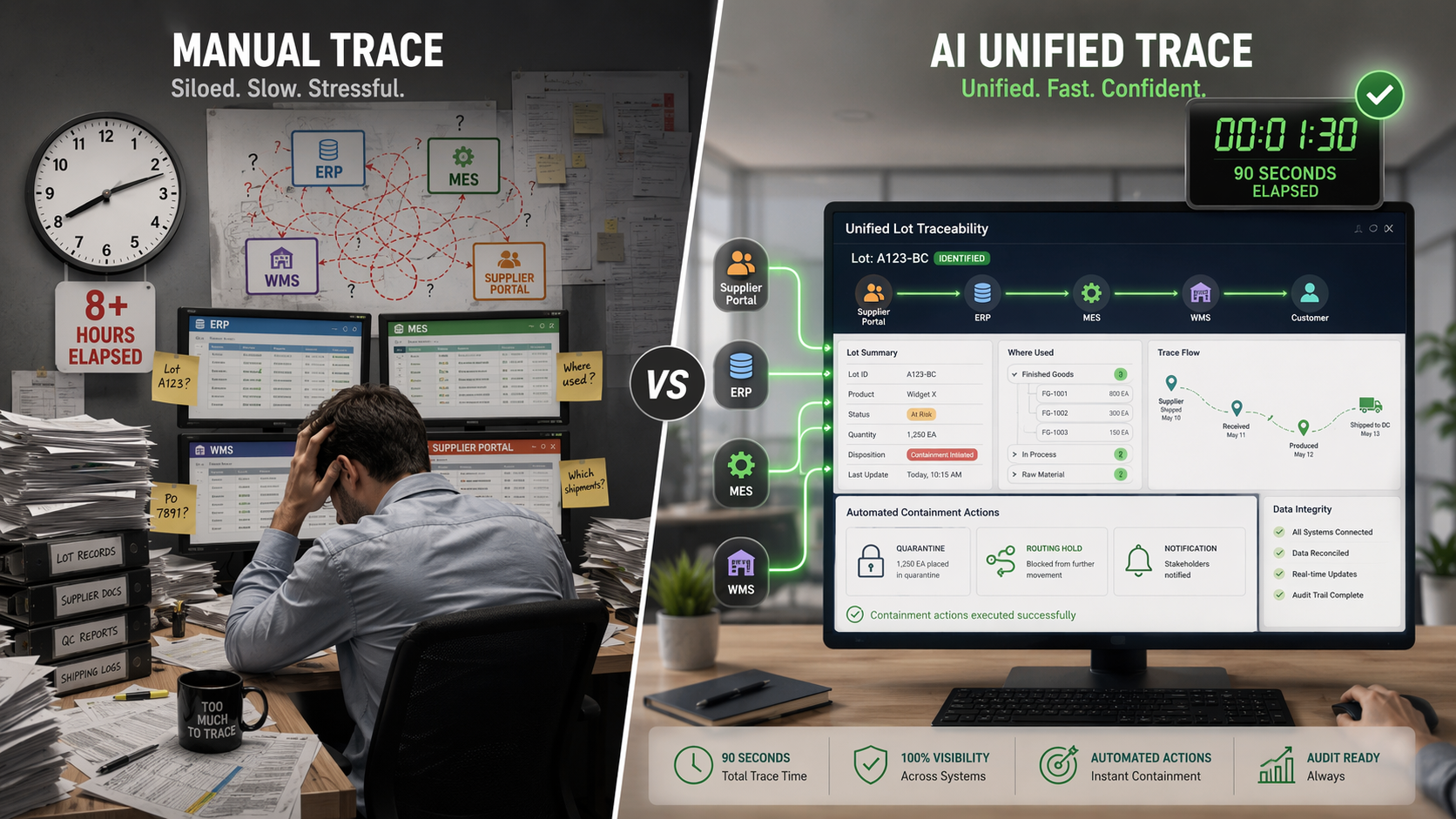
A useful trace does not stop at naming SKUs. SKU-level recall logic is often too broad for execution and too thin for defense. The system needs lot, batch, serial, location, status, and movement history. It should separate product still on hand from product shipped, product already received from product in transit, and product available to pick from product already blocked, returned, consumed, or destroyed. Those distinctions determine whether the next action belongs to plant QA, a DC supervisor, a 3PL, a retailer, customer service, or regulatory affairs.
This is also why mock recalls matter. iFactory says automated mock recalls can run weekly with zero incremental labor, compared with annual manual exercises that require 2 to 3 days each.[3] The labor claim is vendor-reported, but the operating principle is sound: a recall workflow that only gets tested annually is likely to reveal its integration gaps during the real event. Automated exercises are valuable when they test the exact joins the organization will depend on later, not when they only produce a neat readiness score.
From Trace to Scope Prediction
Once the lot graph exists, AI can start doing the work people normally do under pressure: looking for commonality. Which finished lots used the same raw material? Which production runs were close enough in time to share a sanitation, equipment, or handling exposure? Which shipments overlapped by DC, lane, customer, or date? Which adjacent lots are close enough to contain while evidence is reviewed?
iFactory claims its AI scope prediction can identify affected lots, shipments, and customers within 90 seconds at more than 95% accuracy, using raw material commonality, production time proximity, and distribution overlap.[3] That is the kind of claim that deserves attention and verification at the same time. A 90-second scope prediction changes the operating tempo only if the underlying master data, lot genealogy, inventory status, and shipment history are reliable. If those inputs are uneven, the speed can simply move uncertainty faster.
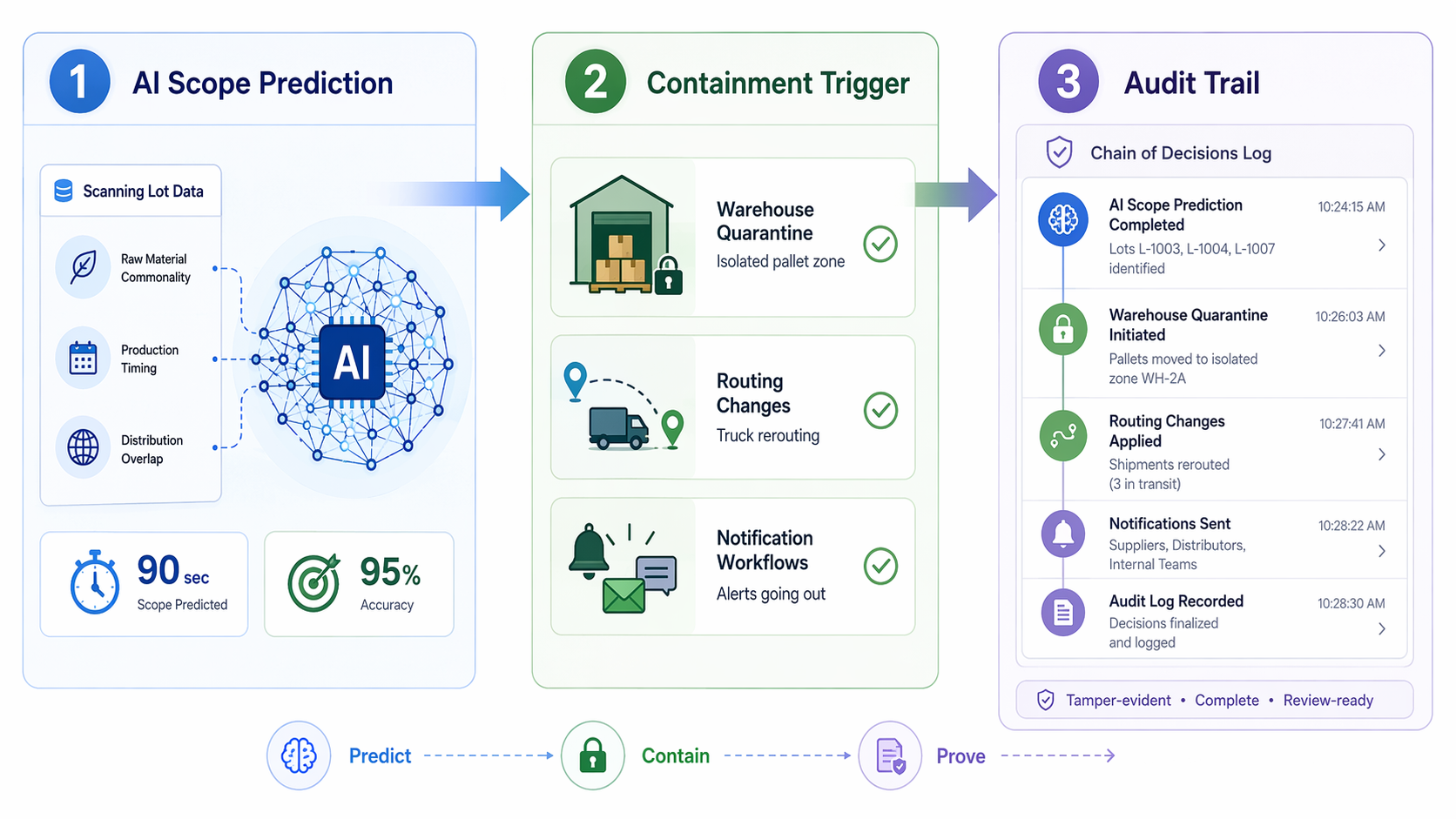
The accuracy number also needs the right interpretation. It is a vendor-reported performance claim, not proof that all AI recall systems can hit that level across industries, product types, and system conditions. In a pilot, the important test is not whether the model performs on a polished demonstration dataset. It is whether it can reproduce known mock-recall scopes, handle incomplete supplier records, distinguish similar but unaffected lots, and show why it included or excluded each node in the chain.
Scope Is a Containment Input, Not the Finish Line
A predicted scope is useful only when it becomes an action. In recall logistics, the cleanest model output still has to cross into the systems that control inventory, orders, routing, returns, and notifications. Otherwise, the team has gained a faster answer and kept the same manual containment delay.
- Warehouse quarantine: affected lots are moved into hold status, blocked from picking, or assigned to physical isolation locations.
- Routing changes: in-transit product is redirected, stopped, or prioritized for inspection depending on status and destination.
- Order controls: open orders containing affected product are blocked, substituted, or routed for review before release.
- Customer and channel notification: distributors, retailers, pharmacies, direct customers, or service teams receive the specific lot and shipment detail they need.
- Shelf sweep and return handling: downstream locations are told what to remove, scan, return, destroy, or document.
Food Logistics, in an article by RTS Labs, describes AI use for 3PL recall management in terms of warehouse isolation and routing optimization.[4] That is the right layer of the problem. A recall does not become safer because an organization knows the affected lot. It becomes safer when the next pick wave, outbound load, store replenishment, return authorization, or customer shipment cannot continue as if nothing happened.
Where Vendor Platforms Fit in the Response Chain
The vendor landscape is easiest to understand by placing each tool in the recall execution chain rather than comparing feature labels. Some tools concentrate on traceability and mock recall automation. Some help score impact. Some execute lot or serial-level shelf sweeps. Some live inside ERP workflows where inventory, orders, and financial consequences are already controlled.
| Platform or approach | Recall logistics role | Boundary to keep in mind |
|---|---|---|
| iFactory recall traceability and AI mock recall | Lot-level traceability, scope prediction, and automated mock recall exercises | Key performance claims are vendor-originated and should be tested against company data |
| Cegeka Quality Impact Recall Agent | AI-assisted impact scoring and structured recall workflow support | Impact scoring helps prioritize action but still depends on execution-system integration |
| LSPedia Serialized Recall | Pharma-oriented lot and serial recall management with shelf-sweep execution | Most relevant where serialization and downstream scan evidence are central |
| Oracle Product Recall Management | ERP-native recall orchestration inside Oracle supply chain and manufacturing processes | ERP fit can reduce handoffs, but coverage depends on connected operational systems |
| TechSee visual AI recall service workflows | Automated customer-service and return handling for recall interactions | Useful for downstream handling, but not core evidence for lot-scope prediction |
Cegeka describes AI-supported recall work around impact scoring and workflow automation.[5] That kind of capability is useful when the organization needs to rank exposure and coordinate actions across functions, but an impact score should not be mistaken for containment. The score has to drive a controlled decision: hold this inventory, notify this customer group, inspect this stock, release this unaffected lot, or escalate this uncertainty.
LSPedia’s Serialized Recall Management is more specific to pharmaceutical execution, where lot and serial-level traceability can support targeted shelf-sweep activity.[6] That is a different operating problem from a broad consumer goods recall where serialization may not exist downstream. The useful lesson is not that every company needs pharma-style serialization. It is that recall execution improves when the unit of action is narrow enough for the people removing product from shelves, bins, totes, or customer locations.
Oracle’s Product Recall Management documentation places recall work inside a cloud supply chain and manufacturing environment, where recall tasks can connect to enterprise records and processes.[7] ERP-native orchestration can reduce handoffs because many affected actions already live there: item records, suppliers, customers, inventory, orders, holds, and financial adjustments. The remaining question is whether the recall logic also sees what happened outside ERP, especially production detail, 3PL movement, supplier genealogy, and downstream channel status.
TechSee’s recall-management discussion sits farther downstream, in customer service and return handling. It cites an anonymized major CPG brand that handled more than 300,000 interactions automatically using visual AI.[8] Because the case is not named, it should be treated as a limited existence proof rather than a general benchmark. It shows that automation can absorb high-volume recall interactions, but it does not prove that the upstream recall scope was accurate or that containment happened faster.
The Audit Trail Is Part of the Logistics System
A recall platform that cannot explain itself creates work for the compliance team later. The organization needs to know which data was used, when it was pulled, which lots were included, which lots were excluded, who approved containment, when inventory was frozen, when notifications went out, and what changed when new information arrived.
This matters most when AI narrows a recall. Broad recalls are expensive, but narrow recalls carry a different burden: the company must be able to defend why adjacent product was left in commerce. That defense cannot be a model confidence score alone. It needs lot genealogy, production timing, distribution evidence, reviewer approval, exception handling, and a record of containment actions. The system should preserve the decision chain as the recall unfolds, not reconstruct it from chat logs and spreadsheet versions after the fact.
How to Validate the Minutes Claim
The strongest numbers in this area are still primarily vendor-reported. That does not make them irrelevant, but it changes how they should be used. A buyer should not ask whether a platform can demonstrate a fast trace in a sales environment. The better test is whether it can run against the company’s own data, product structures, warehouse flows, supplier gaps, and approval rules.
- Run a blind mock recall using a known historical or test lot and compare the AI-generated scope with the expected answer.
- Measure time separately for trace, scope review, approval, quarantine, notification, and downstream confirmation.
- Check whether affected inventory is actually blocked in WMS or ERP, not merely displayed on a dashboard.
- Review false inclusions and false exclusions at lot, shipment, customer, and location level.
- Inspect the audit trail for timestamps, data sources, reviewer actions, overrides, and evidence behind exclusions.
- Repeat the exercise with messy conditions: partial supplier data, in-transit inventory, returns, split lots, rework, co-manufacturing, or 3PL-held stock.
A system that compresses trace time but cannot trigger containment has solved only the investigation layer. A system that blocks inventory quickly but cannot prove why the scope was correct creates audit risk. A system that handles customer interactions at scale but does not connect to lot evidence may improve service without improving recall control. The operational standard has to cover the full chain.
AI can plausibly compress recall logistics from hours to minutes when traceability data is integrated, lot logic is reliable, and containment workflows are wired into warehouse, ERP, transportation, notification, and return processes. The claim is not that AI has solved recalls. The useful question is more concrete: in a real event, can the system tell the organization what to stop, where to stop it, who to notify, and what evidence proves the decision was correct?
References
- Beyond the Label: 2025 Recall Trends, CRC Group
- The Real Cost of a Product Recall, Lumafield
- Product Recall Management Traceability & AI Mock Recall, iFactory
- How AI Helps 3PLs Manage Recalls, Food Logistics / RTS Labs
- Transforming Product Recalls with AI, Cegeka
- Serialized Recall Management, LSPedia
- Overview of Product Recall Management, Oracle
- How AI Is Transforming Product Recall Management Services, TechSee
Comments
Join the discussion with an anonymous comment.