
The practical question behind AI airline technology upgrades is not whether an airline has bought more automation. It is whether the upgrade changes the operational minutes that freight, crews, gates, maintenance planners, and downstream customers actually live with. A gate decision that trims taxi time can matter more than a polished planning demo if it releases an aircraft before a cargo cutoff. A maintenance alert is useful only if it prevents an aircraft from falling out of the schedule when the spare part, crew, and recovery plan are still movable.
That is why the controllable-delay pool matters. OAG and Microsoft attribute roughly 60% of flight delays to industry-controllable operational inefficiencies rather than weather or other external disruption.[1] That does not mean AI can erase 60% of delays. It means a large share of the problem sits inside processes airlines already manage: scheduling, gate assignment, turnaround coordination, crew and aircraft recovery, cargo allocation, routing, and maintenance planning.
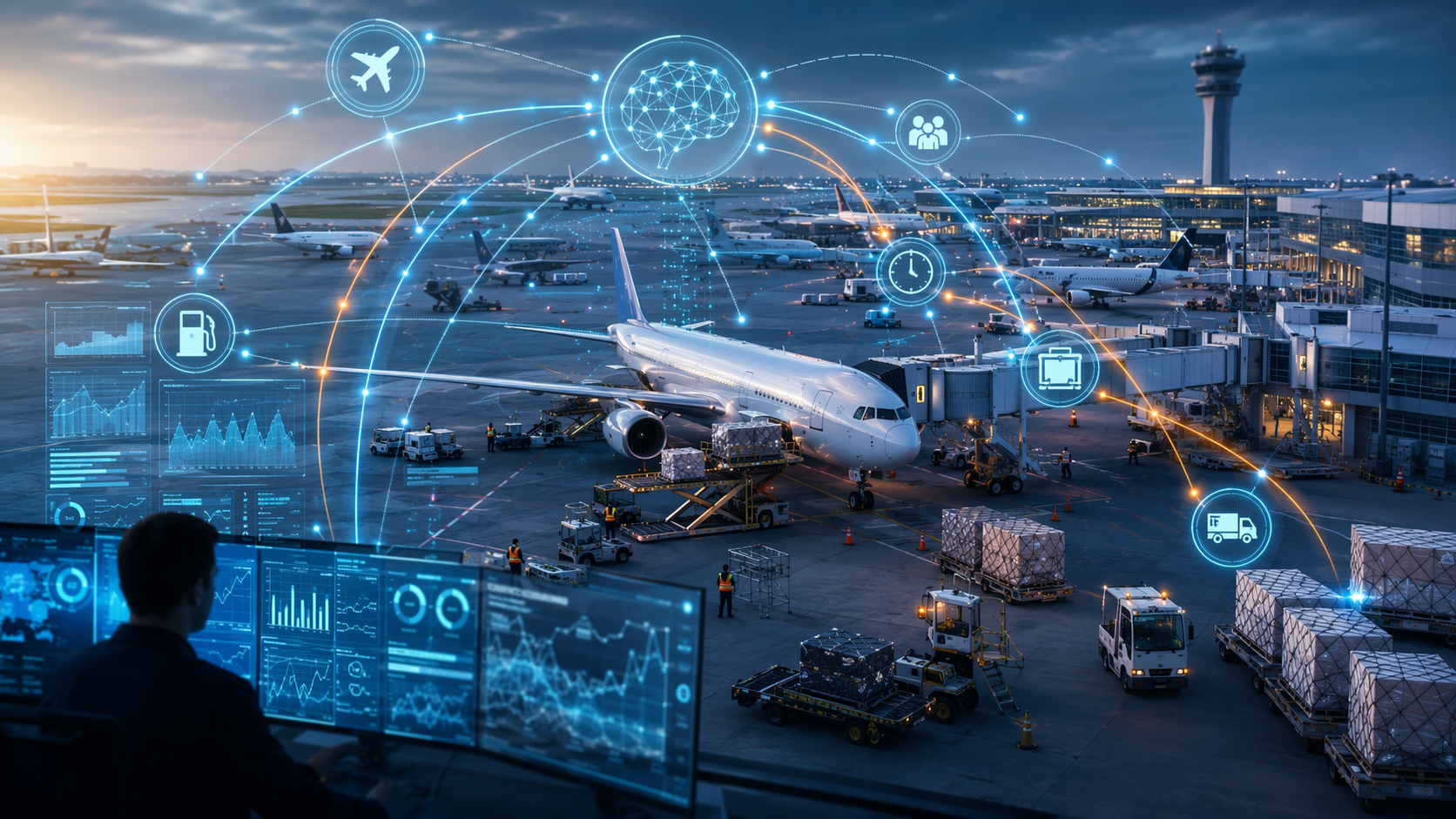
The Metrics That Matter Before the AI Label Does
The cleanest business case starts with physical constraints. Fuel burn is measurable. Taxi time is measurable. Ground delay is measurable. Turnaround time is measurable. Cargo load factor is measurable. Unplanned maintenance events are measurable. Customer experience may improve as a consequence, but the logistics case should not have to lean on soft language before these hard metrics are tested.
| Outcome category | Published improvement or benchmark | Evidence type | How to read it |
|---|---|---|---|
| Controllable delay pool | Roughly 60% of flight delays attributed to industry-controllable operational inefficiencies [1] | Industry report | Defines the addressable operational pool; not a claim that AI fixes every such delay |
| Gate assignment and taxi time | American Airlines Smart Gating reported 17 hours of taxi time saved and 1.4 million gallons of fuel saved annually [2] | Named airline deployment | Strong operational evidence because the metric touches gates, taxi time, and fuel |
| Fuel and operating performance | Qantas reported $30 million in savings through AI-powered operational optimization [3] | Named airline case | Useful production-linked evidence, though the exact contribution of each AI component should not be over-separated without more disclosure |
| Apron and turnaround flow | Rome Fiumicino's ApronAI results included a 6% ground delay reduction and 4% turnaround time improvement [2] | Named airport deployment | Airport-specific, but directly relevant to airline logistics because apron flow governs aircraft release |
| Predictive maintenance | AI predictive maintenance associated with 5–15% fewer unplanned events [4] | Industry benchmark | Relevant for disruption avoidance; less specific than a named carrier implementation |
| Air cargo load factor | McKinsey benchmark cited by TIACA indicates 8–25% load factor improvement [5] | Directional industry benchmark | Promising for cargo planning, but should be treated as directional because it is not a single airline case |
| Broader logistics cost | McKinsey-linked benchmarks cite 5–20% logistics cost reduction and 20–30% inventory reduction in distribution operations [6] | Cross-industry supply chain benchmark | Helpful for sizing context, not airline-specific proof |
This spread of evidence is uneven, and that matters. The named airline and airport cases carry more weight than broad supply chain ranges. They show where an AI system touched an operational lever and a measurable output. The broader benchmarks help frame what may be possible across logistics networks, but they should not be copied into an airline business case as guaranteed savings.
Gate Assignment Is a Logistics Lever, Not a Terminal Convenience
Smart gate assignment rarely gets the same attention as cockpit automation, but it is one of the places where AI can reach the schedule quickly. A poor gate plan turns into extra taxi time, blocked arrivals, tug conflicts, missed passenger connections, late bags, missed freight transfers, and crew legality pressure. When that happens late in the day, the delay does not stay local. It becomes a recovery problem.
American Airlines' Smart Gating example is useful because the reported gains are operationally specific: 17 hours of taxi time saved and 1.4 million gallons of fuel saved annually.[2] The AI value is not that the system produced a more elegant gate map. The value is that fewer aircraft spent unnecessary time moving or waiting on the ground.
For logistics teams, that distinction is not academic. Less taxi time can protect connection windows for belly cargo. It can reduce the number of shipments that arrive at the sorting point after the truck has closed. It can also give operations control more room to recover when a later disruption hits the same aircraft rotation. The same aircraft, gate, crew, and freight plan are all competing for minutes; AI earns its place when it gives some of those minutes back.
Fuel Optimization Becomes More Convincing When It Shows Up in Operations
Fuel is often where airline AI claims become too broad. Route optimization, fuel planning, dispatch support, aircraft performance modeling, and maintenance condition all affect consumption. Published ranges of 5–15% fuel savings or 2–5% fuel reduction from route optimization can be useful for early screening, but they are directional unless the airline can show what changed in dispatch decisions, flight planning, taxi behavior, or maintenance reliability.[2]
The Qantas case deserves attention because it is tied to a named airline and a material financial outcome. The Australian Financial Review reported that Qantas used AI-powered operational optimization to improve on-time performance and save $30 million.[3] That does not automatically isolate one algorithm as the source of every dollar. It does show that AI-assisted operational decisions can move from analytics theater into a cost line that airline leaders recognize.
The logistics consequence of fuel optimization is wider than the fuel bill. Better fuel and routing decisions can reduce knock-on delay risk, improve aircraft availability, and make schedule recovery less expensive. A fuel-saving system that also reduces late arrivals is more valuable than one that only optimizes a planned route under ideal conditions. The operational test is whether dispatchers and controllers trust the recommendation while the day is deteriorating.
Apron Intelligence Works Because Turnaround Is a Chain of Small Hand-Offs
Turnaround is where airline plans meet concrete, fuel trucks, catering lifts, baggage carts, cargo loaders, maintenance signoffs, crew movement, and gate availability. A delay in one hand-off can be absorbed if it is visible early. The same delay becomes expensive if everyone discovers it at departure minus ten.
Rome Fiumicino's ApronAI results are therefore more interesting than a generic computer-vision claim. The reported outcomes were a 6% reduction in ground delay and a 4% improvement in turnaround time.[2] A 4% turnaround improvement may look modest from a distance. Inside an airline operation, it can decide whether an aircraft leaves inside its slot, whether cargo makes the next sector, and whether a crew pairing stays legal.
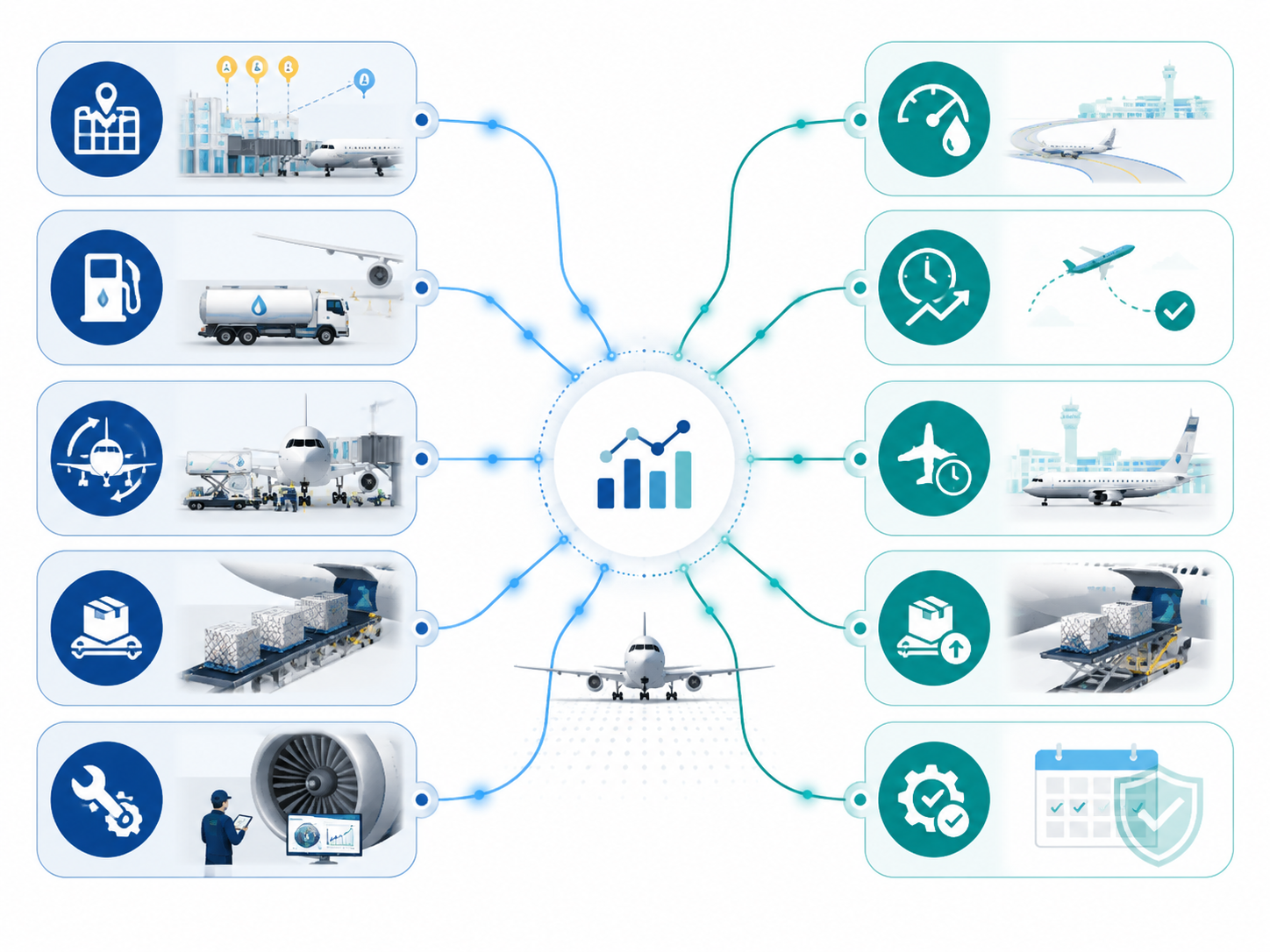
The stronger apron use cases do not merely detect that a belt loader is late. They help the operation decide what to do while there is still time to act: call the ramp supervisor, resequence a task, protect a connecting bag or shipment, or adjust the gate release expectation before the next aircraft is trapped behind it. The metric to watch is not how many events the system detects. It is how many operational conflicts are resolved early enough to change the departure.
Cargo Gains Depend on Capacity Decisions, Not Just Forecast Accuracy
Air cargo is where airline AI upgrades become directly visible to supply chain teams. Belly capacity disappears when passenger schedules change. Freighter capacity is constrained by routing, aircraft availability, crew, ground handling, customs processes, and shipment priority. A forecast can be accurate and still fail if it does not reach the person deciding which shipment moves, which shipment waits, and which route is worth protecting.
The McKinsey benchmark cited by TIACA points to an 8–25% air cargo load factor improvement from AI-enabled cargo optimization.[5] That is a meaningful range, but it should be handled as a benchmark rather than a universal promise. Load factor gains depend on demand mix, shipment density, no-show behavior, regulatory constraints, connection banks, aircraft type, and the carrier's willingness to let the system influence commercial and operational decisions.
The best cargo applications usually sit close to awkward tradeoffs. Should a carrier accept more lower-yield volume if forecast no-shows are high? Should a shipment be rerouted through a less congested hub to protect service? Should capacity be held for late-booking priority freight? AI can improve these decisions by connecting booking data, flown-as-planned history, aircraft payload limits, disruption signals, and downstream handling constraints. The improvement shows up as fewer stranded shipments, better capacity utilization, and less manual firefighting by cargo teams.
Maintenance AI Protects Logistics by Preventing the Bad Surprise
Predictive maintenance is sometimes sold as an engineering story, but its logistics value is recovery time. A failure found on the line just before departure is not only a maintenance event. It is a gate occupancy problem, a crew problem, a passenger reaccommodation problem, a cargo routing problem, and often a spare-parts positioning problem.
Industry statistics cited by Gitnux associate AI predictive maintenance with 5–15% fewer unplanned events.[4] That range is credible as a directional business-case input, provided the airline does not treat it as automatic. The system has to convert sensor or maintenance-history signals into earlier work orders, better parts positioning, and decisions that maintenance control and planning teams trust.
The logistics gain is strongest when predictive maintenance is linked to spares and routing. A forecasted component issue is much less useful if the part is not near the aircraft, the maintenance window is not available, or the aircraft is routed away from a station that can do the work. This is where airline AI begins to overlap with supply chain planning: predicting the failure is only the first move; positioning the remedy is what prevents the disruption.
Broader Cost Benchmarks Help Size the Prize, but They Are Not Airline Proof
Cross-industry supply chain benchmarks are useful when executives need a first-pass estimate of possible value. McKinsey-linked figures cited in 2026 benchmarking material point to 5–20% logistics cost reduction and 20–30% inventory reduction in distribution operations.[6] Those numbers are relevant to airline-dependent logistics, especially where air transport connects to warehouse positioning, expedited freight, and inventory buffers.
They should not be treated the same way as the American Airlines, Qantas, or Rome Fiumicino examples. A warehouse inventory reduction benchmark does not prove that an airline cargo operation will raise load factor by the same amount, or that a passenger airline will reduce disruption cost on the same curve. The transfer is conceptual: better prediction and faster operational decisions can reduce waste. The proof still has to be built in the airline's own network, stations, aircraft types, labor model, and data environment.
Where the Business Case Is Strongest in 2026
The strongest AI airline technology upgrade cases in 2026 share three characteristics. First, they attach the AI system to a decision that already has an operational owner. Gate planners, dispatchers, maintenance controllers, ramp supervisors, and cargo capacity managers need a recommendation they can act on, not a separate dashboard that explains the delay after it has happened.
Second, the metric is close to the physical operation. Taxi time, gallons of fuel, ground delay, turnaround time, load factor, and unplanned maintenance events are harder to hide behind than adoption rates. A survey showing that teams are piloting AI analytics may indicate momentum, but it does not say whether a single aircraft left earlier or a shipment made its connection.
Third, the system reaches production. Pilot programs can prove that a model finds patterns. Production deployments have to survive messy data, irregular operations, local workarounds, labor rules, aircraft swaps, and the pressure of a control center that cannot pause the airline while the model is confused. The gap between those two states is where many attractive AI claims lose their logistics value.
A practical business case should therefore separate evidence into tiers. Named airline or airport deployments with measured operational outcomes belong at the top. Industry benchmarks for fuel, maintenance, cargo, and logistics cost belong in the sizing layer. Adoption surveys and vendor claims can explain market direction, but they should not carry the financial model.
The Implementation Constraint
AI airline technology upgrades can improve several logistics metrics at once because airline operations are tightly coupled. A better gate plan can save taxi time and fuel. Better apron visibility can protect turnaround and cargo connections. Better maintenance prediction can reduce unplanned events and improve spare-parts planning. Better cargo optimization can lift load factor and reduce stranded freight. The effects compound when the same aircraft, crew, gate, and shipment are part of the same recovery problem.
The constraint is not imagination. It is data quality, operational integration, and scale. If the gate data are late, the maintenance status is incomplete, the cargo system is disconnected, or station teams do not trust the recommendation, the model may be technically sound and operationally irrelevant. If the deployment stays inside one controlled pilot, the published improvement may never become a repeatable network outcome.
The credible 2026 answer is calibrated rather than sweeping: AI-powered airline upgrades can support 5–15% fuel-savings ranges, 6–35% delay-reduction estimates, 4–6% turnaround gains, 8–25% cargo load-factor improvements, and fewer unplanned maintenance events where the deployment is tied to real operational decisions.[1][2][4][5] The strongest cases are already visible in named airline and airport operations. Whether those gains repeat elsewhere depends on whether the airline can move the system from a promising pilot into the daily machinery of gates, ramps, dispatch, cargo, and maintenance.
References
- AI and Trusted Data: Building Resilient Airline Operations, OAG
- AI in Aviation, COAX
- How Qantas used AI to land (more) on time and save $30m, Australian Financial Review, May 4, 2026
- 20+ AI In The Airline Industry Statistics, Gitnux
- The future of AI and digitalisation in air cargo, TIACA
- ROI of AI in Supply Chain: Real Case Studies and What the Numbers Actually Show in 2026, ValueAddVC
Comments
Join the discussion with an anonymous comment.